Sally Furniss
Well-known member
UNICEF to distribute 100,000 bird flu prevention kits in Indonesia
http://www.unicef.org/infobycountry/indonesia_39923.html
By Arie Rukmantara
GARUT, Indonesia, 5 June 2007 ? For people in Garut, West Java, a six-hour drive from Jakarta, the Indonesian capital, Monday is usually just the start of another work week.
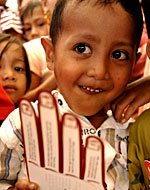
But one recent Monday was different. On 14 May, Garut received its first AI Kits. The kits contain masks, gloves and soap ? as well as street banners, an instructional booklet and video compact discs with short films explaining how to prevent and control avian influenza.
AI Kits are a new weapon in the fight against bird flu, and their arrival in rural Garut marked the start of a new round in that fight.
Reducing the risk of disease
?We are going to make sure that community members properly utilize the kits to help them contain the spread of bird flu in this district, and hopefully get rid of the virus in the district, too,? said Garut?s senior health administrator.
Village heads will use the AI Kits as an educational tool to demonstrate simple, effective ways to help reduce the risk of spreading or contracting the disease.
The kit is a UNICEF initiative supported by the Indonesian National Committee for Avian Influenza Control and Pandemic Preparedness, along with the Government of Japan. UNICEF plans to distribute a total of 100,000 kits to villages across Java and South Sulewesi.
Indonesia?s bird flu hotspots
H5N1, the bird flu virus, remains a serious concern in Indonesia and around the world. While the highly pathogenic virus mainly affects birds, it has also infected at least 98 people in Indonesia ? more than any other country ? and killed a total of 78 here. Experts fear the virus could mutate into a new form that spreads easily between people, with the potential to set off a global pandemic.
UNICEF chose Garut, one of Indonesia?s bird flu hotspots, as the first locality to receive the AI Kit.
The quiet district grabbed international headlines in August 2006 when experts suspected scores of local people might be infected with the virus. Over 2,000 district residents were administered antiviral drugs in an unprecedented preventive measure.
During the end of the outbreak, three people tested positive for H5N1 influenza and two died. Garut has experienced other outbreaks as well: To date, a total of five confirmed human H5N1 cases have been recorded here, including four fatalities.
Local prevention measures
UNICEF will distribute 1,200 avian flu kits to 21 sub-districts in Garut, equipping over 2 million people with practical guidance on how to protect themselves, their families and their communities from bird flu.
?We're going to motivate people to launch collective action, to clean up their neighbourhoods to get rid of bird flu,? said the Garut health administrator, echoing the message from the UNICEF banner included in the kits.
Some community leaders have been motivated by the kits to take their bird flu campaign one step further. ?They plan to establish public hand-washing sites to allow villagers to promote healthy and clean behaviour,? said UNICEF?s Social Mobilization Officer for West Java, Esti Fariah.
Meanwhile, the national coordinating agency for bird flu control is sending out a letter thanking local leaders for taking part in the national campaign to bring the disease under control and save lives. ?These AI Kits are a simple way to inform your communities about bird flu,? the letter states. ?The bird flu problem cannot be solved unless we all work together and take action now.?
http://www.unicef.org/infobycountry/indonesia_39923.html
By Arie Rukmantara
GARUT, Indonesia, 5 June 2007 ? For people in Garut, West Java, a six-hour drive from Jakarta, the Indonesian capital, Monday is usually just the start of another work week.
But one recent Monday was different. On 14 May, Garut received its first AI Kits. The kits contain masks, gloves and soap ? as well as street banners, an instructional booklet and video compact discs with short films explaining how to prevent and control avian influenza.
AI Kits are a new weapon in the fight against bird flu, and their arrival in rural Garut marked the start of a new round in that fight.
Reducing the risk of disease
?We are going to make sure that community members properly utilize the kits to help them contain the spread of bird flu in this district, and hopefully get rid of the virus in the district, too,? said Garut?s senior health administrator.
Village heads will use the AI Kits as an educational tool to demonstrate simple, effective ways to help reduce the risk of spreading or contracting the disease.
The kit is a UNICEF initiative supported by the Indonesian National Committee for Avian Influenza Control and Pandemic Preparedness, along with the Government of Japan. UNICEF plans to distribute a total of 100,000 kits to villages across Java and South Sulewesi.
Indonesia?s bird flu hotspots
H5N1, the bird flu virus, remains a serious concern in Indonesia and around the world. While the highly pathogenic virus mainly affects birds, it has also infected at least 98 people in Indonesia ? more than any other country ? and killed a total of 78 here. Experts fear the virus could mutate into a new form that spreads easily between people, with the potential to set off a global pandemic.
UNICEF chose Garut, one of Indonesia?s bird flu hotspots, as the first locality to receive the AI Kit.
The quiet district grabbed international headlines in August 2006 when experts suspected scores of local people might be infected with the virus. Over 2,000 district residents were administered antiviral drugs in an unprecedented preventive measure.
During the end of the outbreak, three people tested positive for H5N1 influenza and two died. Garut has experienced other outbreaks as well: To date, a total of five confirmed human H5N1 cases have been recorded here, including four fatalities.
Local prevention measures
UNICEF will distribute 1,200 avian flu kits to 21 sub-districts in Garut, equipping over 2 million people with practical guidance on how to protect themselves, their families and their communities from bird flu.
?We're going to motivate people to launch collective action, to clean up their neighbourhoods to get rid of bird flu,? said the Garut health administrator, echoing the message from the UNICEF banner included in the kits.
Some community leaders have been motivated by the kits to take their bird flu campaign one step further. ?They plan to establish public hand-washing sites to allow villagers to promote healthy and clean behaviour,? said UNICEF?s Social Mobilization Officer for West Java, Esti Fariah.
Meanwhile, the national coordinating agency for bird flu control is sending out a letter thanking local leaders for taking part in the national campaign to bring the disease under control and save lives. ?These AI Kits are a simple way to inform your communities about bird flu,? the letter states. ?The bird flu problem cannot be solved unless we all work together and take action now.?