• FluTrackers.com Inc. does not provide medical advice. Information on this web site is collected from various internet resources, and the FluTrackers board of directors makes no warranty to the safety, efficacy, correctness or completeness of the information posted on this site by any author or poster. The information collated here is for instructional and/or discussion purposes only and is NOT intended to diagnose or treat any disease, illness, or other medical condition. Every individual reader or poster should seek advice from their personal physician/healthcare practitioner before considering or using any interventions that are discussed on this website. By continuing to access this website you agree to consult your personal physican before using any interventions posted on this website, and you agree to hold harmless FluTrackers.com Inc., the board of directors, the members, and all authors and posters for any effects from use of any medication, supplement, vitamin or other substance, device, intervention, etc. mentioned in posts on this website, or other internet venues referenced in posts on this website.
  • We are not asking for any donations. Do not donate to any entity who says they are raising funds for us.

UK: Sudden death for thousands of trees

Shiloh

Editor, Senior Moderator
Source: http://www.telegraph.co.uk/earth/8247580/Sudden-death-for-thousands-of-trees.html

Sudden death for thousands of trees
A deadly disease described as the "foot and mouth" of trees is wiping out forests across the country.

By Louise Gray, Environment Correspondent 12:04AM GMT 08 Jan 2011

Sudden oak death arrived in Britain from America, where it decimated the oak population, just under a decade ago via imported plants.

In Britain the disease, officially known as phytophthora ramorum, spared oaks and jumped to rhododendrons and Japanese larch trees. In the last year it has taken hold along the west of the country in larch plantations, including more than 120 Forestry Commission sites, 20 National Trust properties and two Woodland Trust reserves.

Already 4 million trees have been felled or marked for destruction.

More are expected to be chopped down in the coming years because the warmer, wetter conditions expected with climate change encourage the spread of the disease. ..

...The outbreak is one of a number of threats to Britain's ancient trees.

A separate disease, acute oak decline, is killing oaks, while chestnut trees have been felled across the country because of infections spread by moths.
 
Re: UK: Sudden death for thousands of trees

Sudden oak death now threatens more of Britain's trees

After destroying millions of oaks in California, the infection spread to Britain ? then suddenly jumped species
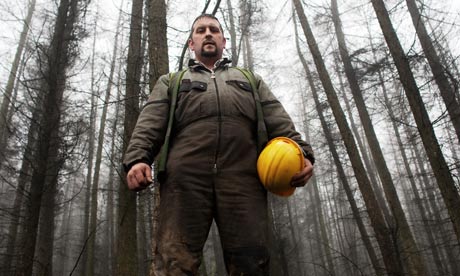
-Jason-Hill-007.jpg
<FIGCAPTION>

Jason Hill among larches he is cutting down in Afan Valley: "I was due to be coming here to thin this lot, but now we?re flattening them all; it?s shocking."
Photograph: Gareth Phillips for the Observer</FIGCAPTION>

Excerpt:

Seated at the computer controls, he operates a mechanical arm which grips a 30ft tall larch and slits through its base. Swinging it to the horizontal, the arm strips the tree down to a denuded trunk and slices it into even lengths of log that drop heavily into a pile. The process takes only minutes before the machine turns to the next tree.

In woodlands around the UK, just as here in Afan Valley, south Wales, the race is on to fell thousands of trees in a desperate effort to contain a new disease which poses a threat to British forests on a scale not seen since Dutch elm disease wiped out millions of trees, changing the landscape of the country for ever.

Already 3,000 hectares of larch forest ? one hectare is about the size of a football pitch ? in Wales, Devon, Cornwall, Somerset and Northern Ireland are known to be infected by Phytophthora ramorum ? sudden oak death ? which comes from the same family as the potato blight organism that caused the Irish famines in the 19th century.

Full text:
http://www.guardian.co.uk/environment/2011/jan/16/sudden-oak-death-forests-tree-species
 
Re: UK: Sudden death for thousands of trees

An overview is available at South Australia government website. Here an extract:

Source: South Australia Govt, Environment: http://www.environment.sa.gov.au/biodiversity/pdfs/phytophthora.pdf

What is Phytophthora?

Phytophthora (pronounced fy-TOFF-thora) species are soil and waterborne fungi that cause disease and often death to a wide variety of native plant species, exotic fruits and vegetables.

The most common species is Phytophthora cinnamomi, which is also referred to as ?Pc?.

Phytophthora attacks the roots and stems of plants.

Early symptoms of the disease are root-rot, and depending on the plant species, stem rot and eventual death.

In effect, the susceptible plants die from an inability to take up sufficient water and nutrients.

The first symptoms of infection are yellowing of the foliage followed by dieback of the entire plant.

Phytophthora cinnamomi is considered a threat to over 1000 plant species worldwide.

While it is still uncertain exactly how many species in Australia are threatened, it is expected to be in the hundreds.

The best indicator species for the disease in South Australia is the yacca or grass-tree Xanthorrhoea sp., as it is highly susceptible.

Other susceptible species are Banksia sp., Myrtle Wattle Acacia myrtifolia, Cone-bush Isopogon ceratophyllus, Messmate Stringybark Eucalyptus obliqua, Mount Lofty Bush-pea Pultenaea involucrata and many others.

A group of dead or dying susceptible plant species is generally a good indication of Phytophthora infestation.

Fruits (apples, pears, cherries, apricots, peaches, grapes, olives, macadamias, chestnuts and walnuts), vegetables (potatoes) and ornamental plants (lilies, camelias, hibiscuses and rhododendrons) are also effected by Phytophthora species.


Where is Phytophthora found in SA?

The fungus is native to South-East Asia and has probably reached Australia in a variety of ways.

In Western Australia it is thought to have arrived around 1900 in orange trees brought in from Indonesia, while in the Mount Lofty Ranges (SA) it probably arrived around 1970 in infested berries from nurseries in the Dandenong Ranges.

On Kangaroo Island, Phytophthora has been noticed since 1993 and the most likely cause of introduction is through infested soil on vehicles from the mainland.

Phytophthora is able to grow in areas where average annual rainfall is greater than 400 mm (16 inches), and soils are acid to neutral.

It has the ability to live in most of the southern areas of South Australia.
Phytophthora has been found in the Mount Lofty Ranges around Adelaide, the Fleurieu Peninsula, on Kangaroo Island and in the Lower South East.

The presence of Phytophthora is suspected on Eyre Peninsula.


What does Phytophthora look like?

Phytophthora is a soil and waterborne microscopic fungus.

It grows in a threadlike fashion through the roots and trunks of infested plants. The only visible sign of its presence is sickness or death of the plants it attacks.

The fungus reproduces by spores (like minute seeds) or by mycelia (mature strands of fungus).

There are two common spore types.

Zoospores are only present when there is considerable moisture in the soil.

Another type of spore called a chlamydospore is long-lived.

These spores can remain dormant for many years until conditions are right for fungal growth (ie. warm and moist conditions).


How does Phytophthora spread?

Phytophthora can spread from plant to plant through root contact.

It is spread most rapidly when rainfall coincides with warm temperatures, generally in spring, summer and early autumn.

The disease can spread very quickly with the help of ?artificial? factors such as human disturbance.

The transport of infested soil and plant material by vehicles and heavy machinery (such as in firefighting, logging and roadworks) is probably the single most important factor in the spread of this fungus.

A bulldozer not cleaned after working in an infested area can easily spread the disease to an uninfested site many kilometres away.

Bushwalkers and bike riders can also spread the disease by transferring mud on their boots and tyres.

For more information see the information sheet ?Phytophthora Bushwalking Guidelines? available from Department for Environment and Heritage offices.

How you can help stop the spr ead of Phytophthora.

The best way to control the fungus is to prevent the transfer of infested soil or plant material.
? Avoid driving, riding or walking in areas when soils are wet and sticky.
? Stay on designated roads and tracks. Vehicles, bikes and people moving off roads into infested areas may pick up infested soil and transfer it to uninfested areas.
? Brush soil off vehicles, bikes, boots and camping gear before and after each trip. Do not take them home to clean.
? Obey road signs. Roads and tracks may be closed, sometimes permanently, to help stop the spread of Phytophthora.
? Use wash down or hygiene stations when provided.
? Protect your bush. Ensure that purchased plants are free of hytophthora.
? Report any unusual plant death. Please report the death of groups of susceptible plants to your local Department for Environment and Heritage office.

For further information please contact:
Department for Environment and Heritage Telephone: (08) 8552 0306, or see SA White Pages for your local Department for Environment and Heritage office.
Online information available at:
http://www.environment.sa.gov.au/biodiversity/plandsand.html

-
-----

 
Re: UK: Sudden death for thousands of trees

Source: http://www.telegraph.co.uk/earth/co...ritains-forests-as-Black-death-sweeps-in.html

Red alert in Britain's forests as Black death sweeps in
Millions of larches have had to be felled to prevent the spread of a lethal virus from Asia. Christopher Middleton reports from the bleak and bare hillsides of South Wales.
By Christopher Middleton 7:00AM GMT 03 Feb 2011


Just before Christmas, you could stand at the top of Crynant Forest in South Wales and not have a clue that there was a village in the valley below. Today, the view down to the little white houses is uninterrupted. Where in mid-December there were thousands of larch trees, now there is a mass of stumps and branches.

It looks like a photograph from a First World War battlefield. A featureless no-man?s-land, interrupted by the occasional blasted tree trunk, pointing at an unnatural angle...
 
Re: UK: Sudden death for thousands of trees

Source: http://www.farminguk.com/news/Ramor...uropean-larch-trees-for-first-time_20221.html

30/03/2011 12:06:30

Ramorum disease found in European larch trees for first time

Ramorum disease, which has caused the early felling of about 2 million Japanese larch trees in the UK, has now been found infecting the European larch species for the first time.

Scientists from the Forestry Commission?s research agency have confirmed infection by the pathogen Phytophthora ramorum in a European larch (Larix decidua) in woodland near Lostwithiel in Cornwall, south-west England, in an area with infected Japanese larch trees nearby.

Ben Jones, the Forestry Commission?s Phytophthora operations manager, said,

"Although it is bad news that this lethal pathogen has proved able to infect yet another tree species, it was not entirely unexpected, given the physiological similarities between European and Japanese larch..."
 
Re: UK: Sudden death for thousands of trees

Source: http://www.isleofman.com/News/article.aspx?article=39883

Tree disease identified by DEFA

Date Posted: 04/Oct/2011 17:16
By: Bill Dale

THE tree disease which has forced the closure of large areas of plantation in Ballaugh and Colden has been identified as ?Sudden Oak Death?, which has been found in larch trees.

Phytophthora ramorum is a fungus-like pathogen which is serious in Japanese larch (larix kaempferi) trees and rhododendron (rhododendron ponticum), both of which produce large numbers of infective spores.

The disease, which kills larch trees very quickly, is a recent appearance in Britain and has been confirmed in Colden (West Baldwin) and Ballaugh plantations, with investigations continuing into other suspected sites identified by aerial surveys...
 
Re: UK: Sudden death for thousands of trees

Source: http://www.gallowaygazette.co.uk/news/local-headlines/larch_tree_disease_found_in_galloway_1_1901959

Monday 10 October 2011
Larch tree disease found in Galloway

Published on Monday 10 October 2011 10:06

AN outbreak of a tree-killing disease has been confirmed in woodland north of Newton stewart.

The fungus-like disease, called Ramorum, was discovered after a recent aerial survey of the west of Scotland and is the third on Japanese larch in Scotland, the first two being found earlier this year on the Craignish peninsula and on the island of Mull.

On larch trees, the disease first causes crown and branch dieback with retained dead needles and resinous lesions. Tree needles wilt, turning grey or blackish before dying. ..
 
Re: UK: Sudden death for thousands of trees

Source: http://www.isleofman.com/News/article.aspx?article=40604

Hundreds of trees will be felled in an attempt to halt spread of larch disease
Date Posted: 01/Nov/2011 18:00
By: Bill Dale

A SERIOUS outbreak of disease in larch trees will mean that many hundreds of trees will have to be felled this winter as an emergency method of controlling the spread of the fungus to other varieties such as rhododendron and blueberry.

The disease has now been officially confirmed after it was initially discovered in the plantations close to Ballaugh village, with the Department of Agriculture taking the decision to close Colden plantation and to restrict access to Ballaugh plantation.

DEFA?staff are currently involved in investigations into other suspected sites identified by aerial surveys. The Department has also called a public meeting for next week to discuss the potential threat to the Island?s trees and shrubs. It will be held at the Glen Helen Hotel on Thursday, November 10th at 7.30pm...
 
Back
Top