

sharon sanders
Editor-in-Chief & President
Lung abnormalities found in long COVID patients with breathlessness
Published: 29/01/2022
Read Time: 5 minutes
Print
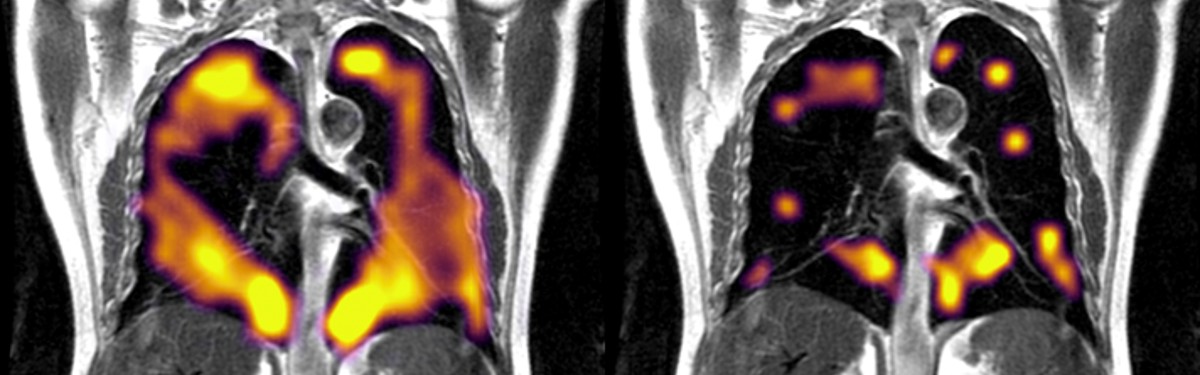
Researchers have identified abnormalities in the lungs of long COVID patients with breathlessness but whose other tests are normal.
The EXPLAIN study is using hyperpolarised xenon MRI scans to investigate possible lung damage in long COVID patients who experience breathlessness and were not hospitalised when they had COVID-19.
These early results suggest that COVID-19 may result in persistent impairment in gas transfer and underlying lung abnormalities. However, the extent to which these abnormalities contribute to breathlessness is currently unclear.
Hyperpolarised xenon MRI requires the patient to lie in an MRI scanner and breathe in one litre of xenon gas that has had its atomic structure altered so it can be seen using MRI. Xenon is an inert gas that behaves in a very similar way to oxygen, so radiologists then can observe how the gas moves from the lungs into the bloodstream.
A previous study using the same imaging method established that patients who had been hospitalised with COVID-19 had persistent lung abnormalities several months after they were discharged.
For this pilot study, the researchers recruited 36 patients who fell into three groups:
The pilot study involves teams in Oxford, Sheffield, Cardiff and Manchester and is funded by the NIHR. It is one of 19 studies that have received nearly £40 million investment from NIHR to improve understanding of long COVID, from diagnosis and treatment through to rehabilitation and recovery. The research is also supported by the NIHR Oxford Biomedical Research Centre.
The study’s Chief Investigator, Fergus Gleeson, Professor of Radiology at the University of Oxford and Consultant Radiologist at Oxford University Hospitals NHS Foundation Trust, said: “We knew from our post-hospital COVID study that xenon could detect abnormalities when the CT scan and other lung function tests are normal.
“What we’ve found now is that, even though their CT scans are normal, the xenon MRI scans have detected similar abnormalities in patients with long COVID. These patients have never been in hospital and did not have an acute severe illness when they had their COVID-19 infection. Some of them have been experiencing their symptoms for a year after contracting COVID-19.”
Hyperpolarised xenon MRI was pioneered by Professor Jim Wild and the Pulmonary, Lung and Respiratory Imaging Sheffield (POLARIS) research group at the University of Sheffield. Professor Wild, a co-researcher and NIHR Research Professor, said: “Xenon MRI is uniquely placed to help understand why breathlessness persists in some patients post COVID. Xenon follows the pathway of oxygen when it is taken up by the lungs and can tell us where the abnormality lies between the airways, gas exchange membranes and capillaries in the lungs.
“This multi-centre study is very exciting, and I really look forward to it helping translate lung MRI methods that we have developed further towards clinical use in the UK.”
Co-researcher Dr Emily Fraser, a Respiratory Consultant who leads the Oxford Post-COVID Assessment Clinic, said: “These are interesting results and may indicate that the changes observed within the lungs of some patients with long COVID contribute to breathlessness. However, these are early findings and further work to understand the clinical significance is key.
“Extending this study to larger numbers of patients and looking at control groups who have recovered from COVID should help us to answer this question and further our understanding of the mechanisms that drive long COVID.”
The full EXPLAIN study will recruit 200 long COVID patients with breathlessness, along with 50 patients who have had COVID-19 but now have no symptoms at all; 50 patients who have no breathlessness, but do have other long COVID symptoms, such as ‘brain fog’; and 50 people who have never had long COVID who will act as controls for comparison.
Professor Nick Lemoine, Chair of NIHR’s Long-COVID funding committee and Medical Director of the NIHR Clinical Research Network, said: “More than a million people in the UK continue to experience symptoms months after having COVID-19, with breathlessness one of the most commonly-reported symptoms. This early research is an important example of both the committed effort the UK research community is taking to understand this new phenomenon, and the world-leading expertise that community contains.”
https://www.nihr.ac.uk/news/lung-ab...long-covid-patients-with-breathlessness/29798
Published: 29/01/2022
Read Time: 5 minutes
Researchers have identified abnormalities in the lungs of long COVID patients with breathlessness but whose other tests are normal.
The EXPLAIN study is using hyperpolarised xenon MRI scans to investigate possible lung damage in long COVID patients who experience breathlessness and were not hospitalised when they had COVID-19.
These early results suggest that COVID-19 may result in persistent impairment in gas transfer and underlying lung abnormalities. However, the extent to which these abnormalities contribute to breathlessness is currently unclear.
Hyperpolarised xenon MRI requires the patient to lie in an MRI scanner and breathe in one litre of xenon gas that has had its atomic structure altered so it can be seen using MRI. Xenon is an inert gas that behaves in a very similar way to oxygen, so radiologists then can observe how the gas moves from the lungs into the bloodstream.
A previous study using the same imaging method established that patients who had been hospitalised with COVID-19 had persistent lung abnormalities several months after they were discharged.
For this pilot study, the researchers recruited 36 patients who fell into three groups:
- People with long COVID who had normal CT scans
- People who had been in hospital with COVID-19 and discharged more than three months previously, who had normal or nearly normal CT scans and who were not experiencing long COVID
- An age- and gender-matched control group who did not have long COVID symptoms nor had been hospitalised with COVID-19
The pilot study involves teams in Oxford, Sheffield, Cardiff and Manchester and is funded by the NIHR. It is one of 19 studies that have received nearly £40 million investment from NIHR to improve understanding of long COVID, from diagnosis and treatment through to rehabilitation and recovery. The research is also supported by the NIHR Oxford Biomedical Research Centre.
The study’s Chief Investigator, Fergus Gleeson, Professor of Radiology at the University of Oxford and Consultant Radiologist at Oxford University Hospitals NHS Foundation Trust, said: “We knew from our post-hospital COVID study that xenon could detect abnormalities when the CT scan and other lung function tests are normal.
“What we’ve found now is that, even though their CT scans are normal, the xenon MRI scans have detected similar abnormalities in patients with long COVID. These patients have never been in hospital and did not have an acute severe illness when they had their COVID-19 infection. Some of them have been experiencing their symptoms for a year after contracting COVID-19.”
Hyperpolarised xenon MRI was pioneered by Professor Jim Wild and the Pulmonary, Lung and Respiratory Imaging Sheffield (POLARIS) research group at the University of Sheffield. Professor Wild, a co-researcher and NIHR Research Professor, said: “Xenon MRI is uniquely placed to help understand why breathlessness persists in some patients post COVID. Xenon follows the pathway of oxygen when it is taken up by the lungs and can tell us where the abnormality lies between the airways, gas exchange membranes and capillaries in the lungs.
“This multi-centre study is very exciting, and I really look forward to it helping translate lung MRI methods that we have developed further towards clinical use in the UK.”
Co-researcher Dr Emily Fraser, a Respiratory Consultant who leads the Oxford Post-COVID Assessment Clinic, said: “These are interesting results and may indicate that the changes observed within the lungs of some patients with long COVID contribute to breathlessness. However, these are early findings and further work to understand the clinical significance is key.
“Extending this study to larger numbers of patients and looking at control groups who have recovered from COVID should help us to answer this question and further our understanding of the mechanisms that drive long COVID.”
The full EXPLAIN study will recruit 200 long COVID patients with breathlessness, along with 50 patients who have had COVID-19 but now have no symptoms at all; 50 patients who have no breathlessness, but do have other long COVID symptoms, such as ‘brain fog’; and 50 people who have never had long COVID who will act as controls for comparison.
Professor Nick Lemoine, Chair of NIHR’s Long-COVID funding committee and Medical Director of the NIHR Clinical Research Network, said: “More than a million people in the UK continue to experience symptoms months after having COVID-19, with breathlessness one of the most commonly-reported symptoms. This early research is an important example of both the committed effort the UK research community is taking to understand this new phenomenon, and the world-leading expertise that community contains.”
https://www.nihr.ac.uk/news/lung-ab...long-covid-patients-with-breathlessness/29798