

Pathfinder
Editor, Senior Moderator
Research and analysis
Enterovirus: summary of strain characterisation
Updated 1 November 2022
Applies to England
Laboratory testing
Many clinical diagnostic laboratories offer PCR assays that detect enterovirus (EV) infection. UK Health Security Agency (UKHSA) Public Health Laboratories(PHLs) also offer enterovirus detection PCR assays; contact the local PHL for further information.
The Enteric Virus Unit (EVU), within Reference Services at Colindale, performs molecular typing and characterisation of all referred positive samples (faeces, respiratory secretions, CSF, tissue and blood), as part of the national surveillance programme.
EVU will only test cDNA or RNA extracts by prior arrangement; local laboratories should send original clinical material whenever possible.
Serological testing for non-polio enteroviruses is not offered currently by EVU.
Non-polio enterovirus types
Enterovirus typing is performed by partial sequencing of the picornavirus VP1 capsid protein gene, with EV-D68 typing supplemented by a specific RT-PCR for EV-D68. Enterovirus typing data from the national reference laboratory are subject to a reporting delay and the numbers reported in any month may change in future reports, as further samples are characterised, and additional data are generated.
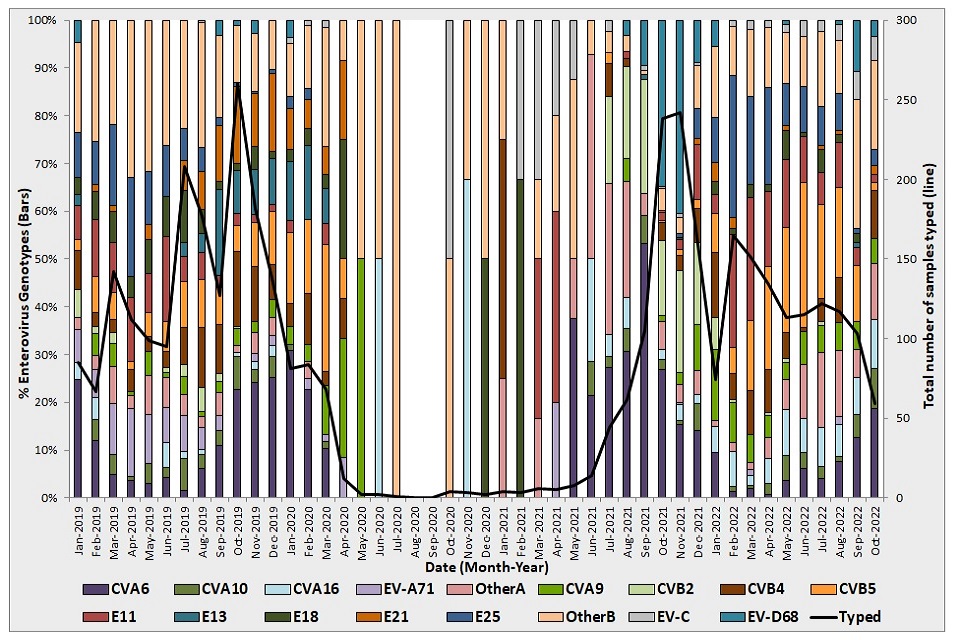
Figure 1. Non-polio enterovirus types identified by month from 3 years prior to the most recent reporting date. Stacked columns represent the contribution of individual or grouped enterovirus types. Total number of samples is represented by a line shown in a secondary axis.
Figure 1 shows non-polio enterovirus types identified in samples referred to EVU from all settings. Some low frequency enterovirus types have been grouped together, to assist with visualisation of data, as described below:
OtherA: CVA2, CVA4, CVA5, CVA8, CVA14, EV-A76, EV-A90.
OtherB: CVB1, CVB3, E2, E3, E4, E5, E6, E7, E9, E14, E15, E16, E17, E19, E20, E26, E27, E29, E30, E33, EV-B81, EV-B106.
EV-C: CVA1, CVA11, CVA17, CVA19, CVA20, CVA21, CVA22, CA24, EV-C99, EV-C105, EV-C116, EV-C117.
Enterovirus EV-D68 and EV-A71 data are shown separately.
Notably, there has been a decrease in the number of specimens referred since March 2020. The most likely reason for this reduction was the introduction of non-pharmaceutical interventions (NPIs) intended to control the ongoing COVID-19 pandemic that probably resulted in reduced EV transmission. Additional factors may have also impacted the number of referred samples. Increasing number of referrals since April 2021 is now evident and levels at the end of 2021 are comparable to pre-pandemic times.
All non-polio enterovirus types combined, enterovirus EV-D68 and enterovirus EV-A71
EV-D68 infection causes a broad spectrum of illness, from mild to severe acute respiratory and acute neurological manifestations. EV-71 has been associated with hand, foot and mouth disease as well as neurologic disease.
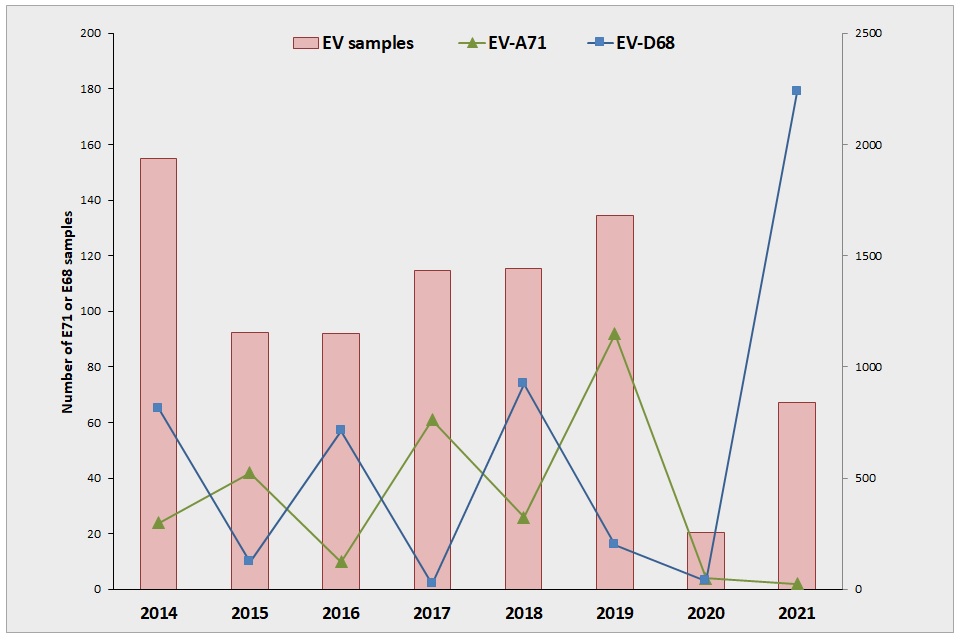
Figure 2. Number of samples identified as enterovirus EV-A71 and EV-D68 types since 2014 represented by coloured lines. Columns represent total number of enterovirus samples by year (secondary axis).
Figure 2 shows all non-polio enterovirus types combined, enterovirus EV-D68 and enterovirus EV-A71 by year, as identified by EVU, 2014 to 2021.
Enterovirus EV-D68 clades identified by EVU, by year, 2014 to 2021
EV-D68 can be further classified into clades (A to D) and subclades. Association of particular clades with neurological complications; is still unclear however monitoring clade circulation may indicate trends.
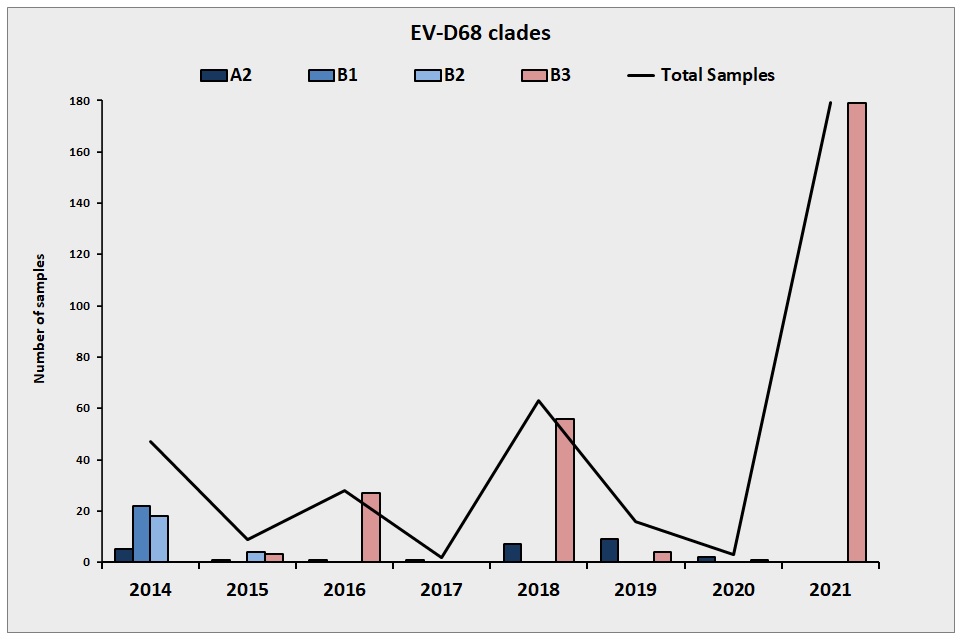
Figure 3. EV-D68 clades identified by year since 2014. Number of samples by clade is represented by coloured columns. Total number of enterovirus samples is represented by a line.
Figure 3 shows enterovirus EV-D68 clades identified by EVU, by year, 2014 to 2021.
https://www.gov.uk/government/public...aracterisation
Enterovirus: summary of strain characterisation
Updated 1 November 2022
Applies to England
Laboratory testing
Many clinical diagnostic laboratories offer PCR assays that detect enterovirus (EV) infection. UK Health Security Agency (UKHSA) Public Health Laboratories(PHLs) also offer enterovirus detection PCR assays; contact the local PHL for further information.
The Enteric Virus Unit (EVU), within Reference Services at Colindale, performs molecular typing and characterisation of all referred positive samples (faeces, respiratory secretions, CSF, tissue and blood), as part of the national surveillance programme.
EVU will only test cDNA or RNA extracts by prior arrangement; local laboratories should send original clinical material whenever possible.
Serological testing for non-polio enteroviruses is not offered currently by EVU.
Non-polio enterovirus types
Enterovirus typing is performed by partial sequencing of the picornavirus VP1 capsid protein gene, with EV-D68 typing supplemented by a specific RT-PCR for EV-D68. Enterovirus typing data from the national reference laboratory are subject to a reporting delay and the numbers reported in any month may change in future reports, as further samples are characterised, and additional data are generated.
Figure 1. Non-polio enterovirus types identified by month from 3 years prior to the most recent reporting date. Stacked columns represent the contribution of individual or grouped enterovirus types. Total number of samples is represented by a line shown in a secondary axis.
Figure 1 shows non-polio enterovirus types identified in samples referred to EVU from all settings. Some low frequency enterovirus types have been grouped together, to assist with visualisation of data, as described below:
OtherA: CVA2, CVA4, CVA5, CVA8, CVA14, EV-A76, EV-A90.
OtherB: CVB1, CVB3, E2, E3, E4, E5, E6, E7, E9, E14, E15, E16, E17, E19, E20, E26, E27, E29, E30, E33, EV-B81, EV-B106.
EV-C: CVA1, CVA11, CVA17, CVA19, CVA20, CVA21, CVA22, CA24, EV-C99, EV-C105, EV-C116, EV-C117.
Enterovirus EV-D68 and EV-A71 data are shown separately.
Notably, there has been a decrease in the number of specimens referred since March 2020. The most likely reason for this reduction was the introduction of non-pharmaceutical interventions (NPIs) intended to control the ongoing COVID-19 pandemic that probably resulted in reduced EV transmission. Additional factors may have also impacted the number of referred samples. Increasing number of referrals since April 2021 is now evident and levels at the end of 2021 are comparable to pre-pandemic times.
All non-polio enterovirus types combined, enterovirus EV-D68 and enterovirus EV-A71
EV-D68 infection causes a broad spectrum of illness, from mild to severe acute respiratory and acute neurological manifestations. EV-71 has been associated with hand, foot and mouth disease as well as neurologic disease.
Figure 2. Number of samples identified as enterovirus EV-A71 and EV-D68 types since 2014 represented by coloured lines. Columns represent total number of enterovirus samples by year (secondary axis).
Figure 2 shows all non-polio enterovirus types combined, enterovirus EV-D68 and enterovirus EV-A71 by year, as identified by EVU, 2014 to 2021.
Enterovirus EV-D68 clades identified by EVU, by year, 2014 to 2021
EV-D68 can be further classified into clades (A to D) and subclades. Association of particular clades with neurological complications; is still unclear however monitoring clade circulation may indicate trends.
Figure 3. EV-D68 clades identified by year since 2014. Number of samples by clade is represented by coloured columns. Total number of enterovirus samples is represented by a line.
Figure 3 shows enterovirus EV-D68 clades identified by EVU, by year, 2014 to 2021.
https://www.gov.uk/government/public...aracterisation