WEEKLY BULLETIN ON OUTBREAKS
AND OTHER EMERGENCIES
Week 46: 7 - 13 November 2022
Data as reported by: 17:00; 13 November 2022
...
Ebola disease caused by Sudan virus in Uganda
140 cases
55 Deaths
39.3% CFR
EVENT DESCRIPTION
During epi week 45 (ending 13 November 2022), five new
confirmed cases of SVD, with two deaths and seven recoveries
have been reported, compared to six confirmed cases, 16 deaths
and 19 recoveries in week 44 (ending 6 November).
Notably, one of the new confirmed cases was reported on 12
November, from a new District and City, Jinja in Buyengo Town
Council. This was a 45-year old male linked to a probable SVD
death, who later succumbed to the disease. A new health worker
infection has been reported in the past week: a 23-year old female
from Eastern Division of Mubende District.
From 19 September to 13 November 2022, a cumulative number
of 140 laboratory-confirmed and 22 probable cases have been
reported. Seventy-seven (77) fatalities have been registered of
which 55 were confirmed cases, an overall case fatality ratio
of 47.5%, and 39.3% among confirmed cases. Men (57.5%)
are slightly more affected than women, and the most affected
age groups are 20-29 years, and 30-39 years. The under-five
represent less than 10% of cases. Nineteen (19) healthcare
worker infections have so far been notified, of whom seven
(36.8%) have died. A total of 69 recoveries have been registered
giving a recovery rate of 49.3%.
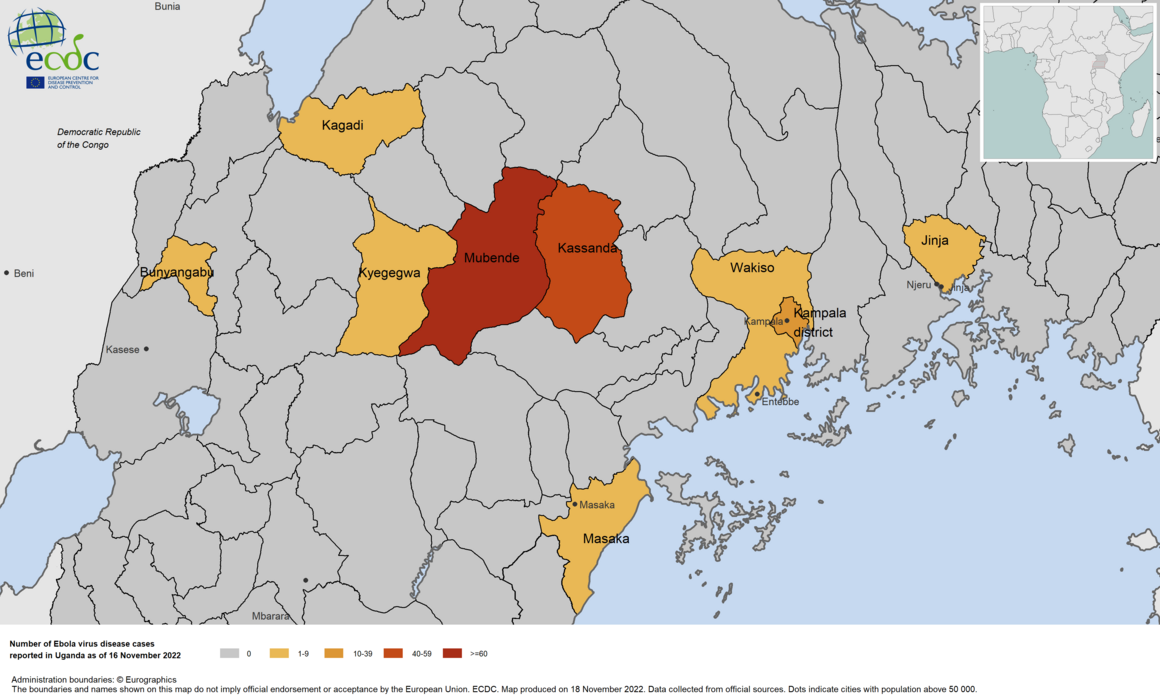
Two new Districts have been affected over the past two weeks,
one each in week 44 (Masaka) and week 45 (Jinja), bringing to
nine the total number of affected Districts. More than half of the
cases, (51.2%) have been reported in Mubende (64 confirmed and
19 probable), followed by Kassanda with 30.9% (48 confirmed
and two probable), Kampala (17 confirmed; 10.5%), Kyegegwa
(four confirmed; 2.5%), Wakiso (three confirmed; 1.9%), Jinja
(one confirmed and one probable; 1.2%), Bunyangabu (one
confirmed; 0.6%), Kagadi (one confirmed; 0.6%), and Masaka
(one confirmed; 0.6%).
As of 13 November, 3 991 contacts have been listed in 14
Districts; contact tracing and follow-up is yet to be initiated in
Jinja. A total of 2 784 contacts have completed 21 days of followup
including all contacts within Bunyangabu, Fort Portal City,
Kagadi, Kakumiro, Luweero, Mitooma, Mityana, Nakasongola,
and Ntungamo.
On 13 November 1 086 contacts were still under active follow-up
in Kampala Metropolitan Area (Kampala + Wakiso + Mukono),
Kassanda, Kyegegwa, Masaka, and Mubende. Of these, 981
contacts (90.3%) were seen over the past 24hrs.
PUBLIC HEALTH ACTIONS
Coordination
Coordination and response mechanisms are being set-up in
Jinja District, following confirmation of a SVD case.
Daily District Task Force meetings, partners’ meetings and
pillar meetings are ongoing in all affected Districts.
National Task Force meetings continue to be held thrice a
week.
Surveillance and Laboratory
Epidemiological investigations, contact tracing, and active
case finding are ongoing in all affected Districts. On 13
November, 1 086 contacts were still under active follow-up,
981 (90.3%) of whom were seen over the past 24hrs.
On 13 November, 86 alerts were received nationwide, all of
whom were verified; 31 (36.0%) of them were validated as
new suspected cases and 20 (64.5%) were evacuated to
Ebola Treatment Units (ETUs).
On 13 November, 78 samples were processed at Uganda
Viral Research Institute and Mubende mobile laboratory, with
one new confirmed case. Cumulatively, 2 687 samples have
been tested since the beginning of the outbreak, yielding 140
confirmed cases of SVD.
Mentorship is ongoing on sample collection from cadavers.
For instance, lab teams are working closely with morticians
in Masaka to collect samples from dead bodies.
Case management and psychosocial support
The response has now four fully functional ETUs including
three in Mubende and one in Entebbe, with a total capacity
of 132 beds, and two additional isolation units, one each
in Madudu and Mulago, with a total capacity of 214 beds.
On 13 November, the bed occupancy rate was at 8.9%
(n=19) in isolation units and 9.1% (n=12) in treatment
units. Cumulatively, 69 (49.3%) recoveries have so far been
recorded.
In Masaka, an isolation unit is being restructured at Masaka
Regional Referral Hospital. In addition, the construction of
the ambulance decontamination area is in its final stages.
On 13 November 2022, Emergency Medical Services (EMS)
teams performed 50 evacuations including 34 in Mubende,
15 in Kassanda and one in Masaka. Final plans are underway
to deploy a team in Jinja.
Psychosocial support continues to be offered to suspected
and confirmed cases in ETUs, as well as to their family
members. Pre-test (and post-test) counselling are also being
offered to all patients at ETUs, and to contacts. In addition,
the resettling of survivors and negative suspected cases into
their community continues. Psychosocial teams are also
providing supportive counselling to all staff working at ETUs.
Infection, prevention and control (IPC)
Daily monitoring of IPC measures continues in all ETUs.
An IPC mentorship support is ongoing in Mubende facilities
that scored less than 50% at baseline evaluation, especially
private clinics, pharmacies and drug shops.
In Masaka, 62 trained IPC mentors have been allocated
to different health care facilities in order to cascade IPC
mentorship; on the occasion, IPC information, education and
communication (IEC) materials were distributed. The SVD
screening area is being modified at Masaka RRH, and water
connectivity is being managed at the isolation unit.
Safe and dignified burial (SDB) teams continue to undertake
safe and dignified burials in all affected Districts. On 13
November, five safe and dignified burials were performed
in Mubende and Kassanda. In Masaka, seven SDB team
members were oriented on their roles and capacity for
sample collection from dead bodies.
Risk communication and community engagement
RCCE interventions are ongoing in all affected Districts and
beyond.
At least 120 radio spots messages continue to be aired daily
through six radio stations in Bunyangabu, Kagadi, Kakumiro,
Kassanda, Kyegegwa, and Mubende. In addition, four radio
talk shows were conducted including three in Masaka and
one in Kassanda.
At total of 463 IEC materials have been disseminated including
200 in Mubende, 150 in Kagadi and 113 in Bunyangabu.
Fifty-two (52) Village Health Teams (VHTs) were sensitized
in Masaka, and a movement plan was developed to support
them reach out to the remaining 600 VHTs.
Community mobilization drives by film vans were conducted
in Kitovu village of Kassanda.
Community engagement is ongoing in all affected Districts.
For instance, community volunteers and VHTs conducted
house to house visits in five districts including Bunyangabu,
Kagadi, Kassanda, Kyegegwa, and Mubende, reaching 545
households and 3 486 people (1 841 males & 1 675 females)
with SVD prevention messages.
Logistics
The distribution of supplies in healthcare facilities within all
affected districts is ongoing, including personal protective
equipment, spray pumps, wooden pallets, tarpaulin, essential
medicines, discharge packages, fuel, vehicles, stationery,
digital thermometers, infra-red thermometers from MoH and
different partners.
SITUATION INTERPRETATION
The number of new confirmed cases of SVD has been almost
constant over the past two weeks (weeks 44-45), with 0-1 case
reported per day compared to 4-6 cases/day during weeks 42-
43, translating into promising results produced by response
interventions, especially in Mubende, Kassanda and Kampala
where majority of transmission chains are being controlled.
However, the evolution has also been marked by an expansion
of the outbreak to newly affected Districts, perhaps highlighting
some weaknesses around community based surveillance,
especially in Jinja where a community death occurred and has
already generated a secondary case. Coordination and response
mechanisms need to be set-up and quickly boosted in these
newly affected areas to rapidly contain the virus. In addition,
preparedness and readiness activities need to be strengthened in
non-affected Districts as well as in neighbouring countries.
...
https://apps.who.int/iris/bitstream/handle/10665/364584/OEW46-0713112022.pdf







 Download Report(PDF | 333.58 KB)