• FluTrackers.com Inc. does not provide medical advice. Information on this web site is collected from various internet resources, and the FluTrackers board of directors makes no warranty to the safety, efficacy, correctness or completeness of the information posted on this site by any author or poster. The information collated here is for instructional and/or discussion purposes only and is NOT intended to diagnose or treat any disease, illness, or other medical condition. Every individual reader or poster should seek advice from their personal physician/healthcare practitioner before considering or using any interventions that are discussed on this website. By continuing to access this website you agree to consult your personal physican before using any interventions posted on this website, and you agree to hold harmless FluTrackers.com Inc., the board of directors, the members, and all authors and posters for any effects from use of any medication, supplement, vitamin or other substance, device, intervention, etc. mentioned in posts on this website, or other internet venues referenced in posts on this website.
  • We are not asking for any donations. Do not donate to any entity who says they are raising funds for us.

Uganda declares Ebola Virus Disease outbreak (SEBOV) - 20 Sept 2022 - Outbreak is over

Source: https://www.bbc.com/news/world-africa-62994459

Uganda's Ebola outbreak: Trainee doctors go on strike over safety fears
By Patience Atuhaire
BBC News, Kampala
Published 2 hours ago

Trainee medics battling Ebola in Uganda's virus epicentre accuse the government of putting their lives at risk.

"Most times you come into contact with a patient and you use your bare hands," one worker told the BBC anonymously.

All trainees at Mubende's regional hospital say they are on strike and are demanding to be moved somewhere safer.

But Ugandan health ministry spokesman Emmanuel Ainebyoona told the BBC there was "no strike at the hospital".

Yet all 34 of the hospital's interns - including doctors, pharmacists and nurses - have announced their decision to strike in a joint statement.

They say they are being put at undue risk because they lack appropriate safety kit, risk allowances and health insurance...
 
VIDEO:

Mubende medical interns withdraw services citing tough conditions

6hours ago.

Medical interns at Mubende Regional Referral Hospital have withdrawn their services amidst Ebola outbreak from the Mubende epicentre. The thirty-four interns have appended their signatures to a letter to the Ministry of Health complaining of difficult working conditions. As Walter Mwesigye reports, this latest development will present a challenge to Ebola management in the face of rising cases.

https://www.ntv.co.ug/ug/news/muben...draw-services-citing-tough-conditions-3962952
 
Seven suspected Ebola patients flee from health officials

Monday, September 26, 2022

By Dan Wandera

The Ebola National taskforce is yet to locate seven suspected Ebola patients who reportedly escaped from the surveillance health teams in Mubende District, the epicenter of the disease.

The seven are among the contacts that are supposed to be at the Ebola isolation centre but escaped from the health teams before they could get to the Centre, the Ebola incident commander, Lt Col Henry Kyobe Bbosa told a stakeholder and taskforce meeting at Mubende District Council Hall at the weekend.
While it is clear that escapees are supposed to be subjected to monitoring at the isolation centre, a section of leaders believe that hiding away from possible treatment could escalate disease spread in cases where the suspects turn out to be positive while in the community.

“The communities need better sensitization on what happens at the isolation centre. There is a lot of misinformation about the isolation facilities. A section of the public claim that isolation facilities are areas where patients are subjected to stress due to lack of family company,” Mr Happy Cleophas, a District Councilor representing Lubimbiri Sub County in Mubende said.
But Mubende RDC, Ms Rosemary Byabasaija says while the incident is unfortunate, the taskforce is working hard to have all contact persons get to the isolation facility.
“We need to handle the Ebola outbreak decisively to ensure that our people survive the epidemic,” she said on Sunday.

... “The community should be made to understand that once you are listed as a contact person, you hand yourself in for treatment. If you run away, you are most likely going to die or spread the disease. An isolation facility is not a prison but for your own safety,” she said.

https://www.monitor.co.ug/uganda/ne...-patients-flee-from-health-officials--3961816
 
Source: https://www.who.int/emergencies/disease-outbreak-news/item/2022-DON410


Ebola Disease caused by Sudan virus - Uganda

26 September 2022

Outbreak at a glance
On 20 September 2022, Uganda health authorities declared an outbreak of Ebola disease, caused by Sudan virus, following laboratory confirmation of a patient from a village in Madudu sub-county, Mubende district, central Uganda.
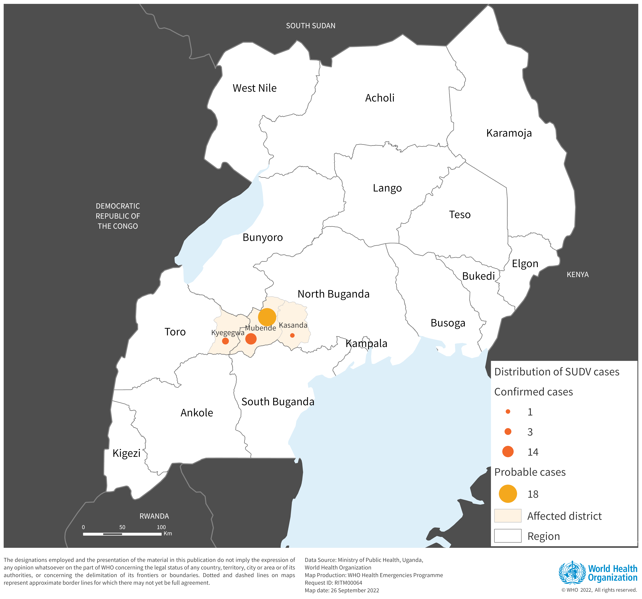
As of 25 September 2022, a cumulative number of 18 confirmed and 18 probable cases have been reported from Mubende, Kyegegwa and Kassanda districts, including 23 deaths, of which five were among confirmed cases (CFR among confirmed cases 28%). This is the first Ebola disease outbreak caused by Sudan virus (SUDV) in Uganda since 2012.
Description of the outbreak
On 20 September 2022, the health authorities in Uganda declared an outbreak of Ebola disease caused by Sudan virus (SUDV), after a case was confirmed in a village of Madudu sub-county in Mubende district, central Uganda.
The case was a 24-year-old male who developed a wide range of symptoms on 11 September including high-grade fever, tonic convulsions, blood-stained vomit and diarrhoea, loss of appetite, pain while swallowing, chest pain, dry cough and bleeding in the eyes. He visited two private clinics, successively between 11-13 and 13-15 September without improvement. He was then referred to the Regional Referral Hospital (RRH) on 15 September where he was isolated as a suspected case of viral haemorrhagic fever. A blood sample was collected on 17 September and sent to the Uganda Virus Research Institute (UVRI) in Kampala where RT- PCR tests conducted were positive for SUDV on 19 September. On the same day, the patient died.
Results of preliminary investigations identified a number of community deaths from an unknown illness in Madudu and Kiruma sub-counties of Mubende district reported in the first two weeks of September. These deaths are now considered to be probable cases of Ebola caused by SUDV.
As of 25 September 2022, a cumulative number of 36 cases (18 confirmed and 18 probable cases) have been reported from Mubende (14 confirmed and 18 probable), Kyegegwa (three confirmed cases) and Kassanda (one confirmed case) districts. Twenty-three deaths have been recorded, of which five were among confirmed cases (CFR among confirmed cases 28%). Of the total confirmed and suspected cases, 62% are female and 38% are male. There are currently 13 confirmed cases hospitalized. The median age of the cases is 26 years (range 1 year to 60 years). A cumulative number of 223 contacts have been listed.
Map of confirmed (n=18) and suspected (n=18) cases of Ebola disease caused by Sudan virus, by district, Uganda (as of 25 September 2022).
Epidemiology of the disease
According to the International Classification of Disease for filoviruses (ICD-11) released in May 2019, Ebola disease is now sub-categorized depending on the causative virus. Outbreaks of Ebola disease caused by Sudan virus are named Sudan Virus Disease (SVD) outbreaks. Prior to May 2019 all viruses causing Ebola disease were grouped together. Based on the results of laboratory tests, this outbreak is caused by Sudan virus.
Sudan virus disease is a severe, often fatal illness affecting humans. Sudan virus was first reported in southern Sudan in June 1976, since then the virus has emerged periodically and up to now, seven outbreaks caused by SUDV have been reported, four in Uganda and three in Sudan. The estimated case fatality ratios of SVD have varied from 41% to 100% in past outbreaks.
The virus is introduced into the human population through close contact with the blood, secretions, organs or other bodily fluids of infected animals such as fruit bats, chimpanzees, gorillas, monkeys, forest antelope or porcupines found ill or dead or in the rainforest. The virus then spreads through human-to-human transmission via direct contact (through broken skin or mucous membranes) with either blood or body fluids of a person who is sick with or has died from SVD or objects that have been contaminated with body fluids (like blood, faeces, vomit) from a person sick with SVD or the body of a person who died from SVD.
The incubation period ranges from 2 to 21 days. People infected with Sudan virus cannot spread the disease until they develop symptoms, and they remain infectious as long as their blood contains the virus. Symptoms of SVD can be sudden and include fever, fatigue, muscle pain, headache, and sore throat later followed by vomiting, diarrhoea, rash, symptoms of impaired kidney and liver function. In some cases, the patient might present both internal and external bleeding (for example, bleeding from the gums, or blood in the stools).
The diagnosis of SVD can be difficult, as early nonspecific manifestation of the disease may mimic other infectious diseases such as malaria, typhoid fever and meningitis. Confirmation is made using numerous diagnostic methods including RT-PCR. Supportive care - rehydration with oral or intravenous fluids - and treatment of specific symptoms improve survival.
There are no licensed vaccines or therapeutics for the prevention and treatment of Sudan virus disease.
Uganda has reported four SVD outbreaks, in 2000, 2011 and 2012 (two outbreaks). Uganda also reported a Bundibugyo virus disease outbreak in 2007 and an Ebola virus disease outbreak in 2019.


Public health response

Coordination
  • The Ministry of Health (MOH) established a National Task Force, with WHO providing technical support
  • The Incidence Management Team was activated both within the MOH and the WHO country office
  • The MOH Incident Commander has been deployed to Mubende District to support response efforts in the affected region
  • WHO is supporting the orientation of the leadership at the Regional Referral Hospital and the district health team on early identification and case management
  • A response plan is being developed and priority actions have been identified

Surveillance and Laboratory
  • WHO has supported the activation of surveillance structures in districts
  • Contact tracing and active case finding are ongoing
  • WHO has deployed a technical team in Mubende district to support surveillance

Case Management
  • WHO has supported the assessment of the isolation unit at the regional referral Hospital and dispatched an Ebola disease kit and tent for the isolation of patients
  • WHO has deployed a central team of experts to support the establishment of a treatment unit in the Regional Referral Hospital
  • Infection prevention and control (IPC) teams were deployed to support capacity building of health workers in IPC and the establishment of screening and triage at all health facilities in affected districts
Communication and Risk Communication
  • As part of the communication and risk communication activities, WHO provided technical support for the organization of the press conference on Ebola and the development and dissemination of a press statement by the Ministry of Health
  • Currently, WHO is supporting the review of Information, Education and Communication (IEC) material for dissemination to the public
WHO risk assessment

Uganda has experience in responding to Ebola virus disease and Sudan virus disease outbreaks, and necessary action has been initiated quickly. The current outbreak is the first Ebola disease outbreak caused by Sudan virus in Uganda since 2012.
In the absence of licensed vaccines and therapeutics for prevention and treatment of Sudan virus disease, the risk of potential serious public health impact is high. Community deaths and care of patients in private facilities and hospitals and other community health services with limited protection and infection prevention and control measures entail a high risk of many transmission chains. Investigations are ongoing to determine the scope of the outbreak and the possibility of spreading to other districts. Importation of cases to neighbouring countries cannot be ruled out at this stage.
According to the information currently available, the overall risk has been assessed as high at national level considering: (i) the confirmed Sudan virus and the lack of an authorized vaccine (ii) the possibility that the event started three weeks before the identification of the index case and several transmission chains have not been not tracked; (iii) patients presented at various facilities with suboptimal infection, prevention and control (IPC) practices including inadequate use of personal protective equipment (PPE); the patients died and were traditionally buried with large gathering ceremonies; (iv) although the country has developed an increased capacity to respond to Ebola outbreaks over recent years, and has a local capacity that can be easily mobilized and organised with available resources to mount a robust response, the system could be overwhelmed if the number of cases increases and the outbreak spreads to other sub-counties, districts and regions, as the country simultaneously responds to multiple emergencies, including anthrax, COVID-19, Rift Valley fever and Yellow fever, as well as flooding and prevailing food insecurity.
In addition, the outbreak was detected among individuals living around an active local gold mine. Mobility among traders of this commodity is likely to be high, and the declaration of the outbreak may cause some miners already incubating the disease to flee.
The currently affected Mubende district has no international borders. Nevertheless, the risk of international spread cannot be ruled out due to the active cross-border population movement. In addition, investigations are ongoing to establish transmission chains and the scope of the outbreak is yet to be determined.
At Regional and Global levels, the overall risk has been assessed as low.

WHO advice

Effective outbreak control relies on applying a package of interventions, including case management, surveillance and contact tracing, an optimal laboratory service, implementation of infection prevention and control measures in health care and community settings, safe and dignified burials and community engagement and social mobilization. Community engagement is essential to successfully controlling outbreaks. Raising awareness of risk factors for Ebola infection and protective measures that individuals can take is an effective way to reduce human transmission.
Early initiation of supportive treatment has been shown to significantly reduce deaths from Ebola disease. There is a need to strengthen surveillance and other response activities to contain the possibility of exponential spread.
Based on available evidence the ERVEBO vaccine — used in the recent responses against the Ebola virus disease outbreaks — will not provide cross-protection against the Sudan virus disease.
The Johnson & Johnson (Janssen) vaccine called Zabdeno/Mvabea against Ebola has only been approved by the European Medicines Agency (EMA) against Ebola virus disease and has not been tested against Sudan virus disease. This vaccine is administered on a two-dose schedule and requires 56 days between the two doses. The first dose provides protection against the Zaire ebolavirus and the second dose was designed to provide protection against other species of the virus, including Sudan. However, this multiantigen protection has not been demonstrated with clinical data. Even if the vaccine was tested and proved to be effective against Sudan ebolavirus, it would only provide protection some days after the second dose is administered. This means the vaccine is not appropriate for outbreak response.
WHO advises against any restrictions on travel and/or trade to Uganda based on available information for the current outbreak.

Further information
Citable reference: World Health Organization (26 September 2022). Disease Outbreak News; Ebola Disease caused by Sudan virus – Uganda. Available at: https://www.who.int/emergencies/dise...em/2022-DON410


See all DONs related to this event
Read more about Ebola virus disease
 
Source: https://kesq.com/news/2022/09/26/ebola-infections-grow-in-uganda-as-death-toll-rises-to-23/

Ebola infections grow in Uganda as death toll rises to 23
By Nimi Princewill, CNN

Ebola infections have risen across districts in Uganda, bringing the cumulative number of confirmed and suspected deaths to 23, health authorities in the east African country said Monday.

Uganda declared an Ebola outbreak last Tuesday after a case of the relatively rare Sudan strain was detected in the country’s Mubende district.

The virus has now spread to neighboring Kyegegwa and Kassanda districts, with the Ugandan Health Ministry reporting that cumulative cases had risen to 36, including confirmed and probable cases. No cases have been detected in the capital city Kampala.

The Ugandan Health Ministry considers a “probable case” as any person who died from suspected EVD (ebola) and had an epidemiological link to a confirmed case but was not tested and did not have lab confirmation.

The ministry considers “confirmed cases” as those with positive lab results. Of the number of infections identified so far, 18 of the cases have been confirmed to be infected while another 18 were suspected of having the virus.

The ministry also stated that five of the deceased patients were confirmed to have died of the virus while 18 were listed as probable deaths. Around 35 patients are currently being admitted, it added...
 
Source: https://www.kfm.co.ug/news/suspected...-district.html

Suspected Ebola patient dies in Wakiso
admin by admin
September 27, 2022
By Mike Sebalu

A 22-year-old girl with symptoms of Ebola died on Monday, September 26 at Kasangati Health Centre IV.

Kasangati Town Council authorities in Wakiso district have criticised the slow response by the government in handling a suspected case of Ebola at the mentioned health facility.

Kasangati Mayor, Tom Muwonge says much as they have identified the contacts of the deceased, their samples have not yet been taken for testing at the Uganda Virus Research Institute.

Muwonge has also decried lack of Personal Protective Equipment (PPE) for the health workers which has put many of their lives at stake...


------------------------------------------------------------------

Wakiso District is a district in the Central Region of Uganda that partly encircles Kampala, Uganda's capital city. The town of Wakiso is the site of the district headquarters. Kira, the country's second largest city and suburb of Kampala, is in the district.

https://en.wikipedia.org/wiki/Wakiso_District

-------------------------------------------------------------------

Kasangati is 7 miles from Kampala, the capital of Uganda.
 
Last edited by a moderator:
Dr. Jane Ruth Aceng Ocero
@JaneRuth_Aceng

As of today, there is no confirmed case of #Ebola in #Kampala. All samples tested for #Ebola from Kampala turned negative.

Right now, we are awaiting the results of the sample tested from Kasangati. We shall keep the public informed and call for calmness and vigilance. Stay safe.

...

4:45 AM · Sep 27, 2022·Twitter for iPhone
 
As Ebola Spreads, Ugandan Medical Interns Strike Over Safety

September 27, 2022 12:51 PM
Halima Athumani

KAMPALA, UGANDA —

...
Uganda Medical Association President, Dr. Samuel Oledo, told VOA one intern, three staff, and a medical student have been confirmed for exposure to the virus and at least three senior health officers (SHO) are showing symptoms.

"We have 34 interns in Mubende. And we have less than 12 doctors employed on the ground,” Oledo said. “If you have interns and they are pulling out at once, it's catastrophic. And the justifications are clear, honestly. Results have come out today and one of the SHOs who actually performed surgeries with one of the interns on one case has become positive of Ebola."

Oledo said they suspect as many as 104 medical students in Mubende hospital have been exposed to the virus.

Uganda’s Ministry of Health has yet to confirm the exposures and infections of students and staff at the hospital.
...

https://www.voanews.com/a/as-ebola-spreads-ugandan-medical-interns-strike-over-safety/6765445.html
 
Six health workers at Mubende Hospital test positive for Ebola

Wednesday, September 28, 2022

By U R N
New Agency
Uganda Radio Network
...
Six health workers at Mubende Regional Referral Hospital have tested positive for the Ebola Virus Disease.

According to the General Secretary of the Uganda Medical Association, Mr Herbert Luswata, three are medical workers, two are interns and one is a medical student. The samples of the health workers were sent to the Uganda Virus Research Institute which confirmed the Ebola virus on Wednesday.
...
Ms Rosemary Byabashaija, the Mubende Resident District Commissioner said that currently there are 42 people admitted at the Ebola Centre in Mubende with 16 people tested and confirmed to be positive for Ebola Virus. She said that one died bringing the number of deaths at the facility to six, while 19 others died in the villages making 25, the total number of deaths.

“Many people continue to contract this disease as the numbers continue increasing, but the good news is that some are being cured of the disease. We currently have 42 people in isolation, and the confirmed positive cases are 16. We have 26 in emergency units,” she said on Wednesday.
...

https://www.monitor.co.ug/uganda/ne...ende-hospital-test-positive-for-ebola-3965644
 
WEEKLY BULLETIN ON OUTBREAKS
AND OTHER EMERGENCIES

Week 39: 19 - 25 September 2022
Data as reported by: 17:00; 25 September 2022

...

Ebola Virus Disease caused by Sudan virus in Uganda

36 cases
23 Deaths
64.0% CFR


EVENT DESCRIPTION

In line with the International Classification of Disease for
filoviruses (ICD-11) released in May 2019, outbreaks of a disease
caused by the Sudan ebolavirus are named Sudan Virus Disease
(SVD) outbreaks. This is the first outbreak of SVD since the new
classification.

On 20 September 2022, the Uganda Ministry of Health officially
declared an outbreak of SVD. The index case is a 24-year-old male
residing in Ngabano village, Madudu Sub-County in Mubende
District. His symptom onset was on 11 September, when he
developed high grade fever, tonic convulsions, blood-stained
vomit and diarrhoea, loss of appetite, pain while swallowing,
chest pain, dry cough and bleeding in the eyes.

He therefore attended two private clinics successively between
11-13 and 13-15 September without improvement. He was then
referred to the Mubende Regional Referral Hospital (RRH) on 15
September where he was immediately isolated as a suspected
case of viral haemorrhagic fever. A sample was collected on 17
September and sent to the Uganda Virus Research Institute in
Kampala where RT- PCR tests conducted were positive for SVD
on 19 September. On the same day, the patient died.

According to ongoing investigations, a series of unexplained
community deaths from an unknown illness, and sudden deaths
appearing in Madudu and Kiruma Sub-Counties of Mubende
District were reported in the first two weeks of September.

Preliminary findings revealed six other suspected deceased cases
with ages ranging from 10 days to 56 years recorded at Mubende
RRH and a few private clinics in Kiruma (five cases) and Madudu
(one case) sub-counties of Mubende district. These fatal cases
include four members of one family and one health care worker.

The deaths occurred between 1–15 September. The cases were
not isolated while in treatment and they were traditionally buried
through gathering ceremonies without specific infection control
measures.

As of 25 September 2022, a total of 36 cases have been reported
including 18 confirmed and 18 probable cases. Twenty-three
deaths have been recorded, including five confirmed, for an
overall case fatality ratio (CFR) of 64% and 28% among confirmed
cases. Women (67%) are twice more affected than men, and 37%
of cases are aged below 20 years.

Three Districts have so far been affected: Mubende, the epicentre
with 32 cases, Kyegegwa with three confirmed casesand
Kassanda withone confirmed case. Thirty-five patients are
currently in admission including 22 suspected and 13 confirmed
cases. A total of 399 contacts have been listed with a 26% followup
rate in the past 24hrs.

PUBLIC HEALTH ACTIONS

Coordination

A National Task Force has been established by the MoH, with
WHO providing technical support, and daily meetings are
being held.

A national SVD response plan has been approved to guide
response activities.

An Incidence Management Team (IMT) has been activated
at national level and the MoH Incident Commander has been
deployed to Mubende District to support response efforts
locally. A situation room has been established at Mubende
RRH to support the coordination.

District Task Force (DTFs) meetings have been activated
in Mubende, Sembabule, Kyankwanzi, Kampala, Mityana,
Kyegegwa, Gomba, Kiboga, Kassanda, Kazo, Kakumiro and
Kibaale.

Rapid Response Teams have been deployed to the 12
districts to activate the response mechanisms, conduct risk
assessments and support development of district response
plans.

Surveillance and Laboratory

Epidemiological investigations, contact tracing, and active
case finding in the districts are ongoing. A total of 399
contacts have already been listed with 176 over the past
24hrs; 104 contacts (26%) have been followed-up. In
addition, an alert desk has been established in Mubende
District: 24 alerts have been received in the past 24hrs, 11
(46%) of which have been investigated.

The Mubende surveillance sub-committee has been activated
and briefed on its role.

Eighteen supervisors have been trained in contact tracing,
alert management, case investigation, event-based
surveillance, and data management.

Additional epidemiologists have been deployed to support
the neighbouring districts, and surveillance tools have been
printed and distributed.

Laboratory experts have been deployed from national level
and capacity building support, sample collection, packaging,
and transportation is ongoing.

Two Bio-fire mobile laboratory equipment and assorted
accessory equipment have been deployed to Mubende, with
a capacity of 20 samples to be tested per day. In an event of
increased number of samples, a higher version of Bio-fire
will be deployed.

Case management and infection, prevention and control (IPC)

Management of patients (suspected and confirmed) is
ongoing at Mubende RRH. A total of 35 patients are currently
in admission at Mubende RRH.

The case management pillar has deployed experts for IPC as
well patient care and treatment to support Mubende RRH.
Mortuary attendants have been trained in safe and dignified
burial practices.

WHO and other Partners are supporting the MoH in
establishing an Ebola Treatment Unit at Mubende RRH.
IPC teams are supporting capacity building of health workers
in IPC and the establishment of triage in all healthcare
facilities in affected districts.

Risk communication

Information, Education and Communication materials have
been reviewed and are being disseminated to affected and
high-risk districts, especially in schools, churches, and
communities at the epicentre of the outbreak. Around 1000
students and teachers of five schools have been sensitized
in Madudu sub-country.

All four radio stations in Mubende have been engaged and
initiated the airing of WHO-sponsored messages and talk
shows.

Logistics

Three Ebola disease kits and an isolation tent have been
received at the Mubende RRH to support case management,
as well as IPC items and supplies.

Fuel cards have been provided to support the mobility of
response teams on ground.

SITUATION INTERPRETATION

The source and extent of this outbreak remain to be determined.
From available information, it is possible that the event started
three weeks ago and is already generating secondary or tertiary
cases. Also, the outbreak was detected among individuals living
around an active local gold mine with a highly mobile population.
Patients presented at different facilities yielding suboptimal IPC
practices where they died and were subsequently traditionally
buried with large gathering ceremonies. In this context, the
possibility of spread to other districts and importation of cases
to neighbouring countries cannot be ruled out.
Therefore, in
the absence of specific vaccines and therapeutics, the control
of this outbreak will solely rely on early detection, isolation and
management of cases, optimal IPC measures, and robust risk
communication and community engagement.

https://extranet.who.int/iris/restricted/bitstream/handle/10665/363303/OEW39-1925092022.pdf

 
Uganda rules out Ebola lockdown

Thursday, September 29, 2022
By Monitor Team
...
Uganda's President Museveni on Wednesday ruled out imposing a lockdown to contain the highly contagious Ebola virus, saying the country had the capacity to contain the outbreak.
...
"We decided that we shall not have lockdowns. It is not necessary," Museveni said.

"Government has capacity to control this outbreak as we have done before. There is no need for anxiety, no restrictions of movements, closure of schools places of worships, markets as of now."
...
Six health workers were receiving treatment after testing positive for Ebola following exposure to the first victim, Museveni said.
...

https://www.monitor.co.ug/uganda/news/national/uganda-rules-out-ebola-lockdown-3966074
 
WHO African Region
@WHOAFRO

UPDATE: #Ebola in #Uganda🇺🇬 Situation Report (28/09/22)

▪️ 50 cases (31 confirmed, 19 probable)
▪️ 2 recoveries in past 24 hours
▪️ 24 deaths ( 6 confirmed, 18 probable)
▪️ 414 contacts identified
▪️ 3 districts affected (Mubende, Kassanda, Kyegegwa)

Fd058FKUYAEPt7z


7:35 AM · Sep 29, 2022·Twitter Web App
 
Dr. Jane Ruth Aceng Ocero
@JaneRuth_Aceng

I regret to announce that we have lost our first doctor, Dr Mohammed Ali, a Tanzanian National, 37yr old Male today at 3:15am. He tested positive of Ebola on Sept 26, 2022 and died while receiving treatment at Fort Portal RRH, Isolation facility ( JMedic).


Fd9ztM0XEAEhlJ9


1:03 AM · Oct 1, 2022·Twitter for iPhone

--------------------------------------

Dr. Jane Ruth Aceng Ocero
@JaneRuth_Aceng
·

I condole with his family, medical fraternity, KIU university and the people of Tanzania.

Dr. Ali is the first Doctor, and second health worker to have succumbed to Ebola. The first was a midwife from St Florence Clinic, a probable case, because she died before testing.
...
1:04 AM · Oct 1, 2022·Twitter for iPhone


--------------------------------------------------------------------

Tanzanian doctor dies from Ebola Virus in UgandaPublished

58 mins ago on October 1, 2022By Akanimoh Etim

A Tanzanian medical doctor, Mohammed Ali, has died in Uganda after being infected with the Ebola virus, the Association of Surgeons of Uganda (ASU) announced on Saturday.
...
The 37-year-old Ali who was pursuing a Master of Medicine in Surgery course at Kampala International University, became the second medical personnel to succumb to Ebola since the renewed outbreak last month, the ASU said.

In a statement by Uganda’s Ministry of Health, it was not clear how Ali got infected but his death came after the Ministry announced that seven more deaths had been recorded on Friday.
...
“So far, at least eight health workers have tested positive for EHVF, including intern doctors and senior house officer (all trainees) who were stationed at the centre of the outbreak at Mubende Regional Referral Hospital, according to Uganda Medical Association (UMA),” the Minister added.

https://africanewswatch.com/2022/10/tanzanian-doctor-dies-from-ebola-virus-in-uganda/
 
Testing trouble adds to disorder in Uganda’s Ebola response

By RODNEY MUHUMUZA
today
...
Thirty-five Ebola cases have been confirmed since Sept. 20, including six health workers, and a doctor is among at least seven confirmed deaths.

Only one government-run facility, located 180 kilometers (111 miles) away in Entebbe, is equipped to test for Ebola, and officials sometimes wait up to 48 hours before results come in.
...
Health authorities are still investigating the source of the current outbreak, which likely began in August, Ugandan President Yoweri Museveni said in a televised address earlier this week. It was a surprising admission for an East African country that’s often cited for its leadership in fighting disease outbreaks.

Hamstrung by testing difficulties from the beginning, the initial response was sometimes chaotic as health officials raced to corral contacts and set up an isolation unit, according to health workers and others on the ground.

Some health workers said they felt helpless when ambulances delayed in picking up patients possibly suffering from Ebola. A woman whose farmworker died of Ebola recalled being taken into an isolation unit where some quarantined patients started to bleed, worrying those without symptoms who knew they risked infection.
...
Ugandan authorities had documented 427 known contacts by Friday. But some taken into quarantine escaped and remain at large, complicating the tracing work that’s key to preventing a widening outbreak.
...
The hospital made “the biggest alarm you can ever think of,” he said, and soon efforts were underway to set up an isolation unit with the help of Doctors Without Borders. That unit was still being set up 10 days after the outbreak had been declared.
...
https://apnews.com/article/health-a...-ebola-virus-ec495bd7e9640b36bbfbee8c62ec6fa3
 
WHO African Region
@WHOAFRO

UPDATE: #Ebola in #Uganda🇺🇬 Situation Report (29/09/22)

▪️ 54 cases (35 confirmed, 19 probable)
▪️ 2 recoveries
▪️ 25 deaths (7 confirmed, 18 probable)
▪️ 517 contacts identified
▪️ 4 districts affected (Mubende, Kassanda, Kyegegwa, Kagadi)

Fd-b_TwWIAEv2gt


4:00 AM · Oct 1, 2022·Twitter Web App
 
Scientists race to test vaccines for Uganda’s Ebola outbreak

As deaths climb, researchers once again scramble to launch trials during a crisis

29 SEP 2022 1:05 PM

BY JON COHEN

A multipronged international effort has begun to pull out all the stops to launch trials of experimental Ebola vaccines in Uganda, which declared an outbreak of the deadly disease on 20 September. According to the most recent World Health Organization (WHO) update, Uganda has had 18 confirmed and 18 suspected cases of Ebola, including 23 deaths—an unusually high case fatality rate of 64%. A trial of a vaccine candidate that’s farthest along in development could launch before the end of next month.

Proven vaccines exist for Zaire ebolavirus, which has led to a dozen outbreaks in the neighboring Democratic Republic of the Congo (DRC) and was responsible for the massive Ebola epidemic in West Africa in 2014. But those vaccines cannot control this outbreak because it’s being driven by a distant viral relative known as Sudan ebolavirus, which last caused an outbreak, also in Uganda, in 2012. The Zaire and Sudan ebolaviruses “are not variants and they’re not strains—they’re different viruses,” says Nancy Sullivan, who heads biodefense research at the National Institute of Allergy and Infectious Diseases (NIAID) and has collaborated on Ebola vaccine studies. Researchers have long recognized that the world badly needs a Sudan ebolavirus vaccine: In 2016, Science published a survey of 50 leading vaccine researchers who ranked the Sudan ebolavirus vaccine as the number one R&D priority based on feasibility and need. But vaccinemakers have had little financial incentive to produce one. Even if the current trial succeeds, producing enough doses fast enough will be a challenge.

Three experimental Sudan ebolavirus vaccines have been tested in human studies, but because outbreaks are so rare, they have not had a real-world test. “We are moving really fast this time and people are really willing to work to get these vaccines on the ground,” says Ana Maria Henao-Restrepo, a WHO vaccine specialist who is coordinating discussions between the Ugandan government and stakeholders elsewhere in the world, including vaccine manufacturers, funders, and nongovernmental organizations.

The farthest ahead is a candidate that the pharmaceutical giant GlaxoSmithKline began to develop during the West African outbreak; GSK donated the license for it to the nonprofit Sabin Vaccine Institute in 2019. The single-dose vaccine contains the gene for the surface protein of the virus stitched into a harmless chimpanzee adenovirus (ChAd), which serves as a shuttle to deliver the payload into cells. The U.S. government’s Biomedical Advanced Research and Development Authority in 2019 awarded Sabin a $128 million contract to develop the product, and the candidate has worked well in monkey studies and small-scale clinical trials conducted by NIAID’s Vaccine Research Center.

Henao-Restrepo says WHO organized two rounds of consultations this week with vaccine developers and others, which led to a unanimous agreement that the Sabin candidate should be first in line for a Ugandan trial. Ugandan health officials are now evaluating a draft proposal for this trial. If all goes well, Henao-Restrepo says a study could begin before the end of October.

NIAID’s Richard Koup, acting director of the vaccine research center, says it has 100 doses of the vaccine and has made them available to Uganda. Another 40,000 doses exist in bulk form that need to be put in vials. The Coalition for Epidemic Preparedness Innovations (CEPI), a nonprofit that supports R&D for vaccines, is working with Sabin to find a manufacturer who can do what’s called “fill and finish.” ...

https://www.science.org/content/article/scientists-race-test-vaccines-uganda-s-ebola-outbreak
 
Back
Top Bottom