

Michael Coston
Editor, Senior Moderator
Trans. & Emerg. Dis.: Appearance Of Reassortant European Avian‐origin H1 influenza A viruses in Swine - Vietnam
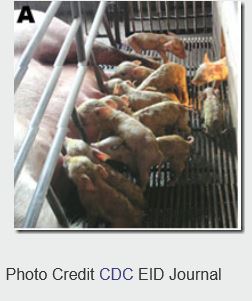
#13,235
According to the FAO, pork is `world’s most consumed meat from terrestrial animals', and global pork production has more than doubled since the 1970s, and continues to rise. According to the USDA:
Internationally, live hogs are often shipped for breeding purposes, to inject genetic diversity into local herds to improve the breed.
Roll in the ability of pigs to pick up human flu viruses, and their susceptibility to avian influenza viruses, and you have a recipe for generating a lot of new genotypes.
Despite the lack of concerted global testing and surveillance, we still get a number of concerning swine-flu reports from around the globe. A few recent examples include:
http://afludiary.blogspot.com/2018/0...arance-of.html
#13,235
According to the FAO, pork is `world’s most consumed meat from terrestrial animals', and global pork production has more than doubled since the 1970s, and continues to rise. According to the USDA:
Global production is forecast up nearly 2 percent in 2018 to 113.1 million tons, primarily on expansion in China and to a lesser extent the United States.
Unlike 50 years ago, pork is no longer a mostly locally produced product of small family farms. Commercial pigs are often mass raised in one region, shipped off to a corn belt' area to be fattened, and often transported again someplace else to be slaughtered.Internationally, live hogs are often shipped for breeding purposes, to inject genetic diversity into local herds to improve the breed.
And hitching a ride are frequently H1, H2, and H3 swine flu viruses - which, while endemic in pigs around the globe - have significant genetic diversity across the world.
The result is that one genotype of a swine origin H1N1 virus can meet up with - and reassort with - a genetically different swine origin virus from another region. And as happens far too often with swine flu viruses, they have the potential to reassort into a new genotype. 
Roll in the ability of pigs to pick up human flu viruses, and their susceptibility to avian influenza viruses, and you have a recipe for generating a lot of new genotypes.
Some, perhaps, with zoonotic capabilities.
Which brings us to a recent Short Communication from Transboundary & Emerging Diseases which details the discovery of two European avian‐like H1N2 IAVs‐Sviruses in Vietnam - which both included internal genes from the human H1N1pdm09 virus - indicating these viruses are reassortants. Appearance of reassortant European avian‐origin H1 influenza A viruses of swine in Vietnam
N. Takemae, P. T. Nguyen, V. T. Le, T. N. Nguyen, T. L. To, T. D. Nguyen, V. P. , ham, H. V. Vo , Q. V. T. Le, H. T. Do, D. T. Nguyen, Y. Uchida, T. Saito
N. Takemae, P. T. Nguyen, V. T. Le, T. N. Nguyen, T. L. To, T. D. Nguyen, V. P. , ham, H. V. Vo , Q. V. T. Le, H. T. Do, D. T. Nguyen, Y. Uchida, T. Saito
First published: 6 March 2018
https://doi.org/10.1111/tbed.12849
Summary
Three subtypes—H1N1, H1N2 and H3N2—of influenza A viruses of swine (IAVs‐S) are currently endemic in swine worldwide, but there is considerable genotypic diversity among each subtype and limited geographical distribution.
Through IAVs‐S monitoring in Vietnam, two H1N2 influenza A viruses were isolated from healthy pigs in Ba Ria‐Vung Tau Province, Southern Vietnam, on 2 December 2016. BLAST and phylogenetic analyses revealed that their HA and NA genes were derived from those of European avian‐like H1N2 IAVs‐S that contained avian‐origin H1 and human‐like N2 genes, and were particularly closely related to those of IAVs‐S circulating in the Netherlands, Germany or Denmark.
In addition, the internal genes of these Vietnamese isolates were derived from human A(H1N1)pdm09 viruses, suggesting that the Vietnamese H1N2 IAVs‐S are reassortants between European H1N2 IAVs‐S and human A(H1N1)pdm09v.
The appearance of European avian‐like H1N2 IAVs‐S in Vietnam marks their first transmission outside Europe. Our results and statistical analyses of the number of live pigs imported into Vietnam suggest that the European avian‐like H1N2 IAVs‐S may have been introduced into Vietnam with their hosts through international trade.
These findings highlight the importance of quarantining imported pigs to impede the introduction of new IAVs‐S.
With global pig production growing rapidly to meet the demands of a hungry world, each year we add tens of millions more `mixing vessels’ to nature's laboratory. And the bulk of the predicted future growth in hog farming is expected in developing countries. https://doi.org/10.1111/tbed.12849
Summary
Three subtypes—H1N1, H1N2 and H3N2—of influenza A viruses of swine (IAVs‐S) are currently endemic in swine worldwide, but there is considerable genotypic diversity among each subtype and limited geographical distribution.
Through IAVs‐S monitoring in Vietnam, two H1N2 influenza A viruses were isolated from healthy pigs in Ba Ria‐Vung Tau Province, Southern Vietnam, on 2 December 2016. BLAST and phylogenetic analyses revealed that their HA and NA genes were derived from those of European avian‐like H1N2 IAVs‐S that contained avian‐origin H1 and human‐like N2 genes, and were particularly closely related to those of IAVs‐S circulating in the Netherlands, Germany or Denmark.
In addition, the internal genes of these Vietnamese isolates were derived from human A(H1N1)pdm09 viruses, suggesting that the Vietnamese H1N2 IAVs‐S are reassortants between European H1N2 IAVs‐S and human A(H1N1)pdm09v.
The appearance of European avian‐like H1N2 IAVs‐S in Vietnam marks their first transmission outside Europe. Our results and statistical analyses of the number of live pigs imported into Vietnam suggest that the European avian‐like H1N2 IAVs‐S may have been introduced into Vietnam with their hosts through international trade.
These findings highlight the importance of quarantining imported pigs to impede the introduction of new IAVs‐S.
While limited viral surveillance in pig farms may be found in some parts of the developed world - for much of the globe - that simply doesn’t happen.
Since swine H1, H2, and H3 viruses are considered to have less far to `jump' to infect humans than do avian (H5, H7 & H9) viruses, swine flu viruses are considered to have moderate pandemic potential (see CDC IRAT).Despite the lack of concerted global testing and surveillance, we still get a number of concerning swine-flu reports from around the globe. A few recent examples include:
Are Influenza Pandemic Viruses Members Of An Exclusive Club?
EID Journal: Transmission Of Swine H3N2 To Humans At Agricultural Exhibits - Michigan & Ohio 2016
J. Virol: Novel Reassortant Human-like H3N2 & H3N1 Influenza A Viruses In Pigs
J. Virology: A Single Amino Acid Change Alters Transmissability Of EAH1N1 In Guinea Pigs
I&ORV: Triple-Reassortant Novel H3 Virus of Human/Swine Origin Established In Danish Pigs
The biggest concern - as always - is what is going on in those areas of the globe where we get no reporting at all.EID Journal: Transmission Of Swine H3N2 To Humans At Agricultural Exhibits - Michigan & Ohio 2016
J. Virol: Novel Reassortant Human-like H3N2 & H3N1 Influenza A Viruses In Pigs
J. Virology: A Single Amino Acid Change Alters Transmissability Of EAH1N1 In Guinea Pigs
I&ORV: Triple-Reassortant Novel H3 Virus of Human/Swine Origin Established In Danish Pigs
http://afludiary.blogspot.com/2018/0...arance-of.html
