Re: Tracking the World Wide Age Distribution of Swine Flu
From ECDC report
Fourth meeting of the SSiaP working group Stockholm, 14?15 July
3.3 The pandemic (H1N1) 2009 experience in the United
States
Lynnette Brammer, Centers for Disease Control and Prevention (US CDC), presented the epidemiology of the
pandemic influenza in the United States.
Main results
? Secondary ILI attack rate in household contacts: 12 %.
? Overall proportion of hospitalisations: 8 %.
? Overall case fatality: 0.2 %.
?
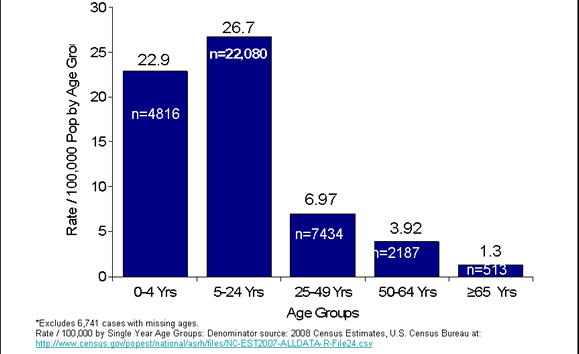
Most cases (58 %) and highest incidence in 5?24 years age group, but second highest incidence in children
under five years of age.
?
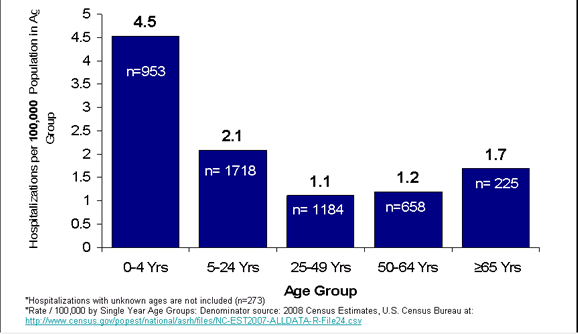
Most hospitalisations (34 %) in 5?24 years age group, but highest age-specific hospitalisation rate per
100 000 population in children under five years of age.
? Highest age-specific proportion of hospitalisations in cases of influenza A(H1N1)v infection is 65 years of
age and older.
?
Most deaths in 5?24 years age group, but highest case-fatality ratio in persons 65 years of age and older.
? Evidence of higher prevalence of the following underlying conditions among hospitalised or deceased
A(H1N1)v influenza patients, compared with the general US population:
− Diabetes.
− Chronic cardio-vascular disease (excluding hypertension).
− Neuromuscular disorder.
− Pregnancy.
− Seizure disorder and other neurodegenerative disease.
Also evidence of higher prevalence of the following underlying conditions among deceased influenza
A(H1N1)v patients, compared with the general US population:
− Chronic renal disease stages III and IV.
− Cancer.
− Obesity.
?
Persons who died from influenza A(H1N1)v virus infection and suffered from underlying neurocognitive,
neuromuscular or seizure disorders tended to be 18 years of age or younger.
Conclusions
? The pandemic has proven many expectations wrong.
? Change in scenario required flexible surveillance: focus on outpatient ILI, rather than hospitalisation and
death.
? Pandemic planning and exercises proved valuable.
? Some of the biggest surveillance challenges were related to IT/data management.
? Pandemic activity is currently declining in the US, but transmission is persisting, and an increase in
infections is expected in the autumn.
? Vaccine priority groups will be finalised in an ACIP meeting.
? The focus of surveillance will shift toward:
− monitoring of changes in risk groups;
− the severe end of the disease spectrum;
− vaccine effectiveness and adverse events;
− more focused virological surveillance; and
− putting an end to the production of numbers (exception: estimates from modelling).
? The level of surveillance carried out in the spring of 2009 will not be sustainable during peak activity.
− Need to change expectations now.
− Build a level of understanding for the data that will be available.
Surveillance and studies in a pandemic: Fourth meeting, 14?15 July 2009
MEETING REPORT
Plenary discussion
Question:
Has the US seen a clear cut-off in pandemic influenza-related morbidity and mortality between age
cohorts born before and after 1957?
Answer: The assumption of a partial or relative immunity in the elderly rests on serological findings. The US
epidemiology of the current pandemic suggests that the elderly may be less susceptible to infection than younger
persons but more prone to severe disease and death if they do get infected.
Question:
Have there been many severe cases without underlying illness?
Answer: This has not been specifically addressed yet, but there is no evidence of higher mortality in previously
healthy children.
Question: What has the impact of the pandemic influenza been on society, especially the healthcare system?
Answer: There has been a huge increase in hospital emergency department visits, and both surveillance and
laboratory systems have been severely stressed. Participants from Canada and Australia added that some patients
required massive sedation, ventilation and even extracorporeal membrane oxygenation, which had an impact on
both ICU staff and equipment.
http://ecdc.europa.eu/en/files/pdf/..._and_Studies_in_a_Pandemic_Meeting_Report.pdf