gsgs
Registered User
Re: Today at GenBank
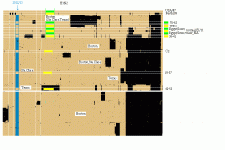
A/panda/Sichuan/01-GG/2009/11/,H1N1 8 segments
http://www.ncbi.nlm.nih.gov/nuccore/KF277204.1
it has 14 mutations:
>A/panda/Sichuan/01-GG/2009,2009/11/,H1N1
G546A(1),C1412T(1)
A300G(2),A1058G(2),A1696G(2)
T198C(3),A495G(3),G849A(3),G1027A(3)
C145A(4),G798C(4)
---
G238A(6),C813T(6),C1332T(6)
---
---
this is surprisingly few . In Nov.2009 I'd expect about 25 mutations.
Let's me speculate whether the virus survived in the environment
some months without replicating.
mutations G546A(1),A300G(2),A1058G(2),C145A(4) are from
the "airplane strain" or "South Carolina strain (2009/04/26)" or "Cancun-2" strain.
I think it was from students returning from Cancun of a school in South Carolina.
It's not the Cancun-strain, that became dominant since 2010.
I have one other early sequence from that strain from Sichuan :
A/Sichuan/1/2009/05/10 from May,10 which has
G546A(1),A300G(2),A1058G(2),G37A(4),
-------------------------------------------------------------------------
here is the paper:
http://wwwnc.cdc.gov/eid/article/20/3/13-1531_article.htm
-----------------------------------------------------------------------
http://www.setbb.com/fluwiki2/viewt...74560a4f2dea4b614e9dafe32ace5&mforum=fluwiki2
The results indicated that A/Sichuan/1/2009 strain had significantly higher replication
ability and virulence than the other strains, and five unique non-synonymous mutations
were identified in important gene-encoding sequences. These mutations led to amino
acid substitutions in HA (L32I), PA (A343T), PB1 (K353R and T566A), and PB2 (T471M),
and may be critical molecular determinants for replication, virulence, and pathogenicity.
Amino acid mutations and the codon posotions:
T471M PB2(1)= C1412T
K353R, T566A PB1(2)= A1058G, A1696G
A343T PA(3)= G1027A
L32I HA(4)= C145A
Sichuan/1/2009 from Genbank; also one at Gisaid
G546A(1),C1412T(1),
A300G(2),A1058G(2),A1696G(2),
T198C(3),A495G(3),G849A(3),G1027A(3),
C145A(4),G798A(4),
Nothing for NP
G238A(6),C813T(6),C1332T(6),
Nothing for MP
Nothing for NS
Survival rates for lab mice:
20% A/Sichuan/1/2009
60% A/California/04/2009
70% A/California/07/2009
50-70% A/Fujian/1/2009, A/Shanghai/1/2009, and A/Guangdong/SWL28/2009
100% A/Shandong/1/2009, A/Beijing/3/2009, A/Jiangsu/1/2009, A/Sichuan-Wenjiang/SWL456/2009
----------------------------------------------------------------------------------
checking again ... the Panda sequence is 100% identical to A/Sichuan/1, so there is a problem.
The A/Sichuan/1/2009 strain was isolated from the first reported
case of 2009 pandemic A (H1N1) influenza virus infection in China;
the patient was a Chinese student who had returned from the
United States in May 2009. The patient reported that no illness
symptoms were experienced during the flight from St. Louis to
Beijing, but fever developed on the following day during the flight
from Beijing to Sichuan. The source of infection remains unknown
[18].
--------------------------
the paper mentions
We named the virus that we isolated A/giant panda/01/Ya’an/2009 (H1N1).
but genbank has another virus
however they mention 100% identity in the 8 segments to
A/Wisconsin/629-D01313/2009 --- G546A,C1412T, May.8
A/Sichuan/1/2009
A/Sichuan/1/2009
A/Sichuan/1/2009
A/Paris/2580/2009 --- C132T , April.30
A/Sichuan/1/2009
A/California/04/2009 --- none
A/Sichuan/1/2009
so that would be just one difference to Sichuan/1 : C132T(5) and the problem remains
A/panda/Sichuan/01-GG/2009/11/,H1N1 8 segments
http://www.ncbi.nlm.nih.gov/nuccore/KF277204.1
it has 14 mutations:
>A/panda/Sichuan/01-GG/2009,2009/11/,H1N1
G546A(1),C1412T(1)
A300G(2),A1058G(2),A1696G(2)
T198C(3),A495G(3),G849A(3),G1027A(3)
C145A(4),G798C(4)
---
G238A(6),C813T(6),C1332T(6)
---
---
this is surprisingly few . In Nov.2009 I'd expect about 25 mutations.
Let's me speculate whether the virus survived in the environment
some months without replicating.
mutations G546A(1),A300G(2),A1058G(2),C145A(4) are from
the "airplane strain" or "South Carolina strain (2009/04/26)" or "Cancun-2" strain.
I think it was from students returning from Cancun of a school in South Carolina.
It's not the Cancun-strain, that became dominant since 2010.
I have one other early sequence from that strain from Sichuan :
A/Sichuan/1/2009/05/10 from May,10 which has
G546A(1),A300G(2),A1058G(2),G37A(4),
-------------------------------------------------------------------------
here is the paper:
http://wwwnc.cdc.gov/eid/article/20/3/13-1531_article.htm
-----------------------------------------------------------------------
http://www.setbb.com/fluwiki2/viewt...74560a4f2dea4b614e9dafe32ace5&mforum=fluwiki2
The results indicated that A/Sichuan/1/2009 strain had significantly higher replication
ability and virulence than the other strains, and five unique non-synonymous mutations
were identified in important gene-encoding sequences. These mutations led to amino
acid substitutions in HA (L32I), PA (A343T), PB1 (K353R and T566A), and PB2 (T471M),
and may be critical molecular determinants for replication, virulence, and pathogenicity.
Amino acid mutations and the codon posotions:
T471M PB2(1)= C1412T
K353R, T566A PB1(2)= A1058G, A1696G
A343T PA(3)= G1027A
L32I HA(4)= C145A
Sichuan/1/2009 from Genbank; also one at Gisaid
G546A(1),C1412T(1),
A300G(2),A1058G(2),A1696G(2),
T198C(3),A495G(3),G849A(3),G1027A(3),
C145A(4),G798A(4),
Nothing for NP
G238A(6),C813T(6),C1332T(6),
Nothing for MP
Nothing for NS
Survival rates for lab mice:
20% A/Sichuan/1/2009
60% A/California/04/2009
70% A/California/07/2009
50-70% A/Fujian/1/2009, A/Shanghai/1/2009, and A/Guangdong/SWL28/2009
100% A/Shandong/1/2009, A/Beijing/3/2009, A/Jiangsu/1/2009, A/Sichuan-Wenjiang/SWL456/2009
----------------------------------------------------------------------------------
checking again ... the Panda sequence is 100% identical to A/Sichuan/1, so there is a problem.
The A/Sichuan/1/2009 strain was isolated from the first reported
case of 2009 pandemic A (H1N1) influenza virus infection in China;
the patient was a Chinese student who had returned from the
United States in May 2009. The patient reported that no illness
symptoms were experienced during the flight from St. Louis to
Beijing, but fever developed on the following day during the flight
from Beijing to Sichuan. The source of infection remains unknown
[18].
--------------------------
the paper mentions
We named the virus that we isolated A/giant panda/01/Ya’an/2009 (H1N1).
but genbank has another virus
however they mention 100% identity in the 8 segments to
A/Wisconsin/629-D01313/2009 --- G546A,C1412T, May.8
A/Sichuan/1/2009
A/Sichuan/1/2009
A/Sichuan/1/2009
A/Paris/2580/2009 --- C132T , April.30
A/Sichuan/1/2009
A/California/04/2009 --- none
A/Sichuan/1/2009
so that would be just one difference to Sichuan/1 : C132T(5) and the problem remains
Last edited: