• FluTrackers.com Inc. does not provide medical advice. Information on this web site is collected from various internet resources, and the FluTrackers board of directors makes no warranty to the safety, efficacy, correctness or completeness of the information posted on this site by any author or poster. The information collated here is for instructional and/or discussion purposes only and is NOT intended to diagnose or treat any disease, illness, or other medical condition. Every individual reader or poster should seek advice from their personal physician/healthcare practitioner before considering or using any interventions that are discussed on this website. By continuing to access this website you agree to consult your personal physican before using any interventions posted on this website, and you agree to hold harmless FluTrackers.com Inc., the board of directors, the members, and all authors and posters for any effects from use of any medication, supplement, vitamin or other substance, device, intervention, etc. mentioned in posts on this website, or other internet venues referenced in posts on this website.
  • We are not asking for any donations. Do not donate to any entity who says they are raising funds for us.

There should be no confusion when dealing with Ebola at hospitals or other locations

Lance

MPH, CSP & CIT Retired, CHMM Emeritus
There should be no confusion when dealing with Ebola at hospitals or other locations:

The CDC, NIH under the Department of Health and Human Services wrote the BMBL (Biosafety in Microbiological and Biomedical Laboratories). This is touted as the corner stone of good biosafety practices and is used and followed in Biotechs and research facilities.

I am an EH&S manager (also a radiation safety officer) for a biotech (handling BSL1, BSL2 and rDNA, lentivirus and Adenoviruses using more skin protection BSL2+) and we follow these practices to safeguard the employees and to ensure that we handle, transport and dispose of infectious materials safely.

Under the BMBL 5th edition, Ebola is considered a BSL-4 requiring BSL-4 containment (BioSafety Level - 4) ? ? work with dangerous and exotic agents that pose a high individual risk of aerosol-transmitted laboratory infections and life-threatening disease that is frequently fatal, for which there are no vaccines or treatments, or a related agent with unknown risk of transmission. Agents with a close or identical antigenic relationship to agents requiring BSL-4 containment must be handled at this level until sufficient data are obtained either to confirm continued work at this level, or re-designate the level. Laboratory staff must have specific and thorough training in handling extremely hazardous infectious agents. Laboratory staff must understand the primary and secondary containment functions of standard and special practices, containment equipment, and laboratory design characteristics. All laboratory staff and supervisors must be competent in handling agents and Procedures.? http://www.cdc.gov/biosafety/publications/bmbl5/

The safety guidelines identify Personal Protective Equipment (PPE), primary and secondary barriers and the design of the laboratory and exhaust. As a biotech we follow these practices.

As a Practicing EH&S manager we train the employees that aerosols can occur during pipetting and any transference of liquids or for any large spill or damaged centrifuge rotors and tubes, whether biological, chemical or radiation. We caution employees to use engineering controls such as Fume Hoods and Biosafety cabinets when working with these substances and that if a spill occurs or a centrifuge has a problem we want them to protect themselves from the aerosol and we want them to leave the area immediately (or wait 20 minutes before opening the centrifuge), after a waiting period we allow re-entry, usually by the EHS response team.

These protection practices are used successfully in every day operations by many industries.

Photo opportunities or incorrect training:

Another thing, I have seen many photos of customs or other agents wearing PPE and looking directly at the person they are interviewing. The PPE is incorrectly used! The pictures I have seen indicate employees wearing surgical masks and in their normal clothes or uniforms with exposed skin.
Caution: I am not complaining that these employees should be wearing hazmat suits and I understand that the photo opportunities may be rushed and they wear whatever is available. The message to the public is wrong and serves to fuel conspiracy theories and a strain on the trust of the employer/employee relationship.

First, hopefully there was a risk assessment completed and documented? The problem with these photos is surgical masks DO NOT protect you against others. An N95 respiratory mask would be more beneficial. Second, designate teams for the interviewing (reducing the numbers of potential exposed personnel). This also reduces the number for medical surveillance. A disposable apron/smock with sleeve covers (scrubs with a laundering service) in case someone was to sneeze would protect the working clothes also a procedure to launder if an incident were to happen should be implemented. Safety glasses are good practices and having the person you are interviewing face to the side would be helpful.
 
Re: There should be no confusion when dealing with Ebola at hospitals or other locations

Disclosure: LAS, MPH is my husband. He holds a BA, CSP, CHMM, CET, RSO, MPH (Masters of Public Health) and has 25 years experience in the environmental safety field. He rarely posts but was ranting this morning about ebola being a BSL4 pathogen so I suggested he post his comments.
 
Re: There should be no confusion when dealing with Ebola at hospitals or other locations

Bravo!!! :applause::applause::applause:

Biology is biology. It does not change from a research setting to a hospital.

Why BSL-4 standards for researchers but not health care workers?

I've been as generous as possible in pondering why CDC was so far off the mark in their risk assessment. I hope to see this change and maybe it will. I'd like to see a solid policy mandating transfer of patients to BSL-4. If we need more beds, we need them. We can't have any more hospitals ending up like the one in Texas.
 
Re: There should be no confusion when dealing with Ebola at hospitals or other locations

Welcome to posting LAS.
What has been used, and has appeared in some of the guidance, is a million miles away from the practices followed in a BSL4 lab. The problem remains though what guidance do you give to those who are likely to be the point of first contact in a healthcare setting. This could be a GP, paramedic or A&E. What could you reasonably expect each of these to have, and be able to do, prior to the arrival of the cavalry.
I would be interested to know how you would structure a workable system?

Sharon: I know you have been tightening up on new members but I think not allowing your own husband a FT account until this year is a bit harsh.
You made him wait 8 years!?
 
Re: There should be no confusion when dealing with Ebola at hospitals or other locations

LOL. He is a shy person. Kind of a "nerdy" and reclusive type. He has not wanted to post.
 
Re: There should be no confusion when dealing with Ebola at hospitals or other locations

Welcome to posting LAS.
What has been used, and has appeared in some of the guidance, is a million miles away from the practices followed in a BSL4 lab. The problem remains though what guidance do you give to those who are likely to be the point of first contact in a healthcare setting. This could be a GP, paramedic or A&E. What could you reasonably expect each of these to have, and be able to do, prior to the arrival of the cavalry.
I would be interested to know how you would structure a workable system?

Sharon: I know you have been tightening up on new members but I think not allowing your own husband a FT account until this year is a bit harsh.
You made him wait 8 years!?

Sharon only lets me out when I have been good!!

Good communications and risk communication always is a must. Universal precautions are a means that has been used effectively with bloodborne pathogens. Cleaning of surfaces and setting up triage and determining preliminary vitals at the onset of a visit have also been used effectively. Setting up a negative room (individually vented, and HEPA filter provided) that can be easily sanitized to hold someone. I use hydrogen peroxide vapor to disinfect and sanitize rooms, procedure rooms and equipment that has been compromised. I also understand that the same vendor that I have dealt with in the past and who I bought the vapor H2O2 machine from has installed units in surgery rooms at hospitals. So engineering controls and work practices have been very beneficial.

Now I understand that some organizations may not have the resources or funding.

One good technique is to have table top exercises (I have used this effectively) with key personnel (management, doctors, logistics, finance and facilities personnel to name a few) and possible community involvement with responders and local governments. This approach brings about a good sense of communication and is one of my favorite techniques (Process Safety Management usually seen in industries and plant operations). It opens the door to questions and techniques that may be effective in different environments.

I actually have used 20+ likely and somewhat unlikely scenarios and found it to be useful in having a base of procedures or steps to take. Also remember no plan is built in concrete and needs to be flexible as the learning process evolves.
 
Re: There should be no confusion when dealing with Ebola at hospitals or other locations

Thank you so much for posting. I have followed fFuTrackers for years and work in primary care and yes I have never seen you post! Thanks Sharon for letting him post. Very useful. One question that is coming up is what to do for safety if a patient gets through our screening and is in front of us in our not so big exam room and we realize that they may be high risk for Ebola. With our flu season screening questionnaire we added in travel questions to screen for MERS and Ebola areas and these are screened at checkin. Our next step if they screen positive is to isolate in private room, keep door open to monitor patient but essentially call Infection control rather than proceed with triage/interview.

However of course with Flu season starting soon we will be seeing a lot of "viral syndromes." We are in a area with a lot of travel and given the outbreak in west Africa is nowhere near winding down I wanted to see if you have any general best practices for a front line worker. So what we do right now is stay a few feet away from patients while questioning them, wear a n95 with patients who have flu like symptoms (facial shield also if performing procedure like the flu swab) and practice excellent hand hygiene. Our nurses do wipe down rooms in between patients with the wipe designated to also kill c difficile. Do you have any practical tips?
 
Re: There should be no confusion when dealing with Ebola at hospitals or other locations

Thank you so much for posting. I have followed fFuTrackers for years and work in primary care and yes I have never seen you post! Thanks Sharon for letting him post. Very useful. One question that is coming up is what to do for safety if a patient gets through our screening and is in front of us in our not so big exam room and we realize that they may be high risk for Ebola. With our flu season screening questionnaire we added in travel questions to screen for MERS and Ebola areas and these are screened at checkin. Our next step if they screen positive is to isolate in private room, keep door open to monitor patient but essentially call Infection control rather than proceed with triage/interview.

However of course with Flu season starting soon we will be seeing a lot of "viral syndromes." We are in a area with a lot of travel and given the outbreak in west Africa is nowhere near winding down I wanted to see if you have any general best practices for a front line worker. So what we do right now is stay a few feet away from patients while questioning them, wear a n95 with patients who have flu like symptoms (facial shield also if performing procedure like the flu swab) and practice excellent hand hygiene. Our nurses do wipe down rooms in between patients with the wipe designated to also kill c difficile. Do you have any practical tips?
I think you are asking much the same as I was. If I could ask what level of PPE do you hold at you facility. N95s, gloves etc. I assume you have but impermeable gowns, full face splash masks, shoe covers etc. how far down the health care system do you find these as stocked items? Same for PAPR with HIPA, plastic tents, autoclaves and the more expensive blood analysers etc. The problem is that one size fits all guidance may have well equipped facilities dumbing down when they could provided better PPE or poorly equipped ones bankrupting themselves trying to emulate a BSL4 lab. The secondary problem is there is not enough global capacity for the manufacture of the fully enclosed PPE used by MSF and it would be a poor use of it to have it sitting in a store cupboards in rural Iowa or Tuscany rather than Monrovia.
The thinking behind my question was to provide a self assessment procedure for all facilities so they can decide, in advance, if they should just isolate the patient without any contact and refer up the chain. If they can engage with the patient what should be attempted at each level before referral to a better equipped and trained unit. What happens when the top level units become full. Dr. Fauci said the NIH facility had 2 beds of the type one of the Dallas nurses is in.
 
Re: There should be no confusion when dealing with Ebola at hospitals or other locations

Thanks for the comments. Welcome QuadrupleM!

LAS will be responding later today with his recommendations.
 
Re: There should be no confusion when dealing with Ebola at hospitals or other locations

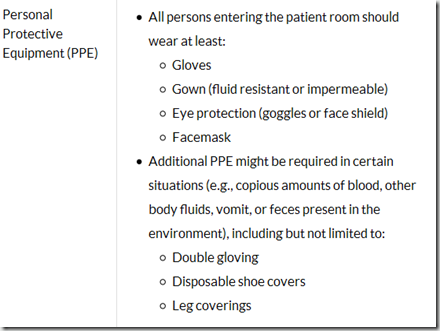
This morning I directed Lance to the CDC ebola site so he can familiarize himself with this material. He found that there is no PPE recommendation at this time for health care workers as regards to ebola. I was really surprised and took a screen shot just because....
 

Attachments

  • Cdcprecautions.webp
    Cdcprecautions.webp
    36.4 KB · Views: 2
Re: There should be no confusion when dealing with Ebola at hospitals or other locations

Thank you so much for posting. I have followed fFuTrackers for years and work in primary care and yes I have never seen you post! Thanks Sharon for letting him post. Very useful. One question that is coming up is what to do for safety if a patient gets through our screening and is in front of us in our not so big exam room and we realize that they may be high risk for Ebola. With our flu season screening questionnaire we added in travel questions to screen for MERS and Ebola areas and these are screened at checkin. Our next step if they screen positive is to isolate in private room, keep door open to monitor patient but essentially call Infection control rather than proceed with triage/interview.

However of course with Flu season starting soon we will be seeing a lot of "viral syndromes." We are in a area with a lot of travel and given the outbreak in west Africa is nowhere near winding down I wanted to see if you have any general best practices for a front line worker. So what we do right now is stay a few feet away from patients while questioning them, wear a n95 with patients who have flu like symptoms (facial shield also if performing procedure like the flu swab) and practice excellent hand hygiene. Our nurses do wipe down rooms in between patients with the wipe designated to also kill c difficile. Do you have any practical tips?

http://www.cdc.gov/vhf/ebola/hcp/index.html

The fact sheets within this link are very good.

You have a good handle on the protection of the employees, the above flow charts and fact sheets from the CDC is also good. A risk assessment and the procedures you have put in place is good. You probably already have done this but remember that with the N95 (tight fits) follow OSHA guidelines on respirators.

https://www.osha.gov/pls/oshaweb/owadisp.show_document?p_table=STANDARDS&p_id=12716

In the past as new areas of environmental concerns have developed established procedures from previous regulations and controls have been adopted to the new concerns. Example, in one of my past lives as an asbestos contractor I have seen the same guidelines be adopted to indoor environmental complaints for removal of mold, in fact before the guidelines were developed we used the same techniques to safeguard employees. The HAZWOPER (Hazardous waste operations and emergency response) is a good process for decontamination not only in a waste scenario but also in infection control (you can reduce the burden of all the stations and still maintain control). The reason I bring this up is you have in your vocation good effective programs such as Bloodborne Pathogens (BBP), Personal Protection Equipment (PPE), TB guidelines, Control of other infectious diseases that can be adopted to protect yourself and your employees.
 
Re: There should be no confusion when dealing with Ebola at hospitals or other locations

I think you are asking much the same as I was. If I could ask what level of PPE do you hold at you facility. N95s, gloves etc. I assume you have but impermeable gowns, full face splash masks, shoe covers etc. how far down the health care system do you find these as stocked items? Same for PAPR with HIPA, plastic tents, autoclaves and the more expensive blood analysers etc. The problem is that one size fits all guidance may have well equipped facilities dumbing down when they could provided better PPE or poorly equipped ones bankrupting themselves trying to emulate a BSL4 lab. The secondary problem is there is not enough global capacity for the manufacture of the fully enclosed PPE used by MSF and it would be a poor use of it to have it sitting in a store cupboards in rural Iowa or Tuscany rather than Monrovia.
The thinking behind my question was to provide a self assessment procedure for all facilities so they can decide, in advance, if they should just isolate the patient without any contact and refer up the chain. If they can engage with the patient what should be attempted at each level before referral to a better equipped and trained unit. What happens when the top level units become full. Dr. Fauci said the NIH facility had 2 beds of the type one of the Dallas nurses is in.

In my current job we have the privilege of moving into a building 7 years ago designed for our work, so engineering controls have been incorporated into our processes. Engineering controls greatly reduce the Personal Protective Equipment (PPE) requirements. With the human variable, the comfort or lack of comfort that PPE poses and the employee themselves can reduce the effectiveness of your program so engineering controls are greatly appreciated. In addition to training and retraining I have had to use disciplinary processes to get adherence (the disciplinary process is my last resort).

Depending on the BSL work, animal (mice) containment or chemical/radioactive isotope use we require different levels of protection. The basic is safety glasses, correct gloves and lab coat.

Double gloves, tapped gloves, sleeve covers, disposable lab coat, sash use on BioSafety Cabinets (BSC) and safety glasses or face shield are used in accordance with the BioSafety Level (BSL). Respirators are used as required, but again the use of engineering controls is very effective (fume foods, snorkels, BSC, and negative tissue culture rooms and negative labs with 100% fresh air and 100% exhaust in all labs). Tier cleanliness in the animal (mice) rooms (vivarium) have been established with other PPE requirements including shoe covers, hair nets and scrubs (of course this is to protect the mice from us and what we may bring in more than protect the employee). We do require certain basic PPE in the vivarium in addition to the PPE for the tier. It is a constant behavior modification process for the EH&S staff to encourage use of the PPE (so we walk the floors throughout the day).

A lot of medical practitioners and small health clinics do not have good engineering controls (In a previous work environment I have experienced health clinics being set up in a county with little regard to ventilation), so I understand that engineering controls may not be optimum. Therefore PPE and procedures become an important defense. Some groups have vendors set up to supply when necessary (Just in time) and some have made cooperative agreements with other practitioners or organizations.

Please also see post #12.

Just an after thought, the surgical mask on the patient could also be used to help prevent possible close contact aerosols (this was used in the county for TB inmates when in court along with separate video monitoring).
 
Last edited:
Re: There should be no confusion when dealing with Ebola at hospitals or other locations

This morning I directed Lance to the CDC ebola site so he can familiarize himself with this material. He found that there is no PPE recommendation at this time for health care workers as regards to ebola. I was really surprised and took a screen shot just because....


hat tip Michael Coston


Sunday, October 19, 2014

NIH: `More Stringent’ PPE Standards For Ebola On The Way


Old CDC Ebola PPE Recommendations
http://www.cdc.gov/vhf/ebola/hcp/infection-prevention-and-control-recommendations.html


# 9216

When Thomas Duncan arrived at a Dallas hospital last month the CDC’s recommended PPEs for HCWs dealing with a suspected or confirmed Ebola case included contact (gloves, gown) and droplet protection (surgical masks, eye protection), but full skin covering and the use of respirators (ie. PAPR, N95) were not for patient care not involving aerosol generating procedures (AGPs).


Some hospitals that received evacuated Ebola cases, such as Emory and UNMC (which have dedicated high containment isolation facilities) were plainly exceeding these standards from the beginning, using PAPRs and full body Hazmat suits for protection.

This disconnect between what the CDC was recommending – and what these high containment facilities were doing - has given rise to concerns among hospitals and healthcare workers that the existing recommendations might not be adequate when dealing with Ebola.

A concern that has only grown since two healthcare workers caring from Mr. Duncan in Dallas were exposed to the virus even though they were – in the words of the hospital – following the CDC’s PPE protocol.
This morning Dr. Anthony Fauci made the rounds of the Sunday morning news shows, and on FACE THE NATION, revealed that new, `more stringent’ PPE standards are soon to be announced by the CDC.
While not wishing to preempt the CDC’s announcement, Dr. Fauci suggested that `no exposed skin’, better training, and a `buddy system’ for donning and doffing PPEs would likely be on the list of new standards.
The CBS news story, and a six minute video clip are available below:
New CDC Ebola guidelines will be "more stringent," NIH expert says
The new protocols that the Centers for Disease Control and Prevention (CDC) are developing for health care workers treating patients with Ebola will be "much more stringent" than previous guidelines, said Dr. Anthony Fauci, the director of the National Institutes of Health [NIH] National Institute of Allergy and Infectious Diseases.

(Continue . . . )
Posted by Michael Coston at "2014-10-19 12:49 PM"
 
Re: There should be no confusion when dealing with Ebola at hospitals or other locations

Thank you everyone. Very useful. I and my facility have been closely following CDC and going steps beyond. We are already doing the things that will likely be in new recs. Also for the clinics we do have patients use surgical face mask on check in if ill and if nauseous give them special bags. I love those bags. Much better than the old bucket with less splash.

We will have PPE kits but as you indicated this is a moving target and having in each clinic is not a good use of resources. Ventilation is a problem which we really see when someone makes it into clinic with TB.

The reality is when someone is sitting in front of us for 10-20 min we should be doing our best to stay safe with what we have. The good news is no one from 1st ED visit with Duncan got ill and that is more likely the state we would see a patient in. I really would love to see exactly what was done by staff.

Also fyi our policy for clinics is to get help and not continue exam/history if they screen positive. Thanks again! Will keep reading the excellent updates and discussions.
 
Re: There should be no confusion when dealing with Ebola at hospitals or other locations

Since there are infection control people reading here right now, I have a question that I wasn't sure where to ask. This weekend I've been on the road in the midwest, including Ohio, and having to use public restrooms. Given the known spread of pathogens from toilet flushing, even when it's possible to put a lid down, has anyone that you all know of considered the potential for droplet spread from an infected person's feces in that kind of public setting? I realize that anyone who was ill enough to be really infectious might be less likely to be out in public and using public restrooms, but it seems like a potential risk still.
 
Re: There should be no confusion when dealing with Ebola at hospitals or other locations


When wearing PPE and training to wear and understand the fit, use and maintenance - remember to practice the operations or procedures you will be using with the PPE. PPE sometimes makes things difficult to perform and the natural response is to remove or adjust while in the hazardous environment. The employees wearing this PPE also need to practice performing tasks wearing the PPE, this will get them familiar with the PPE and may also help them assess the use of other devices that may aid them.

The tendency is to clean the PPE continuously, this also degrades the PPE, so the permeability, degradation and breakthrough will increase as cleaning agents are used (e.g. cleaning gloves after touching infected items). The use of cleaning agent on PPE is great, just realize that you are degrading the protection factors - changing on a schedule is recommended.

Also, there has been discussion on the limited beds. Again as in my prior posts, previous standards and methods of control have been adopted to perform well with other environmental concerns. For example the asbestos and lead removal industry have used effectively plastic sheeting and HEPA fans to create negative work environments so that excursions do not happen (this is in buildings, rooms etc.). PVC piping with plastic sheeting (found at your local hardware store) has been used effectively for decon hallways and entrances. Negative rooms have been developed efficiently within these standards to protect the public and the employees working in these environments. CDC through NIOSH might look at the use of these techniques to see if they could be effectively used within this environment.
 
Back
Top Bottom