
• FluTrackers.com Inc. does not provide medical advice. Information on this web site is collected from various internet resources, and the FluTrackers board of directors makes no warranty to the safety, efficacy, correctness or completeness of the information posted on this site by any author or poster. The information collated here is for instructional and/or discussion purposes only and is NOT intended to diagnose or treat any disease, illness, or other medical condition. Every individual reader or poster should seek advice from their personal physician/healthcare practitioner before considering or using any interventions that are discussed on this website. By continuing to access this website you agree to consult your personal physican before using any interventions posted on this website, and you agree to hold harmless FluTrackers.com Inc., the board of directors, the members, and all authors and posters for any effects from use of any medication, supplement, vitamin or other substance, device, intervention, etc. mentioned in posts on this website, or other internet venues referenced in posts on this website.
  • We are not asking for any donations. Do not donate to any entity who says they are raising funds for us.

The situation of bluetongue (BT) in France (August 23, 2024 +)

Pathfinder

Editor, Senior Moderator
Translation Google
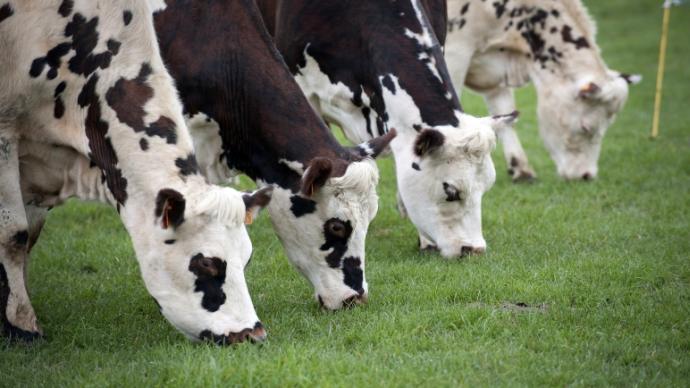
14070_019_vaches.jpg

Pascal Xicluna / agriculture.gouv.fr

August 23, 2024 Info +

The situation of bluetongue (BT) in France

Two serotypes of bluetongue virus have been present: BTV8 and BTV4 since November 2017.

However, a new serotype was introduced in late 2023 in the northern European Union. An epizootic of bluetongue serotype 3 (BTV3) started in the Netherlands around Amsterdam in 2023. This serotype was not previously present in the European territory. The first Belgian outbreaks were reported in September of the same year and the first German outbreaks in October.

At the end of July 2024, outbreaks were reported by the Belgian authorities near the French border.

A first outbreak of bluetongue serotype 3 was confirmed in France on 5 August in the Nord department.

As of 22 August, 190 outbreaks had been recorded, spread across the following departments: Aisne, Ardennes, Haute Marne, Marne, Meurthe et Moselle, Meuse, Moselle, Nord, Oise, Pas-de-Calais.


A targeted voluntary vaccination campaign was launched on Monday 12 August for implementation until 31 December 2024. 6,400,000 doses of vaccine (including 1.1 million doses for sheep and 5.3 million doses for cattle) are provided free of charge by the State to farmers. The voluntary vaccination zone includes the following regions: Hauts-de-France, Normandy, Ile-de-France, Grand-Est, Centre-Val de Loire, Bourgogne-Franche-Comté.
To follow the situation reports, consult the ESA platform


Establishment of a regulated zone against serotype 3 (BTV 3)

Following the detection of two outbreaks in Belgian municipalities bordering France at the end of July 2024, a regulated zone was set up as of Friday, August 2.

This zone has been changing every week since then, depending on the confirmation of new outbreaks in the territory.

Movements from this area to the rest of the national territory are restricted: animals susceptible to FCO (cattle, goats, sheep) must have undergone pest control treatment (the vector of the disease is an insect) two weeks before their departure and have obtained a negative screening test.

For intra-European trade, movements from the regulated area may continue to Member States accepting disinfestation and negative screening tests. For other Member States accepting only vaccinated animals, movements will be suspended from the regulated area.

The regulated area as of August 22, 2024 is shown on this map:
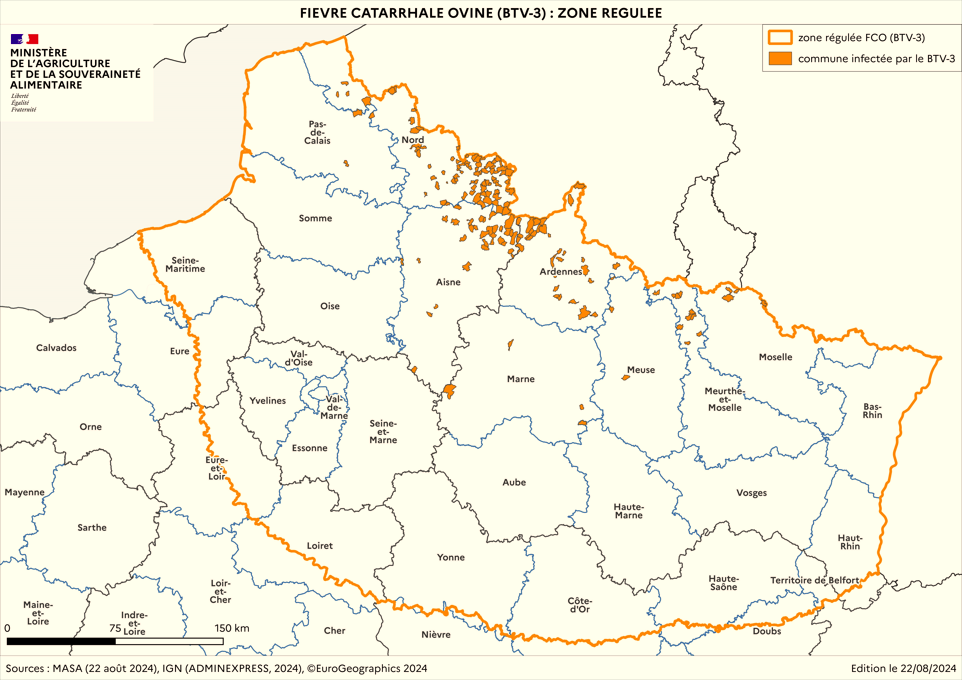
20240822_fco-btv3_zone-regulee.png
[

...
https://agriculture.gouv.fr/la-situation-de-la-fievre-catarrhale-ovine-fco-en-france
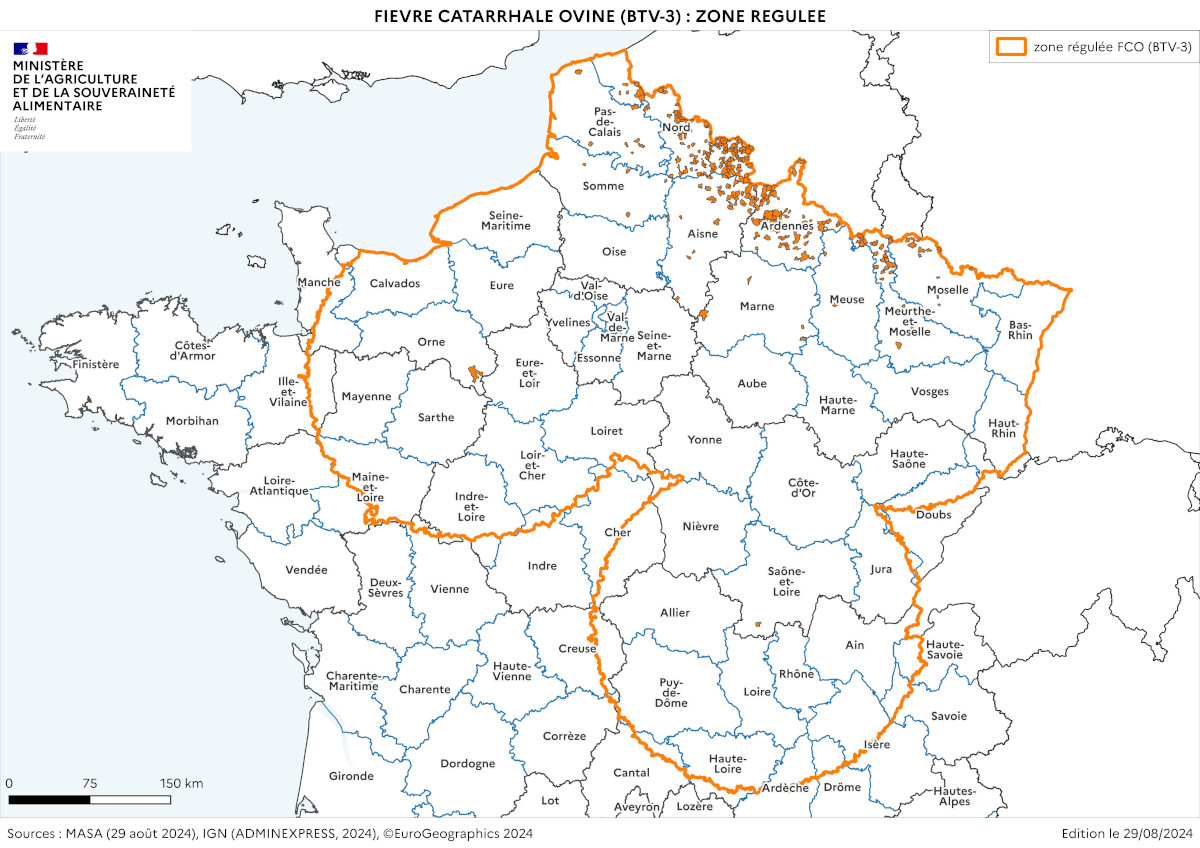


14070_019_vaches.jpg

Pascal Xicluna / agriculture.gouv.fr

August 30, 2024 Info +

The situation of bluetongue (BT) in France
...

Two serotypes of bluetongue virus are present: BTV8 and BTV4 since November 2017.

However, a new serotype was introduced in late 2023 in the northern European Union. An epizootic of bluetongue serotype 3 (BTV3) started in the Netherlands around Amsterdam in 2023. This serotype was not previously present in the European territory. The first Belgian outbreaks were reported in September of the same year and the first German outbreaks in October.

At the end of July 2024, outbreaks were reported by the Belgian authorities near the French border.

A first outbreak of serotype 3 bluetongue was confirmed in France on August 5 in the Nord department.

As of August 29, 342 outbreaks had been recorded, spread across the following departments: Aisne, Ardennes, Haute-Marne, Marne, Meurthe et Moselle, Meuse, Moselle, Nord, Oise, Orne, Pas-de-Calais, Saône-et-Loire, Somme.

A targeted voluntary vaccination campaign was launched on Monday, August 12, for implementation until December 31, 2024.

6,400,000 doses of vaccine (including 1.1 million doses for sheep and 5.3 million doses for cattle) were provided free of charge by the State to breeders, in a voluntary vaccination zone comprising the following regions: Hauts-de-France, Normandy, Ile-de-France, Grand-Est, Centre-Val de Loire, Bourgogne-Franche-Comté.

Faced with the spread of the disease, the voluntary vaccination zone supported by the State was extended on August 30 to the Auvergne-Rhône-Alpes and Pays-de-la-Loire regions, as well as to the departments of Ille-et-Vilaine, Deux-Sèvres, Vienne, Haute-Vienne, Creuse and Corrèze. To provide for the expansion of this vaccination zone, the State is relying on the order of 5.3 million additional doses.

To follow the situation reports, consult the ESA platform


Establishment of a regulated zone against serotype 3 (BTV 3)

Following the detection of two outbreaks in Belgian municipalities bordering France at the end of July 2024, a regulated zone was set up as of Friday, August 2.

This zone has been changing every week since then, depending on the confirmation of new outbreaks in the territory.

Movements from this area to the rest of the national territory are restricted: animals susceptible to FCO (cattle, goats, sheep) must have undergone pest control treatment (the vector of the disease is an insect) two weeks before their departure and have obtained a negative screening test.

For intra-European trade, movements from the regulated area may continue to Member States accepting disinfestation and negative screening tests. For other Member States accepting only vaccinated animals, movements will be suspended from the regulated area.

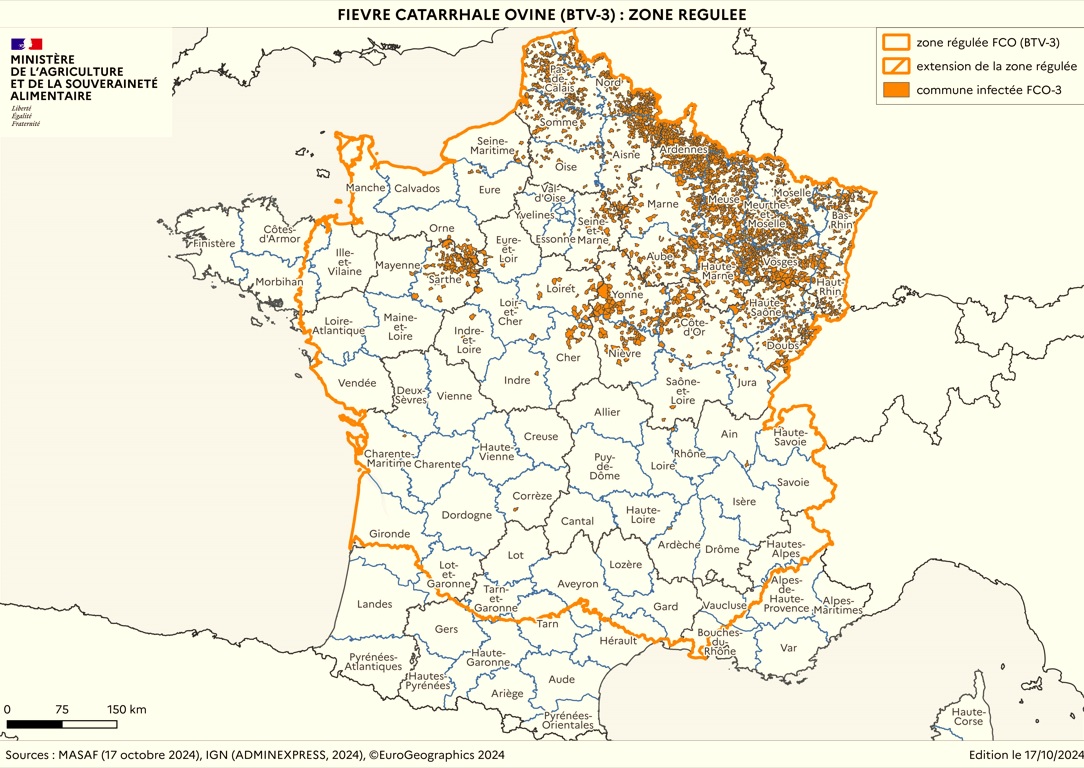
The regulated area as of August 29, 2024 is shown on this map:
20240829%20btv3_zone_regulee.jpeg
...

https://agriculture.gouv.fr/la-situation-de-la-fievre-catarrhale-ovine-fco-en-france


Translation Google

September 13, 2024 Info +

The situation of bluetongue (BT) in France


Two serotypes of bluetongue virus are present: BTV8 and BTV4 since November 2017.

However, a new serotype was introduced in late 2023 in the northern European Union. An epizootic of bluetongue serotype 3 (BTV3) started in the Netherlands around Amsterdam in 2023. This serotype was not previously present in the European territory. The first Belgian outbreaks were reported in September of the same year and the first German outbreaks in October.

At the end of July 2024, outbreaks were reported by the Belgian authorities near the French border.

A first outbreak of serotype 3 bluetongue was confirmed in France on August 5 in the Nord department.

As of September 12, 2024, 1,929 outbreaks were recorded, spread across the following departments: Aisne, Ardennes, Haute-Marne, Marne, Meurthe et Moselle, Meuse, Moselle, Nord, Oise, Orne, Pas-de-Calais, Saône-et-Loire, Somme, Aube, Doubs, Nièvre, Haute-Saône, Sarthe, Yonne, Cher, Eure-et-Loire and Loiret.

A targeted voluntary vaccination campaign was launched on Monday, August 12, for implementation until December 31, 2024.

6,400,000 doses of vaccine (including 1.1 million doses for sheep and 5.3 million doses for cattle) were provided free of charge by the State to breeders, in a voluntary vaccination zone comprising the following regions: Hauts-de-France, Normandy, Île-de-France, Grand-Est, Centre-Val de Loire, Bourgogne-Franche-Comté.

Faced with the spread of the disease, the voluntary vaccination zone supported by the State was extended on August 30 to the Auvergne-Rhône-Alpes and Pays-de-la-Loire regions, as well as to the departments of Ille-et-Vilaine, Deux-Sèvres, Vienne, Haute-Vienne, Creuse and Corrèze. To provide for the expansion of this vaccination zone, the State is relying on the order of 5.3 million additional doses.
...
https://agriculture.gouv.fr/la-situation-de-la-fievre-catarrhale-ovine-fco-en-france
 
Translation Google

September 20, 2024 Info +

The situation of bluetongue (BT) in France

Two serotypes of bluetongue virus are present: BTV8 and BTV4 since November 2017.

However, a new serotype was introduced in late 2023 in the northern European Union. An epizootic of bluetongue serotype 3 (BTV3) started in the Netherlands around Amsterdam in 2023. This serotype was not previously present in the European territory. The first Belgian outbreaks were reported in September of the same year and the first German outbreaks in October.

At the end of July 2024, outbreaks were reported by the Belgian authorities near the French border.

A first outbreak of bluetongue serotype 3 was confirmed in France on August 5 in the Nord department.

As of September 19, 2024, 2,812 outbreaks were recorded, spread across the following departments: Aisne, Ardennes, Haute-Marne, Marne, Meurthe et Moselle, Meuse, Moselle, Nord, Oise, Orne, Pas-de-Calais, Saône-et-Loire, Somme, Aube, Doubs, Nièvre, Haute-Saône, Sarthe, Yonne, Cher, Eure-et-Loire and Loiret, Mayenne and Seine-Maritime.

A targeted voluntary vaccination campaign was launched on Monday, August 12, for implementation until December 31, 2024.
...

https://agriculture.gouv.fr/la-situation-de-la-fievre-catarrhale-ovine-fco-en-france
 
Translation Google

October 4, 2024 Info +

Bluetongue: situation in France, management measures and vaccination strategy

Two serotypes of the bluetongue virus have been present in France for several years: serotype 8 (BTV8) since 2015 (after an initial appearance in 2006, France became free again thanks to a major vaccination campaign), and serotype 4 (BTV4) since November 2017.

A new serotype was introduced in late 2023 in the north of the European Union. An epizootic of bluetongue serotype 3 (BTV3) began in the Netherlands around Amsterdam in 2023. This serotype was not previously present in Europe. The first Belgian outbreaks were reported in September of the same year and the first German outbreaks in October. A first outbreak of bluetongue serotype 3 was confirmed in France on 5 August in the Nord department.

As of October 3, 2024, 4,644 outbreaks of serotype 3 FCO were recorded , distributed across the following departments: Aisne, Ardennes, Haute-Marne, Marne, Meurthe et Moselle, Meuse, Moselle, Nord, Oise, Orne, Pas-de-Calais, Saône-et-Loire, Somme, Aube, Doubs, Nièvre, Haute-Saône, Sarthe, Yonne, Cher, Eure-et-Loire and Loiret, Mayenne, Seine-Maritime, Indre-et-Loire, Loir-et-Cher.
...

https://agriculture.gouv.fr/la-situation-de-la-fievre-catarrhale-ovine-fco-en-france
 
14070_019_vaches.jpg

Pascal Xicluna / agriculture.gouv.fr

Translation Google

October 21, 2024 Info +

Bluetongue: situation in France, management measures and vaccination strategy

...
Two serotypes of the bluetongue virus have been present in France for several years: serotype 8 (BTV8) since 2015 (after an initial appearance in 2006, France became free again thanks to a major vaccination campaign), and serotype 4 (BTV4) since November 2017. Since then, on August 5, 2024, serotype 3 (BTV3) has been identified in France.

Under European regulations (Animal Health Act), bluetongue is classified into categories C, D and E with trade measures for the movement of animals between Member States. These regulations set specific conditions for trade, derogations and surveillance measures. In the Ministerial Decree of 4 July 2024, France defined management measures that are differentiated depending on whether it is an enzootic serotype (i.e. structurally present in France, such as serotypes 4 and 8) or an exotic serotype (serotype 3). For the latter, the establishment of a so-called "regulated" movement restriction zone is planned to limit the spread of the disease and preserve trade with other Member States.


Health situation (serotype 3)

A first outbreak of bluetongue serotype 3 was confirmed in France on August 5 in the Nord department.

Number of households as of October 17, 2024:

6,074 outbreaks of serotype 3 FCO were recorded as of October 10, 2024 , distributed in the following departments: Aisne, Ardennes, Haute-Marne, Marne, Meurthe et Moselle, Meuse, Moselle, Nord, Oise, Orne, Pas-de-Calais, Saône-et-Loire, Somme, Aube, Doubs, Nièvre, Haute-Saône, Sarthe, Yonne, Cher, Eure-et-Loire and Loiret, Mayenne, Seine-Maritime, Indre-et-Loire, Loir-et-Cher, Eure, Jura, Ain, Ardèche, Charente-Maritime, Corrèze, Loire, Haute-Savoie and Essonne.
To follow the situation reports, consult the ESA platform


Management measures (serotype 3)

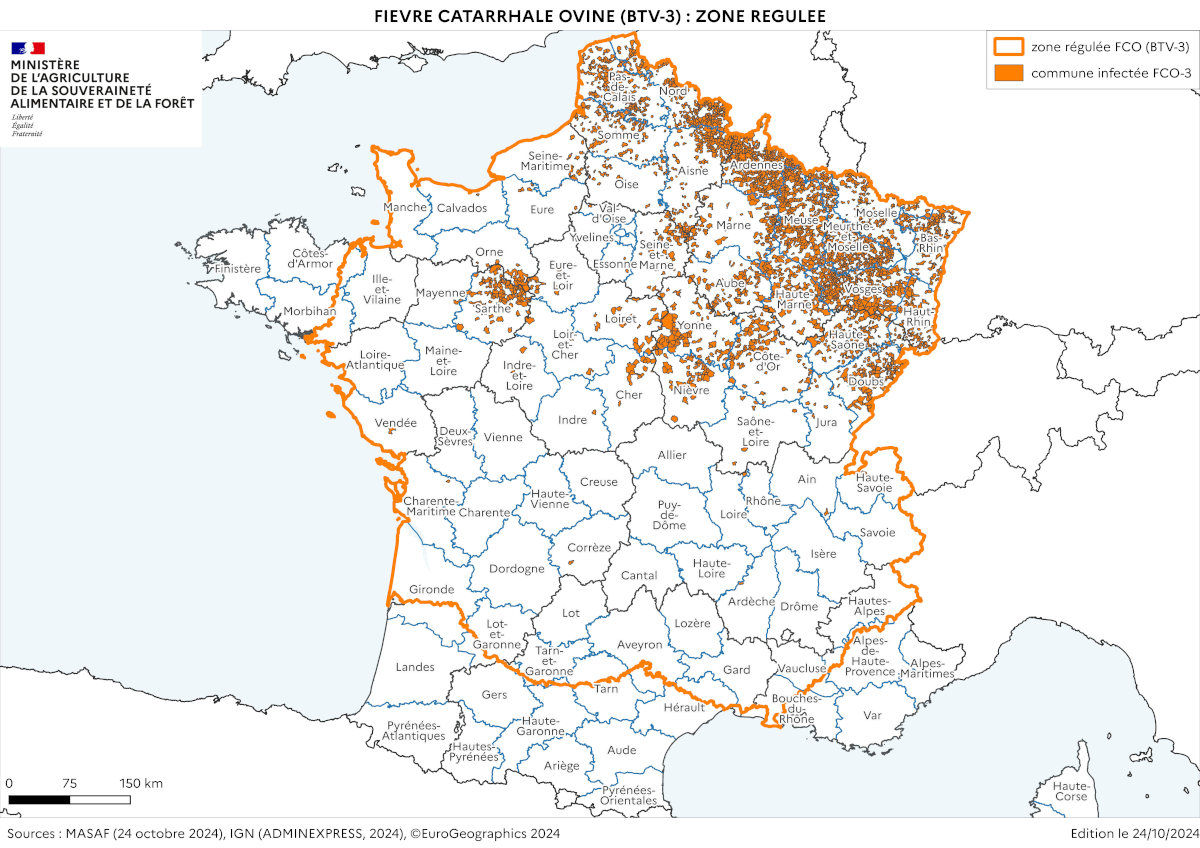
Following the detection of two outbreaks of serotype 3 bluetongue in Belgian municipalities bordering France at the end of July 2024, a regulated zone was set up as of Friday 2 August. This zone has been changing every week since then, depending on the confirmation of new outbreaks in the territory.

Movements from this area to the rest of the national territory are restricted: animals susceptible to FCO (cattle, goats, sheep) must have undergone pest control treatment (the vector of the disease is an insect) two weeks before their departure and have obtained a negative screening test, or have been vaccinated with a vaccine preventing viremia (see section 4.)

For intra-European trade, movements from the regulated area may continue to Member States accepting disinfestation and negative screening tests, as well as in the case of vaccination with a vaccine preventing viraemia.


Map and list of municipalities in the regulated zone as of October 17, 2024:

20241017%20btv3_zone_regulee_0.jpeg
Download List of municipalities located in the FCO regulated zone as of October 17, 2024

Vaccination strategy (serotype 3)

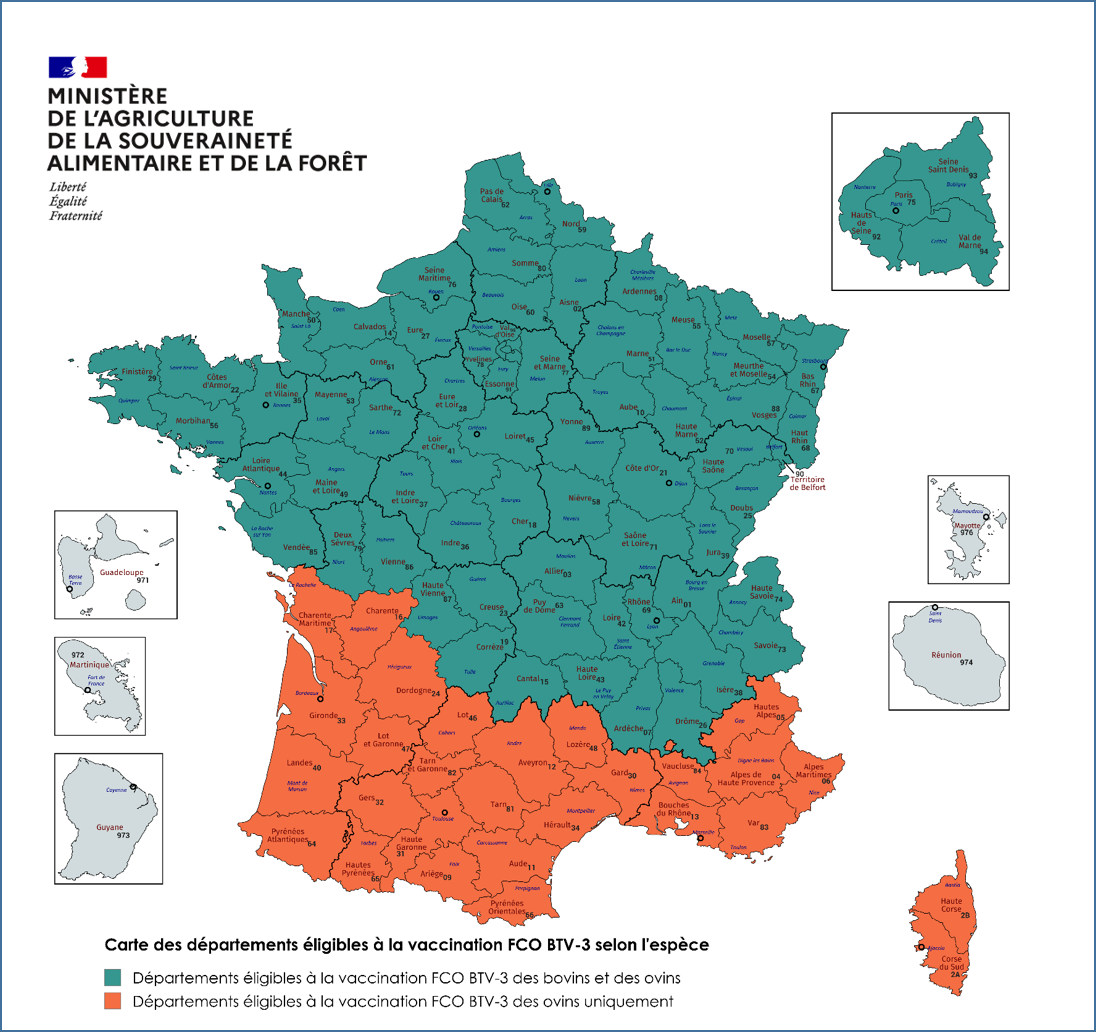
As of August 2024, a strategy was deployed against serotype 3 of the Bluetongue. A vaccination campaign for cattle and sheep was launched, in a voluntary vaccination zone, in order to reduce the health impacts on livestock (mortality, morbidity, abortions, drop in milk and meat production). The voluntary vaccination zone was extended, in stages, to take into account the evolution of the disease:
  • on August 12, establishment of the vaccination zone in six regions (Hauts-de-France, Normandy, Ile-de-France, Grand-Est, Centre-Val de Loire, Bourgogne-Franche-Comté);
  • on August 30, extension of the vaccination zone to two regions (Auvergne-Rhône-Alpes and Pays-de-la-Loire) and six departments (Ille-et-Vilaine, Deux-Sèvres, Vienne, Haute-Vienne, Creuse and Corrèze);
  • September 20, extension of the zone to the Brittany region;
  • On October 3, extension to all of France for the sheep sector.
Map of vaccination zones as of October 17, 2024:

Carte%20zone%20vaccinale%20FCO%20BTV%203_eligibilite%20par%20espece.jpg
View image descriptionVaccination zone map as of October 10, 2024
List of department vaccination zone decision BO agri .
The vaccination campaign provides for the State to cover the cost of the doses and for the State to pay veterinarians for ordering, prescribing and dispensing the vaccines as well as reporting the information to the administration.

Effective vaccines (serotype 3)

The state has ordered 11.7 million doses of vaccine.

As of October 17, 2024:

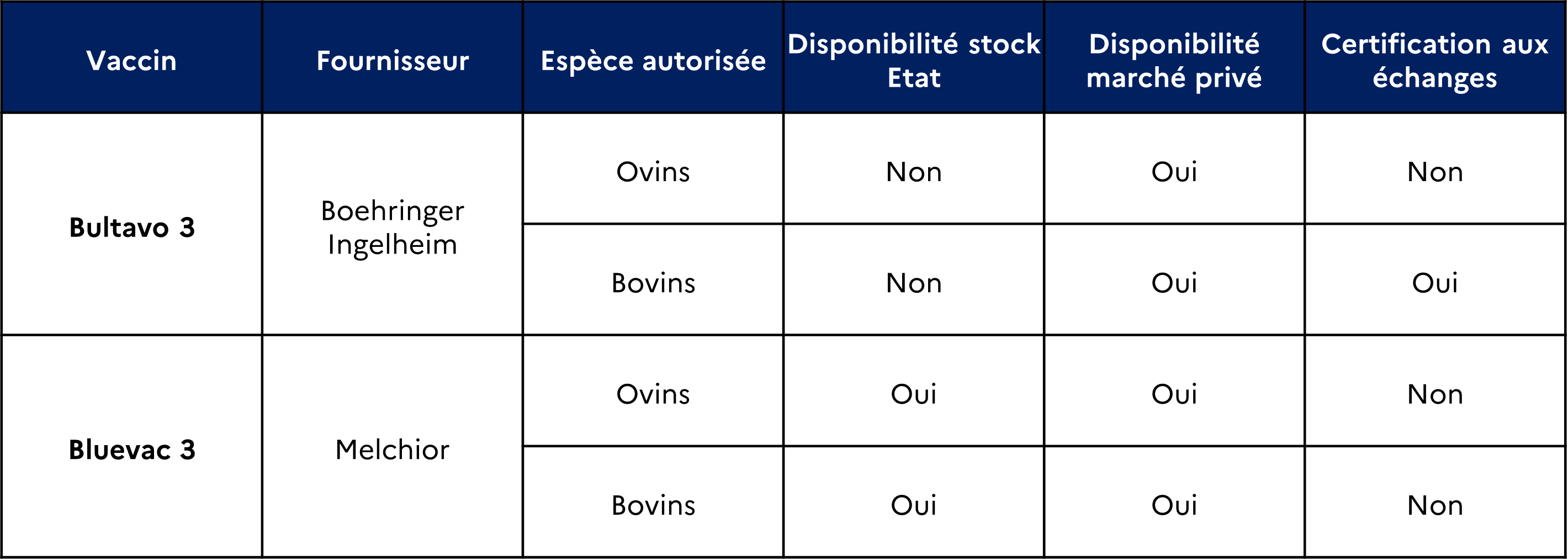
The BLUEVAC 3 vaccine currently available from the state can be used for sheep and cattle.
The stock of BULTAVO 3 vaccines, ordered to vaccinate sheep, is exhausted.
These vaccines can be purchased outside of state stocks, from veterinarians.
Only BULTAVO 3 allows certification for trade in cattle. Cattle vaccinated by a veterinarian with BULTAVO 3, or from herds thus vaccinated, will be able to go on trade without PCR analysis.
241018%20tableau%20vaccin%20FCO.png
View image description FCO vaccine table

https://agriculture.gouv.fr/la-situation-de-la-fievre-catarrhale-ovine-fco-en-france


Focus on serotypes 4 and 8

Since January 1, 2018, serotypes 4 and 8 are considered enzootic on the continental national territory as well as Corsica. Outbreaks must be declared, but animals from these outbreaks can move freely on the national territory.

Effective vaccines exist against these serotypes. The vaccination process is left to the initiative and the responsibility of the sectors.


...
https://agriculture.gouv.fr/la-situation-de-la-fievre-catarrhale-ovine-fco-en-france
 
October 25, 2024 Info + [

Bluetongue: situation in France, management measures and vaccination strategy

...
Two serotypes of the bluetongue virus have been present in France for several years: serotype 8 (BTV8) since 2015 (after an initial appearance in 2006, France became free again thanks to a major vaccination campaign), and serotype 4 (BTV4) since November 2017. Since then, on August 5, 2024, serotype 3 (BTV3) has been identified in France.

Under European regulations (Animal Health Act), bluetongue is classified into categories C, D and E with trade measures for the movement of animals between Member States. These regulations set specific conditions for trade, derogations and surveillance measures. In the Ministerial Decree of 4 July 2024, France defined management measures that are differentiated depending on whether it is an enzootic serotype (i.e. structurally present in France, such as serotypes 4 and 8) or an exotic serotype (serotype 3). For the latter, the establishment of a so-called "regulated" movement restriction zone is planned to limit the spread of the disease and preserve trade with other Member States.


Health situation (serotype 3)

A first outbreak of bluetongue serotype 3 was confirmed in France on August 5 in the Nord department.

Number of households as of October 24, 2024:

6,595 outbreaks of serotype 3 FCO were recorded as of October 24, 2024 , distributed in the following departments: Aisne, Ardennes, Haute-Marne, Marne, Meurthe et Moselle, Meuse, Moselle, Nord, Oise, Orne, Pas-de-Calais, Saône-et-Loire, Somme, Aube, Doubs, Nièvre, Haute-Saône, Sarthe, Yonne, Cher, Eure-et-Loire and Loiret, Mayenne, Seine-Maritime, Indre-et-Loire, Loir-et-Cher, Eure, Jura, Ain, Ardèche, Charente-Maritime, Corrèze, Loire, Haute-Savoie, Essonne, Calvados, Vendée, Val-d'Oise.
To follow the situation reports, consult the ESA platform


Management measures (serotype 3)

Following the detection of two outbreaks of serotype 3 bluetongue in Belgian municipalities bordering France at the end of July 2024, a regulated zone was set up as of Friday 2 August. This zone has been changing every week since then, depending on the confirmation of new outbreaks in the territory.

Movements from this area to the rest of the national territory are restricted: animals susceptible to FCO (cattle, goats, sheep) must have undergone pest control treatment (the vector of the disease is an insect) two weeks before their departure and have obtained a negative screening test, or have been vaccinated with a vaccine preventing viremia (see section 4.)

For intra-European trade, movements from the regulated area may continue to Member States accepting disinfestation and negative screening tests, as well as in the case of vaccination with a vaccine preventing viraemia.


Map and list of municipalities in the regulated zone as of October 24, 2024:

20241024%20btv3_zone_regulee.jpeg
Download List of municipalities located in the FCO regulated zone as of October 24, 2024[COLOR=var(--text-mention-grey)]xlsx - 808.2 KB[/COLOR]

Vaccination strategy (serotype 3)

As of August 2024, a strategy was deployed against serotype 3 of the Bluetongue. A vaccination campaign for cattle and sheep was launched, in a voluntary vaccination zone, in order to reduce the health impacts on livestock (mortality, morbidity, abortions, drop in milk and meat production). The voluntary vaccination zone was extended, in stages, to take into account the evolution of the disease:
  • on August 12, establishment of the vaccination zone in six regions (Hauts-de-France, Normandy, Ile-de-France, Grand-Est, Centre-Val de Loire, Bourgogne-Franche-Comté);
  • on August 30, extension of the vaccination zone to two regions (Auvergne-Rhône-Alpes and Pays-de-la-Loire) and six departments (Ille-et-Vilaine, Deux-Sèvres, Vienne, Haute-Vienne, Creuse and Corrèze);
  • September 20, extension of the zone to the Brittany region;
  • On October 3, extension to all of France for the sheep sector.
Map of vaccination zones as of October 24, 2024:
Carte%20zone%20vaccinale%20FCO%20BTV%203_eligibilite%20par%20espece.jpg
View image descriptionVaccination zone map as of October 10, 2024

List of department vaccination zone decision BO agri .

The vaccination campaign provides for the State to cover the cost of the doses and for the State to pay veterinarians for ordering, prescribing and dispensing the vaccines as well as reporting the information to the administration.

Authorized vaccines (serotype 3)

The state has ordered 11.7 million doses of vaccine.

As of October 24, 2024:

The BLUEVAC 3 vaccine currently available from the state can be used for sheep and cattle.
The stock of BULTAVO 3 vaccines, ordered to vaccinate sheep, is exhausted.
These vaccines can be purchased outside of state stocks, from veterinarians.
Only BULTAVO 3 allows certification for trade in cattle. Cattle vaccinated by a veterinarian with BULTAVO 3, or from herds thus vaccinated, will be able to go on trade without PCR analysis.
241018%20tableau%20vaccin%20FCO.png
View image descriptionFCO vaccine table

Focus on serotypes 4 and 8

Since January 1, 2018, serotypes 4 and 8 are considered enzootic on the continental national territory as well as Corsica. Outbreaks must be declared, but animals from these outbreaks can move freely on the national territory.

Effective vaccines exist against these serotypes. The vaccination process is left to the initiative and the responsibility of the sectors.


https://agriculture.gouv.fr/la-situation-de-la-fievre-catarrhale-ovine-fco-en-france
 
November 19, 2024 Info +

Bluetongue: situation in France, management measures and vaccination strategy
...
Two serotypes of the bluetongue virus have been present in France for several years: serotype 8 (BTV8) since 2015 (after an initial appearance in 2006, France became free again thanks to a major vaccination campaign), and serotype 4 (BTV4) since November 2017. Since then, on August 5, 2024, serotype 3 (BTV3) has been identified in France.

Under European regulations (Animal Health Act), bluetongue is classified into categories C, D and E with trade measures for the movement of animals between Member States. These regulations set specific conditions for trade, derogations and surveillance measures. In the Ministerial Decree of 4 July 2024, France defined management measures that are differentiated depending on whether it is an enzootic serotype (i.e. structurally present in France, such as serotypes 4 and 8) or an exotic serotype (serotype 3). For the latter, the establishment of a so-called "regulated" movement restriction zone is planned to limit the spread of the disease and preserve trade with other Member States.

Health situation (serotype 3)

A first outbreak of bluetongue serotype 3 was confirmed in France on August 5 in the Nord department.

Number of households as of November 13, 2024:

7,666 outbreaks of serotype 3 bluetongue were recorded as of November 13, 2024 , spread across the following departments: Aisne, Ardennes, Haute-Marne, Marne, Meurthe et Moselle, Meuse, Moselle, Nord, Oise, Orne, Pas-de-Calais, Saône-et-Loire, Somme, Aube, Doubs, Nièvre, Haute-Saône, Sarthe, Yonne, Cher, Eure-et-Loire and Loiret, Mayenne, Seine-Maritime, Indre-et-Loire, Loir-et-Cher, Eure, Jura, Ain, Ardèche, Charente-Maritime, Corrèze, Loire, Haute-Savoie, Essonne, Calvados, Vendée, Val-d'Oise, Tarn-et-Garonne, Yvelines, Isère, Maine-et-Loire, Puy-de-Dôme, Gironde, Lozère, South Corsica.

To follow the situation reports, consult the ESA platform

Management measures (serotype 3)

Following the detection of two outbreaks of serotype 3 bluetongue in Belgian municipalities bordering France at the end of July 2024, a regulated zone was set up as of Friday 2 August. This zone has been changing every week since then, depending on the confirmation of new outbreaks in the territory.

Movements from this area to the rest of the national territory are restricted: animals susceptible to FCO (cattle, goats, sheep) must have undergone pest control treatment (the vector of the disease is an insect) two weeks before their departure and have obtained a negative screening test, or have been vaccinated with a vaccine preventing viremia (see section 4.)

For intra-European trade, movements from the regulated area may continue to Member States accepting disinfestation and negative screening tests, as well as in the case of vaccination with a vaccine preventing viraemia.
...
https://agriculture.gouv.fr/la-situation-de-la-fievre-catarrhale-ovine-fco-en-france
 
Translation Google

December 27, 2024 Info +

Bluetongue: situation in France, management measures and vaccination strategy
...
Two serotypes of the bluetongue virus have been present in France for several years: serotype 8 (BTV8) since 2015 (after an initial appearance in 2006, France became free again thanks to a major vaccination campaign), and serotype 4 (BTV4) since November 2017. Since then, on August 5, 2024, serotype 3 (BTV3) has been identified in France.

Under European regulations (Animal Health Act), bluetongue is classified into categories C, D and E with trade measures for the movement of animals between Member States. These regulations set specific conditions for trade, derogations and surveillance measures. In the Ministerial Decree of 4 July 2024, France defined management measures that are differentiated depending on whether it is an enzootic serotype (i.e. structurally present in France, such as serotypes 4 and 8) or an exotic serotype (serotype 3). For the latter, the establishment of a so-called "regulated" movement restriction zone is planned to limit the spread of the disease and preserve trade with other Member States.

Health situation (serotype 3)

A first outbreak of bluetongue serotype 3 was confirmed in France on August 5 in the Nord department.

Number of households as of December 26, 2024:

9,044 outbreaks of serotype 3 bluetongue were recorded as of December 26, 2024 , spread across the following departments: Aisne, Ardennes, Haute-Marne, Marne, Meurthe et Moselle, Meuse, Moselle, Nord, Oise, Orne, Pas-de-Calais, Saône-et-Loire, Somme, Aube, Doubs, Nièvre, Haute-Saône, Sarthe, Yonne, Cher, Eure-et-Loire and Loiret, Mayenne, Seine-Maritime, Indre-et-Loire, Loir-et-Cher, Eure, Jura, Ain, Ardèche, Charente-Maritime, Corrèze, Loire, Haute-Savoie, Essonne, Calvados, Vendée, Val-d'Oise, Tarn-et-Garonne, Yvelines, Isère, Maine-et-Loire, Puy-de-Dôme, Gironde, Lozere, South Corsica, Manche, Upper Corsica, Creuse, Loire-Atlantique, Morbihan, Haute-Vienne.

To follow the situation reports, consult the ESA platform

Management measures (serotype 3)

Following the detection of two outbreaks of serotype 3 bluetongue in Belgian municipalities bordering France at the end of July 2024, a regulated zone was set up as of Friday 2 August. This zone has been changing every week since then, depending on the confirmation of new outbreaks in the territory.

Movements from this area to the rest of the national territory are restricted: animals susceptible to FCO (cattle, goats, sheep) must have undergone pest control treatment (the vector of the disease is an insect) two weeks before their departure and have obtained a negative screening test, or have been vaccinated with a vaccine preventing viremia (see section 4.)

For intra-European trade, movements from the regulated area may continue to Member States accepting disinfestation and negative screening tests, as well as in the case of vaccination with a vaccine preventing viraemia.
...
https://agriculture.gouv.fr/la-situation-de-la-fievre-catarrhale-ovine-fco-en-france

 
Translation Google

February 6, 2025 Info +

Bluetongue: situation in France, management measures and vaccination strategy
...
Two serotypes of the bluetongue virus have been present in France for several years: serotype 8 (BTV8) since 2015 (after an initial appearance in 2006, France became free again thanks to a major vaccination campaign), and serotype 4 (BTV4) since November 2017. Since then, on August 5, 2024, serotype 3 (BTV3) has been identified in France.

Under European regulations (Animal Health Act), bluetongue is classified into categories C, D and E with trade measures for the movement of animals between Member States. These regulations set specific conditions for trade, derogations and surveillance measures. In the Ministerial Decree of 4 July 2024, France defined management measures that are differentiated depending on whether it is an enzootic serotype (i.e. structurally present in France, such as serotypes 4 and 8) or an exotic serotype (serotype 3). For the latter, the establishment of a so-called "regulated" movement restriction zone is planned to limit the spread of the disease and preserve trade with other Member States.

Health situation (serotype 3)

A first outbreak of bluetongue serotype 3 was confirmed in France on August 5 in the Nord department.

Number of outbreaks as of February 6, 2025:

9,825 outbreaks of serotype 3 FCO were recorded as of February 6, 2025 , distributed in the following departments: Aisne, Ardennes, Haute-Marne, Marne, Meurthe et Moselle, Meuse, Moselle, Nord, Oise, Orne, Pas-de-Calais, Saône-et-Loire, Somme, Aube, Doubs, Nièvre, Haute-Saône, Sarthe, Yonne, Cher, Eure-et-Loire and Loiret, Mayenne, Seine-Maritime, Indre-et-Loire, Loir-et-Cher, Eure, Jura, Ain, Ardèche, Charente-Maritime, Corrèze, Loire, Haute-Savoie, Essonne, Calvados, Vendée, Val-d'Oise, Tarn-et-Garonne, Yvelines, Isère, Maine-et-Loire, Puy-de-Dôme, Gironde, Lozère, South Corsica, Manche, Haute-Corse, Creuse, Loire-Atlantique, Morbihan, Haute-Vienne, Finistère, Côte-d'Or, Eure, Indre, Bas-Rhin, Haut-Rhin, Seine-et-Marne, Vosges, Territoire-de-Belfort and Haute-Garonne.

To follow the situation reports, consult the ESA platform
...

https://agriculture.gouv.fr/la-situation-de-la-fievre-catarrhale-ovine-fco-en-france

 
Translation Google

Sarthe: an outbreak of cases of bluetongue on farms

Sarthe
From Steven Gouaillier
Saturday, February 22, 2025 at 5:31 p.m.
By Ici Maine

With 348 outbreaks of type 3 bluetongue recorded as of February 20, Sarthe is the department most affected by the disease, with the exception of the north-eastern quarter of France.

The map of France presented by the Ministry of Agriculture is significant. As noted by Réussir Agri 72 , while the North-Eastern quarter of the country represents the most affected area, the spread of bluetongue type 3 (BC-3) seems to spare the rest of the country... with the exception of Sarthe, with 348 outbreaks recorded as of February 20, 2025. If we compare with neighboring departments, Orne has 49, Mayenne 10 and Maine-et-Loire only 4.

"Very puny, sometimes blind" calves

This viral disease, transmitted by a midge to cattle and sheep , can manifest itself in several ways. " It can range from hypersalivation to fever to mouth ulcers," explains Magali Moreau, technical director of the Sarthe Health Defense Group, " but what we're seeing this winter are abortions, calves that are born very weak, and sometimes blind. It's this kind of symptom that has a big impact on livestock farms ."

" In the fall, there weren't many abortions ," continues the manager, " but now we're in the middle of the calving period ."

And to explain this surge in cases in Sarthe, we must only rely on hypotheses according to Magali Moreau: " it could possibly be animal transport that caused this big jump from the East of France to Sarthe. I think it is rather due to movements of cattle ."

https://www.francebleu.fr/infos/agr...tarrhale-ovine-dans-les-exploitations-5853810
 
Translation Google
14070_019_vaches.jpg.webp

Pascal Xicluna / agriculture.gouv.fr

August 1, 2025 Info +

Bluetongue: situation in France, management measures and vaccination strategy


...
Three serotypes of the bluetongue virus are present in France: serotype 8 (BTV8) since 2015, and serotype 4 (BTV4) since 2017, and serotype 3 (BTV3) since August 5, 2024.

Under European regulations (Animal Health Act), bluetongue is classified into categories C, D and E with trade measures for the movement of animals between Member States. These regulations set specific conditions for trade, derogations and surveillance measures. France has defined in the Ministerial Decree of July 4, 2024 management measures which are differentiated depending on whether it is an enzootic serotype (i.e. structurally present in France, such as serotypes 3, 4 and 8) or an exotic serotype (possible emergence of new serotypes in France). For the latter, the establishment of a so-called "regulated" movement restriction zone is planned to limit the spread of the disease and preserve trade with other Member States.

Health situation
  • Serotype 3
A first outbreak of bluetongue serotype 3 was confirmed in France on August 5 in the Nord department.

[SUP]Between June[/SUP] 1 and July 31, 2025, 1,117 outbreaks of FCO, serotype 3, were recorded in France. Between August 5, 2024 and June 1 [SUP],[/SUP] 2025, 10,813 outbreaks were recorded.

The map below shows the distribution of outbreaks by department.

image.png - Click image for larger version  Name:	image.png Views:	1 Size:	125.7 KB ID:	1017336

  • Serotype 8
Serotype 8 of bluetongue has been present in mainland France since 2015.

[SUP]Between June[/SUP] 1 and July 31, 2025, 1,060 outbreaks of bluetongue serotype 8 were recorded in France. Between August 5, 2024 and June 1 [SUP],[/SUP] 2025, 17,038 outbreaks were recorded.

The map below shows the distribution of outbreaks by department.

image.png - Click image for larger version  Name:	image.png Views:	1 Size:	125.7 KB ID:	1017336

  • Serotype 4
Serotype 4 of FCO has not been isolated in mainland France since 2018.

[SUP]Between June[/SUP] 1 , 2025 and June 26, 2025, no outbreaks of FCO, serotype 4, were recorded in Corsica. Between June 1, [SUP]2024[/SUP] and May 31, 2025, 10 clinical outbreaks of FCO, serotype 4, were recorded in Corsica.

Animals coming from Corsica and going to mainland France are subject to disinfestation and negative PCR analysis or valid vaccination with a vaccine preventing viremia.


...
https://agriculture.gouv.fr/la-situation-de-la-fievre-catarrhale-ovine-fco-en-france
 
Translation Google

August 8, 2025 Info +

Bluetongue: situation in France, management measures and vaccination strategy
...
Health situation

Serotype 3


A first outbreak of bluetongue serotype 3 was confirmed in France on August 5 in the Nord department.

Between June 1 and August 7, 2025, 2,096 outbreaks of FCO, serotype 3, were recorded in France. Between August 5, 2024 and June 1 , 2025, 10,813 outbreaks were recorded.
...
Serotype 8

Serotype 8 of bluetongue has been present in mainland France since 2015.

Between June 1 and August 7, 2025, 1,377 outbreaks of FCO, serotype 8, were recorded in France. Between August 5, 2024 and June 1 , 2025, 17,038 outbreaks were recorded.
...
https://agriculture.gouv.fr/la-situation-de-la-fievre-catarrhale-ovine-fco-en-france

 
Back
Top Bottom