• FluTrackers.com Inc. does not provide medical advice. Information on this web site is collected from various internet resources, and the FluTrackers board of directors makes no warranty to the safety, efficacy, correctness or completeness of the information posted on this site by any author or poster. The information collated here is for instructional and/or discussion purposes only and is NOT intended to diagnose or treat any disease, illness, or other medical condition. Every individual reader or poster should seek advice from their personal physician/healthcare practitioner before considering or using any interventions that are discussed on this website. By continuing to access this website you agree to consult your personal physican before using any interventions posted on this website, and you agree to hold harmless FluTrackers.com Inc., the board of directors, the members, and all authors and posters for any effects from use of any medication, supplement, vitamin or other substance, device, intervention, etc. mentioned in posts on this website, or other internet venues referenced in posts on this website.
  • We are not asking for any donations. Do not donate to any entity who says they are raising funds for us.

The Discovery of the 2009 A/H1N1 Pandemic - Mexico: April 17 New Respiratory Illnesses - Including Mexico City & Oaxaca

Re: Mexico: Respiratory Illnesses - Including Mexico City & Oaxaca

Re: Mexico: Respiratory Illnesses - Including Mexico City & Oaxaca

Ssa called for calm in cases of influenza
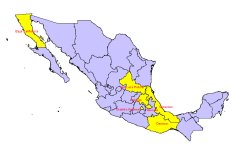
Jose Angel Cordova explained that hospitals in the Federal District, San Luis Potosi, Baja California Norte, Oaxaca, Tlaxcala, Hidalgo and Veracruz, health fences were installed to prevent the spread of the virus. . . .

http://www.milenio.com/node/203916


Map showing the location of the states where health fences have been installed.

Mexico seven states 20090423.jpg
 
Re: Mexico: Respiratory Illnesses - Including Mexico City & Oaxaca

Re: Mexico: Respiratory Illnesses - Including Mexico City & Oaxaca

April 24, 2009

<NYT_HEADLINE version="1.0" type=" ">Unusual Strain of Swine Flu Is Found in People in 2 States </NYT_HEADLINE>

<NYT_BYLINE version="1.0" type=" ">By DONALD G. McNEIL Jr.
</NYT_BYLINE><NYT_TEXT>An unusual strain of swine flu is circulating among people in the Southwest but is not known to have caused any deaths, the Centers for Disease Control and Prevention said Thursday.
The agency, which has found only seven cases, expects to find more now that it has begun looking intensively for them.
?We don?t yet know the extent of the problem,? said Dr. Anne Schuchat, the director of respiratory diseases for the agency, ?but we don?t think this is a time for major concern.?
Five of the people infected were in Imperial and San Diego Counties in California and two were in San Antonio. They were 9 to 54 years old.
None had any contact with pigs, and in two sets of cases ? involving a father and daughter and two 16-year-old schoolmates ? those infected had contact with each other. That convinced the authorities that the virus was being transmitted from person to person.
The seven people were apparently infected from late March to mid-April. Only one was hospitalized, and all recovered.
The A (H1N1) flu strain they had was quite unusual, said Dr. Nancy Cox, the chief of the agency?s flu division. It contained gene segments from North American swine, bird and human flu strains as well as one from Eurasian swine.
Like some human strains, it is resistant to two older flu drugs, amantadine and rimantadine. It is not resistant to Tamiflu or Relenza. However, Tamiflu resistance is common in the H1N1 human flu strain circulating this year, so the swine strain could become resistant to Tamiflu if the viruses mixed in humans or, possibly, in pigs.
Swine flus rarely infect humans. There have been about a dozen cases since 2005, but almost all were in farm workers or others in contact with pigs.
In 1976, there was a cluster of swine flu cases among soldiers at Fort Dix, in New Jersey, one of whom died. That led to a rush to make a new vaccine and administer it to 40 million Americans. No epidemic materialized, but thousands of people claimed that the vaccine had given them Guillain-Barr? syndrome, which can cause lethargy or paralysis. The episode led to the resignation of the director of the disease control center, and the agency has been wary of causing panic over influenza cases ever since.
The unusual strain this year was noticed, Dr. Schuchat said, only because the agency was trying out a new diagnostic test at a Navy laboratory and doing more testing than usual through a new Border Infectious Disease Surveillance Project along the Mexican border.
Officials at the public health agency in Canada said their Mexican counterparts had warned them this week of a ?relatively high? fatality rate for people in Mexico who have had respiratory illnesses this season, some of whom had tested positive for flu. Asked about that, American officials said they had no information. A spokesman said the disease control center had asked Mexican officials to send samples for testing.
The United States flu season is tailing off now. It has been relatively mild; the major surprise had been the widespread Tamiflu resistance in the circulating human H1N1 strain.
Dr. Cox of the disease control center said officials did not yet know whether the flu shot this year protected against the new swine strain.

http://www.nytimes.com/2009/04/24/us/24flu.html?_r=1&ref=us&pagewanted=print
<NYT_UPDATE_BOTTOM></NYT_UPDATE_BOTTOM>
</NYT_TEXT>
 
Re: Mexico: Respiratory Illnesses - Including Mexico City & Oaxaca

Re: Mexico: Respiratory Illnesses - Including Mexico City & Oaxaca

<TABLE style="TABLE-LAYOUT: auto" cellSpacing=0 cellPadding=0 width="100%" summary="Main Page Table" border=0><TBODY><TR><TD vAlign=top><TABLE cellSpacing=10 cellPadding=0 summary="Main Content Table" border=0><TBODY><TR><TD vAlign=top align=left colSpan=2>More US swine flu cases, Mexico illnesses raise pandemic questions

Lisa Schnirring
purple-speck.gif
Staff Writer

Apr 23, 2009 (CIDRAP News) ? Five more cases of an unusual swine influenza virus infection have surfaced, officials from the US Centers for Disease Control and Prevention (CDC) announced today, bringing the total to seven and raising more concerns about human-to-human transmission.
The new cases include two clusters, two 16-year-old boys in San Antonio, Tex., who attended the same school and a father and daughter from San Diego County. Anne Schuchat, MD, interim deputy director for the CDC's science and public health program, told reporters today at a teleconference that the clusters are consistent with human-to-human spread.
She also said that the World Health Organization has not raised its six-phase pandemic alert level above phase 3 (no or very limited human-to-human transmission).
The fifth new case occurred in a patient from Imperial County, which borders San Diego County. Both counties are home to the first two swine flu patients that the CDC announced on Apr 21.
News of the five new swine flu cases came on the same day Canadian officials warned its public health, medical, and quarantine workers to look for illnesses among Canadians returning from Mexico. Mexico has reported several cases of severe respiratory illness and has asked Canada to assist in finding the source of the illnesses, some of which have been fatal, according to a report today from the Canadian Press (CP).
Schuchat said no swine flu cases have been confirmed in Mexico or Canada, but that CDC officials are discussing the situation with Mexican health officials and representatives from the Pan American Health Organization (PAHO).
Novel strain, relatively mild symptoms
Concerning the seven American cases, Schuchat said, "The good news is that all of the patients have recovered, and one was hospitalized. This is not looking like a very severe influenza."
Patients experience fever, cough, and sore throat symptoms similar to typical influenza, but some of the patients who had swine influenza also experienced more diarrhea and vomiting than is typical of seasonal flu.
The CDC said genetic sequencing of samples from the first two patients, California children who lived in adjacent counties, show that the swine flu virus contains segments from four different viruses: some North American swine, some North American avian, one human influenza, and two Eurasian swine.
"This virus hasn't been recognized in the USA or elsewhere," Schuchat said.
CDC scientists have determined that the novel swine flu virus is resistant to the older antivirals rimantadine and amantadine but is susceptible to oseltamivir and zanamivir.
Schuchat said the CDC expects to see more swine flu cases and that it would provide regular updates on its Web site.
"This is not time for major concern around the country, but we want you to know what's going on," she said. Most of the public health response will focus on the California and Texas areas where cases have been identified, but the CDC is urging health departments in other states to heighten their awareness of respiratory illnesses, particularly in those who have had contact with pigs or traveled to the San Diego or San Antonio areas.
Schuchat said the CDC doesn't know yet if the H1N1 component of this season's influenza vaccine provides any protection against the swine flu virus, but she said studies are under way to determine if there is any cross-protection.
Expert reaction
Michael T. Osterholm, PhD, MPH, director of the University of Minnesota Center for Infectious Disease Research and Policy, publisher of CIDRAP News, said the findings, though concerning, don't mean that a pandemic is imminent.
However, he said health officials shouldn't take comfort in the fact that the illnesses so far have been mild. "The first wave of the 1918 pandemic was mild, too," Osterholm pointed out.
Walter Dowdle, PhD, who worked in the CDC's virology unit during the 1976 swine flu outbreak, told CIDRAP News that it's interesting but not greatly alarming that the 2009 swine flu strain contains such an unusual mix of gene segments.
"It's a real mutt," said Dowdle, who now works with the Task Force for Child Survival and Development, based in Atlanta "When you have an evolving RNA mechanism, it's hard to be surprised by anything."
The H1N1 component of the seasonal flu vaccine might provide some degree of protection, he said. And if the swine flu virus persists, federal officials could consider adding an additional H1N1 strain to next year's vaccine.
Marie Gramer, DVM, PhD, a University of Minnesota veterinarian who has studied swine flu, said her preliminary examination shows that the outbreak strain doesn't appear to closely match anything currently circulating in pigs. However, Gramer added that she has only looked at a small number of viruses and only at the hemagglutinin gene.
Risk message implications
Peter Sandman, PhD, a risk communication consultant based in Princeton, N.J., also listened in on today's CDC teleconference. While he credited the CDC with getting a clear, calm, and concise scientific message out about the swine flu cases, he said they missed a teachable moment to promote pandemic preparedness.
"Everyone needs to learn how to say 'This could be bad, and it's a good reason the take precautions and prepare' and 'This could fizzle out,'" Sandman said. "They need to simultaneously say both statements."
He added that "good risk communicators need to know how to be both scary and tentative."
Federal health officials are probably treading cautiously around the word "pandemic," because some accused them of fear mongering when they raised concerns about the H5N1 virus 2 years ago and also because of overreaction during the 1976 swine flu epidemic that led to vaccination missteps.
When talking to the public about pandemic risks, federal officials could take some cues from hurricane forecasters, Sandman said, "and speculate responsibly."
Canadian officials probe Mexico illnesses
Canada's Public Health Authority (PHAC) said today in a situation update that Mexican authorities have asked its assistance in determining the cause of two clusters of severe respiratory illnesses that have occurred this month.
A cluster in Mexico City involved 120 cases and 13 deaths; the other occurred in San Luis Potosi, where 14 cases and 4 deaths were reported. Three deaths were reported from other locations: One from Oaxaca in southern Mexico and two from Baja California Norte, near the US border.
The PHAC report said the disease outbreak struck some healthcare workers and that most patients were previously healthy young adults between the ages of 25 and 44. Symptoms included fever, headache, ocular pain, shortness of breath, and fatigue that rapidly progressed to severe respiratory distress in about 5 days.
Mexican officials detected some influenza A/H1N1 and influenza B viruses, but have apparently ruled out H5N1 virus involvement. The PHAC said it received 51 clinical samples from Mexico for testing at its National Microbiology Lab.
Mexico told the PHAC that it had a late influenza season with an increasing number of influenza-like illnesses since the middle of March. The country also had a higher proportion of influenza B viruses than previous seasons.
See also:
Apr 21 CIDRAP News story "Human swine flu cases with unique train raise concern"
Apr 22 CIDRAP News story "Swine flu cases recall 1976 episode"
CDC swine flu investigation page
CDC swine flu information

</TD></TR></TBODY></TABLE></TD><!-- end MAIN CONTENT CELL --></TR><!-- FOOTER --><TR><TD colSpan=9><TABLE cellSpacing=0 cellPadding=0 width="100%" summary=Footer border=0><TBODY><TR><TD class=footer width="100%" background=/cidrap/images/footer_stretch.gif height=9> http://www.cidrap.umn.edu/cidrap/content/influenza/panflu/news/apr2309swineflu.html</TD></TR></TBODY></TABLE>
</TD></TR></TBODY></TABLE>
 
Re: Mexico: Respiratory Illnesses - Including Mexico City & Oaxaca

Re: Mexico: Respiratory Illnesses - Including Mexico City & Oaxaca

Seven people in U.S. hit by strange new swine flu

Thu Apr 23, 2009 11:02pm EDT
By Maggie Fox, Health and Science Editor
WASHINGTON (Reuters) - Seven people have been diagnosed with a new kind of swine flu in California and Texas, the U.S. Centers for Disease Control and Prevention reported on Thursday.
All seven people have recovered but the virus itself is a never-before-seen mixture of viruses typical among pigs, birds and humans, the CDC said.
"We are likely to find more cases," the CDC's Dr. Anne Schuchat told a telephone briefing. "We don't think this is time for major concern around the country."
Only one of the seven cases was sick enough to be hospitalized and all have recovered, Schuchat said.
CDC officials are unsure whether the cases are related to an unusually late and severe flu season in Mexico in which 20 people have died.
"Generally the period of infection ends during the last week of February and the first week of March, but this year there was an atypical situation where the transmission period was prolonged until April," Mexico's Ministry of Health said in a statement.
Canadian officials have asked doctors to keep an eye out for cases of respiratory illness among travelers from Mexico.
"Symptoms from those seriously ill in Mexico include high fever, headache, eye pain, shortness of breath and extreme fatigue with rapid progression of symptoms to severe respiratory distress in about five days," the British Columbia Center for Disease Control said in a statement.
In the United States, the CDC reported the new strain of swine flu on Tuesday in a boy and a girl from California's two southernmost counties.
Now, five more cases have been found via normal surveillance for seasonal influenza. None of the patients, whose symptoms closely resembled seasonal flu, had any direct contact with pigs.
Two of the new cases were among 16-year-olds at the same school in San Antonio "and there's a father-daughter pair in California," Schuchat said. The boy whose case was reported on Tuesday had flown to Dallas, but the CDC has found no links to the other Texas cases.
The agency will issue daily updates here
HUMAN TO HUMAN
"We believe at this point that human-to-human spread is occurring," Schuchat said. "That's unusual. We don't know yet how widely it is spreading ... We are also working with international partners to understand what is occurring in other parts of the world."
The CDC's Dr. Nancy Cox said virus samples from the seven appear to carry genes from swine flu, avian flu and human flu viruses from North America, Europe and Asia.
"We haven't seen this strain before, but we hadn't been looking as intensively as we have," Schuchat said. "It's very possible that this is something new that hasn't been happening before."
Surveillance for and scrutiny of influenza has been stepped up since 2003, when H5N1 bird flu reappeared in Asia. Experts fear this strain, or another strain, could spark a pandemic that could kill millions.
The influenza A strain is an H1N1, the same subtype as one of the seasonal flu viruses now circulating. Now that the normal influenza season is waning, it may be easier to spot cases of the new swine flu, Schuchat said.
The CDC is asking doctors to think about the possibility of swine flu when patients appear with flu-like symptoms, to take a sample and send it to state health officials or the CDC for testing.
Cox said the CDC is already preparing a vaccine against the new strain, just in case.
"This is standard operating procedure," he said.
(With additional reporting by Mica Rosenberg in Mexico City and Allan Dowd in Vancouver)

http://www.reuters.com/article/healthNews/idUSTRE53M63F20090424
 
Re: Mexico: Respiratory Illnesses - Including Mexico City & Oaxaca

Re: Mexico: Respiratory Illnesses - Including Mexico City & Oaxaca

Mexico shuts schools around capital in flu scare

Fri Apr 24, 2009 12:56am EDT

MEXICO CITY (Reuters) - Mexico is canceling classes for millions of children in the heart of the country on Friday after influenza killed around 20 people in recent weeks.
Canada's government advised doctors to be on the alert for reports of illness from people who recently traveled to Mexico, although it did not advise against visiting the popular beach vacation destination.
Mexican Health Minister Jose Angel Cordoba said on Thursday schools and universities in Mexico City and the surrounding area would be closed on Friday and advised people with flu symptoms to stay home from work.
"We recommend avoiding places or events with a lot of people unless strictly necessary," Cordoba said.
Mexico's flu season normally ends in February or March, but it has extended longer this year, the government said.
Canadian officials have been particularly sensitive to the international spread of respiratory illnesses since Toronto was hit by the SARS epidemic in 2003, which was blamed partly on a slow response to early disease reports.
About 79 people in Mexico are being treated for flu and that number has not increased in recent days, the Health Ministry said.
In the United States, seven people have been diagnosed with a new kind of swine flu in California and Texas, the U.S. Centers for Disease Control and Prevention reported.
All seven people there have recovered but the virus itself is a never-before-seen mixture of viruses typical among pigs, birds and humans, the CDC said.
(Reporting by Noel Randewich and Armando Tovar; editing by Mohammad Zargham)

http://ca.reuters.com/article/topNews/idCATRE53N11B20090424
 
Re: Mexico: Respiratory Illnesses - Including Mexico City & Oaxaca

Re: Mexico: Respiratory Illnesses - Including Mexico City & Oaxaca

<a rel="nofollow" href="http://www.recombinomics.com/News/04240901/H1N1_Swine_Mexico.html">Commentary on swine flu in Mexico</a>
Commentary

Human Swine Flu Spread to Texas and Likely Import from Mexico

Recombinomics Commentary 00:55
April 24, 2009

Now, five more cases have been seen -- all found via normal surveillance for seasonal influenza. None of the patients, whose symptoms closely resembled seasonal flu, had any direct contact with pigs.

"We believe at this point that human-to-human spread is occurring," Schuchat said. "That's unusual. We don't know yet how widely it is spreading ... We are also working with international partners to understand what is occurring in other parts of the world."

Two of the new cases were among 16-year-olds at the same school in San Antonio "and there's a father-daughter pair in California," Schuchat said. One of the boys whose cases was reported on Tuesday had flown to Dallas but the CDC has found no links to the other Texas cases.

Only one of the seven cases was sick enough to be hospitalized and all have recovered, Schuchat said.

The above comments in Reuters describe several points made in today’s CDC conference call. The additional confirmed cases leave little doubt that the swine flu is transmitting human-to-human and has now been confirmed in three <a rel="nofollow" href="http://www.recombinomics.com/News/04220902/H1N1_CA_Swine_H2H.html">distinct locations</a> in two states (see updated map), confirming <a rel="nofollow" href="http://www.recombinomics.com/News/04230902/H1N1_CA_Swine_Sustained.html">sustained transmissions</a>.

The infection of classmates in San Antonio, as well as the father and daughter in California further highlight efficient transmission. The hospitalization of one patient, who had been on a ventilator, raises concerns that infections will produce a wide range of presentations.

The location of the confirmed cases in states that border Mexico, as well as media reports of pneumonia in Canadian travelers returning from Mexico, strongly suggests that the outbreak of influenza in Mexico is also swine flu.

The confirmed cases in the United States likely represent a pandemic of H1N1 swine flu. At this point, most confirmed cases in the United States have been mild and there have been no confirmed fatalities. However, in Mexico there has been a <a rel="nofollow" href="http://www.recombinomics.com/News/04230901/SRI_Mexico_Alert.html">high case fatality rate</a> high case fatality rate[/URL] among young adults, 25-44, with atypical pneumonia, which has similarities with the 1918 pandemic.[/COLOR]

Moreover, the 1918 pandemic was composed of eight gene segments representing recombination between H1N1 seasonal flu and H1N1 swine flu.

An efficiently transmitted swine flu can lead to co-infection with H1N1 seasonal flu. Oseltamivir resistance (H274Y) has become fixed in H1N1 seasonal flu, raising concerns that recombination or reassortment will lead to Tamiflu resistance in the swine flu, which is already resistant to amantadine and rimantadine. Moreover, the existing trivalent seasonal flu vaccine will likely offer little protection.

The spread of swine flu in the United States, and likely import from Mexico, creates a major cause for concern.

.
 
Re: Mexico: Respiratory Illnesses - Including Mexico City & Oaxaca

Re: Mexico: Respiratory Illnesses - Including Mexico City & Oaxaca

Machine translation

They extend sanitary wall against influenza

Vie, 24/04/2009 - 01:17

The holder of the Sanitary Jurisdiction exhorted to maintain the calm since cases by the bud of this evil have not appeared here, but also asks to take the preventive measures to avoid it.

The application of vaccines will continue in the zone, by the bud of influenza that usually occurs in winter. Photo: JOSE LUIS MUD WALL

Due to its proximity with Veracruz and Potosí San Luis, and the alert status in which are these two organizations by the cases of influenza, the South zone maintains a wall sanitary to avoid that the disease extends to Tampico, Madero and Altamira. After which the federal secretary of the Secretariat of Health, Jose Angel Cordoba Villalobos, would explain that in the hospitals of the Federal District, San Luis Potosí, North Baja California, Oaxaca, Tlaxcala, Hidalgo and Veracruz individual sanitary walls by the bud of the stationary epidemic of influenza, the holder of the Sanitary Jurisdiction settled number two, Ernesto Lavín, said that in the South zone it was decided to extend the sanitary wall that it was undertaken from November of the past year.

It assured that until the moment 46 thousand vaccines against influenza have been applied, 22 thousand in minors five years and 24 thousand in adults majors, in the modules installed in the different dependencies from Health, as well as in which they were placed in the streets of the zone center of Tampico. Similarly, it asked to the population to maintain the calm, because until the moment in the South zone a single case of influenza has not appeared stationary, even so the Secretariat of Health does not lower the guard by the proximity of the municipalities that integrate the Sanitary Jurisdiction with the North zone of Veracruz. It indicated that the sanitary wall consists of the application of vaccines, as well as in the monitoring of patients with febrile pictures or symptoms of gripa, this because the 70 percent of the patient that is taken care of in the Civil hospital of Tampico, comes from the state of Veracruz. Influenza affects the respiratory tract; it can initiate with resfriado and frequently it is accompanied by general symptoms like muscular fever, pain throat, weakness, pains (mialgias), you will articulate (arthralgias), and of head (migraine), with cough (that are generally dry and without mucosity) and general malaise. In some more serious cases it can be complicated with pulmonía (pneumonia), that can be mortal, especially in small children and, mainly, old. Although it is possible to be confused with the resfriado one (cold) common, is one more a more serious disease and is caused by a type different from virus. Also it can bring about nauseas and vomits, more often in children, who to the being gastroenteritis symptoms cause that stomach or abdominal influenza is denominated.

It is transmitted from individuals infected through drops in virus aerosol loaded (coming from saliva, nasal and bronchial secretion), that are emitted with the cough or the estornudos or only when speaking. Already much more rarely, through lees of infected birds. Also he is transmissible by the blood and the surfaces or objects contaminated with the virus, that denominate fomites. The virus of the influenza resists more in dry and cold atmosphere. They can conserve its infectious capacity during one week to the temperature of the human body, during 30 days to 0ºC and much more time to smaller temperatures.

Anahy Meza


http://www.milenio.com/node/204141
 
Last edited by a moderator:
Re: Mexico: Respiratory Illnesses - Including Mexico City & Oaxaca

Re: Mexico: Respiratory Illnesses - Including Mexico City & Oaxaca

--------------------------------------
president cancelled planned visit because of influenza
confirmation of foreign laboratories that this is a new influenza virus,
---------------------------------------


Due to the nationwide epidemic of influenza, which already is? present at this border, President Felipe Calder? n Hinojosa cancel? last night? last visit to ten hours? scheduled for a d? aa Ciudad Ju? rez.

Following a meeting? N argued that the president of the nation? N some of his cabinet in the capital of the country? S, is determined? provided that the trip was canceled for today to address the situation? of emergency that has been generated by the outbreak of the disease.

According to staff of Communication? Social Chair of the Municipal Council, told the federal government? that due to force majeure not attributable to any situation? n Ciudad Ju? rez is suspended? tour scheduled for this town to a later date, without specifying the reasons.

Last night on television channels? N Nationally, the Health Secretary, Jos? ? ngel C? rdova Villalobos admitted? it is an epidemic outbreak of influenza occurred in the center of the country? s, even when told that the disease has also been presented? No other states of the country? s lesser n? number of cases.

Referred? who had the confirmation? of foreign laboratories that this is a new influenza virus, but ensures? that the epidemic is? controlled? but we need to strengthen preventive measures?.

? Ten? Masters by some suspicion acute cases? Aims?.

The cancellation? On tour tom n? surprise even to the owner of the Secretariat? at the National Defense, Guillermo Galv?n? n Galve? n, who was already in this city yesterday to participate in activities that have? the federal programs.

The itinerary of the president of M? Mexico was scheduled to begin at 9:30 am, precisely when to go? Aa the Guarnici? Of the Plaza, located on the premises of 20avo. Battle? Of Caballer? A motor is? N Blue Ravine on the street south of the city.

Then at 11:45 it was planned in Central Park to lead the ceremony to reopen the section? N east, which is the subject of a remodelaci? N.

Then hold? To a meeting? No private meeting with members of the clusters? N Maquila Software, a conglomerate of business managers and the maquiladora industry.

Then come back? To Ju City Airport? Rez to go.

Since the beginning of the week dozens of elements of the Presidential bedroom? An itinerary of some items listed in the itinerary president.
 
Re: Mexico: Respiratory Illnesses - Including Mexico City & Oaxaca

Re: Mexico: Respiratory Illnesses - Including Mexico City & Oaxaca

translation from Indonesian

MEXICO CITY, KOMPAS.com - Mexico closed all schools and universities, to accommodate the millions of students and students in the heart of the country, Friday (24 / 4), after the influenza (flu) killed about 20 people in a few weeks back.

Government of Canada recommends, so that the doctors on standby disease reports, from residents who have not recently visited Mexico. Although the Government of Canada does not prohibit citizens to visit tourist areas popular Mexico beach.

Mexican Health Minister Jose Angel Cordoba, Thursday, said, schools and universities in Mexico City and surrounding areas will be closed and encourage people who have symptoms of flu fell ill to remain living at home.

"We recommend not to travel to places or events, that was attended by many people but is very much needed," said Cordoba.

Flu outbreak in Mexico usually ends in February or March, but now more infectious outbreaks are rather long years ago, the government said.

Canadian officials about the development of disease re-respiratory disturbances, which is spreading throughout the world since Toronto SARS outbreak was in 2003. Blame the government had a Ministry of Health slow in anticipating the reports of the disease early.

Around 79 people treated in Mexico because of the number of flu and was not increased in the days of late. Likewise the Ministry of Health disclosed.

"In the U.S., seven people have been diagnosed with one type of new, swine flu, in California and Texas," said Center reports Disease Control and Prevention. Seventh person has now recovered.
http://internasional.kompas.com/rea...178/Astaga.Wabah.Flu.Melanda.Mexico..20.Tewas
 
Re: Mexico: Respiratory Illnesses - Including Mexico City & Oaxaca

Re: Mexico: Respiratory Illnesses - Including Mexico City & Oaxaca

Suspended classes in the City and Edomex
En un mensaje en Cadena Nacional, el secretario de Salud reconoci? la existencia de una epidemia por un nuevo virus de influenza, por lo que tanto en los planteles p?blicos y privados, de todos los niveles educativos, es decir, desde preescolar hasta el nivel universitario se cancelan las clases para evitar contagios.​


In a message on a national network, the Health Secretary acknowledged the existence of an epidemic of a new influenza virus, so both the public and private campuses, at all educational levels, ie from kindergarten to university level Classes are canceled to avoid infections.
<LI style="CURSOR: pointer" onclick=window.print();>
print.gif
Jue, 23/04/2009 - 23:09​
Thu, 23/04/2009 - 23:09
cordobaNtx.jpg
C?rdoba Villalobos dijo que se suspender?n clases desde preescolar hasta nivel universitario en escuelas privadas y p?blicasNtx.​
Cordova Villalobos said that classes will be suspended from kindergarten to university level in private schools and p?blicasNtx.

Ciudad de M?xico.- El secretario de Salud, Jos? ?ngel C?rdova Villalobos, inform? que acord? con la Secretaria de Educaci?n P?blica suspenden las clases en el Distrito Federal y en el Estado de M?xico para evitar el contagio de la influenza.​
Mexico City .- The Health Secretary Jose Angel Cordova Villalobos, reported that an agreement with the Secretary of Education suspended classes in the Federal District and the State of Mexico to avoid contracting influenza.
En un mensaje en Cadena Nacional desde el Los Pinos, el titular de la Salud reconoci? la existencia de una epidemia con un nuevo virus de influenza, pero, asegu? que est? controlada.​
In a message on a national network from Los Pinos, the owner of Health acknowledged the existence of an epidemic with a new influenza virus, but ensure that it is controlled.
Hoy los casos fueron menos que en d?as anteriores, pero se tienen que reforzar las medias preventivas.​
Today, the cases were less than in previous days, but you have to reinforce preventive measures in.
La suspensi?n de clases ser? tanto en los planteles p?blicos y privados, de todos los niveles educativos, es decir, desde preescolar hasta el nivel universitario.​
The suspension of classes will be both public and private campuses, at all educational levels, ie from kindergarten to university level.
En entrevista con Joaqu?n L?pez D?riga el funcionario se?al? que con el apoyo de laboratorios de Canad? y Estados Unidos, se detect? el virus.​
In an interview with Joaquin Lopez Doriga the official noted that with the support of laboratories in Canada and United States, the virus was detected.
La enfermedade tambi?n se han presentado en otros estados de la Rep?blica, pero en menor medida, muy probablemente porque la zona metropolitana se convierte la de mayor aglomeraci?n.​
The disease has also been presented in other Mexican states, but to a lesser extent, most likely because the metropolitan area is the largest agglomeration.
El funcionario consider? importante prevenir los contagios en lugares donde se concentran aglomeraciones, empezando por las misa escuelas en donde hay que cortar el contagio y tratar de evitar que se propague m?s la enfermedad.​
The official considered important to prevent infection in places where there are queues, starting with Mass at schools where you have to cut the infection and try to prevent the disease from spreading further.
C?rdoba Villalobos dio a conocer adem?s una serie de recomendaciones para evitar la propagaci?n de esta enfermedad.​
Cordova Villalobos announced a series of recommendations for preventing the spread of this disease:tiphat:http://74.125.91.132/translate_c?hl...rev=_t&usg=ALkJrhgwXapAdmhM0vltR5xJCzFMkj5nNA
 
Re: Mexico: Respiratory Illnesses - Including Mexico City & Oaxaca

Re: Mexico: Respiratory Illnesses - Including Mexico City & Oaxaca

http://www.ottawacitizen.com/Health/Cornwall+treated+mystery+illness+Ottawa/1527693/story.html

Cornwall man treated for mystery illness in Ottawa

Health officials looking for links to Mexico outbreak

By Mohammed Adam and Lee Greenberg, The Ottawa CitizenApril 24, 2009

OTTAWA - A Cornwall Crown attorney who returned from Mexico with a mysterious illness is believed to be one of a handful of people in Ontario who may be linked to an outbreak that is confounding health authorities, provincial officials say.

Guy Simard, 47, was airlifted to The Ottawa Hospital in late March and admitted into the intensive care unit, a hospital official said Thursday. Simard spent 11 nights in hospital before being released April 9.

Ontario officials confirm they have been warned to be on the lookout for unusual illnesses in Canadians returning from Mexico.

The outbreak has Canadian public health officials scrambling to discover the nature of the deadly flu-like illness that has already killed 20 people in Mexico and has left that country?s medical authorities without any answers.

According to Dr. Danielle Grondin, the acting assistant deputy minister for infectious diseases, what is known so far of the the mysterious illness ? often called severe respiratory illness (SRI) ? is that it strikes healthy people aged 25-44 years and quickly worsens. The outbreak is confined largely to the south and central parts of Mexico, and of the 137 people who have been struck by the unknown virus, 20 have died. Very little is known about the virus or how it spreads, but it is being described in Mexican media as SARS-like.

Grondin, however, said that the description is wrong. From what is known by Canadian authorities so far, it does not appear to be a SARS-like outbreak, she said. She hopes that 51 samples from Mexico that are now being tested at the infectious diseases laboratory in Winnipeg will soon provide some important clues.

Grondin said Canadian authorities are doing everything to help Mexico get to the bottom of the outbreak.

As a precaution, public health authorities, family physicians and hospitals across the country have been placed on high alert to look for any unusual flu-like symptoms in patients. The government?s pandemic surveillance alert has been increased to a state of high vigilance. The federal government, however, has not as yet issued a travel ban to Mexico but is warning prospective Canadian travellers to be vigilant and take precautions against flu.

?There is no evidence as of now that the illness in Mexico is an illness like SARS,? Grondin said.

?It is serious in Mexico, but nothing in Canada. At this point, there are no clusters of SRI in Canada. There are no health concerns for Canadians.?

Dr. Arlene King, who leads the Centre for Immunization and Respiratory Infectious Diseases at the Public Health Agency of Canada, said her organization just learned about the severe respiratory outbreak in the ?last couple of days.?

?There are pneumonia outbreaks, probably of an unknown origin at this point in time, occurring in Mexico,? King told a news conference Thursday, where she was named the province?s new chief medical officer of health.

?A number of different clusters have occurred over the last month or so ? and these have obviously created concern related to their potential to get larger and to spread outside Mexico.?

According to reports, Guy Simard?s illness was considered life-threatening at one point. He was attached to a ventilator and received at least one blood transfusion, according to the Cornwall Standard-Freeholder.

On Thursday, the province?s acting chief medical officer of health, Dr. David Williams, said Simard?s case is one of about 10 being looked at for links with a severe respiratory outbreak in Mexico.

?We haven?t ruled it out and we haven?t ruled it in either. It?s still (under) investigation,? he told reporters Thursday.

?It starts off as a respiratory illness and it just gets worse and worse. It?s quite severe. We?re not talking just a mild issue.?

Grondin told reporters in Ottawa that it is unlikely that the illness of the patient treated at The Ottawa Hospital is related to the Mexican outbreak, but she said the situation is being monitored closely.

Ottawa Hospital spokeswoman Allison Neill said that hospital staff were unaware of the unusual nature of Simard?s illness when he was admitted in late March.

?We would only learn that this week,? she said.

?Even with this patient coming in from Cornwall and us not knowing what was going on ? all the proper protection and procedures were in place at that point. Our professionals have no real concerns.?

Simard was released in ?good condition? on April 9. He has still not returned to his duties in the Crown attorney?s office. He reportedly may suffer permanent lung damage due to the illness. An e-mail to Simard?s work account was not returned Thursday.

Neill says The Ottawa Hospital hasn?t seen any other patients with similar conditions.

?We?ve not seen any other activity in any other patients or staff,? she said.

Pressed by reporters in Ottawa on why the federal government is allowing Canadians to travel to a country where 20 normally healthy people have died suddenly from an unknown disease, Grondin said it is not up public health authorities to tell Canadians where to travel. She said the information public health authorities have so far doesn?t warrant a travel ban. She those intending to travel to Mexico should make sure they?ve had their flu vaccine and take other precautions, such as washing their hands. They should also see their doctor if they have a cough that also includes sneezing.

But Grondin said the travel advisory could change, depending on the results of the tests being done in Winnipeg.

?At this stage, it is not for us to close borders. We don?t want to generate undue scare,? she said.

? Copyright (c) The Ottawa Citizen
 
Last edited by a moderator:
Re: Mexico: Respiratory Illnesses - Including Mexico City & Oaxaca

Re: Mexico: Respiratory Illnesses - Including Mexico City & Oaxaca

Swine Flu in U.S., Mexico Lung Illness Heighten Pandemic Risk


Share | Email | Print | A A A


By Jason Gale
April 24 (Bloomberg) -- Disease trackers are trying to determine whether a previously unseen strain of influenza in the U.S. is related to more than 130 cases of severe respiratory illness in Mexico and may spark a pandemic.
A new variant of H1N1 swine influenza has sickened at least seven patients in California and Texas, the Centers for Disease Control and Prevention in Atlanta said yesterday. Mexico?s Health Minister Jose Cordova canceled classes in the capital today and recommended citizens avoid public places after 20 fatalities from an illness possibly caused by an H1N1 flu virus.
?The infection of humans with a novel influenza-A virus infection of animal origins, as has happened here, is of concern because of the risk, albeit small, that this could represent the appearance of viruses with pandemic potential,? the European Centre for Disease Prevention and Control said in a statement.
Scientists in both countries and Canada are studying the cases to determine whether they pose a larger public health threat. A pandemic can start when a novel influenza type-A virus, to which almost no one has natural immunity, emerges and begins spreading. Experts believe the so-called 1918 Spanish Flu pandemic, which may have killed as many as 50 million people, began when an avian flu virus jumped to people.
Authorities in Mexico asked the Public Health Agency of Canada to help identify what?s causing the lung infection that has also spread to five health-care workers, the Ottawa-based agency said in an e-mail yesterday.
Critical Study
Canada?s National Microbiology Lab received 51 specimens from Mexico on April 22 and will be testing them for a range of pathogens, the public health agency said. Tests in Mexico found patients were also infected with the H1N1 and type-B influenza strains and the parainfluenza virus, the agency said.
?It will be critical to determine whether or not the strains of H1N1 isolated from patients in Mexico are also swine flu,? Donald Low, an infectious diseases specialist at Toronto?s Mount Sinai Hospital, told the Canadian Press.
Thirteen fatal cases of severe respiratory illness were reported in Mexico City; four in San Luis Potosi, a city north of the capital; two in the state of Baja California Norte, bordering California; and another in Oaxaca city in the south. Most cases occurred in southern and central Mexico in previously healthy adults aged 25 to 44 years old.
Symptoms include high fever, headache, eye pain, shortness of breath and extreme fatigue with rapid progression of symptoms to severe respiratory distress in about five days, the Canadian agency said. A ?high proportion? of cases require mechanical respiration, it said.
Milder Symptoms
In contrast, the four males and three females in San Diego County and Imperial County, California, and in San Antonio diagnosed with swine flu had mild flu-like symptoms. The patients, aged 9 to 54 years, began feeling unwell from March 28 to April 19. All have recovered and only one was hospitalized briefly, according to the CDC.
?We have determined that this virus is contagious and is spreading from human to human,? the CDC said in a statement on its Web site. ?We have not determined how easily the virus spreads between people.?
Preliminary analyses of the virus indicate it contains four different gene components representing both North American swine and avian influenza, human flu and a Eurasian swine flu.
?It?s a real mutt,? Walter Dowdle, who in worked in the CDC?s virology unit during a major swine flu outbreak in 1976, told the Center for Infectious Disease Research and Policy?s daily newsletter yesterday. ?When you have an evolving RNA mechanism, it?s hard to be surprised by anything,? said Dowdle, who now works with the Task Force for Child Survival and Development, based in Atlanta.
Human Infections
Swine influenza is a respiratory disease of pigs caused by type-A influenza that regularly causes outbreaks among the animals, according to the CDC. Swine flu doesn?t normally infect people, though human infections do occur and cases of human-to- human spread of swine flu viruses have been documented.
In 1976, 13 soldiers in basic training at Fort Dix in New Jersey fell severely ill from swine flu and one died, prompting concern that a pandemic was unfolding. A vaccine developed to prevent the illness was associated with a paralyzing neurologic illness affecting more than 1,000 people.
Infection in pigs is regarded as especially problematic because of the risk of ?reassortment? to produce a new virus, the European Centre for Disease Prevention and Control said.
?These mild U.S. cases infected with a novel influenza are not reflecting the emergence of a pandemic strain, but they at least raise the possibility that there has been limited human- to-human transmission,? the health agency said. :tiphat:http://www.bloomberg.com/apps/news?pid=20601202&sid=a7MNonvi.C5g&refer=industries
 
Re: Mexico: Respiratory Illnesses - Including Mexico City & Oaxaca

Re: Mexico: Respiratory Illnesses - Including Mexico City & Oaxaca

http://www.oem.com.mx/elsoldesanluis/notas/n1136171.htm

San Luis Potosi
El brote de influenza es a nivel nacional The influenza outbreak is national
Doctor José de Jesús Macías. Dr. José de Jesús Macías. Foto: El Sol de San Luis. Foto: El Sol de San Luis. Medidas del gobierno Measures of government
El Sol de San Luis El Sol de San Luis
24 de abril de 2009 April 24, 2009


Redacción / El Sol de San Luis Drafting / El Sol de San Luis

San Luis Potosí, San Luis Potosí.- En las dos últimas semanas la Secretaría de Salud del estado atendió 27 casos de neumonía atípica, y pese a que ya se registraron cuatro decesos no se considera necesario declarar una alerta sanitaria porque no se ha detectado el virus que la causó. San Luis Potosi, San Luis Potosí .- In the last two weeks, the state Health Department responded to 27 cases of atypical pneumonia, and despite that there were four deaths were not considered necessary to declare a health alert has not been detected virus that caused it.

El secretario de Salud, Juan Sánchez Ramos, dio a conocer que efectivamente hubo muertes pero aún no se establece la causa; dos de los pacientes radicaban en la capital, uno en Soledad, y otro más en Santa María del Río, e insistió en que no puede determinarse que se trata de un brote epidemiológico, pero se tomaron providencias con un programa emergente para revisar todos los centros hospitalarios del estado. Health Secretary, Juan Sanchez Ramos, announced that there were indeed fatalities but had not yet established the cause, two of the patients lay in the capital, one in Soledad, and another in Santa Maria del Rio, and insisted that can not be determined that this is an epidemic outbreak, but arrangements were made with a program to review all emerging hospitals statewide.

La Secretaría de Salud Federal confirmó la muerte de cuatro personas en la entidad a causa de "influenza estacional", pero el titular de Salud de la entidad reiteró que aún no puede asegurarse que se trate de un problema epidemiológico por lo que consideró improbable por ahora declarar el estado de alerta. The Federal Ministry of Health confirmed the death of four people in the state because of "seasonal influenza", but the owner of Health reiterated that the entity can not yet make sure that this is an epidemiological problem therefore considered unlikely for now declare a state of alert.

Entrevistado luego de la inauguración del Segundo Congreso Interinstitucional de Enfermería en la Facultad de Medicina de la Universidad Autónoma de San Luis Potosí (Uaslp), señaló que no hay elementos para afirmar que las muertes tengan relación con el agente de la influenza y por tanto no puede hablarse de una epidemia. Interviewed after the inauguration of the Second Inter-Congress of Nursing in the Faculty of Medicine of the Universidad Autonoma de San Luis Potosí (UASLP), noted that there are no elements to say that the deaths are related to the agent of influenza and therefore do not can speak of an epidemic.

Si se detecta algún riesgo se atiende, se disponen estudios para conocer las causas probables que pudieran estar relacionadas con la influenza, "actualmente, se analizan en los laboratorios de la Secretaría de Salud alrededor de 27 casos relacionados con neumonía, ocho de ellos en el Imss, uno en el Issste, siete en el Hospital Central y el resto en instituciones privadas. If it detects a risk deal, studios will have to learn the probable causes that may be related to the flu, "currently being analyzed in the laboratories of the Ministry of Health about 27 cases with pneumonia, eight of them in the IMSS, ISSSTE in one, seven in the Central Hospital and other private institutions.

El titular de Salud señaló que se da seguimiento a los casos que llegan a los hospitales ya que la mayoría se presentó en un grupo de población que no se incluyó en los cuadros de vacunación. The owner of Health noted that it follows up on cases that come to hospitals because the majority was present in a population group that was not included in the tables of vaccination.

"El brote de influenza que se ha manifestado en las últimas tres semanas, no surgió solamente en San Luis Potosí, sino también en otros lugares de la República, es un brote de influenza estacional". "The outbreak of influenza which occurred in the last three weeks, was not only in San Luis Potosi, but also elsewhere in the Republic, is a seasonal outbreak of influenza."

ACCIONES PREVENTIVAS PREVENTIVE MEASURES

Para evitar que se propague la influenza el Gobierno del Estado a través de los Servicios Estatales de Salud y con apoyo del Ejército, IMSS, ISSSTE, hospitales privados y la sociedad médica, puso en marcha un operativo de acciones preventivas. To prevent the spread of influenza to the State Government through the state health services and support of the Army, IMSS, ISSSTE, private hospitals and the medical society, launched a preventive operation.

Comprende la activación de los Comités Estatales para la Seguridad en Salud y de Vigilancia Epidemiológica, la difusión de alerta epidemiológica, la instalación de la Red Hospitalaria, Capacitación del personal médico, sistema de notificación inmediata de casos identificados, aislamiento de pacientes y medidas de protección al personal de salud. Includes the activation of the State Committee for Safety in Health and Epidemiological Surveillance, the dissemination of epidemiological alert, the installation of the hospital, medical staff training, system of immediate notification of identified cases, isolation of patients and protective measures health personnel.

Además la investigación epidemiológica de los casos y su búsqueda activa; seguimiento de la evolución de los casos y un censo diario; toma de muestras a casos y contactos para identificar el agente causal; muestras de laboratorios y análisis clínico, y promoción de la salud con enfoque de medidas preventivas a la población entre otras cosas, anunció el secretario de Salud del estado Juan Sánchez Ramos. Besides the epidemiological investigation of cases and their active search, tracking the progress of cases and a daily census, sampling for cases and contacts to identify the causal agent, samples and clinical analysis laboratories, and health promotion with preventive approach to the population inter alia, announced the state Health Secretary Juan Sanchez Ramos.

Anunció además que en los centros de salud del gobierno se instrumentaron medidas para proteger al personal interno, a los pacientes hospitalizados y sus familiares, ya quienes acuden a consulta, laboratorios y terapia. He also announced that the government health centers were implemented measures to protect staff, patients hospitalized and their families, and those who come for consultation, laboratory and therapy.

El funcionario estatal informó que la situación esta controlada. The state official reported that the situation is controlled.


NO ES GRIPA AVIAR NO BIRD FLU


"Es necesario que la gente no se confunda y piense que es influenza aviar, no existe ningún elemento para suponerlo, que quede claro y que no cunda el pánico". "It is necessary that people do not get confused and think that it is avian influenza, there is nothing to guess, it is clear that not panic."

Así lo destacó el doctor José de Jesús Macías Mendoza, catedrático de la Facultad de Medicina de la Universidad Autónoma de San Luis Potosí. This was emphasized Dr. José de Jesús Mendoza Macías, professor of the Faculty of Medicine of the Universidad Autonoma de San Luis Potosí.

Señaló que ante este brote deben tomarse medidas de precaución y recomendó evitar concurrir a sitios donde haya aglomeración de gente, abstenerse temporalmente de asistir al cine, a los antros, lavarse las manos, no saludar de mano y de beso porque fácilmente se transmite el padecimiento, en los hospitales deben de tomarse otras medidas de prevención porque hay exposición cercana". He noted that before this outbreak should be taken and recommended precautionary measures to avoid going to crowded places where people temporarily refrain from attending a movie, to the dens, washing hands, not hand to greet and kiss that is easily transmitted disease in hospitals should take other preventive measures, because exposure is near. "

Por otra parte, el galeno de la UASLP precisó que la gente que se vacunó contra la influenza en noviembre y diciembre pasados está protegida, y añadió: "Habrá deseos de vacunarse pero no creo que la Secretaría de Salud tenga en este momento las miles de vacunas que se requieren, entonces hay que extremar las precauciones para no facilitar el contagio". Moreover, the doctor said UASLP of people who were vaccinated against influenza in November and December last is protected, and added: "There will be no desire to be vaccinated, but I think the Health Department has at this time thousands of vaccines that are required, then you should exercise caution not to facilitate the contagion. "

Con relación a los síntomas de la influenza, el doctor Macías Mendoza enfatizó que el dolor de cuerpo es intenso, hay dolor de cabeza y fiebre alta, los síntomas se confunden fácilmente con los de la gripe. With regard to the symptoms of influenza, Dr. Macías Mendoza stressed that the body pain is intense, there is headache and high fever, the symptoms are easily confused with the flu.

"Todos somos vulnerables ante la influenza, pero en especial las personas desnutridas, de edad adulta y los bebés". "We are all vulnerable to influenza, particularly for undernourished people in adults and babies."

La Universidad Autónoma de San Luis Potosí, a través del Programa Institucional de Promoción de la Salud (PIPS), hace las siguientes recomendaciones para prevenir y controlar la transmisión de la influenza: Universidad Autonoma de San Luis Potosi, through the Institutional Program on Health Promotion (PIPS), makes the following recommendations to prevent and control the transmission of influenza:

1.- Extremar las medidas de higiene. 1 .- extreme hygiene measures. Lavarse las manos con agua y jabón, sobre todo antes de comer. Wash hands with soap and water, especially before eating. Aseo diario y cambio de ropa. Toilet and change clothes daily. Usar y eliminar adecuadamente los pañuelos desechables. Properly use and remove tissue.

2.-Evitar asistir a lugares o eventos donde haya aglomeraciones, sobre todo lugares cerrados. 2.-Avoid places or attend events where agglomerations, especially indoors.

3.- Extremar medidas de seguridad cuando se visite a un enfermo. 3 .- Extreme security measures when visiting a patient.

4.- No compartir bebidas, alimentos, ni objetos personales (celulares, tazas, cigarros, etcétera). 4 .- Do not share drinks, food or personal items (cell phones, cups, cigarettes, etc.).

5.- Alimentarse adecuadamente y consumir agua suficiente. 5 .- eat properly and consume enough water.

6.- Evitar contactos personales (saludos con besos). 6 .- Avoid personal contact (greetings with kisses).

7.- Evitar escupir en el suelo y/o en otras superficies expuestas al medio ambiente; si es necesario hacerlo que sea en pañuelos desechables. 7 .- Avoid spitting on the floor or other surfaces exposed to the environment if necessary to do it in a tissue.

8.- Ante un cuadro gripal solicitar valoración profesional, no automedicarse y evitar el contacto con más personas de lo necesario. Table 8 .- Before a flu seek professional valuation, not self and avoiding contact with more people than necessary.

9.- Verificar que el esquema de vacunación esté completo. 9 .- Verify that the vaccination schedule is complete.

 
Last edited by a moderator:
Re: Mexico: Respiratory Illnesses - Including Mexico City & Oaxaca

Re: Mexico: Respiratory Illnesses - Including Mexico City & Oaxaca

http://www.informador.com.mx/mexico/2009/97603/6/el-brote-de-influenza-se-extiende-a-sonora.htm

The influenza outbreak spreads to Sonora
Nota Note Salud p?blica Public health | | Sonora Sonora | | Influenza Influenza
Reportan tres casos en la entidad Reported three cases in the state
La situaci?n se agrava por la poca disponibilidad de la vacuna en las entidades, como ocurre en el estado de M?xico The situation is compounded by the limited availability of vaccine in the states, as in the state of Mexico

M?XICO.- El brote epid?mico de la influenza se extendi? a Sonora, por lo que ya suman ocho estados del pa?s con casos de esta enfermedad. MEXICO .- The outbreak of influenza spread to Sonora, so they will join eight states in the country with cases of this disease.

La situaci?n se agrava por la poca disponibilidad de la vacuna en las entidades, como ocurre en el estado de M?xico, que s?lo cuenta con 300 dosis. The situation is compounded by the limited availability of vaccine in the states, as in the state of Mexico, which has only 300 doses.

La Secretar?a de Salud no ha proporcionado el n?mero total acumulado de personas con influenza, ni tampoco el n?mero de personas que est?n en observaci?n en los hospitales del pa?s, ni aquellas que ya est?n en terapia intensiva. The Health Ministry has not provided the cumulative total number of people with influenza, or the number of people who are under observation in hospitals in the country, not those already in intensive care.

Cada estado tiene datos diferentes a las que entregadas de manera oficial, lo que ha creado una confusi?n de cifras. Each state has different information to that given in an official manner, creating a confusion of figures.

Sonora report? que tres casos de influenza se han detectado en los ?ltimos d?as, de acuerdo con datos confirmados de la Secretar?a de Salud del estado. Sonora reported three cases of influenza have been detected in recent days, according to data confirmed by the Ministry of Health of the state.

Los tres casos est?n en vigilancia y no ha habido defunciones, afirm? la dependencia. The three cases are on supervision and there has been no deaths, the agency said. Se?al? en un reporte que hay m?s de 280 casos en estudio, en el Laboratorio Estatal de Salud. Noted in a report that more than 280 cases under study, the State Health Laboratory. Uno de los casos se detect? en esta capital y otros dos en el municipio de San Miguel de Horcasitas. One case was detected in the capital and two in the town of San Miguel de Horcasitas.

Autoridades sanitarias del estado de M?xico se?alaron que en esta entidad se han registrado 44 casos de influenza, de los cuales 20 son del tipo A, considerado el m?s severo, y 24 del tipo B, de menor gravedad, sin que haya muertes registradas. Health authorities of the State of Mexico reported that this entity have been 44 cases of influenza, of which 20 are type A, considered the most severe, and 24 type B, less serious, with no deaths. S?lo hay 300 dosis para mexiquenses El subdirector de Epidemiolog?a de la Secretar?a de Salud mexiquense, V?ctor Manuel Torres Meza, indic? que 30 personas con s?ntomas similares a los de ese padecimiento est?n en observaci?n. There are only 300 doses of Mexico to the Assistant Director of Epidemiology of the Ministry of Health Mexico State, Victor Manuel Torres Meza, said that 30 people with symptoms similar to those that are suffering under observation. Precis? que las edades de los pacientes que contrajeron la enfermedad oscilan entre los seis y los 48 a?os. He said that the ages of the patients who contracted the disease varies between six and 48 years. Reconoci? que en la actualidad s?lo disponen de 300 vacunas para evitar que la poblaci?n se contagie. He acknowledged that currently only have 300 shots to prevent people from becoming infected.

El Distrito Federal, Hidalgo, Veracruz, Oaxaca, Baja California, Tlaxcala y San Luis Potos? son las entidades en donde se ha concentrado los casos de influenza reportados por el Centro Nacional de Vigilancia Epidemiol?gica y Control de Enfermedades. The Federal District, Hidalgo, Veracruz, Oaxaca, Baja California, Tlaxcala and San Luis Potosi, where the entities are focused on influenza cases reported by the National Center of Epidemiological Surveillance and Disease Control.

El Secretario de Salud del Estado de San Luis Potos?, Juan S?nchez Ramos, asegur? que no se ha podido identificar plenamente el virus causante de la muerte de cuatro potosinos que supuestamente hab?an sido afectados por influenza en las ?ltimas semanas. The Secretary of Health of the State of San Luis Potosi, Juan Sanchez Ramos, said it was not possible to fully identify the virus causing the deaths of four Potosina who had allegedly been affected by influenza in recent weeks.

En tanto, estudiantes de la Facultad de Medicina de la UASLP decidieron abandonar sus pr?cticas en el Hospital Central, mientras es investigada la causa que ha provocado que se registren neumon?as relacionadas con influenza, fuera del periodo normal. Meanwhile, students of the Faculty of Medicine, UASLP decided to abandon their practices in the Central Hospital, while it investigated the cause that has led to register influenza-related pneumonia, outside the normal period.

El secretario de Salud por su parte dijo que pesar de que los cuatro decesos fueron relacionados por la Secretar?a de Salud federal con influenza, aqu? s?lo en dos casos hay sospecha de que las muertes fueron por ese motivo. The Secretary of Health for its part said that although the four deaths were related by the federal Ministry of Health with influenza, here only two cases is suspected that the deaths were because of this.
 
Re: Mexico: Respiratory Illnesses - Including Mexico City & Oaxaca

Re: Mexico: Respiratory Illnesses - Including Mexico City & Oaxaca

Source: http://www.ottawacitizen.com/worried+about+swine+outbreak+Mexico/1529787/story.html

WHO worried about swine flu outbreak in U.S., Mexico


ReutersApril 24, 2009 6:38 AM

GENEVA ? The World Health Organization (WHO) voiced concern on Friday at a confirmed outbreak of swine flu in the United States and what it called more than 800 "influenza-like" cases in Mexico.


The United Nations agency also said it had activated its Strategic Health Operations Centre (SHOC) ? its command and control centre for acute public health events ? but could not say whether it was considering issuing a travel advisory.

U.S. public health officials said on Thursday that seven people had been diagnosed with a new kind of swine flu in California and Texas, while Mexican authorities were due to announce test results later on Friday, WHO spokesman Gregory Hartl said in Geneva.
 
Re: Mexico: Respiratory Illnesses - Including Mexico City & Oaxaca

Re: Mexico: Respiratory Illnesses - Including Mexico City & Oaxaca

Source: http://www.google.com/hostednews/afp/article/ALeqM5hqvUky7Db4m9TlO-2L8Z4q2vDJbw

Swine flu kills 60 in Mexico, moves to US: WHO


GENEVA (AFP) ? A rare outbreak of human swine flu has killed at least 60 people in Mexico and spread to the United States where authorities are on alert, the World Health Organisation said on Friday.


The WHO has identified swine influenza as a potential source of a human flu pandemic. Fadela Chaib, a spokeswoman for the UN health agency, said hundreds of cases of suspected swine flu -- which regularly hits pigs but rarely affects humans -- have been reported in Mexico.

"To date there have been some 800 suspected cases with flu-like illness, with 57 deaths in the Mexico City area," Chaib added.

Twenty four suspected cases and three deaths were also recorded in San Luis Potosi in central Mexico.

Chaib said there are now seven known cases in the southwestern United States in three clusters -- five in California and two in Texas.

"Meanwhile in Mexico unusual end of season influenza activity began to be noticed at the end of March, peaking in April," the spokeswoman told journalists.

"The virus is being described in the United States as a new subtype of A/H1N1. Mexico so far hasn't said anything about the virus, what type of virus it is," said Chaib.

Most of the Mexican cases were found in healthy young adults with no known record of prior illness.

The WHO said it was in constant contact with health authorities in the United States and in Mexico.

Human outbreaks of H1N1 swine influenza virus were recorded in the United States in 1976 and 1988, when two deaths were recorded, and in 1986. In 1988 a pregnant woman died after contact with sick pigs according to the WHO.

In recent years the global focus for a pandemic has shifted to the H5N1 bird flu virus, which has spread from poultry to humans, especially in Asia.
 
Re: Mexico: Respiratory Illnesses - Including Mexico City & Oaxaca

Re: Mexico: Respiratory Illnesses - Including Mexico City & Oaxaca

A physician friend saw a symptomatic pt yesterday in Ontario (illness onset 5 days after returning from mexico)
 
Re: Mexico: Respiratory Illnesses - Including Mexico City & Oaxaca

Re: Mexico: Respiratory Illnesses - Including Mexico City & Oaxaca

Thanks Terrafirma. The CDC mentioned yesterday in the media conference that they think the incubation period for the swine flu in California and Texas is anywhere from "a few days to "9 days".
 
Re: Mexico: Respiratory Illnesses - Including Mexico City & Oaxaca

Re: Mexico: Respiratory Illnesses - Including Mexico City & Oaxaca

Source: http://www.cnnexpansion.com/actualidad/2009/04/24/la-oms-advierte-por-influenza-en-mexico

Google translation:
WHO warns of influenza in Mexico
The World Health Organization expressed concern at the outbreak of the virus in the country this Friday the government suspended classes at all levels in the City and the state of Mexico.
GENEVA (Reuters) - The World Health Organization (WHO) on Friday expressed its concern about a swine flu outbreak confirmed in United States and has already generated about 800 human cases of influenza in Mexico, including 60 deaths, a figure higher than reported by national authorities.


The UN agency said it has activated its Center for Strategic Health Operations (SHOC by its initials in English)-its command and control center for acute public health problems but did not indicate whether it was considering issuing an advisory to travelers.

The Mexican government announced Thursday night the suspension of classes for millions of students before an outbreak of influenza that has killed 20 people in recent weeks.

The Health Ministry said that the major outbreak has been detected in Mexico City, which so far has identified 79 probable cases, although this figure has increased in recent days.

"The Health Department recommends avoiding crowded places or events where mass is not strictly necessary," said the head of the agency, Jose Angel Cordova, in a press conference.

The Center for Disease Control and Prevention United States said the virus is a combination not seen before virus common among pigs, poultry and humans.

The spokesman for the WHO, Fadela Chaib said that Mexican authorities had recorded an unusual activity on the end of flu season in late March and early April.

"To date there have been about 800 cases of an illness similar to influenza, with 57 deaths in the area of Mexico City," he added.

"Similar cases have been found since then in San Luis Potosi in central Mexico. The number of suspected cases and 3 deaths is 24," said the spokesman in contact with the press.

Symptoms

The Health Ministry said that this flu is curable, but urged the public to deal with any trouble with the doctors and avoid greeting kiss and hand and not go to crowded places highly. Among the most common symptoms are:

- Sudden fever of 39 degrees or more

- Headaches, muscular and articular

- Red eyes, nasal discharge and dry cough

- Weakness
 
Re: Mexico: Respiratory Illnesses - Including Mexico City & Oaxaca

Re: Mexico: Respiratory Illnesses - Including Mexico City & Oaxaca

<a rel="nofollow" href="http://www.recombinomics.com/News/04240903/H1N1_Swine_Mexico_Pandemic.html">Commentary</a>
 
Back
Top