Abstract
Gerardo Chowell , C?cile Viboud, Lone Simonsen, Mark A. Miller, Rodolfo Acuna-Soto, Juan M. Ospina D?az, and Abel Fernando Mart?nez-Mart?n
Author affiliations: Arizona State University, Tempe, Arizona, USA (G. Chowell); National Institutes of Health, Bethesda, Maryland, USA (G. Chowell, C. Viboud, M.A. Miller); George Washington University, Washington, DC, USA (L. Simonsen); Universidad Nacional Aut?noma de M?xico, Delegaci?n Coyoac?n, Mexico (R. Acuna-Soto); Universidad Pedag?gica y Tecnol?gica de Colombia, Boyac?, Colombia (J.M. Ospina D?az, A.F. Mar
http://wwwnc.cdc.gov/eid/article/18/1/10-1969_article.htmt?nez-Mart?n)
To quantify age-specific excess-mortality rates and transmissibility patterns for the 1918?20 influenza pandemic in Boyac?, Colombia, we reviewed archival mortality records. We identified a severe pandemic wave during October 1918?January1919 associated with 40 excess deaths per 10,000 population. The age profile for excess deaths was W shaped; highest mortality rates were among infants (<5 y of age), followed by elderly persons (>60 y) and young adults (25?29 y). Mean reproduction number was estimated at 1.4?1.7, assuming 3- or 4-day generation intervals. Boyac?, unlike cities in Europe, the United States, or Mexico, experienced neither a herald pandemic wave of deaths early in 1918 nor a recrudescent wave in 1920. In agreement with reports from Mexico, our study found no death-sparing effect for elderly persons in Colombia. We found regional disparities in prior immunity and timing of introduction of the 1918 pandemic virus across populations.

Figure 4. Age-specific excess-death rates per 10,000 population associated with the 1918?19 pandemic wave in Boyac?, Colombia, October 20, 1918, to January 26, 1919, based on deaths from respiratory illness and all causes.

Figure 5. Comparison of age-specific excess-death rates for respiratory diseases during the main wave of the 1918?19 influenza pandemic in Mexico City, Mexico, and Boyac?, Colombia. Error bars represent 95% CIs.
Main Article
Discussion
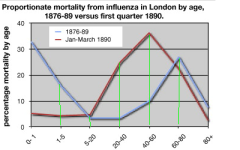
Our study makes use of extensive archival death records covering before and during the 1918?19 influenza pandemic in Boyac?, Colombia, and confirms the substantial number of deaths caused by the pandemic in this region. The main epidemiologic features of the pandemic in Boyac? include a single wave of excess deaths during October 1918?January 1919; high excess-death rates among infants and elderly persons; and a moderate R (estimated at 1.4?1.5, assuming a 3-day generation interval).
We did not identify a herald wave of deaths from pandemic influenza in the early part of 1918 in Boyac?. According to epidemiologic data, herald waves of mild pandemic activity have been reported for the spring and summer of 1918 in other regions of the world, including New York City (1), Mexico (3), Lima (4) Geneva (25,26), Copenhagen (6), military camps in the United States (6), the United Kingdom (27), and Singapore (9). The absence of a herald wave in Boyac? could be explained by late introduction of the pandemic influenza virus; alternatively, a mild first wave may have occurred without causing many deaths. Thus, we cannot rule out early pandemic activity, which might have been associated with mild illnesses, before October 1918 in Boyac?. For instance, the summer pandemic wave of 1918 in Denmark was clearly evident only from time-series case data (6). These epidemiologic findings suggesting early pandemic virus activity have recently been confirmed by sequencing of pandemic influenza virus specimens isolated from Army camp populations in the United States as early as May 1918 (28).
....//
In conclusion, historical studies from understudied areas are especially helpful for documenting the global death rates and transmission patterns of the 1918 pandemic and for revealing substantial variations among locations. In particular, the lack of death sparing for elderly persons in Colombia and Mexico differs markedly from contemporaneous observations in the United States and Europe. During the 19th century, the Latin American region was relatively isolated (and still is today) (40), which would affect the circulation of historical influenza viruses and baseline population immunity to influenza. We believe that this finding suggests recycling of influenza viruses as the best explanation for death sparing among elderly persons in the United States and Europe in 1918. Preservation and interpretation of archival epidemiologic data are crucial for a better understanding of past pandemics and for better preparedness against future pandemics.
Gerardo Chowell
, C?cile Viboud, Lone Simonsen, Mark A. Miller, Rodolfo Acuna-Soto, Juan M. Ospina D?az, and Abel Fernando Mart?nez-Mart?nAuthor affiliations: Arizona State University, Tempe, Arizona, USA (G. Chowell); National Institutes of Health, Bethesda, Maryland, USA (G. Chowell, C. Viboud, M.A. Miller); George Washington University, Washington, DC, USA (L. Simonsen); Universidad Nacional Aut?noma de M?xico, Delegaci?n Coyoac?n, Mexico (R. Acuna-Soto); Universidad Pedag?gica y Tecnol?gica de Colombia, Boyac?, Colombia (J.M. Ospina D?az, A.F. Mar
http://wwwnc.cdc.gov/eid/article/18/1/10-1969_article.htmt?nez-Mart?n)
To quantify age-specific excess-mortality rates and transmissibility patterns for the 1918?20 influenza pandemic in Boyac?, Colombia, we reviewed archival mortality records. We identified a severe pandemic wave during October 1918?January1919 associated with 40 excess deaths per 10,000 population. The age profile for excess deaths was W shaped; highest mortality rates were among infants (<5 y of age), followed by elderly persons (>60 y) and young adults (25?29 y). Mean reproduction number was estimated at 1.4?1.7, assuming 3- or 4-day generation intervals. Boyac?, unlike cities in Europe, the United States, or Mexico, experienced neither a herald pandemic wave of deaths early in 1918 nor a recrudescent wave in 1920. In agreement with reports from Mexico, our study found no death-sparing effect for elderly persons in Colombia. We found regional disparities in prior immunity and timing of introduction of the 1918 pandemic virus across populations.
Figure 4. Age-specific excess-death rates per 10,000 population associated with the 1918?19 pandemic wave in Boyac?, Colombia, October 20, 1918, to January 26, 1919, based on deaths from respiratory illness and all causes.
Figure 5. Comparison of age-specific excess-death rates for respiratory diseases during the main wave of the 1918?19 influenza pandemic in Mexico City, Mexico, and Boyac?, Colombia. Error bars represent 95% CIs.
Main Article
Discussion
Our study makes use of extensive archival death records covering before and during the 1918?19 influenza pandemic in Boyac?, Colombia, and confirms the substantial number of deaths caused by the pandemic in this region. The main epidemiologic features of the pandemic in Boyac? include a single wave of excess deaths during October 1918?January 1919; high excess-death rates among infants and elderly persons; and a moderate R (estimated at 1.4?1.5, assuming a 3-day generation interval).
We did not identify a herald wave of deaths from pandemic influenza in the early part of 1918 in Boyac?. According to epidemiologic data, herald waves of mild pandemic activity have been reported for the spring and summer of 1918 in other regions of the world, including New York City (1), Mexico (3), Lima (4) Geneva (25,26), Copenhagen (6), military camps in the United States (6), the United Kingdom (27), and Singapore (9). The absence of a herald wave in Boyac? could be explained by late introduction of the pandemic influenza virus; alternatively, a mild first wave may have occurred without causing many deaths. Thus, we cannot rule out early pandemic activity, which might have been associated with mild illnesses, before October 1918 in Boyac?. For instance, the summer pandemic wave of 1918 in Denmark was clearly evident only from time-series case data (6). These epidemiologic findings suggesting early pandemic virus activity have recently been confirmed by sequencing of pandemic influenza virus specimens isolated from Army camp populations in the United States as early as May 1918 (28).
....//
In conclusion, historical studies from understudied areas are especially helpful for documenting the global death rates and transmission patterns of the 1918 pandemic and for revealing substantial variations among locations. In particular, the lack of death sparing for elderly persons in Colombia and Mexico differs markedly from contemporaneous observations in the United States and Europe. During the 19th century, the Latin American region was relatively isolated (and still is today) (40), which would affect the circulation of historical influenza viruses and baseline population immunity to influenza. We believe that this finding suggests recycling of influenza viruses as the best explanation for death sparing among elderly persons in the United States and Europe in 1918. Preservation and interpretation of archival epidemiologic data are crucial for a better understanding of past pandemics and for better preparedness against future pandemics.