• FluTrackers.com Inc. does not provide medical advice. Information on this web site is collected from various internet resources, and the FluTrackers board of directors makes no warranty to the safety, efficacy, correctness or completeness of the information posted on this site by any author or poster. The information collated here is for instructional and/or discussion purposes only and is NOT intended to diagnose or treat any disease, illness, or other medical condition. Every individual reader or poster should seek advice from their personal physician/healthcare practitioner before considering or using any interventions that are discussed on this website. By continuing to access this website you agree to consult your personal physican before using any interventions posted on this website, and you agree to hold harmless FluTrackers.com Inc., the board of directors, the members, and all authors and posters for any effects from use of any medication, supplement, vitamin or other substance, device, intervention, etc. mentioned in posts on this website, or other internet venues referenced in posts on this website.
  • We are not asking for any donations. Do not donate to any entity who says they are raising funds for us.

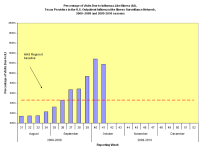
Texas %ILI Week 41

JimO

Well-known member
Source: http://www.dshs.state.tx.us/idcu/disease/influenza/surveillance/2010/

TX %ILI Week 41.png
 
Re: Texas %ILI Week 41

Good correlation with Google Flu Trends
http://www.google.org/flutrends/intl/en_gb/us/

us

Google had Texas peaking earlier (if indeed this is a final peak) in Week 39. Google's value for week 41 was 10.8% and the official value is 11.7%. Of note Google's current value for Texas (week 43) is 8.4% and falling.

It continues to appear as if the virus, at the moment, has difficulty sustaining airborne transmission adult to adult (in warm climates anyway) thus reducing spread. Barry mentioned the recent ferret studies supporting this in the interview with Florida1 yesterday. Also Australian research suggested that for every infected adult less than one other adult would be infected by them. This number was greater than one only for child to child spread.

As it gets colder, airborne transmission becomes easier for the virus (and might select for E627K?) and I wonder if this explains the very rapid rise being seen in Canada in particular.
 
Re: Texas %ILI Week 41

Google trend shows a peak in many US-states now


??!

Look at Georgia - back up again (See thread http://www.flutrackers.com/forum/showthread.php?t=130148 ). Also note that the way Google graphs the data all the lines straighten out at the start of the week as it plots a new week on the X axis but only 1 days worth of new week data for the Y axis (so it's almost the same as the final value for the week before). The best chart is then one posted on Sunday with data for a complete week. You can correct for this if you load the data into a spread sheet and scale the part current week data.
 
Re: Texas %ILI Week 41

It continues to appear as if the virus, at the moment, has difficulty sustaining airborne transmission adult to adult (in warm climates anyway) thus reducing spread. Barry mentioned the recent ferret studies supporting this in the interview with Florida1 yesterday. Also Australian research suggested that for every infected adult less than one other adult would be infected by them. This number was greater than one only for child to child spread.
Wouldn't this support timely school closings as an effective means for delaying the spread of H1N1 until sufficient numbers of vaccines can be deployed?
 
Re: Texas %ILI Week 41

I can't see in that chart that Georgia is back up again ?

I haven't followed google-trends so much ...

maybe our google-specialist can tell us, when USA peaks


do they have a forum ?
 
Re: Texas %ILI Week 41

Wouldn't this support timely school closings as an effective means for delaying the spread of H1N1 until sufficient numbers of vaccines can be deployed?

Yes and the authors said exactly this in their conclusions.

http://www.eurosurveillance.org/ViewArticle.aspx?ArticleId=19363

Despite the limitations of this study, our results support the value of public health interventions that target the school age population. Governments considering mitigation strategies that involve major social disruption, such as school closure, need to weigh the relative costs and benefits of such action. Results from modelling suggest that school closure is effective if done early and universally, and if it leads to reduced contact [20]. Pre-emptive school closure is predicted to be more effective than reactive school closure. However, the effects of any school closure are estimated to be greater in settings where school transmission is high [22], such as Victoria, where school age children account for the majority of early transmission.
 
Back
Top