• FluTrackers.com Inc. does not provide medical advice. Information on this web site is collected from various internet resources, and the FluTrackers board of directors makes no warranty to the safety, efficacy, correctness or completeness of the information posted on this site by any author or poster. The information collated here is for instructional and/or discussion purposes only and is NOT intended to diagnose or treat any disease, illness, or other medical condition. Every individual reader or poster should seek advice from their personal physician/healthcare practitioner before considering or using any interventions that are discussed on this website. By continuing to access this website you agree to consult your personal physican before using any interventions posted on this website, and you agree to hold harmless FluTrackers.com Inc., the board of directors, the members, and all authors and posters for any effects from use of any medication, supplement, vitamin or other substance, device, intervention, etc. mentioned in posts on this website, or other internet venues referenced in posts on this website.
  • We are not asking for any donations. Do not donate to any entity who says they are raising funds for us.

Tanzania - Leptospirosis outbreak 2022

Pathfinder

Editor, Senior Moderator
Translation Google

13 PATIENTS DISCOVERED BY UNKNOWN DISEASE IN LINDI REGION

Posted On: July 13th, 2022

Na. WAF - Dodoma

Thirteen patients have been diagnosed with an undiagnosed disease in Mbekenyera village, Ruangwa District Council, Lindi Region and three of them have died.

Giving the statement the Chief Government Physician Dr. Aifello Sichalwe today July 13, 2022 in front of journalists in Dodoma region. Dkt. Sichalwe said on July 7, 2022 the Ministry of Health received a report from the Lindi Regional Chief Physician.

He said the report stated that in Ruangwa Council there was an undiagnosed disease from Mbekenyera Health Center where within 3 days (July 5 and 7, 2022) they received 2 patients at the center with symptoms of fever, bleeding (especially nostrils). ) headache and body fatigue.

To monitor the report, the Ministry formed a team of experts from the Department of Emergency Medicine and Disasters, Epidemiology, Chief Government Chemist, Research Institute (NIMR), Muhimbili University of Medical Sciences and Muhimbili National Hospital, joined the team. The region also includes the Department of Corrections. " He said Dr. Sichalwe

The Ministry of Health continues to conduct further epidemiological and clinical investigations while awaiting the results of further tests of the Human and Animal Laboratory Laboratory from the Chief State Chemist.

In addition, the ministry continues to look for other people with symptoms such as early detection and isolation to prevent further spread of the disease, as well as to identify all people who are in contact with patients, patients, and the deceased.

Also, Provide treatment for patients diagnosed with symptoms, advise them to isolate themselves while waiting for the results of laboratory tests, To provide education to the community using various media.

However, the Ministry of Health continues to make preparations for medicines, medical supplies and anti-infective devices to treat victims in the event of emergence.

However, the Ministry has appealed to the people to remain calm while the issue continues to be worked out and the people should continue to use health care facilities when they feel sick.


https://www.moh.go.tz/en/news-single/wagonjwa-13-wagundulika-na-ugonjwa-usiofahamika-mkoani-lindi
 
Nosebleed the latest scare in Southern Tanzania

WEDNESDAY JULY 13 2022
...
Gracing the 20th Association of Member Episcopal Conferences in East Africa (AMECEA) Plenary Assembly organised by Tanzania Episcopal Conference (TEC), President Hassan said the hypothesis was that the disease is associated with impacts of environmental degradation.

She said with environmental degradation, the lives of some wild species have been disrupted, forcing them to go closer to human settlements, thus affecting human beings’ health.

“I was speaking with the Prime Minister (Kassim Majaliwa) recently as he toured in the southern part of the country, and he told me that there is this new disease where people have nosebleed and then collapse. We have not known what it is yet, scientists are now going there and hopefully, they will come up with answers and how to contain it,” said President Hassan yesterday.

“If it was one or two cases we could have assumed it was high blood pressure that burst the nerves, but in several cases, something we have never seen before, we consider it a strange disease, which might have been caused by the growing interaction between people and wild animals,” she said.
...
https://www.thecitizen.co.tz/tanzan...the-latest-scare-in-southern-tanzania-3878132
 
Posted at 8:128:12

Tanzania experts probe deadly unknown illness

Dorcas Wangira
Africa health correspondent
...
In total 13 cases have been reported in Lindi region, with patients having symptoms similar to Ebola or Marburg.

They have been experiencing fever, severe headaches, fatigue and bleeding, especially from the nose.

But the health ministry says preliminary lab tests results rule out the Ebola and Marburg viruses in these cases.

Contact tracing was ongoing and five people were currently in isolation, it said.
...

https://www.bbc.com/news/live/world...cd73621136d922db66dea2&pinned_post_type=share
 
https://www.dailymail.co.uk/health/...-Ebola-like-illness-kills-three-Tanzania.html
None of the 13 Tanzanian patients, who live in the southern Lindi region, have tested positive for either of the haemorrhagic viruses.

Covid swabs also came back negative, according to the country's ministry of health.

Tanzania's chief medical officer Aifello Sichalwen said one of the patients had fully recovered while the others were being isolated.

He added: 'The government formed a team of professionals who are still investigating this unknown disease.'

Tanzania's President Samia Suluhu Hassan said the 'strange' disease may have been caused by 'growing interaction' between humans and wild animals.
 
Scientists scramble to identify mystery deadly ‘nosebleed’ disease

Three people have already died from the illness, which bears similarities to a viral haemorrhagic fever


By
Will Brown,
AFRICA CORRESPONDENT, IN NAIROBI and
Sarah Newey,
GLOBAL HEALTH SECURITY CORRESPONDENT
14 July 2022 • 11:01am
...
So far there have been 13 cases recorded in the southeastern region of Lindi and at least three people have died.

The symptoms may point towards some sort of viral haemorrhagic fever, a form of disease that can damage the walls of tiny blood vessels in the victim, making them leak.

Four such viruses have been identified by the World Health Organization as “priority pathogens” with epidemic or pandemic potential – Crimean-Congo haemorrhagic fever, Lassa fever, Marburg and Ebola.

But the patients tested negative for two the haemorrhagic viruses previously in the region – Ebola and Marburg – according to Mr Sichalwe. They have also tested negative for Covid-19. One patient has reportedly recovered and the others are still in isolation.

...

https://www.telegraph.co.uk/global-...le-identify-mystery-deadly-nosebleed-disease/
 
A better symptomatic description would be helpful, in addition to fever and bleeding. Vomiting? Diarrhea? Coughing? Jaundice? The next things I can think of to test for here would be CCHF and yellow fever.
 
Ehrlichia chaffeensis can present with severe nose bleeds.

https://journals.plos.org/plosone/article?id=10.1371/journal.pone.0133700
Andoh M, Sakata A, Takano A, Kawabata H, Fujita H, Une Y, et al. (2015) Detection of Rickettsia and Ehrlichia spp. in Ticks Associated with Exotic Reptiles and Amphibians Imported into Japan. PLoS ONE 10(7): e0133700. https://doi.org/10.1371/journal.pone.0133700
...

A lizard (Varanus exanthematicus) from Tanzania had Amblyomma exornatum ticks, and was positive for Ehrlichia.
...

In the Ehrlichia groEL gene (Fig 4), 100% identity was found between ZambiaAS57-E, Ehrlichia sp. HF565, and Ehrlichia sp. Anan; ZambiaAS69-E and Ehrlichia chaffeensis; and ZambiaAS74O/74S-E and Candidatus Neoehrlichia mikurensis. Other new ehrlichial sequences were in the same phylogenetic cluster (Fig 4).
 
Translation Google

Posted on 6:28 14 July 20226:28 14 July 2022

WHO advises Tanzania to send samples of unknown diseases for testing

The World Health Organization (WHO) has advised Tanzania to send samples of the unnamed disease reported in the southern parts of the country to its referral laboratory in Senegal for further investigation.

The World Health Organization says it is working closely with the Tanzanian authorities to identify the disease that has caused 3 deaths of three people so far.

Despite the country conducting Marburg and Ebola virus tests but WHO standards are that samples of suspected cases must be sent to Pasteur Laboratory in Senegal for full confirmation.

Tanzania has eliminated both viral infections in its study although further testing will help determine the response needed to control further spread.

A new WHO study has further revealed that Africa faces a serious threat of diseases that spread from animals to humans.

The WHO estimates that there is a 63% increase in the number of zoonotic outbreaks.

Ebola and similar flu accounted for about 70% of these outbreaks.

https://bbc.in/3PwWBWN
 
Translation Google

An unknown disease caused fear in Lindi

SATURDAY JULY 16 2022
...
By Mwanja Ibadi

When three of the 13 people who were reported to be suffering from an unknown disease in Ruangwa District, Lindi Region died, the people were said to be so scared that they were afraid to go to the hospital to check on the sick.

They have also asked the Government to provide education to the community about the disease which has caused the death of three people so far.

A resident of Mkaranga Village, Nambilanje Ward, Ruangwa Abdala Chigope district, said he is a victim of the disease, as his sister, Esha Issa, contracted it, but after receiving treatment, she has recovered and is doing well.

"I am one of the victims of this disease, because my sister suffered from this problem. We ask the Government to work, to remove fear from the people."

Abdala said on July 5, at four o'clock in the morning, he received information that his sister suffered a strange fall and was bleeding from the nose and was rushed to the health center in Mbekenyera.

He said that after getting the information, the family members went to the health center and found out that there was another person with similar problems from Naungo township whose condition was worse than their brother's.

"When we arrived at the Mbekenyera health center to check on the patient, we were forbidden to enter the ward where he was admitted and at that time another patient increased, a situation that scared us and we saw that the problem was serious," he said.

Abdala Kimwaga, a resident of Lindi in the city, said: "We are ending up with great doubts now, we are afraid to even go to see patients in the hospital. We ask the Government through Nimr to intervene to conduct urgent research, to save people's lives."

He said that the situation is due to the fact that they still do not know how the disease is transmitted, so they even fail to take precautions to protect themselves.

He also said that it is possible that climate change contributes to the existence of the disease as explained by President Samia Suluhu Hassan, because in the coastal regions there are often very hot conditions during this period, but now the situation has become different.

"Right now there is rain, strong wind and severe cold, something that is not common... it is possible that this situation contributed to the existence of this disease.

Mohamedi Nurubi, a religious leader and a resident of Lindi in the city says that in the history of his life he has never seen or heard of such a disease.

"This is a new problem for us, so it is good for local and foreign health sector stakeholders to cooperate with the Government to investigate, to determine the source," he said.

Mohamedi also said that the religious leaders have the responsibility to sit and reflect on how to help the Government to fight the problem, including providing education to their believers about the disease and how to protect themselves.

Nurudini Abdala, Councilor of Njinjo in Kilwa district in Lindi region asked the citizens to take precautions early, as the disease has started in Ruangwa district, so it can reach other areas and have a big impact.

He said it is the responsibility of the Government to go to the affected areas and provide education, preventive health services as well as taking genetics, in order to go and test and remove the fear of the people in those areas.

Actions taken by the Government

The Chief Medical Officer of the Government, Dr. Aifello Sichwale said that they have formed a ministry team involving experts from various departments who have joined forces with those in Lindi region.

He said the experts are from the Department of Veterinary Medicine, Emergency Diseases and Disasters, Epidemiology, Chief Government Chemist, Human Disease Research Institute (NIMR), Muhimbili University of Medical Sciences and Muhimbili National Hospital.

"Another step is to continue looking for other people with similar symptoms, to identify them early and isolate them to prevent the disease from spreading," said Dr. Sichwale.

Another step is to list all the people who interacted with patients, victims, deceased and monitor them for 21 days.

He also said that they will provide treatment to patients who are found to have symptoms of the disease and advise them to isolate themselves while waiting for the results of the laboratory tests.

Dr. Sichwale mentioned that another step is to provide education, to prepare medicine, medical equipment and to prevent infection in order to serve the victims in case they show up again.

Symptoms of the disease

Patients have been reported to have symptoms of fever, bleeding (especially from the nose), headache and body fatigue.

Dr. Sichwale said the previous samples tested at the National Public Health Laboratory have shown negative responses to Ebola, Marburg and Uviko-19.

"We are continuing to conduct more epidemiological and medical investigations, we are also waiting for the results of more laboratory tests for human and animal diseases by the Chief Government Chemist," he said.

On Tuesday of this week, President Samia, speaking at the 20th meeting of the Federation of Bishops' Councils in East and Central Africa (AMCEA), said that due to the ongoing destruction of the environment, there is a risk that new diseases will continue to emerge due to the movement of human beings. and their homes were raided.

He gave an example that a disease has emerged in Lindi and Mtwara regions.

He said that the reports of the disease are related to the effects of environmental damage.

"The other day I was with the Prime Minister, he was giving me a report of his visit to the southern regions, he says there is a disease in Lindi, people are bleeding from the nose and then they fall to the ground. We don't know what it is, experts and scientists have camped there to try to get a closer look.

"Why should a person have a nosebleed, if it was one or two we would say the blood pressure has risen and the veins have ruptured, but there are many. This is all because we are destroying the habitats of the creatures, as a result we move them to us and they bring us these new diseases."

https://www.mwananchi.co.tz/mw/habar...-lindi-3881736
-----------------------------------------------------

Govt: We can diagnose infectious diseases

SUNDAY NEWS Reporter 17/07/2022

HEALTH Minister Ummy Mwalimu has assured the international community that Tanzania is capable of diagnosing high risk infectious diseases.

The minister's assurance comes amid reports of unknown disease associated with excessive nose bleeding and collapsing infecting people in Lindi Region.
...
Speaking in Kilimanjaro yesterday during the launch of the state of the art laboratory at Kibong'oto Specialised Infectious Diseases Ms Mwalimu said: “There have been reports requesting specimens and want them to be tested outside the country…the VP has seen our modern lab, we have equipment and experts to detect communicable diseases in our country ... I will travel to Lindi on Monday (tomorrow) and I believe that we will have answers on the disease affecting our people in the region.”

She further said that the ministry has allowed experts from the World Health Organisation (WHO) and Centre for Disease Control and Prevention (CDC) to join Tanzanian team on identifying the disease.

...
https://dailynews.co.tz/news/2022-07...e087dea6.aspx#
 
Spontaneous nosebleeds might be a symptom of a hemorrhagic fever. A nose bleed that follows a fall, not so much. Also, I'm assuming "UVIKO" is "COVID", having gone through various translations.
 
Translation Google

Government: The disease that emerged in Lindi is Mgunda fever

MONDAY JULY 18 2022


Summary
The Minister of Health, Ummy Mwalimu has said that laboratory tests have shown that the disease that emerged in Lindi region is Mgunda fever (Leptospirosis).

By Herieth Makwetta
More by this Author

Dar es Salaam. Testing of samples of patients who were suffering from an unknown disease in Ruangwa District in Lindi region has confirmed this outbreak to be of Mgunda fever 'Leptospirosis, Field Fever'.

It has been known that four days have passed since the Government of Tanzania accepted the request of the World Health Organization (WHO) and the Center for Disease Prevention and Control (CDC) from the United States Government to increase the strength of the team of experts in identifying the disease.

Speaking today, Monday, July 18, 2022, the Minister of Health, Ummy Mwalimu has given this information after visiting Ruangwa District in Lindi Region where the explosion occurred.

Minister Ummy has said that tick fever is one of the diseases that can be transmitted from animals to humans and is caused by Leptospira interrogans bacteria.

"This disease has existed in tropical areas that are hot in the continents of North America, South America, Africa, Asia and Australia. Animals such as mice, squirrels, foxes, deer, antelopes, and other wildlife have been reported to be infected with these parasites and become a source of infection for humans," said Minister Ummy.

https://www.mwananchi.co.tz/mw/haba...jwa-ulioibuka-lindi-ni-homa-ya-mgunda-3883698

---------------------------------------------------------

A new disease that causes nosebleeds and kills Lindi is known-Government

Yusuf Mazimu
BBC Swahili
18 July 2022, 13:58 EAT
Updated 2 hours ago

The Tanzanian government has revealed that the disease that kills people in southern Tanzania is Mgunda fever.

The Minister of Health Mr. Ummy Mwalimu has told reporters that the testing of samples of patients who were sick in Ruangwa District in Lindi Region has confirmed this outbreak to be a disease technically called Leptospirosis, Field Fever or in Kiswahili it is known as Mgunda Fever.

Minister Ummy said this today immediately after visiting Ruangwa District in Lindi Region where there has been an outbreak of the disease and talking to journalists.

According to Minister Ummy Mgunda fever is one of the diseases transmitted from animals to humans and is caused by Leptospira interrogans bacteria.

"This disease has been present in tropical areas that are warm in the continents of North America, South America, Africa, Asia and Australia.," he was quoted as adding "Animals such as mice, squirrels, foxes, deer, antelopes, and other wildlife have been reported to be infected with these parasites and become a source of infection for humans," he said.

As of July 17, 2022, there were 20 patients and three (3) deaths from the disease. According to Minister Ummy's statement, currently, only two patients with symptoms are still admitted in the area designated for treatment.

Similarly, the teams have continued with the monitoring of people who interacted with patients where until now, the Government says no one has shown symptoms of illness.

https://www.bbc.com/swahili/habari-62207231
 

The Minister of Health Hon Ummy Mwalimu has said that laboratory tests have shown that the disease that emerged in Lindi region is Leptospirosis


294608874_419593280200447_1495758655398999166_n.jpg


https://www.facebook.com/wizaraafyatz


--------------------------------------------------------


Tanzania Ministry of Health@wizara_afyatz

·3h
Minister of Health Hon@ummymwalimu
He said that the testing of samples of patients who were suffering from an unknown disease in Ruangwa District in Lindi Region has confirmed this outbreak to be Leptospirosis, Field Fever in Kiswahili is known as Mgunda Fever.


Translation Google

UNITED REPUBLIC OF TANZANIA
MINISTRY OF HEALTH

NOTICE TO THE PUBLIC

REPORT OF ILLNESS WITH SYMPTOMS OF FEVER ACCOMPANIED BY
BLEEDING IN RUANGWA COUNCIL, LINDI REGION


18 JULY 2022, RUANGWA – LINDI

Dear citizens

It will be remembered that on July 7, 2022, the Ministry of Health received information from
to the Chief Medical Officer of Lindi Region for the presence of patients with symptoms of
fever accompanied by bleeding in Ruangwa District in Lindi Region.
Following the information, the Ministry sent a team of experts from the Ministry level and
others from the National Laboratory of Community Health, Laboratory Authority
Chief Government Chemist, Muhimbili National Hospital (MNH), Research Institute
of Human Diseases (NIMR), University of Health and Allied Sciences
(MUHAS), Mzumbe University, Experts from the Management Teams of
Health Services Lindi Region and Kilwa and Ruangwa Councils together
and Veterinary experts of Ruangwa and Kilwa Councils to do
diagnosis of this disease. In addition, we had the participation of experts from the Organization
World Health (WHO) and the Center for Disease Control and Prevention
United States (US CDC).

Dear citizens,
Until the day of July 17, 2022, a total of 20 patients and deaths
three (3) have been informed. In addition, currently, only two patients with
symptoms are still lying in the designated area for treatment. Such
As such, teams have continued monitoring of people who have interacted with patients
(contacts) where until now, no one has shown symptoms of this disease.

Dear citizens
It will be remembered that, the previous information of the samples measured in the Laboratory
The National Public Health Laboratory (National Public Health Laboratory) showed negative responses
(negative) for Ebola, Marburg and UVIKO-19. Likewise, investigation
more developed at the National Laboratory of Community Health and the Agency
The Veterinary Laboratory has shown negative responses to the disease
Influenza, Anthrax, Crimean Congo Hemorrhagic Fever (CCHF),
Yellow Fever, Chikungunya, West Nile Virus and Rift Valley Fever.

Dear Citizens
In increasing the scope of diagnosis of the source of this disease, investigation
in the Laboratory Authority of the Chief Government Chemist has been held to determine
the possibility of having toxins or chemicals that affect Human Health. Answers
from this laboratory have shown that there is no poison or any chemical
likely to affect human health.

Dear Citizens
I take this opportunity to inform you that, at the moment, the testing of patient samples
from our laboratories have confirmed this outbreak as a disease of
Leptospirosis, Field Fever (and in the Kiswahili language it is known as
Mgunda fever). Leptospirosis is one of the diseases
transmitted from animals to humans and
caused by Leptospira interrogans bacteria. This disease
you have been in tropical areas that are hot in
the continents of North America, South America, Africa, Asia and Australia.
Animals such as mice, squirrels, foxes, deer, gazelles, and wild animals
others have been reported to be infected with these parasites and become the source of
infection in humans. For Tanzania, this disease is not new, and it has been around for a long time
happened in 2014 in Buhigwe Council in Kigoma region.

Dear citizens
Leptospirosis is transmitted from animals to
humans through environmental pollution including water sources from
urine of infected animals. The infection of this disease to go
for humans it goes through the following ways;
i. Touching urine (or other bodily fluids) from animals
infected.
ii. Touching water, soil, or food contaminated with animal urine
infected.
iii. Drinking water contaminated with bacterial pathogens of this disease
In addition, bacteria can also enter the body through the skin or mucous membrane
(eyes, nose or mouth) and through broken skin. The infection of
This disease from one human to another happens to
rare.

Dear Citizens
A patient infected with the parasite of this disease begins to show symptoms
in a period between five (5) to 14 days and sometimes the symptoms can
occurring between two (2) to 30 days. Symptoms of this disease include fever,
headache, muscle pain, body fatigue, body color
jaundice, bloodshot eyes, nosebleeds and coughing up blood.

Dear Citizens,
The government through the Ministry of Health and other stakeholders has continued to take action
various as follows:
i. Finding other people with symptoms to provide care to
ii. Providing services to patients when they show up
iii. Facilitating access to medicines, medical equipment and protective equipment
infection
iv. Implementing the concept of One Health (One Health Concept) by involving them
Livestock, Wildlife, Agriculture and Environment experts in control
this disease
v. Providing expert guidance on how to identify more patients and
to serve them
v. Providing education to the community to protect themselves from this disease

Dear Citizens,
Fortunately, this disease is preventable and treatable. The Ministry provides
call on all people to consider the following:
i. Take all appropriate measures to protect yourself from this disease, including avoiding it
touching water or things contaminated with animal urine and drinking water
clean and safe that has been boiled or treated
ii. Patients with symptoms of fever, bleeding, headache and body ache
tired of going to health care centers to get them
proper treatment
iii. Provide information on patients who show the symptoms mentioned above if necessary
will be found in the community

Before concluding, I would like to express my gratitude to our Health Professionals
Ruangwa Council and Lindi Region in collaboration with leaders
them, how they were able to quickly identify this threat and provide information in advance.
This shows how the area of Disease Surveillance (Disease Surveillance)
as it has been strengthened, continue with that procedure and let this be for the whole country. In addition,
I congratulate all the experts from various National and International institutions
who participated in the monitoring of this disease.

Conclusion
Dear citizens
The Ministry continues to take measures to deal with this disease and continue
provide information to the public about the trend of this disease. So the Government
It urges the people not to be afraid as this disease continues
controlled.

Issued by;
Ummy A. Mwalimu (Mb)
MINISTER OF HEALTH

https://www.moh.go.tz/storage/app/uploads/public/62d/546/469/62d5464696c3b531459878.pdf
https://www.moh.go.tz/
 
WEEKLY BULLETIN ON OUTBREAKS
AND OTHER EMERGENCIES

Week 30: 18 to 24 July 2022
Data as reported by: 17:00; 24 July 2022

...

Leptospirosis United Republic of Tanzania

20 cases
3 Deaths
15% CFR


EVENT DESCRIPTION

Two patients presented at the Mbekenyera Health Centre located
in Ruangwa District Council, Lindi Region, with similar symptoms
including fever, nose bleeding, headache, coughing blood and
general body weakness on 5 and 7 July 2022. The Ministry of
Health was alerted by the Chief Medical Officer of Lindi Region
on 7 July 2022 and a rapid response team was deployed to the
field to further investigate and assist in control of the unknown
disease.

Overall, 18 samples were collected and tested at the National
Public Health Laboratory and the Tanzania Veterinary Laboratory
Agency and returned negative for Ebola virus disease, Marburg
virus disease, Influenza, Crimean-Congo haemorrhagic fever,
yellow fever, Chikungunya, West Nile virus and Rift Valley fever.
However, 15 cases were confirmed positive for Leptospirosis
following further laboratory testing performed at the Sokoine
University of Agriculture reference laboratory. The last case was
notified on 15 July 2022. Two patients remain hospitalised.
As of 19 July 2022, a total of 20 cases and three deaths (case
fatality ratio 15%) have been reported. A total of 15 contacts
have been identified, none of whom has so far shown any of the
reported symptoms.

Patients’ ages ranged from 18 to 77 years, with a median of 45
years. Majority of cases (n=15; 75%) were aged between 31 and
60 years. Males (n=15; 75%) were thrice more affected than
women. All cases were peasant farmers detected in Naungo
Hamlet located in Kilwa District where they lived in a temporary
camp for agricultural activities. Three districts have so far been
affected, all of which are located in Lindi Region: Ruangwa (17
cases; 85%), Kilwa (2 cases; 10%) and Tandahimba (1 case; 5%).

PUBLIC HEALTH ACTIONS

An official press release produced on 18 July 2022 by MoH
to publicly notify the outbreak and coordination mechanisms
at national and regional levels were put in place.

A detailed health sector costed response plan in being
developed.

A multidisciplinary rapid response team was deployed to the
field and response activities are ongoing.

Surveillance activities including epidemiological
investigations have been enhanced and active case search
are ongoing.

Sensitization activities of health care workers on case
definitions and infection prevention are ongoing.

More samples have been collected from human, animal and
water sources, for laboratory testing.

Cases have been isolated and provided adequate medical
care. Medicines and medical equipment including personal
protective equipment are in place.

Health education is being provided to the community.

SITUATION INTERPRETATION

Tanzania has previously reported an outbreak of Leptospirosis in
2014, in Buhigwe District Council, Kigoma Region. Although the
source of the disease remains to be determined, all cases were
peasant farmers temporarily living in Naungo village. Naungo
is characterized by fertile land that attracts farmers from other
areas who make temporary settlements while farming. The area
has a seasonal influx, and very limited social services including
water supply, sanitation and hygiene, and health care services,
inferring that many other people can be exposed to the same
contaminated environment. Therefore, surveillance activities
should be reinforced especially at community level to early and
quickly detect any new case. Additionally, infection, prevention
and control interventions at health care and community levels
as well as community health education would be paramount to
control the outbreak.

https://apps.who.int/iris/bitstream/handle/10665/360976/OEW30-1824072022.pdf
 
Source: https://www.who.int/emergencies/disease-outbreak-news/item/2022-DON403


Leptospirosis - United Republic of Tanzania

12 August 2022


Outbreak at a glance
As of 8 August, the United Republic of Tanzania has reported 20 cases of leptospirosis in two districts in Lindi Region, including three deaths. Of these, 15 cases have been laboratory-confirmed. The majority of cases are men, and all are reported to be farmers, with occupational exposure as the likely source of infection. No new cases have been reported since 15 July. Field investigations and active case finding are ongoing to identify any new or missed cases.

Cases of leptospirosis are not unexpected in the United Republic of Tanzania, although reports of outbreaks are rare. Cases tend to have a seasonal distribution, increasing with elevated rainfall or temperature. Transmission usually occurs through direct exposure to infected animal urine or through environmental exposure.

This Disease Outbreak News summarizes the epidemiology of the outbreak, provides an overview of the public health response to this event, and WHO advice to the general public and healthcare workers in affected areas.

Description of the outbreak

On 14 July 2022, the Ministry of Health (MoH) of the United Republic of Tanzania notified WHO of 13 cases of an undiagnosed disease, later diagnosed as leptospirosis. The first two cases presented to a Health Centre located in Ruangwa District, Lindi Region on 5 and 7 July, with symptoms of fever, bleeding from the nose, headache and general body weakness. Samples tested negative for Ebola virus disease, Marburg virus disease, Influenza, Crimean-Congo haemorrhagic fever, yellow fever, Chikungunya, West Nile virus and Rift Valley fever at the National Public Health Laboratory and the Tanzania Veterinary Laboratory Agency, and subsequently tested positive for leptospirosis at the Sokoine University of Agriculture reference laboratory.

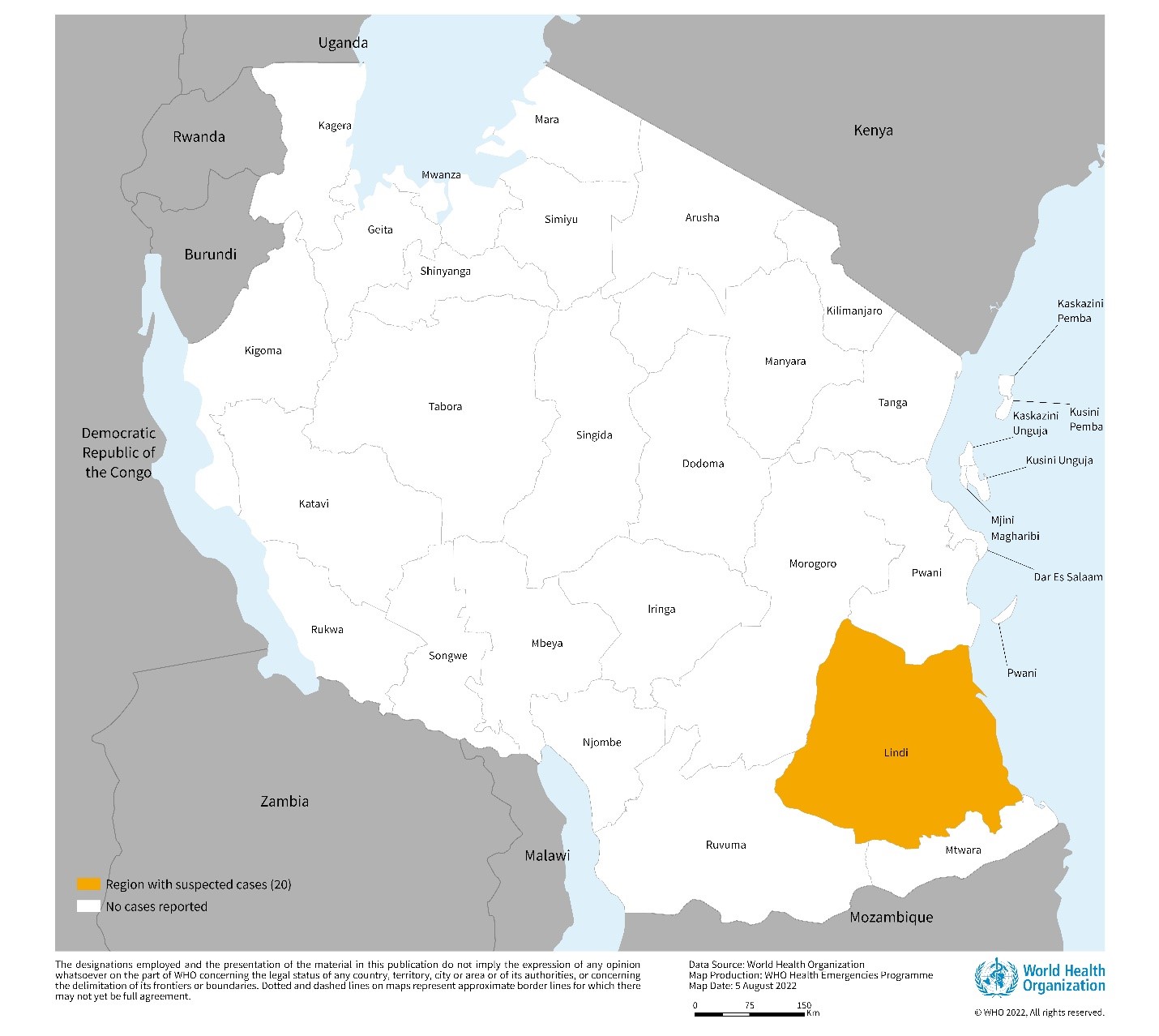
As of 8 August, a total of 20 cases of leptospirosis and three deaths had been reported from two districts including Ruangwa (18 cases) and Kilwa (two cases) in Lindi Region (Figure 1). Of these, 15 cases have been laboratory-confirmed, including one death (case fatality rate 6.7%). Of the remaining five cases, three cases, including one death, tested negative for leptospirosis while samples were not taken for two cases, of which one died.

The cases ranged from 18 to 77 years of age (median age 45 years) and the majority (n=15; 75%) were between 31 and 60 years. Most of the cases (n=15, 75%) were males, who were farmers by occupation and were detected in a temporary camp for agricultural activities.

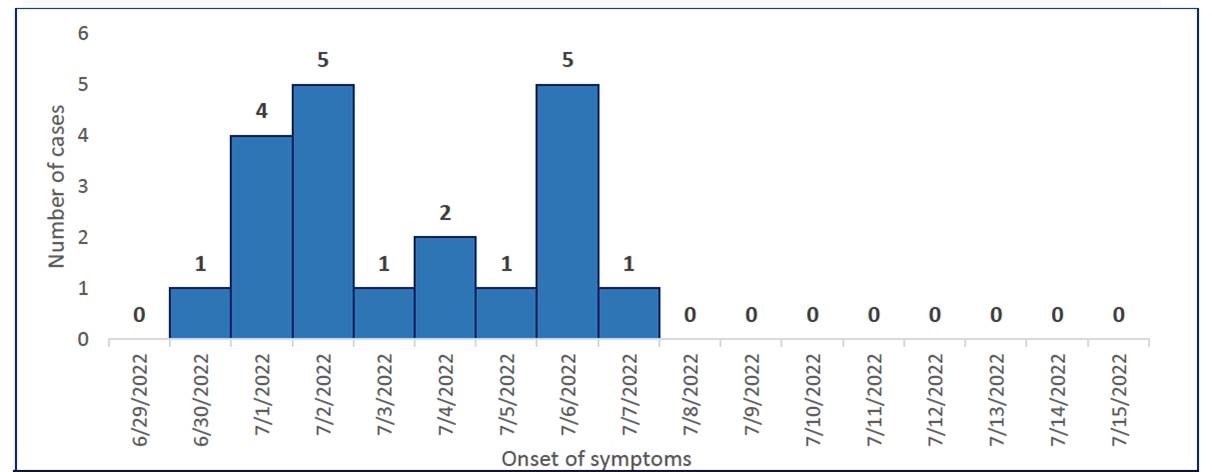
Cases who reported onset of symptoms from 30 June to 3 July were identified in the community during active case finding. The majority of cases reported onset of symptoms between 2 and 6 July, and the most recent cases reported onset of symptoms on 7 July. No new cases have been reported since 15 July (Figure 2). Field investigations and active case finding are ongoing to identify any new or missed cases.

Figure 1: Geographic distribution of suspected cases of leptospirosis in the United Republic of Tanzania, as of 15 July 2022

Figure 2: Suspected cases of leptospirosis by onset of symptoms, as of 15 July 2022
Source: United Republic of Tanzania Ministry of Health.

Epidemiology of the disease

Leptospirosis is a zoonotic disease caused by the Leptospira genus of bacteria, and a worldwide public health problem attributed to climatic and environmental conditions. Humans become infected through contact with urine (or other body fluids, except saliva) from infected animals, such as rodents, dogs, pigs, cattle, horses, racoons, and wild animals, or contact with water, soil, or food contaminated with the urine of infected animals. Human-to-human transmission occurs only very rarely. The incubation period is usually 7–10 days, with a range of 2–30 days.

Clinical features of leptospirosis include fever, headache, myalgia (particularly in the calf muscle), conjunctival suffusion, jaundice, and general malaise. As these symptoms are similar to other infectious diseases, it is important to correctly diagnose early after the onset of symptoms to treat patients and prevent severe illness. Severe cases include renal and cardiac failure as well as pulmonary hemorrhages and can mimic other epidemic diseases of international importance.

Outbreaks of leptospirosis are rare, with a seasonal distribution, increasing with increased rainfall or higher temperature, and are usually caused by exposure to contaminated water, such as floodwaters or may be associated with changes in human behaviour, animal or sewage contamination of water, changes in animal reservoir density, or following natural disasters.

Public health response
  • On 18 July, the MoH issued a press release notifying the outbreak and initiated coordination mechanisms at national and regional levels. A detailed national health sector response plan has been developed.
  • The MoH, in collaboration with WHO, deployed a multidisciplinary rapid response team to the affected areas and response activities were implemented.
  • Surveillance activities including epidemiological investigations and active case finding are ongoing. This includes enhanced surveillance for human and animal health.
  • Training on leptospirosis including integrated disease surveillance and response was conducted for health care workers in Ruangwa district.
  • Sensitization activities of health care workers on clinical presentation and infection prevention and control (IPC) are ongoing. Leptospirosis factsheets have been printed and distributed to all health care facilities in the affected areas.
  • Additional samples have been collected from human, animal, and water sources for laboratory testing.
  • Cases were provided with appropriate medical care. Medicines and medical equipment including personal protective equipment were provided to the region.
  • Health education is being broadcasted through the local radio station delivering accurate health information to the community and answering their questions.


WHO risk assessment

WHO assesses the overall risk at the national level as moderate. Although the exact source of the outbreak remains unidentified, it is likely linked to farming activities. The affected areas attract farmers from other locations who make temporary settlements while farming and the area has a seasonal influx of farmers, inferring that many other people can be exposed to the same source of contamination and the number of cases may increase.

In addition, the affected areas have limited basic services including water supply, sanitation and hygiene, and health care services. It is therefore anticipated that IPC capacities at the community level would be weak. Moreover, the country’s capacity to respond to this outbreak might become overwhelmed, if the number of cases and affected areas increase in addition to other ongoing health threats. Leptospirosis has been previously reported in the United Republic of Tanzania (2014, in Kigoma Region) and is a recognized public health risk. However, the incidence in different regions is not well known and surveillance capacity is limited.

The risk of disease spread both at regional and global levels is considered Low.

WHO advice

The control of leptospirosis is complicated and will depend on the local conditions. Control can be achieved by controlling the disease reservoir. Preventive measures must be based on a knowledge of the groups at particular risk of infection and the local epidemiological factors. Prevention and control should be targeted at: (a) the infection source; (b) the route of transmission between the infection source and the human host; or (c) infection or disease in the human host.

Transmission can therefore be prevented by:
  • wearing protective clothing (boots, gloves);
  • covering skin lesions with waterproof dressings;
  • washing or showering after exposure to urine splashes or contaminated soil or water;
  • washing and cleaning wounds;
  • developing an awareness of potential risks and methods of preventing or minimizing exposure, for instance by avoiding or preventing urine splashes and aerosols, avoiding touching ill or dead animals, fetuses, placentas, organs (kidneys, bladders) with bare hands, and, unless wearing gloves, avoiding assisting animals giving birth;
  • strictly maintaining hygienic measures during care or handling all animals, including wearing gloves when handling the urine of dogs and other animals, washing hands afterward, and being aware that it is possible to be infected while nursing sick dogs or other animals;
  • where feasible, disinfecting contaminated areas (scrubbing floors in stables, butcheries, abattoirs, etc.).
  • providing clean drinking water;
  • preventing access to or giving adequate warning of water bodies known or suspected to be contaminated (pools, ponds, rivers);
  • introducing good herd management (avoiding communal pastures, buying certified leptospire-free stock);
  • implementing standard safety procedures in laboratories.

When an outbreak occurs, both health care workers and the general public need to be rapidly informed of the situation and of the ways in which the disease may be prevented. Widespread community education can greatly assist in the identification of risk factors, the prevention of illness, and reducing the duration of illness and its severity through the early recognition of suspicious symptoms and self-referral for evaluation and treatment.

The general public should be provided with information on the clinical signs of leptospirosis, on the risk of exposure, and on the importance of seeking medical care as soon as possible as the disease responds to antibiotics. Information should also be given on methods of prevention, such as people should avoid drinking or submerging in water that may be contaminated, and not wash clothes in potentially contaminated water if any open wounds are present.

Health care providers should be given information to help them recognize a febrile illness, possibly due to leptospirosis, and on suitable treatments for the disease. Health care workers caring for patients with suspected or confirmed leptospirosis should apply standard and transmission-based IPC precautions. In addition, information on the symptoms of leptospirosis, risk factors, diagnostic testing and therapeutic strategies should be regularly disseminated to health care workers through various channels.

Surveillance activities including active case search should be reinforced in all affected areas and surroundings. The One Health approach should also be strengthened with surveillance activities reinforced not only with regard to human health but also animal and environmental health.

WHO does not recommend any restriction on travel or trade to the United Republic of Tanzania based on the current situation.

Further information
Citable reference: World Health Organization (12 August 2022). Disease Outbreak News; Leptospirosis in the United Republic of Tanzania . Available at: https://www.who.int/emergencies/dise...em/2022-DON403


See all DONs related to this event
 
Back
Top