• FluTrackers.com Inc. does not provide medical advice. Information on this web site is collected from various internet resources, and the FluTrackers board of directors makes no warranty to the safety, efficacy, correctness or completeness of the information posted on this site by any author or poster. The information collated here is for instructional and/or discussion purposes only and is NOT intended to diagnose or treat any disease, illness, or other medical condition. Every individual reader or poster should seek advice from their personal physician/healthcare practitioner before considering or using any interventions that are discussed on this website. By continuing to access this website you agree to consult your personal physican before using any interventions posted on this website, and you agree to hold harmless FluTrackers.com Inc., the board of directors, the members, and all authors and posters for any effects from use of any medication, supplement, vitamin or other substance, device, intervention, etc. mentioned in posts on this website, or other internet venues referenced in posts on this website.
  • We are not asking for any donations. Do not donate to any entity who says they are raising funds for us.

Tanzania (ex Uganda): WHO alerted after several cases of undiagnosed hemorrhagic illness - gov denies Ebola

alert

Senior Moderator
I disagree with the ProMED moderator here. Unless lab results are showing something unusual, I think the most likely reason for such an alert is a potential EVD importation from the outbreak in the DRC. A single fatal illness, without a travel link or unusual lab finding, almost anywhere in the world, isn't usually enough to get such an alert.
Published Date: 2019-09-13 15:04:15
Subject: PRO/AH/EDR> Undiagnosed illness - Tanzania: fatal, WHO team deployment, RFI
Archive Number: 20190913.6672971
UNDIAGNOSED ILLNESS - TANZANIA: FATAL, WHO TEAM DEPLOYMENT, REQUEST FOR INFORMATION
************************************************** *********************************
A ProMED-mail post
http://www.promedmail.org
ProMED-mail is a program of the
International Society for Infectious Diseases
http://www.isid.org

Date: Thu 12 Sep 2019
Source: WHO Africa [edited]
https://www.afro.who.int/news/who-de...nknown-illness


The World Health Organization (WHO) is aware of a rumour related to the death of a person due to an unknown illness in Tanzania. We have reached out to Ministry of Health officials for further details and have offered our support.

In line with our responsibility under the International Health Regulations, WHO regularly receives and investigates numerous rumours of public health events.

In this regard, WHO is working with national health authorities and is deploying a technical team to Tanzania to investigate this rumour as a matter of urgency.

WHO will be informing Member States of the outcome of this investigation through their national International Health Regulations focal points.

--
Communicated by:
ProMED-mail
<promed@promedmail.org>

[This unusually urgent deployment of a WHO technical team to Tanzania raises concern for the possibility of a communicable disease with high mortality, such as Ebola virus disease (EVD) or another viral hemorrhagic fever. EVD has not been previously reported from Tanzania, and such a case would be relatively unlikely to be related to the current EVD outbreak in the Democratic Republic of Congo, as the 2 countries do not share a land border and are separated by Lake Tanganyika. ProMED would appreciate any information regarding this or related cases in Tanzania. - Mod.LXL


Last edited by a moderator:
WHO investigating death in Tanzania due to unknown illness
Sep 13, 2019 | Reuters | 0 |

By Omar Mohammed

NAIROBI (Reuters) ? A woman whose death in Tanzania is being investigated by the World Health Organization probably did not have Ebola, a spokesman for the U.S. Centers for Disease Control and Prevention said on Friday.

There is increased vigilance across the region because of an outbreak of Ebola in Democratic Republic of Congo, and the WHO said on Thursday it was looking into the death of a patient in Tanzania.

The woman who died in Dar es Salaam on Sept. 8 presented symptoms common to several diseases, including dengue or malaria, both endemic in East Africa, said Justin Williams, the director for communication and policy at the Nairobi office of the U.S. Centers for Disease Control and Prevention.

Such symptoms also present in Ebola, he said, but there was no indication the woman had traveled to an affected area or had contact with an infected person.

?It?s more likely something else. She has not traveled to the (Democratic Republic of Congo) and was not in close contact to an Ebola patient from DRC or Uganda,? he told Reuters.
...
https://www.physiciansweekly.com/who-investigating-death-in/
 
I think there's still a missing piece to this puzzle. If a person dies suddenly, even with horrific symptoms, but with no travel history, no positive lab results, and no one else ill, you don't get this kind of response. There are a wide variety of common causes that can produce such an outcome in severe cases. We've seen countless reports of sudden, horrendous deaths, even due to seasonal flu or an acute poisoning. We often never even know the cause of many such cases.

Now that we know this case has no travel history and lab results are not in yet, I have to wonder whether this case was part of a cluster of unexplained illness to merit such an investigation.
 
Tanzania govt defuses Ebola scare as doctor dies in Dar es Salaam
SUNDAY SEPTEMBER 15 2019

Minister for Health, Community Development,
Minister for Health, Community Development, Gender, Elderly and Children, Ms Ummy Mwalimu speaks during a press conference in Dar es Salaam yesterday. Left is her Deputy, Dr Faustine Ndugulile and the Chief Medical Officer, Prof Muhammad Kambi (right). PHOTO | SAID KHAMIS

In Summary
Health minister Ummy Mwalimu said samples of two people from Dar es Salaam and Mwanza who had been suspected to have contracted Ebola tested negative.

By The Citizen Reporter @TheCitizenTz news@thecitizen.co.tz


...
https://www.thecitizen.co.tz/news/1840340-5273898-9cih1q/index.html
 
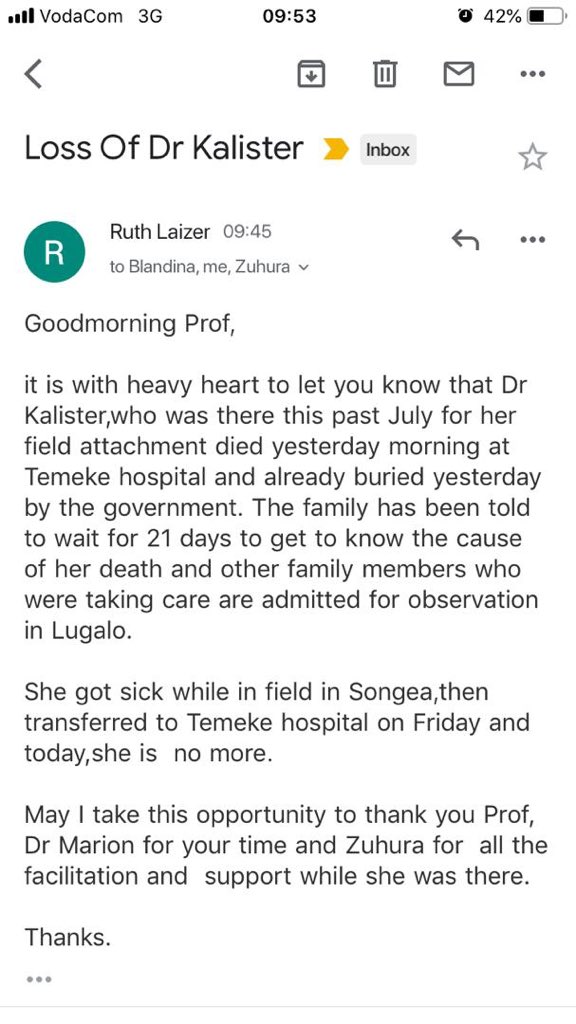
And there's the missing pieces of the puzzle. The undiagnosed fatality was a doctor, raising the possibility of nosocomial spread of an infection. The doctor also had a travel history to Uganda, where CCHF and plague are both endemic. Even though Ebola has now been ruled out, I hope they are testing for other hemorrhagic fevers like CCHF as there are things other than Ebola that would be a serious health risk if they were spreading in a hospital.

The article Ronan linked above states that the doctor did indeed have the symptoms of a hemorrhagic fever.
 
US urges transparency in Ebola-like death in Tanzania

Associated Press
an hour ago

KAMPALA, Uganda (AP) ? Tanzanian authorities must show transparency in the case of a patient who recently died after suffering Ebola-like symptoms, the U.S. health and human services secretary said Monday.

Alex Azar, speaking in Uganda, told reporters that he and others are ?very concerned? and urged Tanzania?s government to share laboratory results regarding the case. The Ebola outbreak in neighboring Congo has become the second-deadliest in history, with confirmed cases now exceeding 3,000.

Azar said efforts were underway to secure Tanzania?s compliance with international health regulations and obligations to the World Health Organization ?to protect Tanzanians as well as all people in the region.?

Tanzania?s government said Saturday there is no confirmed case of Ebola in the East African nation. No confirmed Ebola case has ever been recorded there.
...

https://www.apnews.com/831c09ff3ab24917956c42bab2ac539b
 
Tanzanian authorities inform WHO they have no cases of Ebola

Brazzaville, 18 September 2019 ? On 14 September, the World Health Organization (WHO) received formal notification from the Government of the United Republic of Tanzania that there are no cases of Ebola virus disease in the country. This followed earlier rumours of the death of one person and illness in a few others. The Tanzanian authorities did not indicate what the cause of the illnesses might have been.

WHO has informed Member States of this update from the United Republic of Tanzania in accordance with the International Health Regulations.

The United Republic of Tanzania is on heightened alert for potential cases of Ebola due to the outbreak in neighbouring Democratic Republic of the Congo, ongoing since 1 August 2018. WHO continues to work with the country to improve its ability to prevent, detect, confirm and care for anyone with the disease. A team of WHO technical experts has been deployed to the United Republic of Tanzania to supplement experts based in the WHO country office.

https://www.afro.who.int/news/tanzanian-authorities-inform-who-they-have-no-cases-ebola
 
SEPTEMBER 19, 2019 / 2:29 AM / UPDATED 7 HOURS AGO

Tanzania tells WHO it has no Ebola cases - statement

Omar Mohammed

NAIROBI (Reuters) - Tanzania has formally told the World Health Organization (WHO) that it has no cases of Ebola after a woman died there earlier this month from an unknown illness following Ebola-like symptoms, the organisation said on Wednesday.
...
The WHO announcement came a day after the head of a U.S. government health agency travelled to Tanzania at the direction of America?s health secretary, Alex Azar. Azar criticized Tanzania earlier this week for not sharing information.
...
Tanzania?s health minister said on Saturday that the government had investigated two recent cases of unknown illnesses, but they were not Ebola.

?The two patients did not have Ebola,? Ummy Mwalimu told reporters. ?There is no Ebola outbreak in Tanzania as we speak, people should not panic.?

She did not say if the two cases investigated included the death of the woman. The ministry did not answer calls on Wednesday.
...

https://af.reuters.com/article/topNews/idAFKBN1W40O6-OZATP
 
This looks like a public spank against countries who ignore the IHR. Hopefully they will target China too.


Cases of Undiagnosed Febrile Illness &#150; United Republic of Tanzania

Disease Outbreak News
21 September 2019


The following is a description of the current situation in the United Republic of Tanzania regarding unofficial reports of a number of cases of illness and a summary of WHO efforts to obtain information about this situation.
As specified in Article 9 of the International Health Regulations (IHR), WHO may take into account reports from sources other than notifications from Member States and shall assess these reports according to established epidemiological principles under the IHR.
On 10 September 2019, through its regular event-based surveillance process, WHO was made aware of unofficial reports regarding the death of a person with suspected Ebola Virus disease (EVD) case in Dar es Salaam, United Republic of Tanzania. The identified contacts of the deceased were unofficially reported to be quarantined in various sites in the country. Under the IHR Articles 9 and 10, WHO immediately sent a verification request to the National IHR Focal Point (NFP) of the country.
On 11 September, through its regular event-based surveillance process, WHO was made aware of unofficial reports that a RT-PCR test performed at the Tanzanian National Health Laboratory was positive for EVD for this patient. On the same day, WHO received unofficial reports regarding another suspected EVD case in Mwanza, located in the northern region of the United Republic of Tanzania, who later tested negative for EVD. WHO continued to reach out under the IHR to the health authorities of the United Republic of Tanzania to verify these signals.
On 12 September 2019, WHO was informed by unofficial sources of a 27-year-old patient suspected of EVD admitted in a hospital of Dar es Salaam without further information regarding laboratory tests and results
Despite several requests, WHO did not receive further details of any of these cases from Tanzanian authorities.
Considering: (i) the absence of any detailed information received by WHO from the United Republic of Tanzania at that stage, (ii) that EVD/suspected EVD is a notifiable disease under the IHR, and (iii) the potential public health significance of a presumptive EVD case, WHO took the following steps:

  • Continued to reach out to the Tanzanian IHR National Focal Point (NFP) to obtain verification of the rumours under the IHR.
  • Conducted an internal Rapid Risk Assessment. Due to uncertainties around the event, the absence of any official information, and considering that if confirmed this would have been the first EVD outbreak reported in this country, and that the presumptive case travelled extensively within the United Republic of Tanzania, the risk was assessed as very high at national level. The risk at regional level was considered as high due to potential cross-border travels and significant population movements as well as potential unknown transmission chains. The risk at the global level was considered low.
  • Informed all Member States&#146; IHR National Focal Points (NFP) of the available information, including questions, concerns, and recommendations, through the WHO Event Information Site (EIS) for IHR NFP. This is a password restricted, secure, web-based platform dedicated to information sharing between WHO and its Member States under the IHR.
  • Issued a press release on the website of the WHO Regional Office for Africa
  • Deployed a multidisciplinary rapid response team to the United Republic of Tanzania to expand response capacity in the WHO country office. The team is also available to provide further technical assistance to the national officials in their investigation, should this be requested.
On 14 September, the United Republic of Tanzania officially reported to WHO that no case of EVD was confirmed in the country. According to the information provided by the Ministry of Health in a press release, two suspected cases were identified and both tested negative for EVD at a national laboratory via RT-PCR. The information did not include a potential differential diagnosis regarding the cause of illness.
On 16 September, WHO was officially informed that Tanzanian health authorities were not considering secondary confirmation testing for EVD at a WHO Collaborating Centre for Viral Haemorrhagic Fever (VHF). WHO reiterated its recommendation for secondary confirmation testing to be performed and renewed its offer to assist in liaising with a WHO Collaborating Centre for VHF. WHO collaborating centres are institutions such as research institutes, parts of universities or academies, which are designated by the Director-General to carry out activities in support of the Organization's programmes.
On 18 September, WHO informed all Members States&#146; IHR NFPs through the EIS platform that the United Republic of Tanzania had officially reported that no case of EVD was confirmed in the country, based on the tests performed at a national laboratory. The same day, this was also communicated to the general public on the website of the WHO regional office for Africa. The statement indicated that no further information had been provided.
On 19 September 2019, through its regular event-based surveillance process, WHO was made aware of unofficial reports regarding a contact of the initially presumptive case of EVD who was reported to be sick and hospitalized. In accordance with Article 10 of IHR, WHO immediately sent a formal verification request through the IHR National Focal Point (NFP) of the United Republic of Tanzania. The response of the IHR NFP of the United Republic of Tanzania was received on the same day and stated that as of 19 September 2019, &#147;the United Republic of Tanzania does not have any EVD case&#148; and does not &#147;have any suspected case admitted anywhere.&#148;
However, to date, clinical data, results of the investigations, possible contacts and potential laboratory tests performed for differential diagnosis of those patients have not been communicated to WHO. This information is required for WHO to be able to fully assess of the potential risk posed by this event.
On 20 September, WHO informed all Member States&#146; IHR NFPs through the EIS platform.
Public health response

  • The United Republic of Tanzania has initiated the implementation of EVD preparedness since May 2018, with an assessment of EVD preparedness status that led to the development of a national EVD contingency plan. As part of the recommended EVD preparedness activities, an Ebola treatment centre (ETC) has been established in Dar es Salaam, a public health emergency operation centre (PHEOC) has been operationalized, training of three rapid response teams has been conducted, a hotline for alerts has been activated, and key EVD messages have been developed and translated to major local languages with ongoing EVD sensitization in both radio and print media. However, an EVD simulation exercise conducted in the United Republic of Tanzania in August 2019 identified areas for improvement
  • WHO continues to work with the United Republic of Tanzania to support preparedness activities undertaken by the national health authorities in order to improve the capacities for prevention, detection, confirmation of any suspicion of EVD.
  • In preparation for vaccination of frontline health workers in case of an EVD outbreak, a vaccination protocol (for rVSV-ZEBOV-GP) has received provisional approval from the national authorities. On 13 September, WHO shipped 1000 personal protective equipment (PPE) sets and additional logistics equipment. WHO has also shipped supplies to support vaccination.
  • WHO and partners continue to engage with national authorities.
WHO risk assessment

The limited available official information from Tanzanian authorities represents a challenge for assessing the risk posed by this event.
To date, the clinical details and the results of the investigation, including laboratory tests performed for differential diagnosis of these patients, have not been shared with WHO. The insufficient information received by WHO does not allow for a formulation of a hypotheses regarding the possible cause of the illness. At this stage, WHO is not aware of signs of a widespread transmission of any illness related to these cases, however investigations, including with the support of WHO Collaborating Centres, should continue to reach a diagnosis and further inform the risk assessment.
WHO advice

On 17 July 2019, the EVD outbreak in the Democratic Republic of the Congo was declared a Public Health Emergency of International Concern, and the overall EVD risk at the regional level was assessed to be very high. In that context, WHO urges Member States of the region to strengthen operational readiness and preparedness activities, including timely detection, verification, reporting, and laboratory confirmation of any suspicion of EVD.
In line with the WHO Interim Guidelines on the laboratory diagnosis of EVD, WHO strongly recommends Member States liaise with a WHO Collaborating Centre for Viral Haemorrhagic Fever (VHF) for secondary confirmation testing, in particular Member States where EVD tests are not performed routinely. When a negative laboratory diagnosis for EVD is reached in accordance with the principles of these guidelines, WHO recommends further investigations and laboratory tests be performed in order to reach a final diagnosis regarding the cause of disease.
WHO continues to monitor the EVD situation at global level to detect and verify, under the IHR, any signals regarding suspicions of EVD.
WHO Travel advice

WHO advises against the application of any restrictions of travel or trade to the United Republic of Tanzania in relation to the above situation, based on the currently available information.
For more information regarding Ebola virus disease, please see the following links:

https://www.who.int/csr/don/21-septe...s-tanzania/en/
 
So the index case died on the 10th, and a contact was reported ill on the 19th. That's definitely too long of an incubation period for plague, and pushing the limits of CCHF as well (unless the case had already been ill for several days by the 19th). None of these cases have an exposure history that suggests Ebola, but another VHF certainly seems suspect. Testing perhaps should include Lassa or Marburg at this point if nothing else has come back positive.

The fact that one of the cases had apparently tested positive for Ebola by PCR on the 11th is interesting. We've had several false alarms over the years for various diseases due to false positive PCR tests caused by various errors, but I don't remember seeing that for Ebola yet.
 
East Africa: Tanzania 'Not Sharing' Data On Suspected Ebola Cases - WHO


22 SEPTEMBER 2019
Deutsche Welle (Bonn)
The World Health Organization has said it learned the east African country has one confirmed and two suspected cases of Ebola. The latest outbreak has already spread from the Democratic Republic of Congo to Uganda.

Tanzania is refusing to provide detailed information on suspected Ebola cases, the World Health Organization said on Sunday, accusing the east African country of impairing efforts to curb the spread of the deadly virus.

Despite Tanzanian authorities reporting no Ebola in the country on September 14, the WHO said it had learned four days earlier of a suspected case in Dar es Salaam, Tanzania's most populous city.

The Geneva-based WHO said the affected woman later tested positive for the disease and had died.
...
https://allafrica.com/stories/20190...ource=twitter&utm_content=promote:aans:abqpss
...
 
If anyone who works in the health care industry in Tanzania wants to report suspicious laboratory results or knows of people who are sick with a fever and lot of bleeding - please contact us at our email. We protect our sources.

You are not alone.


flutrackers@earthlink.net
 
[FONT=&quot]Kigogo 🇰🇪@kigogo2014
...
[/FONT]
[FONT=&quot]
EEZ6zv3X4AAeBtx.jpg


EEZ6zqgXoAEI7Yt.jpg
[/FONT]


[FONT=&quot]11:31 PM - 13 Sep 2019[/FONT]
 
Now WHO is bringing the controversy to twitter. I have never seen them do this before:
 
Tanzania appeals for help to stop Ebola spread

SATURDAY SEPTEMBER 21 2019
...
Permanent Secretary of Health Zainabu Chaula has written to the World Health Organisation, the Deutsche Gesellschaft f?r Internationale Zusammenarbeit (GIZ), the UK Department for International Development (DfID) and the World Food Programme, requesting $9.5 million to support the country?s preparedness and operational readiness.

In the letter dated September 18 and seen by The EastAfrican, Tanzania says; ?It is our expectation that you will help us to accomplish these tasks at the shortest possible time frame.?

The government cites the free movement of people across the border to and from the country, ?making Tanzania at a very high risk, since the affected health zones in DRC are all located to eastern and southern areas near the long borders of western Tanzania that has over 300 unofficial border crossings.?
...
https://www.theeastafrican.co.ke/sc...bola-spread/3073694-5282204-v5vr4k/index.html
 
Alarm over cases of disease with Ebola-like symptoms in Tanzania

Peter Beaumont
Mon 23 Sep 2019 08.10 EDTLast modified on Mon 23 Sep 2019 08.11 EDT
...
?We don?t know what?s going on,? one international health official told the Guardian. ?We don?t know what this disease is. The symptoms in the sister of the initial patient are different to the symptoms we?ve seen in the Ebola outbreak in Congo, which could suggest it is a different strain, but we just don?t know and that is what is driving the concern.?
...
https://www.theguardian.com/global-...-disease-with-ebola-like-symptoms-in-tanzania
 
SEPTEMBER 24, 2019 / 5:25 AM / UPDATED AN HOUR AGO

Tanzania summons World Health Organization rep over Ebola complaint

Fumbuka Ng'wanakilala

DAR ES SALAAM (Reuters) -
...
On Tuesday government spokesman Hassan Abbasi said on Twitter that WHO country representative Tigest Ketsela Mengestu was summoned by deputy foreign affairs minister Damas Ndumbaro, in the commercial capital Dar es Salaam.

&#147;The representative insisted that the WHO has not declared that there is Ebola in Tanzania, nor does it have any evidence on that and pledged to cooperate with the government,&#148; Abbasi said.

&#147;During the talks, the WHO agreed to strictly follow guidelines outlined by the agency itself and ratified by the government if it wants to get any additional information from the Tanzanian government.&#148;
...
WHO spokeswoman Fadela Chaib told reporters in Geneva on Tuesday that the agency had not received any information after it had requested Tanzanian authorities to assess potential risks from the recent incidences.
...
&#147;What we need to do is to continue communicating with them and provide them with help and expertise. We cannot sanction a country. It is not our mandate,&#148; Chaib said.

https://www.reuters.com/article/us-h...-idUSKBN1W9165
 
[FONT=&quot]Translation Google

ChiefGovernment @TZMsemajiMkuu4h4 hours ago4 hours ago 4h4 hours ago
[/FONT]


[FONT=&quot]The government has called on a representative of the World Health Organization (WHO) in the country to find out the Agency's deepest propaganda. The representative has insisted that the WHO has not said nor has any evidence that TZ has Ebola and will cooperate with the Government.[/FONT]

[FONT=&quot]
EFN8b3fXsAAqwYw.jpg


EFN8csUX4AAtL3i.jpg
[/FONT]


---------------------------------------------------------------------
[FONT=&quot]ChiefGovernment @TZMsemajiMkuu 4h4 hours ago [/FONT]


[FONT=&quot]In addition, in the negotiations the WHO has come to the conclusion that if there is a need for further information from the Government of Tanzania the procedure must be outlined in the guidelines of the institution and which is approved by the Government to be fully followed.[/FONT]
 
Back
Top