
• FluTrackers.com Inc. does not provide medical advice. Information on this web site is collected from various internet resources, and the FluTrackers board of directors makes no warranty to the safety, efficacy, correctness or completeness of the information posted on this site by any author or poster. The information collated here is for instructional and/or discussion purposes only and is NOT intended to diagnose or treat any disease, illness, or other medical condition. Every individual reader or poster should seek advice from their personal physician/healthcare practitioner before considering or using any interventions that are discussed on this website. By continuing to access this website you agree to consult your personal physican before using any interventions posted on this website, and you agree to hold harmless FluTrackers.com Inc., the board of directors, the members, and all authors and posters for any effects from use of any medication, supplement, vitamin or other substance, device, intervention, etc. mentioned in posts on this website, or other internet venues referenced in posts on this website.
  • We are not asking for any donations. Do not donate to any entity who says they are raising funds for us.

Taiwan - Avian Flu H6N1 Infected Dogs

Gert van der Hoek

In Memoriam - Editor, Senior Moderator
[h=1]Avian flu mutation has infected dogs: academic[/h] [h=3]MONITORING CHANGES:

As the H6N1 virus moves from infecting chickens to dogs, some are worried that the government is not doing enough to react to the changes[/h] A paper submitted by a Taiwanese academic to the US Centers for Disease Control and Prevention?s scientific journal in July confirmed that the H6N1 strain of avian influenza is continuing to mutate in Taiwan, with canines now also susceptible to the virus.
In the paper written by National Taiwan University school of veterinary science professor Wang Ching-ho (王金和), he said that he last year learned that canines have contracted the H6N1 strain of avian influenza, adding that after further research he found that roughly 2.1 percent of canines in Taiwan have been infected.
In a recent interview with Chinese-language newspaper the Liberty Times (sister paper of the Taipei Times), Wang said he came across the first case several years ago when examining a dog?s temperament. They discovered that the dog was infected with H6N1 after conducting virus isolation procedures.
Wang explained that it is possible the virus detects biological similarities between canines and birds, hence the virus could infect dogs.
The strain of H6N1 in Taiwan has not only infected dogs, but has also become the first known case world-wide to infect humans, Wang said. Taiwan?s Centers for Disease Control discovered in May that a 20-year-old female dog in Nantou County had also become infected with the virus.
When asked why he had not informed the government in May about dogs being suspected carriers of the H6N1 viral strain, Wang said it was not a disease mandated by the World Organization for Animal Health that had to be reported.
However, Wang said that he had mentioned the report several years ago during a seminar at National Taiwan University, adding that he had also sent an e-mail to the Council of Agriculture about the issue.
In response, Bureau of Animal and Plant Health Inspection and Quarantine director-general Chang Su-san (張淑賢) said that while the case of a dog being infected by H6N1 was the first in Taiwan, the viral strain has a 40-year history in Taiwan.
The bureau did not need to be informed of the case, as it was a common and low-pathogenic virus often seen on chicken farms, she said, adding the bureau did not place great emphasis on the report.
Unsatisfied with the response, freelance journalist Lee Hui-jen (李惠仁), who spent more than six years investigating avian influenza in Taiwan and directed the documentary A Secret that Can?t be Exposed (不能戳的秘密) said the bureau?s inaction was indirectly escalating the danger the endemic H6N1 strain posed to the nation.
A mild avian influenza outbreak earlier this year consisted of allegedly high pathogenic virus strains, the H5N8 strain and a new H5N2 strain, Lee said, adding that virus strains are starting to mutate in Taiwan, but that the bureau was not paying any attention to it.


 
Volume 21, Number 12—December 2015

Dispatch

Influenza A(H6N1) Virus in Dogs, Taiwan

On This Page
Figures
Tables
Technical Appendicies
Downloads

Hui-Ting Lin1, Ching-Ho Wang1, Ling-Ling Chueh, Bi-Ling Su, and Lih-Chiann Wang
Author affiliations: National Taiwan University, Taipei, Taiwan
Suggested citation for this article

Abstract

We determined the prevalence of influenza A virus in dogs in Taiwan and isolated A/canine/Taiwan/E01/2014. Molecular analysis indicated that this isolate was closely related to influenza A(H6N1) viruses circulating in Taiwan and harbored the E627K substitution in the polymerase basic 2 protein, which indicated its ability to replicate in mammalian species.


Infections with influenza viruses are rare in dogs. However, interspecies transmission of an equine influenza A(H3N8) virus to dogs was identified during a respiratory disease outbreak in Florida, USA, in 2004 (1). Influenza A(H6N1) virus is the most common naturally occurring avian influenza virus in Taiwan (2). Therefore, to determine to the prevalence of influenza A virus infection in dogs in Taiwan, we performed serologic analysis, 1-step reverse transcription PCR (RT-PCR) screening, and virus isolation.

The Study

A total 474 serum specimens were collected in Taiwan during October 2012–October 2013. Two hundred eighty-one specimens were collected from household (owned) dogs at the National Taiwan University Veterinary Hospital in Taipei. The remaining 193 serum specimens were obtained from free-roaming dogs in rural areas.

All serum specimens were tested for antibodies against influenza A virus by using a species-independent blocking ELISA (Influenza A Virus Antibody Test Kit; Idexx, Westbrook, ME, USA). All antibody-positive serum specimens were further tested by using a hemagglutination inhibition (HI) assay. HI was determined according to procedures recommended by the World Organisation for Animal Health. Chicken erythrocytes (1%) were used. Serum samples were treated with receptor-destroying enzyme (Denka Seiken, Tokyo, Japan) before conducting the assay to destroy nonspecific inhibitors (3). A/chicken/Taiwan/2838V/2000 (H6N1) and A/chicken/Taiwan/1209/03 (H5N2) viruses were used as antigens.

Nasal swab specimens were collected from dogs with respiratory signs, such as nasal discharge, sneezing, coughing, at the National Taiwan University Veterinary Hospital during November 2012–February 2014. Specimens were suspended in viral transportation medium (Creative, Taipei, Taiwan), and RNA was extracted by using a commercial kit (Viral RNA Mini Kit; QIAGEN, Hilden, Germany) according to the manufacturer’s instructions. A 1-step RT-PCR was then performed by using the One-Step RT-PCR Kit (QIAGEN). A primer set (M52C/M253R) specific for a highly conserved region of matrix (M) gene was used for detection of influenza A virus nucleotides (4). The remaining nasal swab suspension solutions from dogs positive by RT-PCR were used for virus isolation from 10-day-old specific pathogen–free chicken eggs (Animal Health Research Institute, Taipei, Taiwan).

Phylogenetic trees were constructed with complete nucleotide sequences obtained from the Global Initiative on Sharing All Influenza Data (http://platform.gisaid.org/epi3/frontend#185d95) and GenBank. Multiple sequence alignments and phylogenetic analyses were performed by using MEGA6 software (5). Sequences were aligned by using the ClustalW method (http://www.genome.jp/tools/clustalw/). Trees were constructed by using the maximum-likelihood method and analysis with 1,000 bootstrap replications.

A total of 3/281 (1.1%) household dogs and 6/193 (3.1%) free-roaming dogs were positive by ELISA for influenza A virus. The HI assay showed that 1 of the 9 virus-positive dogs had antibodies against influenza A(H6N1) virus (titer = 20). This dog was from Yunlin, Taiwan, a rural area that is a major site for poultry production. No serum samples had antibodies against influenza A(H5N2) virus.

Nasal swab specimens from 4/185 (2.1%) dogs were positive by RT-PCR for influenza virus M gene. All 4 RT-PCR positive dogs had nasal discharges or coughing. Three of these dogs were <6 months of age and adopted from an animal shelter (n = 1) or rescued from the streets (n = 2). The fourth dog was a 15-year-old household pet.

Influenza A virus was isolated from a 4-month-old dog co-infected with canine distemper virus. The virus influenza isolate was designated A/canine/Taiwan/E01/2014 (GenBank accession nos. KM20333&#150;KM203344). This dog was rescued from the streets and had severe purulent nasal discharge, cough, and fever. Chest radiographs showed a severe bilateral air bronchogram in the lung field. Serum specimens (collected on days 1, 7, 14, and 19 after hospitalization) from this dog were assessed by using ELISA and HI assay, but no seroconversion was observed.

Sequence homology of 8 influenza virus gene segments from A/canine/Taiwan/E01/2014 (H6N1) was compared with segments in the Global Initiative on Sharing All Influenza Data (Table 1). Hemagglutinin (HA) and neuraminidase (NA) genes of this virus had the highest nucleotide sequence similarity (99%) with A/chicken/Taiwan/1843/2012 (H6N1) and A/chicken/Taiwan/2084/2012 (H6N1), respectively. Polymerase basic 2 (PB2), PB1, nucleoprotein (NP), and nonstructural protein (NS) genes were closely related to those of H6N1 subtype virus isolates from chickens in Taiwan (similarity range 97%&#150;99%). Polymerase acidic (PA) and M genes had the highest nucleotide sequence similarity (99%) to A/chicken/Taiwan/2593/2012 (H5N2). On the basis of HA and NA sequence analysis results, A/canine/Taiwan/E01/2014 was designated an H6N1 subtype influenza virus.

Only 1 basic amino acid (PQIATR*G) was found at the HA cleavage site of A/canine/Taiwan/E01/2014. G228S substitution (H3 numbering) on the receptor binding site for HA was also observed for this virus, which indicated increased virus binding ability for the α2&#150;6 sialic acid receptor (6,7). In NA, a 14-aa deletion in the NA stalk region was observed at aa positions 42&#150;53 and 68&#150;69, which is associated with virus circulation in domestic poultry. The amino acid H275Y substitution (oseltamivir resistance marker) in NA was not found in this virus. In the M2 protein, A/canine/Taiwan/E01/2014 had an S31N substitution, which suggested resistance to admantanes (8,9).

Other major signatures associated with replication ability in a mammalian host or pathogenicity were also observed, including E627K in the PB2 and the PDZ ligand domain at the C-terminal region of NS1 of this virus. Additional molecular comparisons with H6N1subtype virus (A/Taiwan/2/2013) isolated from humans (7,10,11) and from dogs experimentally infected H6N1 subtype virus (A/mallard/San-Jiang/275/2007) (12) were made (Table 2).


14-1229-F1-tn.jpg

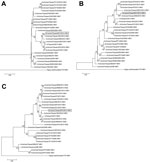
Figure. Phylogenetic relationship between influenza A(H6N1) virus A/canine/Taiwan/E01/2014 isolated from dogs in Taiwan (boxes) and other influenza A virus lineages. Maximum-likelihood analysis with bootstrap analysis was conducted with 1,000 replications. Only branches...


Phylogenetic analysis of HA and NA gene segments indicated that A/canine/Taiwan/E01/2014 belongs to the H6N1 lineage that has been circulating in chickens in Taiwan since 1997 (Figure, panels A, B). Although the lineage of internal gene segments (PB2, PB1, PA, NP, M, and NS) is composed mainly of H6N1 subtype viruses isolated in Taiwan, some H5N2 subtype isolates in the H6N1 lineage were observed (Figure, panel C; Technical Appendix[PDF - 148 KB - 1 page]).


Conclusions

Avian influenza A(H6N1) viruses have been widespread in chickens in Taiwan since 1972 (13&#150;15). These viruses are clustered in a unique lineage that differs from viruses circulating in Hong Kong and southeastern China since 1997 (13). Unlike avian species, H6 subtype virus infections are rare in mammals.
In this study, 9 of 474 dog serum specimens were positive for influenza A virus by ELISA, and 4/185 (2.1%) dogs had RT-PCR−positive results for this virus. A/canine/Taiwan/E01/2014 was isolated from 1 dog that was co-infected with canine distemper virus. On the basis of molecular analysis of A/canine/Taiwan/E01/2014, HA, NA, PB1, PB2, NP, and NS genes showed high homology (>97% nucleotide identity) with avian H6N1 subtype virus isolates that are currently prevalent in Taiwan. PA and M genes of A/canine/Taiwan/E01/2014 showed 99% nucleotide identity with A/chicken/Taiwan/2593/2013 (H5N2).

Phylogenetic analysis showed that 8 eight virus genes were derived from H6N1 subtype viruses isolated in Taiwan. All 8 influenza virus genes found in the dog probably originated from avian sources. We speculate that a complete avian influenza virus had infected this dog. However, additional analysis is required to verify this hypothesis.


Dr Lin is a postgraduate scientist at the National Taiwan University Veterinary Hospital, Taipei, Taiwan. Her research interests are veterinary virology and internal medicine in companion animals.

...

http://wwwnc.cdc.gov/eid/article/21/12/14-1229_article
 
Back
Top Bottom