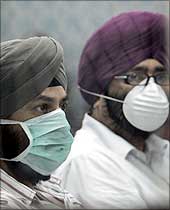
Re: Swine flu kills 13 within a fortnight in Andhra - total 16
H1N1 outbreak: authorities fail to ?see? it coming city Pulse
M. Sai Gopal
State average of swine flu deaths way above the national average
Officialdom fails to realise the importance of having more testing centres for H1N1
Patients from districts are being referred in droves to the hospitals in the capital
HYDERABAD: The ever-increasing number of H1N1 deaths in the State and utter chaos at swine flu screening centres has exposed the inherent frailties in the State government?s response to swine flu outbreak. What could have been a ?containable? outbreak, thanks to the failure of authorities to ?see? it coming, has now become a pandemic, threatening to claim more lives in the coming months.
The signals were there for all to see but nobody anticipated. Between May and August, the first swine flu case was reported from Hyderabad in May; the State government did nothing and lost precious time. During these months authorities insisted to operate only one swine flu nodal centre at Government Chest Hospital, Erragadda and did not expand H1N1 screening centres to districts and private hospitals.
By the time more isolation wards at private and Government Hospitals were roped in, the ?imported? H1N1 virus already had mutated by mixing with local viral forms and managed to sneak into the community. Since then, between September and October,
the virulent form of H1N1 virus has officially claimed 26 lives.
Several experts have claimed that the swine flu death toll has already crossed 40 in the State. If this is the case, then the State average of number of swine flu deaths with respect to the positive patients, which is over 400, is nearly ten per cent.
This is way above the national average, which is at three per cent. Only Maharashtra and Karnataka have more swine flu death average than Andhra Pradesh.
That the health infrastructure in government hospitals is crumbling is evident at Gandhi Hospital. Besieged with the swelling number of swine flu patients, the hospital has closed its outpatient services on Wednesday. As its emergency wards are filled with H1N1 cases, it had begun diverting all emergency admission cases to other hospitals already.
Furthermore, the political vacuum created after the death of Y. S. Rajasekhara Reddy, appears to have had a severe impact on the Government?s poor response.
The State capital was witness to a strange spectacle of the Chief Minister K. Rosaiah reviewing the swine flu situation in Gandhi Hospital, while the Health Minister D. Nagendar was busy attending condolence meetings. What enraged many was his brazen admission that condolences meetings were important for him rather than swine flu review meetings.
?The Ministers sent wrong signals to medical officers by not attending the review meeting of Chief Minister K. Rosaiah. There is no coordination among the three Ministers,? points out former member of Medical Council of India Dr. C. L. Venkat Rao.
In addition to the lack of a direction from the political executive, officials at the decision making level like the Director of Health and Commissioner of Andhra Pradesh Vaidya Vidhan Parishad (APVVP), are ?in-charge? appointees and therefore do not command total cooperation.
The government?s response to H1N1 at district-level too was found wanting. Save for ten isolation beds in each district, there are no ventilators, testing centres and trained doctors to treat H1N1 cases in districts.
As a result, patients from districts are being referred in droves to the hospitals in the capital.
Instead of making district hospitals ?self-sufficient? in treating H1N1 patients, authorities merely asserted that H1N1 virus is ?imported? and will not spread to the community.
The officialdom failed to realise the importance of having more testing centres for H1N1.
The Institute of Preventive Medicine (IPM), which started testing for H1N1 recently, can only test 50 samples a day while the demand is around 200 samples. The government did not take measures to equip the five district laboratories under IPM at Warangal, Kurnool, Guntur, Visakhapatnam and Tirupati for H1N1 testing.
Experts point out that there is a need for State government to come up with an order that provides legal immunity to private doctors while treating H1N1 patients. ?
A patient can initiate legal action if the doctor treats him without diagnosis. Due to this, several doctors refer patients to get tested for H1N1 at IPM first. Vital time is lost,? experts suggest. There should be a scope for doctors to prescribe swine flu treatment based on presumptive assessment instead of waiting for diagnostic results.
http://www.hindu.com/2009/09/24/stories/2009092458750300.htm