
• FluTrackers.com Inc. does not provide medical advice. Information on this web site is collected from various internet resources, and the FluTrackers board of directors makes no warranty to the safety, efficacy, correctness or completeness of the information posted on this site by any author or poster. The information collated here is for instructional and/or discussion purposes only and is NOT intended to diagnose or treat any disease, illness, or other medical condition. Every individual reader or poster should seek advice from their personal physician/healthcare practitioner before considering or using any interventions that are discussed on this website. By continuing to access this website you agree to consult your personal physican before using any interventions posted on this website, and you agree to hold harmless FluTrackers.com Inc., the board of directors, the members, and all authors and posters for any effects from use of any medication, supplement, vitamin or other substance, device, intervention, etc. mentioned in posts on this website, or other internet venues referenced in posts on this website.
  • We are not asking for any donations. Do not donate to any entity who says they are raising funds for us.

Svalbard: HPAI H5N5 Detected In Arctic Foxes - Sept 2026 Preprint Widespread H5N5 in Arctic Foxes

Michael Coston

Editor, Senior Moderator
Svalbard: HPAI H5N5 Detected In Arctic Foxes
AVvXsEgPTHn685kZ6rs_b74LJdR3uM2ImbnbhnhuPO1T4YXv0QFJQbrCfGuyzd3bawqEIidYlzaJ-04gcP0prUtSLbooRCkT_C6OlQhtHjJKdYZVmngMaial2a0ZaFhyQbquXpCApSBsmfGgRbAXyh00Rrp868Z8YkjHZP6UoXP5UNIXz-kykaEtUpg=w260-h340

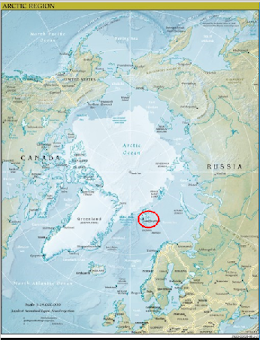
Location of Svalbard in the Arctic Ocean


#18,825

While H5N1 clade 2.3.4.4b is currently the dominant HPAI strain around the globe, older clades (2.3.2.1a in India and 2.3.2.1e in Cambodia) continue to circulate and occasionally spill over into humans.
Additionally, China has reported > 90 human infections with a different subtype; H5N6 (clade 2.3.4.4x), and we've been closely watching the spread of HPAI H5N5 in both Eastern Canada, and Northern Europe.


In the summer of 2022, the Norwegian Veterinary Institute reported both H5N1 and H5N5 for the first time in wild birds on Svalbard, which lies above the Arctic circle (see More HPAI (H5N5 & H5N1) Detected In Arctic (Svalbard).

Since then we've been tracking a small - but growing - number of spillovers of H5N5 to mammals in both Europe and Canada, including seals in the UK, domestic cats in Iceland, and raccoons (and other small mammals) in Canada.
Last summer, in Cell Reports: Multiple Transatlantic Incursions of HPAI clade 2.3.4.4b A(H5N5) Virus into North America and Spillover to Mammals, researchers reported finding the mammalian adaptive E627K mutation in a number of samples.​

While HPAI H5N5 doesn't currently appear likely to overtake or supplant H5N1, we've seen several abrupt dominant subtype changes (H1N1-> H5N8 -> H5N1) occur over the past 20 years.
With influenza, the only constant is change.

All of which brings us to the following (translated) report, published yesterday by the Norwegian Veterinary Institute, which reports on H5N5 infections in Arctic foxes on Svalbard.
Published 04.08.2025
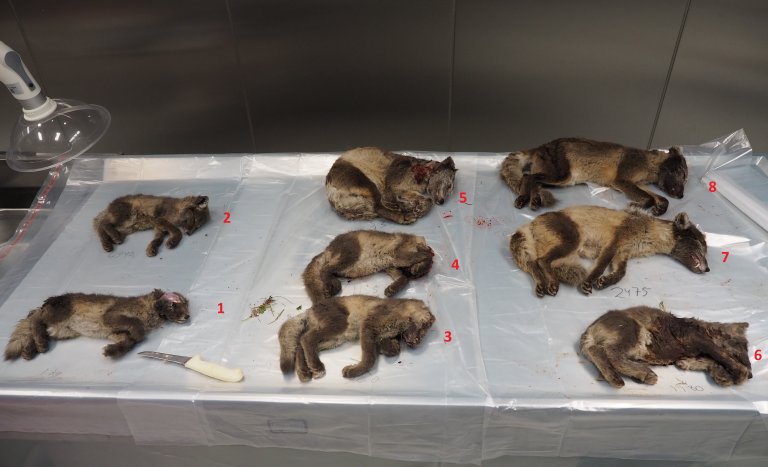
The Norwegian Veterinary Institute has detected highly pathogenic avian influenza virus in four arctic fox pups from an area near the Russian settlement of Barentsburg on Svalbard. This is the first time the virus has been detected in arctic foxes in Norway.
R%C3%B8drevSvalb.jpg
Arctic foxes from Svalbard have been studied at the Norwegian Veterinary Institute. Photo: Ingunn Ruud, Norwegian Veterinary Institute
At the end of July 2025, the Governor of Svalbard received a report of several sick mountain foxes near the Russian settlement of Barentsburg. Three sick pups were initially observed, and two of these were euthanized for animal welfare reasons. Due to the proximity to Barentsburg and increased rabies vigilance, the rest of the litter was euthanized. Of the three remaining pups, one was sick. In addition, three adult mountain foxes near the den were euthanized.

H5N5 is circulating in the highlands
The arctic foxes were sent to the Veterinary Institute in Ås for testing for rabies and avian influenza viruses. The analyses showed that all the foxes were negative for rabies virus, while four arctic fox pups were positive for highly pathogenic avian influenza virus. The virus detected is of the subtype H5N5, a subtype that circulates in the high north and has caused cases of disease in both wild birds and mammals in the Nordic countries, Iceland and the United Kingdom in recent years. The subtype was detected in a walrus in Svalbard in 2023.
On the mainland, the H5N5 subtype has been detected in Nordland and Finnmark in June and July, with the last case being in a black-backed deer in Vadsø at the end of July. There have been no detections of H5N5 in mammals in Norway this year, but the subtype was detected in otters in Tromsø in October and December 2024, and in red foxes in Kvænangen in February 2024.

Infection pressure when eating infected birds
Arctic foxes can become infected with avian influenza through direct contact with sick or dead animals. Foxes are scavengers that are exposed to high infection pressure when they eat infected birds. Studies of red foxes on the mainland indicate that foxes do not have the ability to infect each other. Whole-genome sequencing of the viruses from arctic fox pups will be carried out to investigate whether there are signs of mammalian adaptation in the viruses.

May resemble rabies infection
Highly pathogenic avian influenza virus can cause clinical signs of brain disease and are similar to those seen in rabies infection. Neurological signs such as circling gait, tilted head position, paralysis and decreased shyness towards humans are common. Both highly pathogenic avian influenza and rabies are serious diseases that can infect humans, and it is therefore important to avoid contact with sick animals. If the population of Svalbard observes sick animals with or without neurological symptoms, it is important that the findings are reported to the Governor.

Report any suspicions to the Norwegian Food Safety Authority
If there is suspicion of infection with avian influenza in birds and other animals, the Norwegian Food Safety Authority must be notified . The Veterinary Institute is the national reference laboratory for avian influenza and has PCR diagnostics and whole genome sequencing available for the detection and characterization of avian influenza viruses.


Although HPAI H5 is primarily regarded as a respiratory virus, two years ago (see Cell: The Neuropathogenesis of HPAI H5Nx Viruses in Mammalian Species Including Humans) researchers warned that ` . . . highly pathogenic avian influenza (HPAI) H5Nx viruses can cause neurological complications in many mammalian species, including humans'.

While clinical details on cases are often limited, we've already seen a small number of human infections reported as presenting with severe neurological involvement, including:

A sobering reminder that the next global health crisis may not play out like the last one, or the ones that came before. As epidemiologists like to say:

“If you’ve seen one pandemic . . . you’ve seen one pandemic.”

https://afludiary.blogspot.com/2025/08/svalbard-hpai-h5n5-detected-in-arctic.html
 
Last edited:
Please see:


Canada - One domestic cat was infected with highly pathogenic avian influenza H5N5 in Prince Edward Island (WOAH report, May 08, 2025)​ link

UK APHA: More Detections (n=13) of HPAI H5N5 In Seals

Iceland 2025 - "Three cats (one adult female and two 10 week old kittens) from the same household died on December 20., 21. and 22. after they had been ill for only a few days. The main clinical signs were lethargy, anorexia, cramps and stiffness. Other kittens from the same litter had been rehomed before those three got sick and they have not shown any symptoms. The most probable source of infection is wild birds. HPAI H5N5 have been diagnosed in a few wild birds in Iceland since September last year. On January 10 another cat was confirmed infected with HPAI H5N5. The cat had been sick since January 4, with fever and CNS symptoms. On January 6 it started to get epileptic seizures and was euthanized on January 9. There are two other cats in the household and they have no clinical symptoms. The cat has probably acquired the infection from an infected wild bird. A wild mink which was confirmed positive with HPAI H5N5 was found dead on January 19 on a location where many Greylag Geese have died due to HPAI H5N5. A wild Arctic Fox was observed sick on January 29 (lethargic, wobbly and apathetic). It was killed and the carcass brought to the laboratory where HPAI H5N5 was confirmed. A kitten was sick for a few days and finally got seizures and was then euthanized. Samples were taken and HPAI H5N5 was confirmed. Older cat in the same household was not affected." link
 

Preprint: Serological Evidence of Widespread Exposure to H5 Avian Influenza Virus in Arctic Foxes in Svalbard, Norway


AVvXsEgPTHn685kZ6rs_b74LJdR3uM2ImbnbhnhuPO1T4YXv0QFJQbrCfGuyzd3bawqEIidYlzaJ-04gcP0prUtSLbooRCkT_C6OlQhtHjJKdYZVmngMaial2a0ZaFhyQbquXpCApSBsmfGgRbAXyh00Rrp868Z8YkjHZP6UoXP5UNIXz-kykaEtUpg=w260-h340

Location of Svalbard in the Arctic Ocean

#19,343


The Svalbard Archipelago, located well above the Arctic Circle - roughly midway between the northern coast of Norway and the North Pole - is about the size of West Virginia and is home to fewer than 3,000 people.

Since 2022, Svalbard has also become a frequent center of HPAI H5 activity, reporting a mixture of H5N1 and H5N5 (see Norwegian Veterinary Institute : HPAI Detected In Arctic (Svalbard) For the First Time).

This becomes all the more important because Svalbard - like many high-latitude avian nesting regions - is the summer home for millions of migratory seabirds, waterfowl, waders, and other birds. As we saw in 2016's Sci Repts.: Southward Autumn Migration Of Waterfowl Facilitates Transmission Of HPAI H5N1, it is thought that these breeding areas may contribute to viral evolution and global spread of new reassortants.

As we discussed in 2025's H5Nx: Reassort & Repeat, each fall we watch for the introduction of new genotypes and/or subtypes with the autumn arrival of migratory birds.
Arctic+Preserve.png


We revisited the Svalbard story again in 2024's HPAI H5N5: A Variation On A Theme, and over the past few months, we've also seen extensive reporting on the detection of H5N5 in polar bears in the region.


While most of the world continues to deal primarily with clade 2.3.4.4b HPAI H5N1, since 2023 we've been following a relatively small - but persistent - presence of H5N5 in Northern Europe, Iceland, Eastern Canada, and even the Pacific Northwest.
AVvXsEi8M-PqaXvdBabflVtNrCgQ1cVWDjlBwEU13lYSUKpfOGKIVwVqWtseEyLf0IBp270UG65p5YesopY-2_DVzGmKd0GZcajEb0F2kVCtntGtvLZ1jyg9XI1R0lF1mB-RwOLzDYj6FTgUoVsVqTR9UcJilLi0v87QKNNnLHE3_gyx4o8lDCmb5J3ROA=w216-h223

Credit: Multiple transatlantic incursions of HPAI
clade 2.3.4.4b A(H5N5) virus into North America and spillover to mammals

Like H5N1, H5N5 appears to have an affinity for spilling over into mammalian species, including seals, walruses, polar bears, raccoons, mink, deer, domestic cats, and humans (n=1).

While these infections often prove fatal, we've also seen growing serological evidence of non-lethal infection.

In August of 2025, the Norwegian Veterinary Institute reported the first detection of H5N5 in Arctic Foxes on Svalbard Island. Their press release stated:
Arctic foxes can become infected with avian influenza through direct contact with sick or dead animals. Foxes are scavengers that are exposed to high infection pressure when they eat infected birds. Studies of red foxes on the mainland indicate that foxes do not have the ability to infect each other. Whole-genome sequencing of the viruses from arctic fox pups will be carried out to investigate whether there are signs of mammalian adaptation in the viruses.
This week researchers from the Norwegian Veterinary Institute have published a follow-up, in the form of a 26-page preprint, documenting serological evidence of widespread H5 exposure among Svalbard's population of Arctic foxes.

Due to its length I've only posted some excerpts (reformatted for readability), so you'll want to follow the link to read it in its entirety. I'll have a bit more after you return.

Serological Evidence of Widespread Exposure to H5 Avian Influenza Virus in Arctic Foxes in Svalbard, Norway

Johanna Hol H Fosse, Eva Fuglei, Francesco Bonfante, Line Olsen, Luca Bordes, Rebecca K. Davidson, Torill Mork, Ida Kristin Myhrvold, Lone Thiel Engerdahl, Sandra Venema, Kjersti Sturod, Johan Akerstedt, Olav Hungnes, Monika Z. Ballmann, Lineke Begeman, Ingebjorg Helena Nymo, Ragnhild Tonnessen, Bjornar Ytrehus
doi: https://doi.org/10.64898/2026.09.17.752278
This article is a preprint and has not been certified by peer review [what does this mean?].

Preview PDF

Abstract

The continued circulation of H5 clade 2.3.4.4b highly pathogenic avian influenza virus (HPAIV) has caused extensive mortality in wild bird populations worldwide with increasing spillover to mammals. In 2022, H5 HPAIV emerged in Svalbard, Norway, with subsequent detections in wild birds, walruses, polar bears, and arctic foxes.

To understand the population-level exposure among Svalbard arctic foxes, we analysed body fluids from carcasses trapped in 2006-2015 (n = 56), 2023-2024 (n = 112), and 2024-2025 (n = 94) for antibodies to H5 avian influenza (anti-H5), influenza A nucleoprotein (anti-NP), and neuraminidase subtypes using ELISAs, haemagglutination inhibition (HI), and a multiplex assay.
  • Only three samples from 2006-2015 tested positive for anti-H5 and were interpreted as false positives.
  • In 2023-2024, seropositivity for anti-H5 was high (95%), supported by a lower anti-NP seropositivity (85%) and antibody profiles consistent with mixed H5N1 (42%) and H5N5 (52%) exposure.
  • In 2024-2025, anti-H5 and anti-NP seroprevalences remained high (83% and 57%), with H5N5 (87%) exposure predominating over H5N1 (3%).
A subset of anti-H5-positive samples tested positive by HI (2023-2024: 30%; 2024-2025: 14%). Juveniles with exposure limited to the previous season had higher odds of anti-H5 seropositivity in 2023-2024 than in 2024-2025 (OR 5.5). Analysis of paired lung extracts from a subset of individuals (n = 63) yielded results concordant with body fluids, using an indirect anti-H5 ELISA adapted for carnivores. Our findings demonstrate widespread H5 virus exposure.
Together with occasional reports of progression to fatal HPAI, this highlights the need for continued population monitoring to evaluate ecological consequences.
(SNIP)

Discussion

Our study reveals widespread exposure to H5 avian influenza in Svalbard arctic foxes trapped during the winters 2023-2024 and 2024-2025, with no evidence of H5 exposure during the preemergence period (2006-2015), as the few anti-H5-positive results detected in that period were interpreted as likely false positives.

Antibody profiles changed over time, suggesting a transition from mixed H5N1 and H5N5 exposure in 2023-2024 to predominantly H5N5 exposure in 2024-2025.

Our findings demonstrate that many arctic foxes survive exposure to H5 avian influenza viruses and develop a detectable humoral response. However, recent detections of fatal HPAI in arctic fox pups suggest that the virus may have profound effects in some individuals, although its potential effects on population dynamics remain unknown. The temporal changes in antibody profiles should be viewed in the context of HPAIV detections in Svalbard wildlife. Both H5N1 and H5N5 viruses were detected in birds and marine mammals in 2023, whereas no detections were reported in 2024. However, H5N5 was subsequently detected in arctic foxes in 2025 and in a polar bear and an Atlantic walrus in 2026 [13,18].
(SNIP)

In conclusion, our findings demonstrate widespread exposure of Svalbard arctic foxes to H5 avian influenza virus following the emergence of clade 2.3.4.4b viruses in the High Arctic, with unknown consequences for the population. The exceptionally high seroprevalence, combined with temporal changes in antibody profiles, indicates substantial and evolving exposure within the Svalbard ecosystem. Arctic foxes may represent a useful sentinel species for monitoring HPAIV circulation in remote regions where conventional surveillance is challenging.

Continued integrated surveillance of wildlife hosts, predators, and scavengers will be important for understanding the long-term ecological consequences of HPAIV circulation and for detecting future changes in virus distribution, subtype composition, and transmission dynamics [18].

(Continue . . . )


Interestingly, while H5N1 remains the dominant HPAI across the rest of the world, in Svalbard (and potentially other poorly-monitored high-latitude regions); H5N5 appears to have - at least temporarily - gained the upper hand.

It’s not yet clear whether H5N5’s apparent success in Svalbard reflects some inherent viral advantage, favorable local environments or hosts, or simply chance.
But it's an outlier, which makes it well worth our continued attention.


https://afludiary.blogspot.com/2026/09/preprint-serological-evidence-of.html
 
Back
Top Bottom