Re: Summary of Arizona Dept. of Health
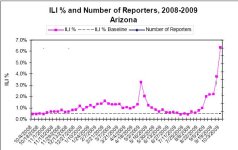
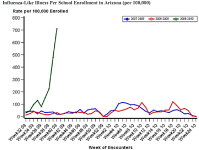
Arizona Department of Health Services H1N1 and Influenza Weekly Summary
OCTOBER 17, 2009
{Note there are 2 Reports: a Supplemental Report and a Highlights Report}
Cumulative H1N1 Deaths=46, New H1N1 Deaths=7 (2 of which were pediatric)
http://www.azdhs.gov/phs/oids/epi/flu/index.htm
Last Week All Confirmed Flu Subtypes / Last Week Confirmed H1N1Flu
Week of OCT 11-17
Apache 13 / 2
Cochise 127 / 4
Coconino 29 / 21
Gila 3 / 3
Graham 2 / 2
Greenlee 0 / 0
La Paz 0 / 0
Maricopa 539 / 805
Mohave 12 / 37
Navajo 11 / 16
Pima 227 / 35
Pinal 30 / 19
Santa Cruz 11 / 4
Yavapai 82 / 9
Yuma 71 / 24
Unknown 2 / 1
TOTAL 1159*/ 471*
*These numbers do not include several hundreds cases that have not been classified.
2009-2010 Influenza Season (Season began 10/4/2009)
Influenza activity highlights:
•1,159 laboratory-confirmed cases of influenza were reported in the past week,; this includes 471 laboratory-confirmed cases of 2009 H1N1 influenza. This number does not include several hundred cases that have not been classified.
•100% of subtyped influenza viruses at the Arizona State Laboratory during the previous week were 2009 H1N1 influenza virus
•5 pneumonia and influenza deaths were identified from death certificates in the past week; 5 pneumonia and influenza deaths have been identified in the 2009-2010 influenza season; 880 pneumonia and influenza deaths were identified during the 2008-2009 influenza season
•7 deaths associated with lab-confirmed 2009 H1N1 influenza virus were identified in the previous week; 46 deaths associated with the 2009 H1N1 influenza virus have been identified since April 2009.
•2 lab-confirmed influenza-associated pediatric deaths were reported in the past week and 3 deaths have been reported for the current season. All reported deaths were confirmed to be associated with the 2009 H1N1 influenza virus.
•The cases included in this report represent a small proportion of the true number of cases of influenza. Many people do not visit the doctor when ill and doctors should not be expected to run tests on all patients exhibiting influenza-like symptoms.
Laboratory-Confirmed Influenza Activity by Season [2007-2010]:
Positive influenza tests are reported to ADHS. These include many types of test (rapid tests, culture, PCR, DFA, etc.). Many of these do not distinguish 2009 H1N1 influenza from other influenza strains. Number of Lab-Confirmed Influenza Cases Reported by Week of Report, During 2007-2010.......
All Types Lab Confirmed Total 2009-2010 Season=2917*
Last Week=1159*
H1N1 Lab Confirmed Total 2009-2010 Season=1123*
Last Week=471*
Total H1N1 Since April 2009=3456*
*These numbers do not include several hundred cases that have not been classified.
Arizona State Public Health Laboratory (ASPHL) - Influenza Subtyping Data:
•In the past week, 396 specimens tested positive for influenza at ASPHL.
•100% of the influenza viral subtypes identified at ASPHL were 2009 H1N1 influenza.
3
Epidemiologic Information for confirmed 2009 H1N1 influenza cases since April 2009:
Total Confirmed H1N1 Cases
(N=3,456)
Investigated H1N1 Hospitalizations**
(N=552)
Identified H1N1-associated Deaths**
(N=46)
AGE
Range
9 Days – 89 Years
9 Days – 89 Years
1 Year – 77 Years
Mean, Median
20 years, 15 years
26 Years, 21 years
39 Years, 40.5 years
AGE GROUP
0 to 4 years
438 (13%)
117 (21%)
1 (2%)
5 to 18 years
1,709 (49%)
144 (26%)
9 (20%)
19 to 49 years
1,000 (29%)
174 (32%)
18 (39%)
50 to 64 years
234 (7%)
88 (16%)
14 (30%)
65 years or older
63 (2%)
29 (5%)
4 (9%)
Unknown age
12 (0%)
0 (0%)
0 (0%)
MEDICAL HISTORY & INFO
At least 1 Underlying Medical Condition*
N/A
372 (67%)
39 (85%)
Pneumonia at Time of Hospital Admission
N/A
220 (40%)
29 (63%)
Intensive Care Unit Admission
N/A
140 (25%)
35 (76%)
Mechanical ventilation required
N/A
80 (14%)
35 (76%)
*Medical conditions include: asthma, chronic lung disease, chronic heart or circulatory disease, metabolic disease, cancer, pregnancy, immunosuppressive condition, neurologic disease, and other chronic diseases.
**Investigations for identified H1N1 hospitalizations and deaths are ongoing. Pertinent data may not be collected for all identified cases at time of the report, so data presented above may be incomplete.
Glossary of Key Terms:
2009-2010 Influenza Season – The season is defined by surveillance weeks. The first day of the 2009-2010 influenza season was October 4th, 2009, or week 40 and the 2009-2010 surveillance season will continue through October 2nd, 2010, or week 39.
Widespread Activity – Increased influenza-like illness (ILI) and/or institutional outbreaks (ILI or laboratory-confirmed) in at least half of Arizona’s defined regions AND recent (within the previous three weeks) laboratory-confirmed influenza in the state.
Pneumonia and Influenza Mortality – Many influenza-related deaths are due to complications of influenza infection, including pneumonia, and influenza is infrequently listed as the cause of death on death certificates. Surveillance from death certificates often uses the category of “pneumonia and influenza” as an indicator, although not all pneumonias are associated with influenza. See the CDC website for more information
http://www.cdc.gov/flu/about/disease/us_flu-related_deaths.htm.
Hospitalization – A hospitalization, for purposes of 2009 H1N1 influenza investigations, is defined as a laboratory-confirmed 2009 H1N1 influenza case who has been admitted to the hospital for at least 24 hours.