• FluTrackers.com Inc. does not provide medical advice. Information on this web site is collected from various internet resources, and the FluTrackers board of directors makes no warranty to the safety, efficacy, correctness or completeness of the information posted on this site by any author or poster. The information collated here is for instructional and/or discussion purposes only and is NOT intended to diagnose or treat any disease, illness, or other medical condition. Every individual reader or poster should seek advice from their personal physician/healthcare practitioner before considering or using any interventions that are discussed on this website. By continuing to access this website you agree to consult your personal physican before using any interventions posted on this website, and you agree to hold harmless FluTrackers.com Inc., the board of directors, the members, and all authors and posters for any effects from use of any medication, supplement, vitamin or other substance, device, intervention, etc. mentioned in posts on this website, or other internet venues referenced in posts on this website.
  • We are not asking for any donations. Do not donate to any entity who says they are raising funds for us.

Study - Vaccinate Children to Reduce Medical Visits

sharon sanders

Editor-in-Chief & President
Childhood Influenza: Number Needed to Vaccinate to Prevent 1 Hospitalization or Outpatient Visit

Elizabeth N. Lewis, MD Marie R. Griffin, MD, MPH Peter G. Szilagyi, MD, MPH Yuwei Zhu, MD, MS Kathryn M. Edwards, MD Katherine A. Poehling, MD, MPH


Vanderbilt University Medical School
Departments of Medicine Preventive Medicine
Biostatistics
Pediatrics, Vanderbilt University Medical Center, Nashville, Tennessee
Department of Pediatrics
Strong Children's Research Center, University of Rochester School of Medicine and Dentistry, Rochester, New York
The goal was to assess the potential benefits of the influenza vaccine recommendations for children 6 to 59 months of age by estimating the number of children needed to be vaccinated to prevent 1 hospitalization or 1 outpatient visit attributable to influenza.

METHODS. The influenza burden was obtained from published studiesin which rates for children 6 to 23 months and 24 to 59 months of age could be ascertained. We assumed a range of influenza vaccine efficacies of 25% to 75%, consistent with the literature. We estimated the number of children who needed to be vaccinated to prevent 1 influenza-attributable hospitalization or 1 outpatient visit for each age group.

RESULTS. As both vaccine efficacy and severity of the influenza season increased, the number of children who needed to be vaccinated to prevent 1 hospitalization or 1 outpatient visit decreased. The numbers of children who needed to be vaccinated to prevent 1 hospitalization in a year with 50% vaccine efficacy ranged from 1031 to 3050 for children 6 to 23 months of age and from 4255 to 6897 for children 24 to 59 months of age. For every 12 to 42 children 6 to 59 months of age vaccinated in a year with 50% vaccine efficacy, we estimated that 1 influenza-attributable outpatient visit would be prevented.

CONCLUSIONS. With 1 outpatient visit being prevented through vaccination of <50 children, influenza vaccination can reduce influenza-attributable medical visits in children significantly, even in years with modest vaccine efficacy.

Key Words: influenza • vaccine efficacy • number needed to treat • hospitalizations • outpatient visits • children

Abbreviations: ACIP—Advisory Committee on Immunization Practices
Accepted Apr 24, 2007.

http://pediatrics.aappublications.org/cgi/content/abstract/120/3/467
 
Last edited by a moderator:
Re: Study - Vaccinate Children to Reduce Medical Visits

> The numbers of children who needed to be vaccinated to
> prevent 1 hospitalization in a year with 50% vaccine efficacy
> ranged from 1031 to 3050 for children 6 to 23 months of age
> and from 4255 to 6897 for children 24 to 59 months of age.

> For every 12 to 42 children 6 to 59 months of age vaccinated
> in a year with 50% vaccine efficacy, we estimated
> that 1 influenza-attributable outpatient visit would be prevented.

~2000 vaccinations prevent one hospitalization
~25 vaccinations prevent one outpatient visit

> CONCLUSIONS. With 1 outpatient visit being prevented
> through vaccination of <50 children, influenza vaccination
> can reduce influenza-attributable medical visits in children
> significantly, even in years with modest vaccine efficacy.

one vaccination = ~$10
one outpatient visit = ~$100(?)
so vaccination is not economical.
 
Re: Study - Vaccinate Children to Reduce Medical Visits

How do you measure the cost of one death or, the cost of someone who is so sick they enter the hospital?
 
Re: Study - Vaccinate Children to Reduce Medical Visits

updated

shannon1.jpg

shannon2.jpg

shannon3.jpg

shannon5.jpg
 
Last edited by a moderator:
Re: Study - Vaccinate Children to Reduce Medical Visits

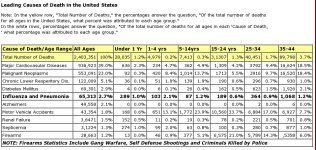
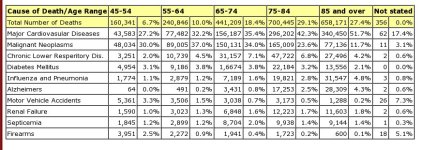
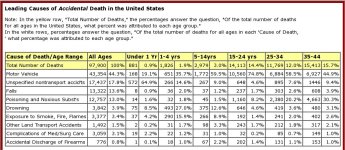
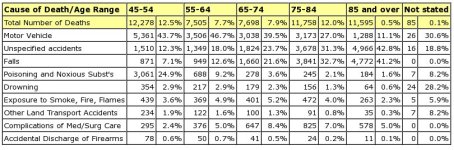
A staggering 2.7% of all U.S. deaths in the year 2002 (not a bad flu year BTW) were from flu and pneumonia. It even beat out the number of motor vehicle deaths!
 
Re: Study - Vaccinate Children to Reduce Medical Visits

The total cost for a small child is not known since they can not go by themselves.

An adult must take them. This would involve time off from work, transportation, and opportunity costs at the least.
 
Re: Study - Vaccinate Children to Reduce Medical Visits

A staggering 2.7% of all U.S. deaths in the year 2002 (not a bad flu year BTW) were from flu and pneumonia. It even beat out the number of motor vehicle deaths!


Year
Number of Flu Deaths
Number of Pneumonia Deaths
Number of Flu and Pneumonia Deaths Combined
----------------------------
1999 1665 62065 63730
2000 1765 63548 65313
2001 0257 61577 62034
 
Re: Study - Vaccinate Children to Reduce Medical Visits

Thanks you AnneZ for retrieving most of the data. I know it takes a lot of time and effort to correct the problem.
 
Re: Study - Vaccinate Children to Reduce Medical Visits

What has not (yet) reappeared is the total number of deaths from flu and pneumonia which were between 65,000 and 67,000.

GSGS your argument for not immunising children does not take into account the number of lost hours by parents who must remain home to nurse all those who do not visit the doctor. Neither does it calculate the pain and suffering of both the sick and the bereaved. Since our purpose here at FluTrackers is to reduce the morbidity and mortality we also need to add these costs into the equation along with the actual economic costs. If we didn't then we could also use the same rationale to not feed homeless children or, care for those who are nearing the end of their lives. All of which are completely unacceptable in my opinion. The cost in lost productivity alone must run into the millions if not billions. Vaccinate children and we reduce the morbidity and mortality for a significant portion of persons. Mandate vaccinations for everyone and we gain herd immunity thereby reducing the numbers to a tiny fraction. A thought to mull over.
 
Re: Study - Vaccinate Children to Reduce Medical Visits

http://www.businessgrouphealth.org/prevention/aciprecommendations.cfm

New ACIP Vaccine Recommendations

ACIP Broadens Flu Vaccine Recommendations

The Centers for Disease Control and Prevention's Advisory Committee on Immunization Practices (ACIP) recently announced that the targeted flu vaccination population should be broadened to include children ages 2 to 5 years old. In addition to this new age group, ACIP recommends that household contacts such as parents and siblings of the 2-to-5 age group also receive the flu vaccine. These groups should be given the vaccine every year.

The direct and indirect medical cost of influenza is substantial. About $75 billion is spent each year in direct (hospitalizations, physician visits) and indirect costs (lost productivity, loss of life) due to influenza for all age groups.
While influenza in the 2-to-5 age group makes up only a small percentage of serious illness or deaths, it is responsible for high health care utilization, and lost work time among parents. For example, One study found that for every 100 cases of influenza in young children, parents miss 20 days of work and family members experience 22 cases of secondary illness.
Further, because children spread the virus more readily than adults, vaccinating the 2-5 age group may provide more protection from flu complications for high-risk population such as the elderly and chronically ill.
Sources:
Brown, David "Wider Flu Vaccination Urged" The Washington Post. February 23. 2006. Available at www.washingtonpost.com Neuzil KM, Hohlbein C, Zhu Y. Illness among schoolchildren during influenza season. Effect on school absenteeism, parental absenteeism from work, and secondary illness in families. Arch Pediatr Adolesc Med 2002;156:986-91.
 
Re: Study - Vaccinate Children to Reduce Medical Visits

> For example, One study found that for every 100 cases of influenza in young children,
> parents miss 20 days of work and family members experience 22 cases of secondary illness.

these secondary cases are counted in the statistics as well,
so let's see the 0.2 days of missed work.
That's about $30. Seems rather low.
Add that to the $4 for the outpatient visit.


the $75B cost of influenza per year is only given in one source.
When I search the web , I find:

----------------------------------------------------------
http://www.cdc.gov/ncidod/EID/vol5no5/meltzer.htm
estimate $71 - $166 billion cost for a pandemic

http://sec.edgar-online.com/2001/05/15/0001095811-01-502241/Section7.asp
The Health Care
Financing Administration estimates that the cost of influenza in the United
States was $12.0 billion in 1992

The most significant cost of influenza to society is the indirect cost of lost productivity and absenteeism. In Europe influenza accounts for around 10 percent of sick leave while the cost of lost productivity in France and Germany alone is estimated at ? 8.3 to 12.6 billion per year.

In the United States, the. economic cost of influenza epidemics. exceeds $12 billion annually

In a study of the cost of influenza in France during 1989, the costs to society were FF14.3 billion [2.18 billion euro (EUR), $US2.05 billion

for Germany: Euro 1.1B (RKI) , Swiss estimates: upto Euro5B per year
http://64.233.183.104/search?q=cach...+milliarden&hl=en&ct=clnk&cd=1&gl=de&ie=UTF-8

-----------------------------------------------------------------------------------------------------

so, let's say an average of $25B as total cost for influenza in USA per year.
Or $83 per citizen per year.
The Cochrane multi-study gave 0.4 saved work-days per influenza vaccination.
This is in a similar order of magnitude

the costs for pediatric cases is not clear from the given data.
The 0.2 workdays missed per case probably don't refect the real costs

any estimates of the real costs ? I'll have to search for it.
maybe someone else can do it...
 
Back
Top