
RISK OF GLOBAL CLIMATE CHANGE BY BP OIL SPILL
Gianluigi Zangari
(edited)
The Gulf Stream importance in the global climate thermoregulation processes is well assessed. The latest real time satellite data maps of May-June 2010 show for the first time a direct evidence of the rapid breaking of the Loop Current, a warm ocean current, crucial part of the Gulf Stream.
As displayed both by the sea surface velocity maps and the sea surface height maps, the Loop Current broke down for the first time around May 18th and generated a clock wise eddy, which is still active.
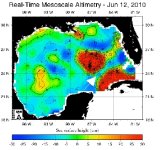
As of today the situation has deteriorated up to the point in which the eddy has detached itself completely from the main stream therefore destroying completely the Loop Current, as in figure 2 below, dated June 12th 2010.
Since comparative analysis with past satellite data until may 2010 didn’t show relevant anomalies, it might be therefore plausible to correlate the breaking of the Loop Current with the biochemical and physical action of the BP Oil Spill on the Gulf Stream. It is reasonable to foresee the threat that the breaking of a crucial warm stream as the Loop Current may generate a chain reaction of unpredictable critical phenomena and instabilities due to strong non linearities which may have serious consequences on the dynamics of the Gulf Stream thermoregulation activity of the Global Climate.
http://www.associazionegeofisica.it/OilSpill.pdf
Arrow shows where the large eddy has detached from the Loop Current in this June 12, 2010 pic.
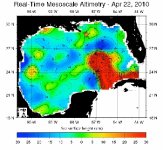
Here is how the current looked on April 22, 2010
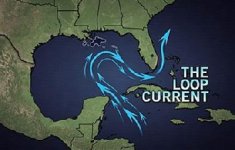
I found this good loop pic in an unrelated USAtoday story explaning how the current could spread the oil.
http://content.usatoday.com/communities/sciencefair/post/2010/05/in-the-loop-current/1
In comparing the pictures, it really does look like a very large portion of the loop has broken off. The USAtoday article talks about small eddies often forming at the edge of the current and these apparently don't cause problems ordinarily. I wonder if we have ever experienced such a large portion breaking off before?
Gianluigi Zangari
(edited)
The Gulf Stream importance in the global climate thermoregulation processes is well assessed. The latest real time satellite data maps of May-June 2010 show for the first time a direct evidence of the rapid breaking of the Loop Current, a warm ocean current, crucial part of the Gulf Stream.
As displayed both by the sea surface velocity maps and the sea surface height maps, the Loop Current broke down for the first time around May 18th and generated a clock wise eddy, which is still active.
As of today the situation has deteriorated up to the point in which the eddy has detached itself completely from the main stream therefore destroying completely the Loop Current, as in figure 2 below, dated June 12th 2010.
Since comparative analysis with past satellite data until may 2010 didn’t show relevant anomalies, it might be therefore plausible to correlate the breaking of the Loop Current with the biochemical and physical action of the BP Oil Spill on the Gulf Stream. It is reasonable to foresee the threat that the breaking of a crucial warm stream as the Loop Current may generate a chain reaction of unpredictable critical phenomena and instabilities due to strong non linearities which may have serious consequences on the dynamics of the Gulf Stream thermoregulation activity of the Global Climate.
http://www.associazionegeofisica.it/OilSpill.pdf
Arrow shows where the large eddy has detached from the Loop Current in this June 12, 2010 pic.
Here is how the current looked on April 22, 2010
I found this good loop pic in an unrelated USAtoday story explaning how the current could spread the oil.
http://content.usatoday.com/communities/sciencefair/post/2010/05/in-the-loop-current/1
In comparing the pictures, it really does look like a very large portion of the loop has broken off. The USAtoday article talks about small eddies often forming at the edge of the current and these apparently don't cause problems ordinarily. I wonder if we have ever experienced such a large portion breaking off before?