Pathfinder
Editor, Senior Moderator
H1N1 follows ethnic pattern
STUDY: Alaska Natives, Asians among groups most hospitalized with swine flu.
By ROSEMARY SHINOHARA
rshinohara@adn.com
Published: November 28th, 2009 04:34 PM
Last Modified: November 28th, 2009 10:34 PM
State and federal health officials wanted to know what kind of people were hospitalized with swine flu, so they studied Anchorage residents who tested positive and were admitted at four area hospitals over several weeks -- 59 people.
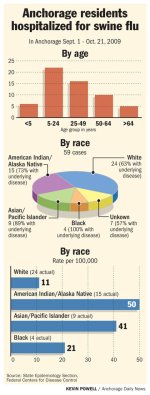
The biggest surprise, according to state epidemiologist Dr. Joe McLaughlin: People from two ethnic groups -- Alaska Natives and American Indians, and Asians and Pacific Islanders -- were hospitalized at higher rates than those in any other ethnic groups.
The rate for Alaska Natives was 4 1/2 times greater than for white people, at 50 per 100,000, said McLaughlin. Asians and Pacific Islanders weren't far behind Alaska Natives, at a rate of 41 hospitalizations per 100,000.
As expected, most people of all races who were hospitalized -- 71 percent -- had another medical condition that put them at higher risk of complications from the flu.
The most common pre-existing health problem was asthma, which affected 17 of those admitted, said Dr. Jay Wenger, an epidemiologist with the Arctic Investigation Program of the federal Centers for Disease Control and Prevention. Wenger was one of the report's authors.
Heart disease was next with 10 people, and other lung diseases were next with six people. People might have had more than one underlying condition.
Nine of the 59 people were so seriously ill they were treated in intensive care units. One of the 59 died.
The researchers studied Anchorage residents hospitalized from Sept. 1 through Oct. 21 at Providence Alaska Medical Center, Alaska Regional Hospital, the Elmendorf Air Force Base hospital and Alaska Native Medical Center. They eliminated anybody not from Anchorage, even if they were hospitalized here, so they could compare the results against Anchorage's known demographics.
None of the people had received the H1N1, or swine flu, vaccine, which was first available in Alaska in limited quantities in early October.
But most of the patients -- 73 percent -- were in one of the five priority groups established by the CDC for getting vaccinated.
Wenger said researchers suspected in advance that Alaska Natives might be especially affected by swine flu because prior studies show that the highest rates of respiratory diseases in Alaska occur in Native people.
The fact that a greater proportion of Alaska Natives are younger than 24 than the population as whole also might have contributed to Alaska Natives' higher rates of serious illness with swine flu in the study, said McLaughlin.
Young people all across the country are more vulnerable to the swine flu that's taken hold this year, compared with normal, seasonal flu viruses.
Fifty-eight percent of the Alaska Native and Asian-Pacific Islander patients hospitalized in Anchorage during the study were young -- under age 25. Only 29 percent of the whites hospitalized were under 25.
The researchers picked Anchorage to study first because there are more patients here. Wenger said the CDC will also help the state look at people hospitalized in some other parts of Alaska, including the Yukon-Kuskokwim delta.
http://www.adn.com/swineflu/story/1031513.html
STUDY: Alaska Natives, Asians among groups most hospitalized with swine flu.
By ROSEMARY SHINOHARA
rshinohara@adn.com
Published: November 28th, 2009 04:34 PM
Last Modified: November 28th, 2009 10:34 PM
State and federal health officials wanted to know what kind of people were hospitalized with swine flu, so they studied Anchorage residents who tested positive and were admitted at four area hospitals over several weeks -- 59 people.
The biggest surprise, according to state epidemiologist Dr. Joe McLaughlin: People from two ethnic groups -- Alaska Natives and American Indians, and Asians and Pacific Islanders -- were hospitalized at higher rates than those in any other ethnic groups.
The rate for Alaska Natives was 4 1/2 times greater than for white people, at 50 per 100,000, said McLaughlin. Asians and Pacific Islanders weren't far behind Alaska Natives, at a rate of 41 hospitalizations per 100,000.
As expected, most people of all races who were hospitalized -- 71 percent -- had another medical condition that put them at higher risk of complications from the flu.
The most common pre-existing health problem was asthma, which affected 17 of those admitted, said Dr. Jay Wenger, an epidemiologist with the Arctic Investigation Program of the federal Centers for Disease Control and Prevention. Wenger was one of the report's authors.
Heart disease was next with 10 people, and other lung diseases were next with six people. People might have had more than one underlying condition.
Nine of the 59 people were so seriously ill they were treated in intensive care units. One of the 59 died.
The researchers studied Anchorage residents hospitalized from Sept. 1 through Oct. 21 at Providence Alaska Medical Center, Alaska Regional Hospital, the Elmendorf Air Force Base hospital and Alaska Native Medical Center. They eliminated anybody not from Anchorage, even if they were hospitalized here, so they could compare the results against Anchorage's known demographics.
None of the people had received the H1N1, or swine flu, vaccine, which was first available in Alaska in limited quantities in early October.
But most of the patients -- 73 percent -- were in one of the five priority groups established by the CDC for getting vaccinated.
Wenger said researchers suspected in advance that Alaska Natives might be especially affected by swine flu because prior studies show that the highest rates of respiratory diseases in Alaska occur in Native people.
The fact that a greater proportion of Alaska Natives are younger than 24 than the population as whole also might have contributed to Alaska Natives' higher rates of serious illness with swine flu in the study, said McLaughlin.
Young people all across the country are more vulnerable to the swine flu that's taken hold this year, compared with normal, seasonal flu viruses.
Fifty-eight percent of the Alaska Native and Asian-Pacific Islander patients hospitalized in Anchorage during the study were young -- under age 25. Only 29 percent of the whites hospitalized were under 25.
The researchers picked Anchorage to study first because there are more patients here. Wenger said the CDC will also help the state look at people hospitalized in some other parts of Alaska, including the Yukon-Kuskokwim delta.
http://www.adn.com/swineflu/story/1031513.html