Re: State issues preliminary report on swine flu hospitalizations
Complete DHSS report is here:
http://www.epi.alaska.gov/bulletins/docs/b2009_30.pdf
NOTE this is ONLY for Anchorage.
Influenza Hospitalizations ? Municipality of Anchorage, September 1 ? October 21, 2009
Introduction
Since May 2009, laboratory-confirmed 2009 H1N1 influenza
infection has been diagnosed in over 1,000 Alaskans, and 10
Alaskans are known to have died from the virus.1 Staff from the
Centers for Disease Control and Prevention?s Arctic Investigations
Program (CDC/AIP), four Anchorage hospitals, and Section of
Epidemiology (SOE) collaborated to describe the clinical and
epidemiologic characteristics of Anchorage residents who were
hospitalized with laboratory-confirmed influenza infection.
Methods
A case was defined as an acute respiratory illness in a person
hospitalized from September 1 through October 21, 2009 in one of
four acute care hospitals in the Municipality of Anchorage (MOA;
2008 population, 284,994)2, who had lived in the MOA >1 month
prior to admission, and tested positive for influenza A by rapid test
or for 2009 H1N1 influenza by PCR or culture. Case-patients were
identified through review of discharge diagnosis codes (ICD-9CM
487.0, 487.1, 487.8 or 488.1) and lists of patients with influenzalike
illness (ILI) kept by hospital infection preventionists. Medical
records were abstracted using a form modified from a prior CDC
study.3 Race was determined by patients? medical records.
Results
Of the 59 persons identified who met the case definition, 32 (54%)
were female; the median age was 27 years (range: 1 month to 81
years). Five (8%) patients were aged <2 years and 3 (5%) were
aged <6 months. Hospitalization rates were highest in persons
aged <25 years and persons aged >64 years; however, when
compared with persons aged 25?64 years, the rate differences
were not statistically significant. Most patients had an underlying
medical condition (Table); the most common co-morbidities were
asthma (29%) and heart disease (17%). Three (5%) patients were
pregnant. Of the 25 patients aged >18 years for whom a body mass
index (BMI) was calculated, 11 (44%) were obese (BMI >30); by
comparison, 28% of Alaskan adults surveyed in 2007 reported
having a BMI >30.4
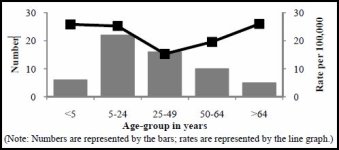
Figure. Influenza Hospitalizations (N=59) and Rates by Age-Group
? Municipality of Anchorage, Sep 1?Oct 21, 2009
(Note: Numbers are represented by the bars; rates are represented by the line graph.)
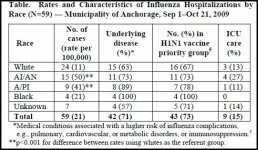
*Medical conditions associated with a higher risk of influenza complications,
e.g., pulmonary, cardiovascular, or metabolic disorders, or immunosuppression.5
**p<0.001 for difference between rates using whites as the referent group.
Of the 52 (88%) patients for whom race was determined, 46%
were white, 29% were American Indian/Alaska Native (AI/AN),
17% were Asian/Pacific Islander (A/PI), and 8% were black;
hospitalization rates were highest for AI/AN and A/PI (Table). A
higher proportion of AI/AN and A/PI patients were aged <25
years (14/24, 58%) compared with whites (7/24, 29%; p<0.05).
Among AI/AN and A/PI patients, 13/14 (93%) aged <25 years and
8/10 (80%) aged >25 met the current criteria for empiric antiviral
therapy prior to hospitalization.6 Most patients were in a 2009 H1N1
vaccine priority group (Table); none received 2009 H1N1 vaccine
prior to hospitalization (the vaccine was first available for priority
groups in Alaska in early October). Among persons aged >6 months
who were not in a vaccine priority group (seven white, two AI/AN,
two A/PI, and zero black patients), differences in hospitalization
rates by race were not statistically significant (data not shown).
The mean length of hospital stay was 3.8 days (range 1?40); the
duration of hospitalization did not differ significantly by race or agegroup.
Oseltamivir was administered to 46 (78%) of hospitalized
patients. Eight (15%) patients were admitted to an intensive care unit
(ICU; Table); one (3%) person died.
Discussion
Characteristics of MOA residents hospitalized with influenza were
similar to those of patients reported in previous North American
reviews.3,7 Hospitalization rates were high in persons aged <25 years,
most cases occurred in persons with pre-existing health conditions,
and a higher proportion of adult patients were obese when compared
to the general population. One notable difference was the high
hospitalization rate among patients aged >64 years; however, this
higher rate was not statistically significant when compared to the rate
in persons aged 25?49 years.
In this evaluation, the race-specific hospitalization rates were highest
for AI/AN and A/PI persons, particularly those aged <25 years. Most
AI/AN and A/PI hospitalizations occurred in persons who were in
one of the 2009 H1N1 influenza vaccine priority groups (18/24;
75%) and persons for whom empiric antiviral treatment is currently
recommended (21/24; 88%).5,6 Therefore, these data do not support a
need to modify CDC?s existing 2009 H1N1 vaccine priority groups
or empiric treatment recommendations for Alaska.5,6
This evaluation is subject to several limitations. First, small sample
sizes limit the ability to compare rates with a high degree of
certainty. Second, we did not assess differences in hospital admission
practices by disease severity or influenza testing patterns by facility,
both of which could have affected the rate estimates.
Recommendations
1. Vaccinate all persons who are in one of the 2009 H1N1
influenza vaccine priority groups as soon as possible.5
2. Provide early empiric antiviral treatment to all patients at higher
risk for complications as per current CDC guidelines.6
3. Submit nasopharyngeal samples for 2009 H1N1 testing as per
the current testing recommendations, which are available at:
http://www.hss.state.ak.us/dph/labs/pdfs/H1N1Sample.pdf
References
1. Section of Epidemiology. Alaska Influenza Surveillance Report. Available at:
http://www.epi.alaska.gov/id/influenza/influenza.jsp
2. Alaska Dept of Labor and Workforce Development, Workforce Info, Population
Estimates. Available at:
http://laborstats.alaska.gov/?PAGEID=67&SUBID=171
3. Jain S, Kamimoto L, Bramley A, et al. Hospitalized patients with 2009 H1N1
influenza in the United States, April?June 2009. NEJM 2009;361(20):1935-44.
4. Section of Chronic Disease Prevention and Health Promotion. ?Health Risks in
Alaska Among Adults?, Alaska Behavioral Risk Factor Survey 2007. Available at:
http://www.hss.state.ak.us/dph/chronic/obesity/pubs/Obesity-Trend.pdf
5. Section of Epidemiology. ?Recommendations for Influenza A (H1N1) 2009
Monovalent Vaccine.? Epidemiology Bulletin No. 27, October 14, 2009. Available at:
http://www.epi.alaska.gov/bulletins/docs/b2009_27.pdf
6. Recommendations for Early Empiric Antiviral Treatment in Persons with Suspected
Influenza who are at Increased Risk of Developing Severe Disease. CDC.
http://www.pandemicflu.alaska.gov/PDFs/AKPHAN_EmpiricAntiviral10-19-09.pdf
7. Kumar A, Zarychanski R, Pinto R, et al. Critically ill patients with 2009 influenza
A(H1N1) infection in Canada. J Am Med Assn 2009;302(17):1872
Acknowledgements
We would like to thank Sarah Freeman and Kathy Schultz, Alaska Native Medical
Center; Shelley White, Alaska Regional Hospital; Kelley Foreman, Providence Alaska
Medical Center; Cindy Hamlin, Third Medical Group (Elmendorf Air Force Base);
staff in the Medical Records Departments at these institutions; and Kim Boyd-
Hummel, Debbie Hurlburt, and Sassa Kitka, from CDC/AIP.
Department of Health and Social Services
William H. Hogan, MSW, Commissioner
Division of Public Health
Ward Hurlburt, MD, MPH, CMO/Director
Editor:
Joe McLaughlin, MD, MPH
Bulletin No. 30 November 25, 2009
3601 C Street, Suite 540 Local (907) 269-8000
Anchorage, AK 99503
http://www.epi.Alaska.gov 24 Hour Emergency 1-800-478-0084
(Contributed by Jay Wenger, MD, AIP; Thomas Hennessy, MD, MPH, AIP; Louisa Castrodale, DVM, MPH, SOE; and Donna Fearey, ANP, MS, SOE.)
.

