
• FluTrackers.com Inc. does not provide medical advice. Information on this web site is collected from various internet resources, and the FluTrackers board of directors makes no warranty to the safety, efficacy, correctness or completeness of the information posted on this site by any author or poster. The information collated here is for instructional and/or discussion purposes only and is NOT intended to diagnose or treat any disease, illness, or other medical condition. Every individual reader or poster should seek advice from their personal physician/healthcare practitioner before considering or using any interventions that are discussed on this website. By continuing to access this website you agree to consult your personal physican before using any interventions posted on this website, and you agree to hold harmless FluTrackers.com Inc., the board of directors, the members, and all authors and posters for any effects from use of any medication, supplement, vitamin or other substance, device, intervention, etc. mentioned in posts on this website, or other internet venues referenced in posts on this website.
  • We are not asking for any donations. Do not donate to any entity who says they are raising funds for us.

Sri Lanka: 2009 Dengue- 33,081 cases; 334 deaths

Re: Sri Lanka: Dengue- 156 deaths; 13,692 cases

Re: Sri Lanka: Dengue- 156 deaths; 13,692 cases

Source: http://www.sundaytimes.lk/090705/News/sundaytimesnews_13.html

Dengue crisis bigger than Bti
Experts call for comprehensive eradication plan
By Kumudini Hettiarachchi

Cuba is to send some experts to Sri Lanka for discussions and relevant studies with authorities after which a decision would be taken over the type of ?bug? or bacteria needed against the dengue menace which has caused the deaths of 163 and affected nearly 15,000 others.

Two Cuban experts are expected soon, said a high-level Health Ministry source, explaining that once that happens, the bacteria ? Bacillus thuringiensis sub-species israelensis (Bti) ?which they are planning to use as a biological pest control agent against the mosquito larvae will be imported to Sri Lanka in the many-pronged battle against dengue. (See box for how the bug works and what approvals are needed)

While the authorities were awaiting such expertise, mosquito-control was among many issues raised at an urgent, top-level meeting summoned by the ministry on Friday, where detailed discussions were held among experts and professors from the fields of entomology, parasitology, zoology and epidemiology. A technical committee is being formed, it is learnt.
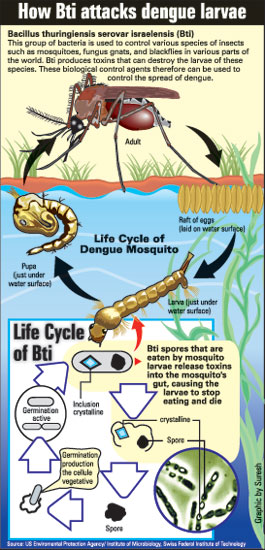
Final-Dengu.jpg
The most-important aspects of dengue control such as keeping the environment free of small containers including yoghurt cups, coconut shells, rigi-foam containers, pieces of polythene etc, proper garbage collection and disposal, and the need for fogging in dengue-affected areas were also stressed, the Sunday Times understands.

Explaining the different stages at which the dengue mosquito could be contained, an expert said that the most urgent requirement would be to deal with ?source reduction? or the breeding grounds not only during an epidemic but all the time.

?If you remove the breeding places (in Sri Lanka the dengue mosquito is known to be mainly a ?container breeder?), the mosquito or vector will not be able to lay its eggs and the dengue threat could be contained, he said, adding that next would come steps to destroy the larvae followed by measures to deal with the adult mosquito.

While the application of biological agents such as Bti could prevent the larvae from growing to be adults, fogging, in turn, would destroy this tiny but potent mosquito which has brought death to many people, it is learnt.

The people are expecting a ?miracle? in the form of Bti in controlling dengue but this is a ?complementary? measure which has to be done parallel with all others such as destroying breeding places, garbage control and also fogging, another source stressed.

For, Bti has been used in trials in Sri Lanka as far back as 2004, the Sunday Times learns, where its application was found to have ?limited usefulness? and that too only for generally large water bodies such as water tanks.

Do you think people will go around their homes putting Bti into small containers or even bird baths and vases, queried another source, adding that it will be easier to clear domestic premises of such containers.

Explaining how it works, the source said Bti must be at the water surface for the mosquito larvae which is also suspended there to feed on it and die. What happens is that the Bti, after several days, goes down or precipitates at the bottom of the tank, while the larvae remain at the surface. ?So to ensure success, Bti will have to be introduced to these tanks every seven days or so,? he said.

Another question raised by a source was whether the Cuban Bti (in liquid form) has been evaluated and passed by the World Health Organization (WHO) for use in public health programmes, while another pointed out that Bti from a different country (in powder form) is already being used in the Colombo Municipal Council (CMC) area.

The WHO Pesticide Evaluation Scheme (WHOPES) collects, consolidates, evaluates and disseminates information on the use of pesticides for public health. Its recommendations facilitate the registration of pesticides by member states, according to its website.

Health sources claimed that as far as they knew the Cuban Bti has not been put up for evaluation to WHOPES and efforts to contact the WHO Colombo office were unsuccessful.

The Sunday Times was also unable to contact CMC officers to check whether they were using Bti from another country and how successful it was in curbing dengue. If the CMC is using Bti, the number of dengue patients in its area would point otherwise, another source said.

The consensus among the experts, however, was that a concerted effort was needed to battle dengue not only on one front but on all ? while larvae control with biological agents was important as would be fogging for the adult mosquito, emphasis should be on ridding homes, offices, roads, playgrounds and parks of breeding grounds by cleaning-up the environment and having proper garbage disposal.


That is the long-term answer, echoed by many over the years, but not implemented leading to the unnecessary deaths of men, women and children from a preventable disease.

What is Bti

Bti, a bacterium found naturally in soil, has been used as a biological pest control agent to combat both, mosquitoes and black-flies experts have found. Bacterium is the simplest and smallest form of life.

During the spore-forming stage of its lifecycle, the Bti bacterium produces a protein crystal which is toxic only to the mosquito and black-fly larvae. When the crystals are ingested by the insect larva when feeding, the alkaline environment of its digestive system makes them dissolve and convert into toxic protein molecules that destroy the walls of its stomach. The larva dies within days, it is learnt.

The bacteria are not harmful to humans and animals because their acidic stomachs do not activate the Bti toxins, sources said.

Bti bacteria are applied directly to the water where mosquito and black-fly larvae are found, the Sunday Times understands. However, none of the products containing Bti are generally applied to treated, finished drinking water for human consumption, a source pointed out because during the production process, if contaminated, when fermenting Bti, could release other bacteria which could be harmful to humans.

That?s why WHO evaluation is of paramount importance, sources pointed out.

Procedure for bringing in a biological agent

As Bti would be brought in the form of a pesticide, it has to be mandatorily registered with the Registrar of Pesticides who would look into aspects of safety, check out pest-risk analysis and specific certification etc., which process would take about six months to a year, it is disclosed.

However, based on ?exigencies of need? the process could be expedited if there is a Health Ministry request, it is learnt. In this case, there would be no problem, because it is already registered after 2004 trials, a source said. Meanwhile, environmentalist Jagath Gunawardena said Bti was a harmless, species specific bacteria which would only affect the mosquito larvae.
 
Re: Sri Lanka: Dengue- 163 deaths; 14,692 cases

Re: Sri Lanka: Dengue- 163 deaths; 14,692 cases

Source: http://www.dailymirror.lk/DM_BLOG/Sections/frmNewsDetailView.aspx?ARTID=53888

Two specialists here with bacteria to combat Dengue


By Sandun A Jayasekera

A stock of BTI (Bacillus Thurengenesis Israelenesis) bacteria from Cuba, used to combat the dengue mosquito, together with two microbiologists are expected in the country this week, a health ministry spokesman said yesterday.

The airlifting of BTI initially hit a snag, as many countries are reluctant to provide transshipment or transit facilities and special arrangements are required to import it. Health Minister Nimal Siripala De Silva made the request for a stock of BTI from Cuba almost a month ago, the spokesman said. ?The health ministry decided on this measure to try to end the dengue epidemic which is out of control. The BTI bacteria is said to be a forbidden item in Sri Lanka as well as abroad and there had to be several diplomatic and quarantine related steps taken before it was permitted in the country. The Health and Foreign Affairs Ministries, the Bandaranaike International Airport Quarantine Section and the Cuban Embassy attended to the necessary modalities, he said. Meanwhile the number deaths attributed to dengue rose to 163 while the number detections rose to 14,692 by yesterday, he said.
 
Re: Sri Lanka: Dengue- 163 deaths; 14,692 cases

Re: Sri Lanka: Dengue- 163 deaths; 14,692 cases

Source: http://www.dailynews.lk/2009/07/09/news21.asp

Thursday, 9 July 2009
New system to identify dengue patients

Nadira GUNATILLEKE

The Healthcare and Nutrition Ministry has taken a decision to formulate a new system to identify dengue patients who require hospitalization, a Healthcare and Nutrition Ministry spokesman said.

He said a special discussion was held at the Epidemiology Unit yesterday.

Healthcare and Nutrition Minister Nimal Siripala de Silva, Senior Paediatricians and Physicians from Lady Ridgway Hospital, Peradeniya, Kandy, Kegalle, Ragama and Kalubowila Teaching Hospitals participated. It was also revealed that delays in hospitalization is a major reason behind the increasing number of dengue deaths. It was decided to provide special training for physicians and paediatricians in both main and regional hospitals, trained OPD doctors, improve protocols in treating dengue patients and educate the public. It was also decided that patients with Dengue Haemorrhagic Fever should be treated by experienced doctors.

The intention of the discussion was to present new recommendations on preventing deaths caused by Dengue Haemorrhagic Fever and Dengue Shock Syndrome and exchanging experiences on controlling dengue.
 
Re: Sri Lanka: Dengue- 168 deaths; 15,528 cases

Re: Sri Lanka: Dengue- 168 deaths; 15,528 cases

Source: http://www.colombopage.com/archive_091/Jul1247150233RA.html

* Dengue patients in Sri Lanka over 15,000, 168 deaths
Thu, Jul 9, 2009, 08:07 pm SL Time, ColomboPage News Desk, Sri Lanka.

July 09, Colombo: For the first time in Sri Lankan history the total number of dengue infected cases has gone past 15,000 in less than a year with a death toll of 168.

The Dengue Prevention Unit said that 15,528 are infected with the highest number of patients reported in the last month, totaling 6699.

The highest number of deaths reported from Gampaha District with 33 deaths, The Dengue Prevention Unit confirmed.


The two entomologists from Cuba had already reached the country to make a special frame work to control the dengue epidemic.

Sri Lanka is to import BTI bacteria, (Bacillus thuringiensis israelensis) from Cuba after the two specialists implement the special frame work.
 
Re: Sri Lanka: Dengue- 168 deaths; 15,528 cases

Re: Sri Lanka: Dengue- 168 deaths; 15,528 cases

Source: http://www.dailynews.lk/2009/07/13/news11.asp

Dengue claims Engineering Faculty undergrad

Asela Kuruluwanse

A third year Engineering Faculty student of Peradeniya University died of dengue fever yesterday at the Peradeniya Teaching Hospital.

The deceased undergraduate is identified as Malaka Padmasiri of Ulapane, Gampola.


It is reported that the medical officer attached to Peradeniya University has failed to heed the requests by health authorities to take steps to destroy mosquito breeding places identified at several locations at the Medical and Agriculture Faculties of the university.

Meanwhile, Kandy district has reported 2,225 dengue cases with 28 deaths, Director Health Services (Central Province) Dr. Shanthi Samarasinghe said.
 
Re: Sri Lanka: Dengue- 175 deaths; 16,714 cases

Re: Sri Lanka: Dengue- 175 deaths; 16,714 cases

Source: http://www.colombopage.com/archive_091/Jul1247582267CH.html

* Dengue deaths rising in Sri Lanka
Tue, Jul 14, 2009, 08:07 pm SL Time, ColomboPage News Desk, Sri Lanka.

July 14, Colombo: Sri Lankan health authorities are losing the battle with dengue outbreak in the country as the death toll from the deadly epidemic has risen to 175 so far this year.

According to the National Dengue Prevention Unit, since January 16,714 dengue cases have been reported all over the country.

Sri Lanka's Health Ministry is baffled that most of the cases are reported from the upcountry. The central hill district of Kandy is the worst affected, with about 2,200 cases. Colombo, Gampaha, and Kalutara districts also have reported high rates of infection and deaths.

The Ministry has taken unusual measures to contain the spread of the disease so as to even arrest the public who inadvertently provide breeding grounds for the deadly mosquito, which is active during the daylight hours.

The government brought in two entomologists from Cuba to assist in developing a strategy to kill the mosquitoes. The government is planning to import the bacteria, Bacillus Thuringiensis Israelensis or BTI, which can kill the mosquito at the larvae stage.
 
Re: Sri Lanka: Dengue- 180 deaths; 18,030 cases

Re: Sri Lanka: Dengue- 180 deaths; 18,030 cases

Source: http://www.sundaytimes.lk/090719/News/sundaytimesnews_07.html


Dengue experts arrival delayed
Decision on Cuban bacteria use after study

The two dengue experts from Cuba who were due to arrive in Sri Lanka at dawn yesterday did not show up due to a flight delay.

Dr. Aramis Martinez, a chief epidemiologist and Dr. Yalina, an assistant epidemiologist were due to arrive last night at the Katunayake airport where Cuban ambassador Ms. Nirsiyo Castro, Embassy officials and senior health officials were waiting at the VIP lounge.

The experts are to conduct a case study in Tangalle, Hambantota and Moneragala to decide whether the use of Bti (Bacillus thuringiensis israelensis) bacteria, a bio insecticide would be suitable for mosquito control in the country.

A Health Ministry official said that the bacteria was mostly used in reservoirs in Canada but in Sri Lanka mosquito breeding takes place mostly in small containers in which water is stored for day to day purposes.

He said that on the final day of their study the experts would have a discussion with the Health Ministry Secretary to decide whether Sri Lanka should import Bti or not.

Meanwhile our Kandy correspondent Shane Seneviratne reports that Central Province Health Services Director Dr. Shanthi Samarasinghe has said the Cuban bacteria Bti due to be imported to control the mosquito menace is impractical for use here.

She said her technical officers confirmed that it is not possible to implement the programme as the bacteria has to be administered every five days and its use in places where water collects in small quantities such as in drains and cemented drainage areas is rather difficult as compared to its use in large reservoir areas, which is much easier.

The Central Province recorded the highest number of deaths of 29 while 2475 cases were reported in the country. During the first fortnight of July the number which contracted the epidemic stood at 155. Two of them had succumbed to the disease during the first two weeks in July.

The cleansing of probable breeding places is one of several preventive methods now undertaken by medical officials in the district, Dr. Samarasinghe said

She said that though residents of Gampola and Akurana where the spread is said to be rapid are being educated on preventive measures, their co-operation in the anti-dengue campaign was not appreciable.

Highlights

* Dengue cases being to rise from January - Reaches its peak in May and June with 156 deaths reported
* Local health authorities initiate legal action
* Health Ministry decides to import Bti bacteria from Cuba
* Total deaths by July 17- 180
* Total cases by July 17- 18,030
* Cuban experts arrival delayed
 
Re: Sri Lanka: Dengue- 190 deaths; 18,452 cases

Re: Sri Lanka: Dengue- 190 deaths; 18,452 cases

Source: http://news.xinhuanet.com/english/2009-07/21/content_11746172.htm

Dengue fever claims 190 lives in Sri Lanka
www.chinaview.cn 2009-07-21 19:52:55

COLOMBO, July 21 (Xinhua) -- The number of dengue deaths has risen to 190 while more than 18,452 cases have been reported in Sri Lanka so far, government officials said on Tuesday.

The Department of Government Information said in a statement that the majority of these cases have been reported from areas like Gampaha, Kegalle, Kandy and Colombo.

As part of the efforts to control Dengue fever, two Dengue specialists from Cuba arrived in the capital Colombo on Tuesday to help health officials to handle the fast spreading Dengue epidemic in the island, the statement said.

Health officials said of the 18,452 cases the highest number of patients was reported from June, totaling 7,005.

This represents a sharp increase as 4,156 dengue cases and 85 deaths were reported for the whole year of 2008.

Government officials said dengue virus has hit countrywide this year affecting mostly the youth, many of them being students.

The rapidly rise in the level of the epidemic has forced the health authorities to carry out extensive public awareness campaign to eradicate the mosquito based epidemic.

Households have been warned to keep the environment free of mosquitoes. Those who allow the mosquitoes to breed by allowing stagnating water face prosecution with a special hotline being made available for public information.

The World Health Organization said some 2.5 billion people, two fifths of the world's population, are now at risk from dengue and estimated that there may be 50 million cases of dengue infection worldwide every year.
 
Re: Sri Lanka: Dengue- 190 deaths; 18,452 cases

Re: Sri Lanka: Dengue- 190 deaths; 18,452 cases

Source: http://www.colombopage.com/archive_091/Jul1248273086RA.html

* Huge responsibility on Sri Lankans to control dengue, Cuban epidemiologists say
Wed, Jul 22, 2009, 08:01 pm SL Time, ColomboPage News Desk, Sri Lanka.

July 22, Colombo: The Cuban epidemiologists who arrived in Sri Lanka Tuesday morning asked today for public support to control the fast spreading dengue fever.

Chief Epidemiologist, Dr. Aramis Martinez told the media that the Cuban Government managed to control dengue virus completely by, not only using the bacteria Bacillus Thuringensis Israelensis (BTI), but also with the support of general public.

He stressed that Sri Lankans should take responsibility for controlling the dengue epidemic and that the sole dependence on the introduction of the bacteria may not completely solve the problem.

According to the Cuban epidemiologists, the bacteria, BTI could mix even into the drinking water and the bacteria would be successful in Sri Lanka too.

Meanwhile, speaking at the parliament this morning the Health Minister Nimal Siripala De Silva said that 190 people have already died and another 18,032 are still affected by the dengue at the moment.
 
Re: Sri Lanka: Dengue- 190 deaths; 18,452 cases

Re: Sri Lanka: Dengue- 190 deaths; 18,452 cases

Source: http://www.dailymirror.lk/DM_BLOG/Sections/frmNewsDetailView.aspx?ARTID=55714

Dengue deaths due to medical negligence?
Friday, July 24, 2009

By Sandun A Jayasekera

A study conducted by the Health Ministry has found some serious lapses on the part of government doctors attending to dengue patients resulting in the high death toll among them, a ministry spokesman said yesterday.

The number of dengue patients crossed the 18,400 mark yesterday with a death toll of 190.

?Patient management has been not up to the expected standard at many hospitals. The report of the study says that many doctors do not admit a dengue patient until the ?Platelet Count? comes down to less than 100,000? he said.

The risk here is that when the ?Platelet Count? of the patient decreases to less than 100,000 at home, the patient develops Dengue

Hemorrhagic Fever accompanied with shock. When the patient is brought to the hospital in that condition, it is too late, he added. The normal ?Platelet Count? of a healthy person is 150,000, he said.

Some times doctors do this as there is a heavy congestion of indoor patients at some major hospitals. Dengue deaths have been reported mainly from hospitals in Colombo, Gampaha, Kandy, Ragama and from the Lady Ridgeway Children?s Hospitals.

The study has also reveals that many doctors have failed to follow the ?Medical Guide? issued to them by the health ministry. The booklet clearly instructs medical practitioners on diagnose, treatment and ethics. There is no evidence to suggest that doctors are knowledgeable about the guidelines.

Meanwhile, the health ministry has instructed Medical Officers of Health and PHIs to increase raids at state institutions as the study has revealed that mosquito breeding grounds are found in abundance at the premises of state institutions.

?Raids will be conducted on Divisional Secretariats, state departments, hospitals, local government offices and other public institutions. Two weeks notice will be issued on the errant institutions to clean the premises. The heads of the public institutions will be prosecuted if they ignore the warnings to keep the place free of mosquito breeding places,? he stressed.
 
Re: Sri Lanka: Dengue- 212 deaths; 19,367 cases

Re: Sri Lanka: Dengue- 212 deaths; 19,367 cases

Source: http://news.xinhuanet.com/english/2009-07/24/content_11766704.htm


Dengue fever claims 212 lives in Sri Lanka
www.chinaview.cn 2009-07-24 17:45:56

COLOMBO, July 24 (Xinhua) -- The number of dengue deaths has risen to 212 while more than 19,367 cases have been reported in Sri Lanka so far, the Epidemiological Unit of Health Ministry said on Friday.

The Epidemiological Unit said in its latest statistics that among the 19,367 cases, the highest number of patients were reported in June totaling 7,005.

This represents a sharp increase as 4,156 dengue cases and 85 deaths were reported for the whole year of 2008.

Health officials said that the majority of these cases have been reported from areas like Gampaha, Kegalle, Kandy and Colombo.

Government officials said dengue virus has hit countrywide this year affecting mostly the youth, many of them being students.

As part of the efforts to control dengue fever, two dengue specialists from Cuba were invited to Sri Lanka to help health officials to handle the fast spreading dengue epidemic in the island.

The rapidly rise in the level of the epidemic has forced the health authorities to carry out extensive public awareness campaign to eradicate the mosquito based epidemic.

Households have been warned to keep the environment free of mosquitoes. Those who allow the mosquitoes to breed by allowing stagnating water face prosecution with a special hotline being made available for public information.

The World Health Organization said some 2.5 billion people, two fifths of the world's population, are now at risk from dengue and estimated that there may be 50 million cases of dengue infection worldwide every year.
 
Re: Sri Lanka: Dengue- 212 deaths; 19,367 cases

Re: Sri Lanka: Dengue- 212 deaths; 19,367 cases

Source: http://www.dailynews.lk/2009/07/25/fea03.asp

Saturday, 25 July 2009
Dengue control:
The Cuban way and the Sri Lankan way

Jayatilleke DE SILVA

Cuba is a country that has successfully combated dengue epidemics. Its expertise is sought by many countries to combat dengue. Now two Cuban epidemiologists are in Sri Lanka to assist her in combating the epidemic.

How did Cuba achieve success? What was its approach to the problem? The Cubans followed three basic principles in working out their approach. First, they relied on scientific data that determined how to confront and eliminate the epidemic. Second was political will or government support. Third was mass participation of the public in the anti-dengue campaign.

Their methodology of working was sequential. They first established a national surveillance system with suitable technical facilities to cover the entire population. Then the surveillance system identified the presence and spread of the pathogen. Subsequently the government and the public health system was alerted.

Further, the media was fully involved in creating an awareness of the problem and their role in combating it. Such a strategy requires coordination across all sectors and pooling of resources. Professor and Associate Researcher at the Higher Institute of Medical Sciences, Havana and Director of Health Tendencies Analysis Unit (UATS) Daniel Rodriguez Milord says the Cuban Surveillance model ?is based on integration, cooperation and participation between all disciplines and institutions in the function of public health and there is no public health without political will on the part of the government?. For example the Cuban system relies on even the expertise of geographers, meteorologists and ecologists in surveying, analysing and evaluating health risks.

Hence it is wrong to assume that the Cuban system relies merely on the application of bio-larvicides for mosquito control. The use of bio-larvicides, however, yielded quick and lasting results. Cuba produces and uses two types of bio-larvicides.

They are Griselesf and Bactivec. While Bactivec has been used in Cuba since 1980, Griselesf has been in use since 1990.Both of them are recognized by public health institutions in Bactivec is registered in nine countries and Griselesf in 13 countries. Geographically these countries are in Central and South America, Africa and Asia. China has already started a factory to produce them locally.

Both products have been validated by several WHO collaborating research centres. They are highly effective in the control of larvae of different types of mosquitoes under most varied climates and application conditions. They do not cause any harmful effects on animals and plantlife. As they are bio-degradable, they are environment friendly. Bactivec has proved to be effective in small doses against the larvae of the Aedes aegypti mosquito. Griselesf is used in the case of large water bodies.

What has been the Sri Lankan way? While Cuba has developed an integrated coordinated system for surveillance and control ours has been a disjointed system with various institutions in the healthcare system itself being at loggerheads with one another. Nor has there been sufficient public awareness and participation in dengue control. The media too has taken sides, unfortunately on political allegiances of journalists and publishing houses.

Sri Lanka is yet to set up a unified command for dengue control with the participation of all sectors and institutions. Cuban experience also tells us the necessity of constant surveillance and the need to use scientific methodology and technology for the purpose.

The authorities should realize that even one death is too many. There is also the danger of people contacting the disease for second and third time with the risk of fatality increasing. Unfortunately there seems to be a strong lobby that for commercial and other reasons are opposed to the introduction of Cuban BTI to the country. They have been raising various unfounded concerns about its environmental impact even without bothering to find out the properties of the bio-larvicides. There was also an attempt to cast doubts on their suitability by claiming that they have not been certified by the WHO.

This is untrue as they are validated by the WHO and several other UN agencies. The viscious nature of the anti-Cuban BTI lobby could be seen from the humorous media stories about ?Missing Cuban epidemiologists? when their arrival was delayed due to changed flight schedules
 
Re: Sri Lanka: Dengue- 223 deaths; 20,385 cases

Re: Sri Lanka: Dengue- 223 deaths; 20,385 cases

Source: http://www.colombopage.com/archive_091/Jul1248880239CH.html

Despite measures Dengue death toll in Sri Lanka rises to 223
Wed, Jul 29, 2009, 08:40 pm SL Time, ColomboPage News Desk, Sri Lanka.

July 29, Colombo: Despite increased awareness and stringent measures the Sri Lankan health authorities have not been able to contain the alarming rise of the dengue epidemic in the country.

The Epidemiology Unit of Sri Lanka's Health Ministry today reported 223 deaths and a total of 20,385 cases of dengue so far this year.

Compared to last year this is a tremendous rise in the disease. Only 85 deaths and 4,156 cases of dengue were reported for the whole 2008.

The Unit's statistics show that the highest number of cases has been reported from the central part of the country in Kandy, Kurunegala, Ratnapura, and Kegalle districts while Colombo and Gampaha districts also recorded high number of cases. Most number of deaths has been reported in the Gampaha District.

Authorities attribute the alarming spread of the disease in these areas to the public negligence in keeping their environment clean and free of garbage and breeding grounds for the dengue mosquitoes.

Sri Lanka recently sought the assistance of Cuban epidemiologists to control the spreading of the epidemic in the country.
 
Re: Sri Lanka: Dengue- 227 deaths; 20,896 cases

Re: Sri Lanka: Dengue- 227 deaths; 20,896 cases

Source: http://news.xinhuanet.com/english/2009-08/03/content_11819810.htm

Dengue fever claims 227 lives in Sri Lanka this year
www.chinaview.cn 2009-08-03 19:25:22

COLOMBO, Aug. 3 (Xinhua) -- The number of deaths from Dengue has risen to 227 while more than 20,896 cases have been reported in Sri Lanka so far this year, the Epidemiological Unit of the Ministry Health said on Monday.

The Epidemiological Unit said in its latest statistics that of the 20,896 cases, the highest number of patients were reported from June, totaling 7,049.

This represents a sharp increase as 4,156 Dengue cases and 85 deaths were reported for the whole year of 2008.

Health officials said that the majority of these cases have been reported from areas like Gampaha, Kegalle, Kandy and Colombo.

Government officials said the Dengue virus has hit countrywide this year affecting mostly the youth, many of them being students.

The rapidly rise in the level of the epidemic has forced the health authorities to carry out extensive public awareness campaign to eradicate the mosquito based epidemic.

Households have been warned to keep the environment free of mosquitoes. Those who allow the mosquitoes to breed by allowing stagnating water face prosecution with a special hotline being made available for public information.

The World Health Organization said some 2.5 billion people, two-fifths of the world's population, are now at risk from dengue and estimated that there may be 50 million cases of Dengue infection worldwide every year.
 
Re: Sri Lanka: Dengue- 227 deaths; 21,178 cases

Re: Sri Lanka: Dengue- 227 deaths; 21,178 cases

Source: http://news.xinhuanet.com/english/2009-08/04/content_11825643.htm

Dengue fever cases rise to 21,178 in Sri Lanka
www.chinaview.cn 2009-08-04 19:09:14

COLOMBO, Aug. 4 (Xinhua) -- The number of dengue cases has risen to 21,178 while 227 people have died of the disease in Sri Lanka so far, the Epidemiological Unit of the Health Ministry said on Tuesday.

The Epidemiological Unit said in its latest statistics that of these cases, the highest number of patients were reported from June totaling 7,049.

This represents a sharp increase as 4,156 dengue cases and 85 deaths were reported for the whole year of 2008.

Health officials said the majority of these cases have been reported from the areas of Gampaha, Kegalle, Kandy and Colombo.

The rapid rise in the level of the epidemic has forced the health authorities to carry out extensive public awareness campaign to eradicate the mosquito based epidemic.

Households have been warned to keep the environment free of mosquitoes. Those who allow the mosquitoes to breed by allowing stagnating water face prosecution with a special hotline being made available for public information.

The World Health Organization says some 2.5 billion people, two fifths of the world's population, are now at risk from dengue and estimates that there may be 50 million cases of dengue infection worldwide every year.
 
Re: Sri Lanka: Dengue- 232 deaths; 22,427 cases

Re: Sri Lanka: Dengue- 232 deaths; 22,427 cases

Source: http://www.colombopage.com/archive_091/Aug1250003863CH.html

Sri Lanka Health Ministry to fight dengue with BTI bacteria as the death toll reaches 232
Tue, Aug 11, 2009, 08:47 pm SL Time, ColomboPage News Desk, Sri Lanka.

Aug 11, Colombo: Sri Lanka's Ministry of Health has intensified its battle against the dengue epidemic with the aid of locally manufactured and Cuban-imported bacteria Bacillus Thuringiensis Israelensis (BTI).

The death toll from the dengue virus reached 232 as of this week although the total number of dengue cases fell in the month of July to 6,664 from a peak of 7,049 in June this year.

According to the figures released by the Epidemiology Unit of the Health Ministry, a total of 22,427 case of has been reported throughout the country. Most of the cases have been reported from the districts of Colombo, Gampaha, Kandy, Kegalle, and Kurunegala.

Despite increased awareness and stringent measures the Sri Lankan health authorities have not been able to contain the alarming rise of the dengue epidemic in the country.

Sri Lanka recently sought the assistance of Cuban epidemiologists to control the spread of the dengue mosquitoes as it has been shown that BTI, a naturally occurring soil bacterium, effectively destroys the mosquito larvae.

Two Cuban epidemiologists visited Sri Lanka last month to setup a new framework to control the breeding of dengue mosquitoes with BTI. The duo has experimented with the Cuban bacteria in the Hambantota and Kandy districts. They are to give their recommendations to the Health Ministry next week.
 
Re: Sri Lanka: Dengue- 232 deaths; 22,645 cases

Re: Sri Lanka: Dengue- 232 deaths; 22,645 cases

Source: http://www.reliefweb.int/rw/rwb.nsf/db900SID/ACIO-7UUDJJ?OpenDocument

Dengue fever cases rise to 22,645 in Sri Lanka this year

Source: Xinhua News Agency

Date: 12 Aug 2009


COLOMBO, Aug 12, 2009 (Xinhua via COMTEX) -- The number of Dengue cases has risen to 22,645 while 232 people have died of the disease in Sri Lanka so far this year, the Epidemiological Unit of the Health Ministry said on Wednesday.

The Epidemiological Unit said in its latest statistics that of the 22,645 cases, the highest number of patients were reported from June totalling 7,050. It is followed by July with 6,714 cases being reported.

This represents a sharp increase as only 4,156 Dengue cases and 85 deaths were reported for the whole year of 2008.

Health officials said the majority of these cases have been reported from the areas of Gampaha, Kegalle, Kandy and Colombo.

The rapid rise in the level of the epidemic has forced the health authorities to carry out extensive public awareness campaign to eradicate the mosquito based epidemic.

Households have been warned to keep the environment free of mosquitoes. Those who allow the mosquitoes to breed by allowing stagnating water face prosecution with a special hotline being made available for public information.

The World Health Organization says some 2.5 billion people, two fifths of the world's population, are now at risk from Dengue and estimates that there may be 50 million cases of dengue infection worldwide every year.
 
Re: Sri Lanka: Dengue- 232 deaths; 22,849 cases

Re: Sri Lanka: Dengue- 232 deaths; 22,849 cases

Source: http://news.xinhuanet.com/english/2009-08/14/content_11883237.htm

Dengue fever cases rise to 22,849 in Sri Lanka
www.chinaview.cn 2009-08-14 20:01:56

COLOMBO, Aug. 14 (Xinhua) -- The number of Dengue cases has risen to 22,849 while 232 people have died of the disease in Sri Lanka so far, the Epidemiological Unit of the Health Ministry said on Friday.

The Epidemiological Unit said in its latest statistics that of the 22,849 cases, the highest number of patients were reported from June totaling 7,050. It is followed by July with 6,714 cases being reported.

This represents a sharp increase as only 4,156 Dengue cases and85 deaths were reported for the whole year of 2008.

Health officials said the majority of these cases have been reported from the areas of Gampaha, Kegalle, Kandy and Colombo.

The rapid rise has forced the health authorities to carry out extensive public awareness campaign to eradicate the mosquito based epidemic.

Households have been warned to keep the environment free of mosquitoes. Those who allow the mosquitoes to breed by allowing stagnating water face prosecution with a special hotline being made available for public information.

The World Health Organization says some 2.5 billion people, two fifths of the world's population, are now at risk from Dengue and estimates that there may be 50 million cases of dengue infection worldwide every year.
 
Re: Sri Lanka: Dengue- 232 deaths; 22,849 cases

Re: Sri Lanka: Dengue- 232 deaths; 22,849 cases

Source: http://www.colombopage.com/archive_091/Aug1250256334RA.html

Cuban epidemiologists are to hand over their report on dengue
Fri, Aug 14, 2009, 06:55 pm SL Time, ColomboPage News Desk, Sri Lanka.

Aug 14, Colombo: The two Cuban epidemiologists arrived in Sri Lanka this evening to hand over their initial report on controlling the dengue mosquito in the country using the BTI bacteria to the Health Ministry.

The Ministry said the two Cuban epidemiologists toured the country last month in order to compile this report on the effective implementation of the BTI (Bacillus Thuringensis Israelensis) bacteria. They had already completed their investigation.

Dr. Palitha Maheepala, Director of the Public Health unit in Health Ministry said they will implement the new system to introduce BTI after considering the report from the Cuban specialists.

According to the Epidemiology Unit of the Health Ministry dengue has already claimed more than 232 lives in Sri Lanka while another 22,849 had been affected by the disease this year.

However, the Health Ministry said the figures showed a slight decline last month as the authorities have implemented more stringent measures and conducted awareness programs to control the spreading of the disease.
 
Re: Sri Lanka: Dengue- 232 deaths; 22,849 cases

Re: Sri Lanka: Dengue- 232 deaths; 22,849 cases

Source: http://www.dailynews.lk/2009/08/15/news22.asp

Saturday, 15 August 2009
Cuban doctors submit dengue report

Nadira GUNATILLEKE

Cuban epidemiologists, Chief Epidemiologist Dr.Aramis Martines and Assistant Epidemiologist, Dr. Yelina Abang submitted their report on Dengue fever in Sri Lanka to the Healthcare and Nutrition Ministry yesterday, a Ministry spokesman said.

Deputy Director General Health Services Dr.Palitha Maheepala said the report was handed over to Ministry Secretary Dr.Athula Kahandaliyanage who will hand over the report to Healthcare and Nutrition Minister Nimal Siripala de Silva once he returns to Sri Lanka.

Arrangements will be made to study the report and take necessary action.

The Cuban specialists conducted the study covering Hambantota, Kandy and Colombo districts and several other areas. They examined the possibility of using BTI bacteria in Sri Lanka to control breeding of dengue mosquitoes.

The dengue epidemic reached its peak during the 25th week. During the week, 2,096 dengue cases and 19 deaths were reported.

After the 25th week, the epidemic decreased rapidly due to intense dengue control programs carried out by the Healthcare and Nutrition Ministry with the assistance of Civil Defence Committees and other contributors.
 
Back
Top Bottom