
• FluTrackers.com Inc. does not provide medical advice. Information on this web site is collected from various internet resources, and the FluTrackers board of directors makes no warranty to the safety, efficacy, correctness or completeness of the information posted on this site by any author or poster. The information collated here is for instructional and/or discussion purposes only and is NOT intended to diagnose or treat any disease, illness, or other medical condition. Every individual reader or poster should seek advice from their personal physician/healthcare practitioner before considering or using any interventions that are discussed on this website. By continuing to access this website you agree to consult your personal physican before using any interventions posted on this website, and you agree to hold harmless FluTrackers.com Inc., the board of directors, the members, and all authors and posters for any effects from use of any medication, supplement, vitamin or other substance, device, intervention, etc. mentioned in posts on this website, or other internet venues referenced in posts on this website.
  • We are not asking for any donations. Do not donate to any entity who says they are raising funds for us.

South Korea: Suspected H5N1 Human Cases in Seoul

Re: South Korea: Suspected H5N1 Human Cases in Seoul

SEOUL (AFP) - The first bird flu outbreak in South Korea's capital Seoul was caused by the virulent H5N1 strain, the agriculture ministry said Wednesday, as residents in the affected district scrambled for medical checks.

The case at an aviary in the eastern district of Gwangjin brings to 34 the number of bird flu cases nationwide since April. Not all have been confirmed to be H5N1, which is potentially deadly to humans.

Quarantine officials have slaughtered all 53 chickens, turkeys and pheasants at the aviary, and also poultry at a nearby public park in the same district and at an amusement park in southern Seoul.

No outbreak has been reported except in Gwangjin.

The Korea Center for Disease Control and Prevention said it asked all hospitals in Seoul to keep a close eye on their patients and immediately report any suspected cases of human bird flu.

The public health clinic in Gwangjin said Wednesday it had been swamped with inquiry calls or visits by residents, some with a high fever and headache, for medical checks. No bird flu infections were reported.

"They all turned out to be completely irrelevant to bird flu," Mo Hyun-Hee, head of the clinic, told AFP.

South Korea has not recorded any human cases of bird flu. A soldier taken to hospital last month was found not to have the disease.

The agriculture ministry said quarantine authorities were continuing to decontaminate all aviaries and poultry farms in the city. Public access has been limited to those areas.

It was also trying to trace poultry dealers and farms which had sold birds to a market at Seongnam south of Seoul, which was the suspected supplier of infected pheasants to the Gwangjin aviary.

More than six million chickens and ducks have been slaughtered since the country's latest bird flu outbreak was reported on April 1. The previous outbreak was between November 2006 and March last year.

The H5N1 strain has killed more than 240 people worldwide since late 2003.

http://news.yahoo.com/s/afp/20080507/wl_asia_afp/healthfluskorea
 
Re: South Korea: Suspected H5N1 Human Cases in Seoul

Seoul hospitals on alert for bird flu

Hospitals in Seoul were put on alert for bird flu after health officials issued emergency warnings to all hospitals in the capital city to watch out possible bird flu symptoms, the Korea Herald reported on Thursday.

The Korea Center for Disease Control and Prevention has urged medical institutes in the capital to make immediate reports of any patients who have symptoms of the H5 avian influenza virus, such as a high fever, severe coughing, a sore throat and difficulty in breathing, the daily newspaper said.

"Detailed examinations of patients will be conducted and cooperation measures between government branches will be strengthened," Lee Jong-ku, head of the KCDCP said Wednesday.

"We will also distribute the antiviral drug Tamiflu to regional offices and make efforts to secure the necessary budget to deal with the matter," he said.

Blood tests will be done on patients who may have been infected by the virus, the official said.

The measures came after the government confirmed an outbreak of deadly H5N1 strain of bird flu in eastern Seoul on Monday. It is the first time that bird flu has been discovered in the capital city.

According to the Ministry of Food, Agriculture, Forestry and Fisheries, a total of 34 cases of the highly pathogenic avian influenza, which could lead to disease in people, have been confirmed nationwide.

http://english.people.com.cn/90001/90782/6406862.html
 
Re: South Korea: Suspected H5N1 Human Cases in Seoul

Hospitals to watch for bird flu
May 08, 2008

A government body Wednesday urgently asked all the medical institutions in the Seoul area to be on the lookout for any cases of bird flu in humans.
The action comes one day after authorities announced that the disease had been detected in two chickens in the city.

Korea Centers for Disease Control and Prevention said medical institutions should carefully monitor any patients with bird flu symptoms: sore throat, high fever and cough.

So far, no Koreans are known to have been infected with the deadly H5N1 strain of the virus. However it has infected people in other countries and has a very high mortality rate.

The center also asked visitors who had any contact with birds in Gwangjin District Office, the Children??s Grand Park and Seoul Grand Park, to keep an eye on their physical condition.

About 30 people have contacted doctors at the Gwangjin Public Health Center, but all were told they had the common cold, health center officials said.

Government officials say more than 500,000 people visited the Children??s Grand Park on Monday. The park is only 1.1 kilometers (0.68 miles) away from the infected aviary.

Meanwhile, the national center announced that a 22-year-old soldier suspected of being infected with a form of bird flu did not carry the H5N1 strain. Center officials said that the soldier had suffered from bacterial pneumonia. :surrender:

As Seoul went on high-alert, further quarantines were implemented.
A quarantine team captured about 20 ducks at Konkuk University in Gwangjin District. They will be tested to see if they are infected with H5N1 and will be culled.

The Seoul Metropolitan Office of Education also said yesterday that it decided to cull all birds raised in kindergartens and schools in the Seoul area and advised students not to purchase chicks near schools.

On Tuesday authorities slaughtered about 60 birds in kindergartens and schools that were within a 500-meter-radius of the infected aviary in Gwangjin District Office.

A total of 34 confirmed bird flu outbreaks have so far been found in 13 cities and counties: Seoul; Daegu; Ulsan; Pyeongtaek and Anseong in Gyeonggi; Nonsan in South Chungcheong; Gimje, Iksan, Jeongeup, and Sunchang in North Jeolla; Naju and Yeongam in South Jeolla, and Yeongcheon in North Gyeongsang.

To prevent the spread of the disease to humans, over 6.4 million birds have been killed since the outbreak began in early April.

By Park Sang-woo Staff Reporter/ Min Dong-ki JoongAng Ilbo
-
http://joongangdaily.joins.com/article/view.asp?aid=2889525
-------
 
Re: South Korea: Suspected H5N1 Human Cases in Seoul

Dr. Niman, what do you think of this?

Post 18:
The KCDC said blood serum tests showed conclusively that none were affected.

"Actual examinations of symptoms showed considerable difference from bird flu infections," said a health official. He added that it is not easy to catch bird flu, and past infections were limited to people who culled and buried sick birds.

No South Korean has gotten sick from avian influenza, but a few have shown antibodies in blood tests. Antibodies are a telltale sign that the virus has affected the body.
 
Re: South Korea: Suspected H5N1 Human Cases in Seoul

South Koreans assumed to have detected in at least nine people antibodies anti-H5 in the past years after poultry epizootics. None of the patients suffered for typical bf clinical signs (eg: high fever, cough, x-ray confirmed pneumonia, multi-organ failures) but only mild symptoms or asymptomatic at all. WHO didn't confirmed any of these cases.
IOH
 
Re: South Korea: Suspected H5N1 Human Cases in Seoul

<!-- Middle03 - 기사 -->
AI found in Chuncheon uijeung gobyeongwonseong
When workers reported fever vaccine dosage salcheobun urge ..
  • Chuncheon in Gangwon Province discovered avian influenza (AI) uijeung panmyeongdwae health authorities in this gobyeongwonseong went into emergency measures.

    If the past four days Chuncheon in Gangwon Province sabuk ohtanri two chicken farms in the 83 kiwoodeon pyesahan of 58 ducks for the National Science geomyeokwon the precision of the results of tests conducted, gobyeongwonseongin 'H5' AI virus was confirmed in eight days.

    Accordingly, a sudden fever and cough to help health authorities, AI inhutong symptoms appear, such as patient as soon as the report found that the human body, such as infection prevention into the countryside.

    Chuncheon is especially farmers and the defenses agents balbyeonghan AI is the target of investigations conducted by the dynamics of the blood tests and a cure Meanwhile, AI 'Tamiflu' medication.
    The region's health. Medical institutions and personnel for emergency medical system, having jurisdiction over sabuk Meanwhile, AI found that sabuk Health Branch at the 'AI emergency facilities' emergency and the system worked today.

    .​
    First, AI raised with the farmers and the poultry within a radius of 500m salcheobunhago, chickens are raised in breeding ducks within a radius of about 10 ㎞ limit the move to take action.

    The boundaries of the risk areas and 10 ㎞ balsaengji 3 ㎞ radius, including a recipe for revenge as resetting decided to give each tongjeseon decided to strengthen defenses.

    <연합>​
    <Union>
 
Re: South Korea: Suspected H5N1 Human Cases in Seoul

South Koreans assumed to have detected in at least nine people antibodies anti-H5 in the past years after poultry epizootics. None of the patients suffered for typical bf clinical signs (eg: high fever, cough, x-ray confirmed pneumonia, multi-organ failures) but only mild symptoms or asymptomatic at all. WHO didn't confirmed any of these cases.
IOH

Thanks IOH. I'm assuming it was low path.
 
Re: South Korea: Suspected H5N1 Human Cases in Seoul

'AI proliferation of' do Goyang choginjang

Tickets positive ohrideung 500 books yeomari imports Agriculture authorities confirmed defenses, such as farm access control checks after picking gageommul
[2008-5-9 game Ilbo]
Avian Influenza (AI) is spreading nationwide as a duck-breeding farms in the middle of Goyang AI defenses authorities suspected the duck found to be imported and then examining the tension in this courtroom.
G Goyang duck breeding farms seongseokdong eastern Monographs on August 8, 11 am to fetch water, livestock uisimdoen sikke as saying at the AI report said.
AI has recently confirmed farmers cigar G A positive panjeongdoen Anseong 400 farms from a week ago, the number of geese, ducks and a total of 100 to 500 the number of Fish said.
Accordingly, the poetry of water, livestock farms and livestock hygiene institute gageommul examine evidence and closed the entrances to the farm to control naseoteumyeo.
City officials are "imported ducks and other strange symptoms do not appear in AI positive panjeongdoen imported livestock farms in as many checks," he said.
Earlier, Mr. Y geoncheonri gongdoeup farm in Anseong, ducks, chickens and AI was confirmed as the cause of our farm was to remain ssiohri, 14,850 chickens and 20,000 al salcheobun both measures.
However, whether AI is 9 am gobyeongwonseong of the National Science geomyeokwon inspection of the final results to come through.
This farm is AI gobyeongwonseong past five days as a farm in hwakjindoen ANSUNG miyang fell 4.8 ㎞ ssiohri where 14,850 chickens and 502 are from 6 to 7 marijung our collective assume that Mr. Y was reported.
Happened in the last six days per inspection report AI liver tested negative for the disease in chickens, but the next day, 6 am to liver scan showed positive reaction.
Authorities raised the defenses around the farm to install and control patrol vehicles transporting poultry and animal feed, as well as entrances to and control of the vehicle while bunnyo the farm chuliphan buhwajang, bunnyo, feed farm-related vehicles and these vehicles are moved about the precise mechanics investigation In the West Bank.
AI also raised miyang you're running a control post inside the 10 ㎞ radius of the farm where 13 farms raised gongdoeup together control around expanding operations began installing two guardhouse.

http://translate.google.com/transla..._news/news_news.php?cate=16&page=2&idx=287965
 
Re: South Korea: Suspected H5N1 Human Cases in Seoul

<TABLE id=tbl_article cellSpacing=0 cellPadding=0 width="100%" border=0><TBODY><TR><TD style="PADDING-BOTTOM: 20px"><TABLE cellSpacing=0 cellPadding=0 border=0><TBODY><TR><TD>Hospitals to watch for bird flu
</TD></TR></TBODY></TABLE>
May 08, 2008​
</TD></TR><TR><TD class=actxt id=articleBody style="PADDING-RIGHT: 0px; PADDING-LEFT: 0px; FONT-SIZE: 18px; PADDING-BOTTOM: 20px; LINE-HEIGHT: 27px; PADDING-TOP: 0px"><TABLE style="PADDING-RIGHT: 10px; PADDING-LEFT: 0px; PADDING-BOTTOM: 0px; PADDING-TOP: 0px" cellSpacing=0 cellPadding=0 width=10 align=center border=0><TBODY><TR><TD width=15></TD><TD>
08062839.jpg
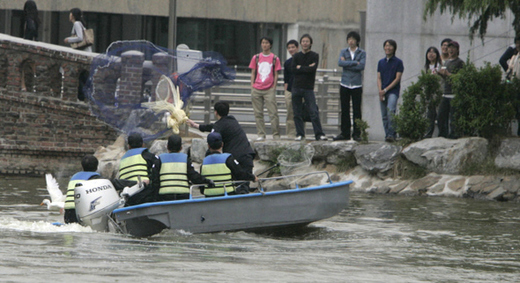
</TD></TR><TR><TD width=18></TD><TD style="PADDING-RIGHT: 0px; PADDING-LEFT: 0px; PADDING-BOTTOM: 0px; PADDING-TOP: 0px">A quarantine team yesterday tries to capture ducks raised in the lake on the campus of Konkuk University, only 1.6 kilometers (1 mile) away from the area where the first confirmed outbreak of bird flu was found in Seoul. [YONHAP]</TD></TR></TBODY></TABLE>A government body Wednesday urgently asked all the medical institutions in the Seoul area to be on the lookout for any cases of bird flu in humans.
The action comes one day after authorities announced that the disease had been detected in two chickens in the city.
Korea Centers for Disease Control and Prevention said medical institutions should carefully monitor any patients with bird flu symptoms: sore throat, high fever and cough.
So far, no Koreans are known to have been infected with the deadly H5N1 strain of the virus.:rolleyes: However it has infected people in other countries and has a very high mortality rate.
The center also asked visitors who had any contact with birds in Gwangjin District Office, the Children??s Grand Park and Seoul Grand Park, to keep an eye on their physical condition.
About 30 people have contacted doctors at the Gwangjin Public Health Center, but all were told they had the common cold, health center officials said.
Government officials say more than 500,000 people visited the Children??s Grand Park on Monday. The park is only 1.1 kilometers (0.68 miles) away from the infected aviary.
Meanwhile, the national center announced that a 22-year-old soldier suspected of being infected with a form of bird flu did not carry the H5N1 strain. Center officials said that the soldier had suffered from bacterial pneumonia.
As Seoul went on high-alert, further quarantines were implemented.
A quarantine team captured about 20 ducks at Konkuk University in Gwangjin District. They will be tested to see if they are infected with H5N1 and will be culled.
The Seoul Metropolitan Office of Education also said yesterday that it decided to cull all birds raised in kindergartens and schools in the Seoul area and advised students not to purchase chicks near schools.
On Tuesday authorities slaughtered about 60 birds in kindergartens and schools that were within a 500-meter-radius of the infected aviary in Gwangjin District Office.
A total of 34 confirmed bird flu outbreaks have so far been found in 13 cities and counties: Seoul; Daegu; Ulsan; Pyeongtaek and Anseong in Gyeonggi; Nonsan in South Chungcheong; Gimje, Iksan, Jeongeup, and Sunchang in North Jeolla; Naju and Yeongam in South Jeolla, and Yeongcheon in North Gyeongsang.
To prevent the spread of the disease to humans, over 6.4 million birds have been killed since the outbreak began in early April.
:tiphat: http://joongangdaily.joins.com/article/view.asp?aid=2889525</TD></TR></TBODY></TABLE>
 
Re: South Korea: Suspected H5N1 Human Cases in Seoul

<TABLE id=tbl_article cellSpacing=0 cellPadding=0 width="100%" border=0><TBODY><TR><TD style="PADDING-BOTTOM: 20px"><TABLE cellSpacing=0 cellPadding=0 border=0><TBODY><TR><TD>Soldier??s illness not bird flu: KCDC
</TD></TR></TBODY></TABLE>
May 09, 2008​
</TD></TR><TR><TD class=actxt id=articleBody style="PADDING-RIGHT: 0px; PADDING-LEFT: 0px; FONT-SIZE: 18px; PADDING-BOTTOM: 20px; LINE-HEIGHT: 27px; PADDING-TOP: 0px">The Korea Centers for Disease Control and Prevention said yesterday that a 22-year-old soldier hospitalized after helping with the slaughter of suspected bird-flu infected poultry, has tested negative for the deadly H5N1 strain of the virus.
He was infected with the H5 strain, it said, but did not develop symptoms because the virus??s presence was weak.
Center officials said Wednesday in a statement that the soldier, identified only by the last name Cho, had suffered from bacterial pneumonia, not avian influenza, known as bird flu.
On April 21, the soldier was coughing and had a high fever after participating in the culling of birds, leading to his hospitalization.
Inspectors at the center said yesterday that even though initial examinations detected a small amount of the H5 virus in the patient??s body, including the HA gene that indicates the presence of the virus, they could not find any indicators of the highly contagious H5N1 strain ? the HA and NA genes ? after more detailed tests. H5N1 is one of four strains of the virus that affects humans.
??We think that the H5 virus in the patient??s body was unstable,?? said Lee Joo-yeon, an inspector at the center. ??It was too weak to prompt the symptoms of bird flu.:rolleyes: Also, he did not have the N1 strain of the virus.??
Inspectors participating in the tests said that human cases of avian influenza are confirmed when the H5 virus, including the HA gene, and the N1 strain, including the NA gene, are all detected, under the guidelines of the World Health Organization.;)
??We had to do detailed tests because the soldier tested positive for the H5 virus on the initial test,?? Lee said. ??To verify whether or not the virus was H5N1, we needed several tests and a few weeks.??
Meanwhile, the soldier has fully recovered and will soon return to his military unit. He is still in the Armed Forces Capital Hospital in Bundang District, Seongnam, just south of Seoul.
??He will be given permission to leave the hospital by his physician,?? said a hospital official who declined to be named. ??Even though his condition has already gone back to normal, we had to wait for the final result from the national center.??
According to the World Health Organization, more than 230 people in the world have been killed by the H5N1 strain of bird flu since late 2003. There have been no confirmed human cases of H5N1 in Korea.
:tiphat: http://joongangdaily.joins.com/article/view.asp?aid=2889565</TD></TR></TBODY></TABLE>
 
Re: South Korea: Suspected H5N1 Human Cases in Seoul

<TABLE cellSpacing=0 cellPadding=0 width="100%" border=0><TBODY><TR><TD class=headtitle01_eng style="PADDING-TOP: 20px">Bird flu fears incite hospital visits in Seoul</TD></TR><TR><TD class=subtitle01_eng style="VERTICAL-ALIGN: top">Gov??t faces criticism for its slow reaction and poor handling of the outbreak</TD></TR><TR><TD height=8></TD></TR><TR height=1><TD bgColor=#e3e3e3></TD></TR><TR bgColor=#efefef height=27><TD align=right>
btn_honly_eng.gif
</TD></TR><TR height=1><TD bgColor=#e3e3e3></TD></TR></TBODY></TABLE><!-- ##### news text - auto ST ##### --><TABLE cellSpacing=0 cellPadding=0 width="100%" border=0><TBODY><TR><TD style="PADDING-RIGHT: 0px; PADDING-LEFT: 0px; PADDING-BOTTOM: 0px; PADDING-TOP: 14px"><!--????????--><!-- ??Ʈ ũ??????--><SCRIPT src="/section-homepage/news/06/news_font.js" type=text/javascript></SCRIPT><STYLE type=text/css> .article, .article a, .article a:visited, .article p{ font-size:14px; color:#222222; line-height:24px; } </STYLE><!-- ### news option ST ### --><TABLE cellSpacing=0 cellPadding=0 width=290 align=center border=0><TBODY><TR><TD noWrap width=15><!-- Padding - Width --></TD><TD><!-- ???? --><TABLE cellSpacing=0 cellPadding=0 width="100%" border=0><TBODY><TR><TD align=middle>
121022028329_20080509.JPG
</TD></TR><TR><TD height=3></TD></TR></TBODY></TABLE><!-- ???? --><!-- ???????? --><TABLE cellSpacing=0 cellPadding=0 width="100%" border=0><TBODY><TR><TD class=movie_text style="WORD-BREAK: break-all" bgColor=#8f8f8f>? Gwangjin District Office officials catch ducks on Ilgam Lake at Konkuk University on May 7. Seoul??s first case of avian influenza was discovered at an aviary located on the grounds of the district office, which is located near the lake.</TD></TR><TR><TD noWrap height=3></TD></TR></TBODY></TABLE><!--???????? --></TD><TD noWrap width=15><!-- Padding - Width --></TD></TR><TR height=15><TD noWrap colSpan=3><!-- Padding - Height --></TD></TR></TBODY></TABLE><!-- ### news option END ### -->

One day after the highly virulent H5N1 strain of avian influenza, known to pass from infected poultry to humans, was found in two dead pheasants from a nature preserve in the Gwangjin district of Seoul, concerns were growing as some residents in the affected area visited hospitals with a high fever and headache. As citizen worries continue to spread, the government has been accused of coping too slowly with the poultry epidemic, which was first discovered in the southwestern region of the country on April 1.

At a public health clinic set up to provide consultations on avian influenza in Seoul??s Gwangjin district, where the latest case avian influenza was discovered, 19 people made telephone calls and nine made visits to inquire about getting tested for infection as of 3:00 p.m. on May 7.

A 50-year-old female resident, who was only identified by the surname Lee, said, ??I??m angry with the district office because it dealt too slowly with the case, even though suspected cases were found several days ago. My neighbors are reluctant to go out because they are worried,?? Lee said.


On May 6, the Seoul Metropolitan Government decontaminated and blocked off a 500-meter radius around the affected area after the latest outbreak of avian influenza was confirmed as the dangerous H5N1 strain. However, the central government requires officials to block the affected area with a 10-kilometer radius. ??If we (block the area) in line with the measures, we would be blocking all nearby motorways,?? a city official said. ??There are no measures that fit the reality of each region,?? the city official said. Though the poultry epidemic has spread for more than a month nationwide, the Ministry for Food, Agriculture, Forestry and Fisheries and local governments have failed to control the outbreak of avian influenza. The ministry, which has put its focus on calming public anxiety over mad cow disease in the wake of a planned full resumption of U.S. beef imports, has only released press releases on the details of its inspections for avian influenza and related countermeasures. There are also some significant holes in the government??s policy on traditional poultry markets. Since May 1, the ministry has banned the traditional markets from selling chickens, ducks and other poultry, but the measure was late in coming because, by then, most of the animals had already been sold to other cities and provinces. The preventive measure came nearly 20 days after middlemen dealing in these kinds of poultry were discovered to have been one of the major causes for the epidemic??s rapid spread to other parts of the country.:tiphat: http://english.hani.co.kr/arti/english_edition/e_national/286433.html

</TD></TR></TBODY></TABLE>
 
Re: South Korea: Suspected H5N1 Human Cases in Seoul

Government vows to step up bird flu fight Friday, May 9, 2008 The government will announce a comprehensive scheme today to cope with the bird flu that has spread across the nation since its first outbreak last month.

After being initially discovered in the southwestern Jeolla region, the virus spread to the southeastern Gyeongsang region and Gyeonggi Province, finally hitting Seoul last week. The flu continued to make its way to Gangwon Province and other parts of Gyeonggi Province yesterday.
The government and the ruling Grand National Party plan to hold an emergency meeting this afternoon, a move that comes after state health authorities issued urgent warnings to all hospitals across Seoul on Wednesday.
"The fact that bird flu was discovered at the nature learning center in Seoul highlights the seriousness of the problem," said Cho Yoon-sun, the spokeswoman for the ruling Grand National Party. "There's a great possibility that public health may have been affected by the incident since tens of thousands of citizens visited the nearby park located in the capital on May 5, Children's Day."
<TABLE style="PADDING-RIGHT: 5px" cellSpacing=0 cellPadding=0 width=150 align=left border=0><TBODY><TR><TD>
200805090012.jpg
</TD></TR><TR><TD class=caption>Elementary school girls cover their noses during decontamination work in northern Seoul yesterday. [Lee Gil-dong/The Korea Herald]</TD></TR></TBODY></TABLE>
Over half a million people visited the nearby Children's Grand Park on Children's Day, following the deaths of two pheasants and five other birds, which were confirmed to have bird flu, in Gwangjin, eastern Seoul. This is the first time the virus has hit the capital.
The National Veternary Research and Quarantine Service said another case of highly pathogenic avian influenza - which could lead to disease in people - was additionally discovered from some 58 dead ducks and chickens in Chuncheon, Gangwon Province.
As a follow-up measure, the regional government held blood tests and medical examinations, as well as administering antiviral drug Tamiflu to those most vulnerable to the virus, such as residents living in farming areas and health officials in charge of decontamination, its officials said. A public health center in the region was also designated as an avian influenza emergency care center to effectively deal with the bird flu virus.
In Anseong, Gyeonggi Province, about 14,000 ducks were slaughtered yesterday, after a test showed that the ducks were most likely infected with avian influenza. However, the outcome of a detailed examination to determine whether it is highly contagious avian influenza, will be revealed this morning. So far, a total of 34 cases of highly pathogenic avian influenza have been confirmed nationwide, excluding the case in Chuncheon, Gyeonggi Province, according to the Ministry of Food, Agriculture, Forestry and Fisheries. A final test result must show that the birds are positively infected with the virus to become a confirmed infection case. :tiphat: http://www.koreaherald.co.kr/
 
Re: South Korea: Suspected H5N1 Human Cases in Seoul

South Korea says soldier not infected with bird flu
09 May 2008 01:14:33 GMT
Source: Reuters

SEOUL, May 9 (Reuters) -

A South Korean soldier tested for bird flu did not contract the deadly virus and will be released from hospital, according to a statement obtained on Friday.

"The soldier, who was quarantined after showing symptoms of bird flu, has tested negative. We have determined his condition was caused by bacterial pneumonia," the Korea Centre for Disease Control and Prevention said in a news release.

The soldier, 21, who was hospitalised last month, had been taking part in the culling of more than 5 million birds as South Korea works to contain its worst outbreak of avian influenza.

Despite government efforts, the H5N1 strain of bird flu has spread to most parts of the country including Seoul, leading many to steer clear of zoos and the pigeon flocks that roam the capital.

Earlier this week, North Korea said it was stepping up measures to prevent the outbreak from being carried over its borders by migratory flocks.

The last known bird flu outbreak in impoverished North Korea was in 2005.

(Reporting by Jon Herskovitz and Lee Jiyeon; editing by Jonathan Hopfner and Valerie Lee)
-
http://www.alertnet.org/thenews/newsdesk/SEO36703.htm
-------
 
Re: South Korea: Suspected H5N1 Human Cases in Seoul

?AI (AI) the possibility where become the 21st century first time `great scholar line influenzas (petal [mik] * pandemic) 'is high very.?

Prof. Korea University medical treatment circle Kim outer space (49 * infection internal medicine) until Seoul indicated a strong worry about AI where is diffused. In Seoul nine from eastern Korea University medical treatment circle Prof. Kim 9th innumerable difficulties when ?tried to turn round a history and the great scholar line influenza of average 3 time threw over the human being at 100 and? ?AI was and 1918 about 5000 life of ten thousand people Oh! Oh the possibility becoming the reappearance of `Spain influenza '? warned. Prof. Kim [ey_tta_lu_myen] the great scholar line influenza minimum 10, sought the human being at the longest 40 period and came.

? ?Him ?the great scholar line influenza which occurs last is about 70 `Hong Kong influenza which puts out the dead person of ten thousand people ' this year which occurs becomes 40 tightly to do and as is the fact that must promise a perfection, was caused by with AI and our situation which is trembling insecurely had ahead a defeat as and like the baseball team which meets `9 end 2 outs ' coming to feel, did and said?.

`Hands which are counted with AI preventive measures which are general washing, ' after ocean `going out ' etc. closes an infection is not an extra ordinary effect the thing is explanation of Prof. Kim. Him ?piece which the private citizens will pay attention only the times when does not visit poultry farming farm etc. is located in the area where AI is diffused and? ?forms in order prevents and a countermeasure from governmental dimension and a virus proliferation the hereafter like this situation not to recur, said year law whose only is only to promise a perfection,?.

AI where is confirmed together initially from last month 1st Jeollabuk-do Kimje at about only one months until Seoul being tantalizing about being diffused, distinguished. He ?after the fact where AI occurs is confirmed the authorities will live the neighborhood birds and he disposes and after giving a movement limit order, the anti-epidemic measure which is thorough tax [wess] more ramyon like this situation the thing which will not come? knows ?only the domestic fowl of the Seoul storehouse position ward office animal feedlot neighborhood where AI occurs until the Mammalia blew and to open Prosecuting Attorney arm must grasp the actual condition which is accurate said?.

From 1998 Prof. Kim who keeps internal medicine department chief this hospital infection holds two or more positions concurrently the National Institute of Health respiratory organ virus and department chief and etc. AI relation National Assembly public hearing etc. attends frequently with the foot disciples with one person in the field domestic highest specialist is counted. National daily report cookie news weakness of mind:tiphat: http://svsurl.systransoft.com/?t=ou...ask=11d1def534ea1be0-3d1e4877-119c7b859b2-86b
 
Re: South Korea: Suspected H5N1 Human Cases in Seoul

May 10, 2008
S. Korea to double Tamiflu stockpile over bird flu fears

SEOUL - SOUTH Korea will double its stockpiles of antiviral flu medicine Tamiflu as avian flu has spread through most the country, health officials said on Saturday.
South Korea has not recorded any human cases, however the deadly H5N1 strain was detected in an aviary in Seoul this week, the first time bird flu has been found in the capital.

The state-run Korea Center for Disease and Control said that it would secure Tamiflu reserve for 2.5 million treatment courses by the end of this year, up from the current reserve set for 1.24 million.

The decision came after South Korean President Lee Myung Bak on Saturday told his cabinet to increase stockpiles of anti-viral drugs to ease public fears about bird flu.
-snip-
As of Friday, more than 6.8 million chickens and ducks had been slaughtered since the latest bird flu outbreak was reported on April 1. The previous outbreak was between November 2006 and March last year. -- AFP

http://www.straitstimes.com/Latest+News/Asia/STIStory_235995.html
 
Re: South Korea: Suspected H5N1 Human Cases in Seoul

<table border="0" cellpadding="0" cellspacing="0" width="100%"><tbody><tr><td class="padlrt8 blue verdana10" valign="center">May 10, 2008</td><td class="padlrt8 blue verdana10" align="right" valign="center"></td></tr><tr><td class="padlrt8" colspan="2"><!-- headline one : start -->S. Korean president calls for drug stockpiles against bird flu <!-- headline one : end -->
</td></tr><tr><td class="georgia11 padcell8" colspan="2"><!-- more than 7 paragraphs --><!-- show image if available --><table class="padl8" valign="top" align="right" border="0" width="154"><tbody><tr><td>
ST876073401_01_0001.jpg

c.gif

South Korean President Lee Myung-Bak on Saturday told his cabinet to increase stockpiles of anti-viral drugs to ease public fears about bird flu. -- PHOTO: REUTERS
c.gif

</td></tr></tbody></table><!-- story content : start -->SEOUL - SOUTH Korean President Lee Myung-Bak on Saturday told his cabinet to increase stockpiles of anti-viral drugs to ease public fears about bird flu, which has spread through most the country.
South Korea has not recorded any human cases, however the deadly H5N1 strain was detected in an aviary in Seoul this week, the first time bird flu has been found in the capital.
'The people are increasingly concerned about human infection of avian influenza,' Mr Lee was quoted as saying at a meeting of cabinet ministers by Yonhap news agency.
'The government has to devise sufficient countermeasures, including expansion of antiviral flu drug imports,' he said.
The H5N1 strain has killed more than 240 people worldwide since late 2003.
The agriculture ministry said quarantine authorities were continuing to decontaminate all aviaries and poultry farms in Seoul and public access has been limited to those areas.
<!-- show media links starting at 7th para --><table valign="top" align="left" width="200"><tbody><tr><td class="padr8"><!-- Vodcast --><!-- Background Story -->

</td></tr></tbody></table>The butchering of chickens and ducks at traditional markets and restaurants should be prohibited to contain the spread of bird flu, the ministry said.
'Traditional markets where chickens and ducks are sold and butchered in unsanitary conditions are suspected of having contributed to spreading the avian flu,' said Mr Kim Chang Seob, chief veterinary officer at the agriculture ministry.
As of Friday, more than 6.8 million chickens and ducks had been slaughtered since the latest bird flu outbreak was reported on April 1. The previous outbreak was between November 2006 and March last year. -- AFP
:tiphat: http://www.straitstimes.com/Latest+News/Asia/STIStory_235995.html
 
Re: South Korea: Suspected H5N1 Human Cases in Seoul

S. Korea to raise Tamiflu reserves amid bird flu scare

SEOUL, May 10 (Yonhap) -- South Korea plans to increase its emergency reserves of the avian influenza drug Tamiflu to cope with humans possibly contracting the deadly virus amid the country's worst bird flu outbreak, health officials said Saturday.

South Korea has culled more than 6.8 million birds since the latest bird flu outbreak started on April 1, causing 53.2 billion (US$50.8 million) in estimated damages.
Even though no human deaths have been reported in South Korea, some 240 people have reportedly died from the deadly H5N1 strain around the world.

The state-run Korea Center for Disease and Control said that it decided to increase its Tamiflu reserve for up to 2.5 million people, or 5 percent of the country's population, from the current reserve set for 1.24 million by the end of the year.

The drug is manufactured by the Swiss pharmaceutical company Roche Holding AG.

The government is also mulling the creation of a separate pre-pandemic vaccine reserve for up to 40,000 people, an official at the agency said.

"We are considering, for now, a small stockpile due to price concerns, as the vaccines are mostly valid for a year," the official said.

Earlier in the day, President Lee Myung-bak instructed his Cabinet to take measures to prevent human bird flu infection and to secure a sufficient amount of antiviral flu drug in preparation for a nationwide spread of avian influenza.:tiphat:
http://english.yonhapnews.co.kr/techscience/2008/05/10/47/0601000000AEN20080510001900320F.HTML
 
Re: South Korea: Suspected H5N1 Human Cases in Seoul

<!-- Middle03 - 기사 -->
3 AI raised Gwangjin Ward got close a nearby kindergarten chodeunggyo
  • Avian influenza in my nature hakseupjang Gwangjin district office in Seoul (AI) has occurred along the nearby elementary school and kindergarten in the first place and began to close.

    .​
    According to Seoul Metropolitan Office of Education Child and the 9th daegongwon line drawing closer to kindergarten and elementary school gyeongbok Gwangjin-active material, including three children a place to temporarily close the school entered the hall.

    Nine elementary schools were closed temporarily gyeongbok day kindergarten in September through the holidays after a 14 line drawings hyuwonhan until after the 15th Teacher's Day, the school hall and kindergarten children are 8 and closed nine days temporary measures.

    Parents who will guide you through the elementary school gyeongbok "We think the big fear, but you do not have young children who have a weak immune system could be a risky business decision to temporarily close down the 9th day," he explained.

    .​
    Many of the birds in breeding centers and kindergarten children in the child's location is close daegongwon hyuwon early action on the 8th and reportedly close to the building itself. AI infection for kindergarten parents who do line drawings of the concerns off "without any measures have unprotected children are still keeping watch on the situation YOUNG safety education as a responsibility that must be protected." Hyuwon decided.

    Children grow in the current daegongwon poultry within a suspected case of AI is not as pronounced, but nearby residents and civil unrest that has jamjaewoogi yeokbu jokin.

  • May 10, 2008 11:02, modify the final Saturday, May :tiphat: http://209.85.171.104/translate_c?h...g2=00&subctg1=01&subctg2=00&cid=0101080100000
 
Re: South Korea: Suspected H5N1 Human Cases in Seoul

<TABLE id=tbl_article cellSpacing=0 cellPadding=0 width="100%" border=0><TBODY><TR><TD style="PADDING-BOTTOM: 20px"><TABLE cellSpacing=0 cellPadding=0 border=0><TBODY><TR><TD>Soldier??s illness not bird flu: KCDC

</TD></TR></TBODY></TABLE>
May 09, 2008​

</TD></TR><TR><TD class=actxt id=articleBody style="PADDING-RIGHT: 0px; PADDING-LEFT: 0px; FONT-SIZE: 18px; PADDING-BOTTOM: 20px; LINE-HEIGHT: 27px; PADDING-TOP: 0px"> the soldier was coughing and had a high fever after participating in the culling of birds, leading to his hospitalization.
Inspectors at the center said yesterday that even though initial examinations detected a small amount of the H5 virus in the patient??s body, including the HA gene that indicates the presence of the virus, they could not find any indicators of the highly contagious H5N1 strain ? the HA and NA genes ? after more detailed tests. H5N1 is one of four strains of the virus that affects humans.
??We think that the H5 virus in the patient??s body was unstable,?? said Lee Joo-yeon, an inspector at the center. ??It was too weak to prompt the symptoms of bird flu.:rolleyes: Also, he did not have the N1 strain of the virus.??
Inspectors participating in the tests said that human cases of avian influenza are confirmed when the H5 virus, including the HA gene, and the N1 strain, including the NA gene, are all detected, under the guidelines of the World Health Organization.;)
??We had to do detailed tests because the soldier tested positive for the H5 virus on the initial test,?? Lee said. ??To verify whether or not the virus was H5N1, we needed several tests and a few weeks.??
:tiphat: http://joongangdaily.joins.com/article/view.asp?aid=2889565
</TD></TR></TBODY></TABLE>
South Korrea is clearly making it up as they go along. There is NO WHO requirement for H5N1 isolation. H5 confirmation by two labs is a confirmed case. Many WHO confirmed human cases did NOT yield H5N1 virus.

This is well into the hocus pocus category.
 
Back
Top