• FluTrackers.com Inc. does not provide medical advice. Information on this web site is collected from various internet resources, and the FluTrackers board of directors makes no warranty to the safety, efficacy, correctness or completeness of the information posted on this site by any author or poster. The information collated here is for instructional and/or discussion purposes only and is NOT intended to diagnose or treat any disease, illness, or other medical condition. Every individual reader or poster should seek advice from their personal physician/healthcare practitioner before considering or using any interventions that are discussed on this website. By continuing to access this website you agree to consult your personal physican before using any interventions posted on this website, and you agree to hold harmless FluTrackers.com Inc., the board of directors, the members, and all authors and posters for any effects from use of any medication, supplement, vitamin or other substance, device, intervention, etc. mentioned in posts on this website, or other internet venues referenced in posts on this website.
  • We are not asking for any donations. Do not donate to any entity who says they are raising funds for us.

South Korea - H5N1 - Seosan & Pyeongtaek

Gert van der Hoek

In Memoriam - Editor, Senior Moderator
SKorea reports second bird flu outbreak this week in poultry; not H5N1 strain

11.24.2006, 12:22 AM


SEOUL (XFN-ASIA) - The agriculture ministry said a second apparent bird flu outbreak this week has emerged south of Seoul, althogh the case does not appear to involve the H5N1 strain of the virus.

The ministry said some 200 chickens died at a farm in Pyeongtaek, 70 kilometers south of the capital, of a strain not considered lethal to humans.

The ministry said the government would ban the movement of birds from the Pyeongtaek farm, but added no cull is necessary.

Yesterday the ministry announced a suspected outbreak in the southern city of Iksan, the first suspected bird flu case since South Korea declared itself free of the disease last December.

Some 6,000 chicken died in three days at the farm at Seokmae village in Iksan, 250 kilometers south of Seoul, prompting the agriculture ministry to order the culling of the remaining 6,000 birds in the farm.

afp
http://www.forbes.com/home/feeds/afx/2006/11/23/afx3201024.html

South Korea says low-grade bird flu kills 200 chickens south of Seoul

SEOUL, South Korea (AP) - A low-grade strain of bird flu has killed 200 chickens south of the South Korean capital, the agriculture ministry said Friday.

The ministry identified the strain of bird flu as "low pathogenic'' and said that it was neither the H5N1, which can be lethal to humans, nor the less dangerous H5N2 strains.

The ministry said it would take preventive measures, including disinfecting the remaining 19,000 chickens at a chicken farm in Pyeongtaek city, about 65 kilometers (40 miles) south of Seoul. (Edt: no culling..)

The exact cause of the outbreak has yet to be determined but "it has nothing to do with a suspected case of bird flu'' in the southwestern province of Jeolla, said Lee Joo-won, an official at the ministry.

http://thestar.com.my/news/story.asp?file=/2006/11/24/apworld/20061124144222&sec=apworld
 
Last edited:
Re: SOUTH KOREA - Suspected bf case at poultry farm

Re: SOUTH KOREA - Suspected bf case at poultry farm

Mild bird flu confirmed


Korean authorities confirmed yesterday that a mild form of avian influenza broke out on a chicken farm south of Seoul.


The low-pathogenic strain of the bird flu virus was discovered on the farm in Pyeongtaek, about 70 kilometers south of the capital, after 200 chickens died over three days starting from Tuesday, the Ministry of Agriculture and Forestry said.

"Tests showed the virus was low pathogenic and has little chance of being transmitted to humans," it said.

The confirmation came a day after the ministry announced that it had detected a possibly virulent strain of bird flu in Iksan, about 230 kilometers south of Seoul. Authorities speculated that the Iksan virus may be the H5N1 strain that has killed more than 140 people so far worldwide.


No South Koreans have died from the human influenza. The ministry said the government will ban the movement of birds from the Pyeongtaek farm, but no action will be taken to slaughter sick chickens, since they usually recover. The government will also take no action against birds on nearby farms.

According to World Organization for Animal Health rules, a non-virulent strain does not warrant a trade ban.

"Technically, this non-virulent strain is not classified as avian influenza," said Kim Chang-seob, the chief veterinary officer at the ministry. The government has reported such discoveries to keep the general public informed.

The ministry has been on high alert since Nov. 1 to detect any bird flu outbreaks, which usually coincide with the arrival of migratory birds. The alert will be in place until late February.

Meanwhile, Japan has temporarily suspended South Korean poultry imports due to a suspected bird flu outbreak that has killed around 6,000 chickens and prompted authorities to cull thousands more, the top government spokesman said Friday.

"As a precaution, we decided (Thursday) to temporarily suspend imports of Korean poultry and to ask that people entering Japan from South Korea sterilize their shoes," Chief Cabinet Secretary Yasuhisa Shiozaki told reporters.

The government has asked Seoul for more details about the outbreak in the country's southwest, Shiozaki added.

Japan imported 289 metric tons of chicken meat from South Korea in 2005, according to the Japan External Trade Organization.

Most bird flu viruses are not harmful to humans, but South Korea's agriculture ministry hoped to confirm this weekend whether the suspected outbreak was caused by the H5N1 strain, which can be deadly to people.

The discovery was made in the southwestern province of Jeolla on Wednesday, according to a statement from the agriculture ministry.

It said 6,000 chickens in the area had died, and authorities would kill a further 6,000 to prevent the virus from spreading.

Korea culled 5.3 million birds during the last known outbreak of bird flu in 2003.

The H5N1 virus began ravaging Asian poultry stocks in late 2003 and has killed at least 153 people worldwide.


http://www.koreaherald.co.kr/SITE/data/html_dir/2006/11/25/200611250008.asp
 
South Korea - H5N1 - Seosan & Pyeongtaek

LEAD) Bird flu newly found in South Korea amid massive quarantine efforts SEOUL, Nov. 27 (Yonhap) -- Bird flu was found in a pair of chickens raised in South Korea's southern city of Seosan, 140 kilometers north of Iksan where the first outbreak forced quarantine officials to slaughter nearly 100,000 livestock last week, government officials said Monday.

The infected chickens had been hatched out of eggs supplied in mid-November from a breeding farm in Iksan where the virus was first discovered last week, the provincial officials said.
 
Re: LEAD) Bird flu newly found in South Korea amid massive quarantine efforts

Re: LEAD) Bird flu newly found in South Korea amid massive quarantine efforts

<TABLE cellSpacing=0 cellPadding=0 width=466 border=0><TBODY><TR><TD width=233></TD><TD align=right width=233>2006/11/27 12:37 KST </TD></TR></TBODY></TABLE>
x.gif

Bird flu spreads in South Korea despite quarantine measures SEOUL, Nov. 27 (Yonhap) -- Bird flu was found in a pair of chickens raised in South Korea's southern city of Seosan, north of Iksan where the first outbreak took place and thousands of chickens were subsequently culled, government officials said Monday.

The chickens found to be infected with the deadly epidemic had been born out of eggs supplied from the Iksan poultry farm where the highly-virulent strain of bird flu was discovered last week, the provincial officials said.

They said they plan to keep their eye on other blood samples extracted from the poultry for the preliminary test and tighten embargo on transfer of livestock.

Bird flu, also known as avian influenza, broke out last week in South Korea's southern city of Iksan, the first outbreak in the country in four years.

South Korea remains on a heightened alert and is implementing full quarantine measures, fearing the spread of the fatal virus believed to have killed some 250 people worldwide since its outbreak in 2003.

The Geneva-based World Health Organization believes the virus may mutate into a highly virulent strain that can easily be transmitted among humans if left unchecked.

samkim@yna.co.kr
 
Re: LEAD) Bird flu newly found in South Korea amid massive quarantine efforts

Re: LEAD) Bird flu newly found in South Korea amid massive quarantine efforts

They're talking about this spreading to Seosan via poultry eggs from Iksan, but there also seems to have been some concern about migratory birds in Seosan back on Friday (the date of this article). Also, they're handing out Tamiflu to cullers. (Horrible machine-translation follows....)

Google-translated from Korean:

[AI disease prevention emergencies] last decision the [ik] mountain [Iksan] which has ahead storm eve
Nov 24, 2006

Chollapuk_do AI charge government employee 5 month for vacancies? Chwung Cheng ['Chungcheongnam-do' or South Chungcheong -- province where Seosan is located] migratory bird arrival [ci] * condition area extreme tension


The birds influenza which occurs from chollapuk_do [ik] [Iksan] mountain hour (AI) the hardship with accomplishes well and support it is not, the hole was pierced indication is consideration to watch hardship system of the back authorities where the lung four one chicken flows out at outside.

When it followed in 24th chollapuk_do degree and the [ik] mountain right time farmland proprietor step mother (56) Sea with AI about 6,500 the chicken the group lung company the [ik] mountain which it does but it is sour but did not struggle in degree. 19th 19, 20th 200, 21st 400 and 22nd 5,000 died and went out and the farmland proprietor hardship to load 5 chickens which die instead of in the passenger car of direct oneself, Anyang national veterinarian scientific unit which is to condition Anyang hour it visited.

When AI is suspected, after struggling immediately in the appropriate authority, in order to conduct a disease prevention and the serum prosecuting attorney, it means that one confrontation system is not operated. [ci] 10th where 2003 Edo AI occurs or after passing, Oh! it had the result where in the wind where the farmhouse struggles this fact the damage is diffused with national and it came.

Tile hour 22nd afternoon AIth possibility is high late from the national veterinarian scientific unit and before being notified until, it knew a group lung company fact. Compared to it acts but the winter season whose AI occurrence possibilities which go round are high all becomes but also the reason which is extra ordinary the livestock raising division chief place which will generalize AI management services let to leave without at the vacancies during 5 months.

It confronts hereupon and the officials ?the large unit poultry farming farmhouses directness to struggle in the problematic occurrence hour quarantine unit and it will be common one and to request the prosecuting attorney, to the confrontation system there will not be a big problem and " it talked this time and ?in order to construct the hardship watch which and quick is systematic with opportunity".

It seeks at only 3 years and with all AI the entire country is trembling in fear. 'AI epicentral [ci] ' the [ik] mountain hour box ten [up] region which is [nong] with the [huy] [ppwu] yearly disinfecting chemicals was coming to sprinkle in the bottom here and there, to the farmhouse entrance 'entrance and exit prohibition' [phays] it walked an end and it put and event site seniority in age [khey] powerfully. Kyonggi-Do the past AI occurrence area and Ich'on hour foreign wine hour Ansong hour P'yongt'aek hour P'och'on hour exaltation hour Kimp'o hour Yongin hour Hwa-Seng kwun back 9:00 proclaimed armies at the intensive control region.

From the Chung Cheong Nam Do where there is only a domestic maximum migratory bird arrival [ci] rainwater mountain hour only the rainwater the wild duck and it will be able to contact in order the chicken and the duck of the circumferential farm, surrounded with the net which is close the barn. The light northern province against the chicken duck breeding farmhouse it strengthened farm disinfecting and the outsider entrance and exit control back.

http://news.hankooki.com/lpage/society/200611/h2006112418270184100.htm

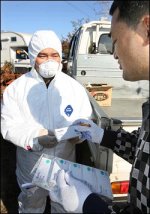
Photo caption: The chollapuk_do [ik] [Iksan] mountain public health center staff 24th birds influenza (other America which is AI preventive medicines [phul] divides the [lwu] in the staffs which control an entrance and exit from AI) occurrence areas and it is giving.

Iksan.jpg
 
Re: LEAD) Bird flu newly found in South Korea amid massive quarantine efforts

Re: LEAD) Bird flu newly found in South Korea amid massive quarantine efforts

Note that cullers in this photo & one in another thread (posted by Mingus, I believe), are NOT wearing goggles! BF via conjunctivitis anyone?

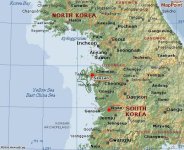
Look at the outbreaks. If you were a migratory bird headed to mainland china, via the Yellow Sea, where would you stop & get your fill of food before the flight? Yep, both towns look likely to me.

.
 
Re: LEAD) Bird flu newly found in South Korea amid massive quarantine efforts

Re: LEAD) Bird flu newly found in South Korea amid massive quarantine efforts

Second Bird Flu Case Tied to Iksan Farm


By Park Chung-a
Staff Reporter

Bird flu has been found in a pair of chickens raised in Sosan, South Chungchong Province, 140 kilometers north of the virus?? first outbreak this year, Iksan. The outbreak in Iksan led to the slaughtering of almost 100,000 animals last week.

The infected chickens had been hatched out of eggs bought in mid-November from a breeding farm in Iksan, according to provincial officials.

The infection was discovered through blood samples taken from eight poultry farms for preliminary tests under special surveillance by the government.

They also conducted preliminary tests on another five farms in South Chungchong Province as they have made purchases from an Iksan-located breeding farm.


The officials in Sosan said that they will do their best to enforce the embargo on the circulation of livestock.

The National Veterinary Research & Quarantine Service is currently working on finding out whether the virus found in Sosan is a highly-virulent strain like the one found in Iksan, which could cause human infections.

However, the Ministry of Agriculture and Forestry announced that since the chickens in the farm have not died en masse, it is unlikely that the virus is a highly pathogenic one. The results of the final tests are expected today.

Quarantine officials have so far slaughtered 96,000 birds within a 500-meter radius of the outbreak site in Iksan, which is about 250 kilometers south of Seoul, in order to block the spread of the fatal virus. Bird flu has reportedly killed some 250 people worldwide since its outbreak in 2003.

The officials also said that they plan to destroy an additional 230,000 animals by Thursday and disposal areas could expand depending on further discoveries.

The government has launched a publicity campaign to raise public awareness of the fact that the bird flu virus is completely killed when poultry is cooked for five minutes at a temperature higher than 70 degrees Celsius.

In 2003 and 2004, the nation had to destroy more than 5 million birds in order to prevent the spread of the disease. No South Korean has ever been reported to be infected.

http://times.hankooki.com/lpage/200611/kt2006112717061710230.htm
 
Re: LEAD) Bird flu newly found in South Korea amid massive quarantine efforts

Re: LEAD) Bird flu newly found in South Korea amid massive quarantine efforts

niman said:
Commentary

H5 Spread on South Korean Farms
Recombinomics Commentary
November 27, 2006

Bird flu was found in a pair of chickens raised in South Korea's southern city of Seosan, north of Iksan where the first outbreak took place and thousands of chickens were subsequently culled, government officials said Monday.

The chickens found to be infected with the deadly epidemic had been born out of eggs supplied from the Iksan poultry farm where the highly-virulent strain of bird flu was discovered last week, the provincial officials said.

The above comments indicate the H5N1 on South Korean farms may have spread. Earlier reports had indicated that the infected farm was on a migratory bird flyway, which would also be true for the second farm, which is near the western coast of the South Korean peninsula. Both high and low path H5 is spread by migratory birds.

The time and location of the first outbreak suggest the H5N1 is being spread by migratory birds. The last confirmed outbreak of H5N1 in Korea was in December, 2003. That outbreak was quickly followed by H5N1 in Japan in early 2004. H5N1 from both countries was very similar and the H5N1 in Japan was found in wild birds.

The sequences from Korea and Japan in 2003/2004 were subsequently found in dead waterfowl at Qinghai Lake in the spring of 2005, further linking H5N1 in Korea and Japan to long range migratory birds. These birds were the likely source of the H5N1 outbreaks that exploded in Asia in 2004.

At that time, there was little sequence data on wild birds, but the H5N1 in Hong Kong in 2002 and 2003 had many polymorphisms that were not in H5N1 isolates from 2001, indicating the new polymorphisms had flown into the region.

The Qinghai outbreak provide clear data for the transport and transmission of H5N1 because the Qinghai isolates had the novel HA cleavage site of GERRRRKKR as well as PB2 E627K. Moreover, the strain could killed wild and domestic waterfowl, which created a trail of dead and dying birds along the migration routes.

Prior to the Qinghai outbreak, the Asian strain of H5N1 had not been detected west of China. The newly introduced H5N1 into Russia, Kazakhstan, Mongolia, India, Afghanistan, and countries throughout Europe, the Middle East, and Africa were all infected with the Qinghai strain of H5N1 in 2005/2006

Detection of the Qinghai strain in eastern Asia has been limited. Although over 700 Qinghai H5N1 infections were identified in Europe, only one Qinghai isolate has been reported in eastern Asia (Shantou in 2006). However, this detection failure is likely to be due to surveillance issues, which have been largely limited to feces from live markets in southern China.

More aggressive testing of dead or dying waterfowl would be useful. Most H5N1 detected in Europe have been from dead wild birds. Detection in live birds is rare, unless the level of H5N1 in the area is high, such as the detection of H5N1 in wild birds in Siberia after widespread detection in dead or dying poultry on farms.

Surveillance of H5N1 remains poor worldwide. These failures are largely due to efforts focused on testing live wild birds, and active avoidance of dead or dying birds. In the United States, approximately 35,000 live of hunter killed birds have been tested this year, while the number of dead or dying birds is less than 1000 throughout the country, including Alaska and Hawaii. Although low path H5N1 has been detected in the live birds collected over a wide area, there has been no H5N1 reported in dead or dying birds from the same areas, indicating the collection and testing experimental design is fatally flawed.

Thus, more outbreaks on farms form migratory birds are expected to occur without warning, because the surveillance methods worldwide have largely failed.

More details on the age of the infected chickens, as well as sequence data on the bird flu detected in both locations would be useful.

.
 
Re: LEAD) Bird flu newly found in South Korea amid massive quarantine efforts

Re: LEAD) Bird flu newly found in South Korea amid massive quarantine efforts

Any chance the Canadian LP H5N1 polymorphisms traveled through Alaska this past summer and are now arriving in SE Asia?

.
 
Re: LEAD) Bird flu newly found in South Korea amid massive quarantine efforts

Re: LEAD) Bird flu newly found in South Korea amid massive quarantine efforts

http://english.hani.co.kr/arti/english_edition/e_business/174473.html


<TABLE cellSpacing=0 cellPadding=0 width="100%" border=0><TBODY><TR><TD class=headtitle01_eng style="PADDING-TOP: 20px">After bird flu found, industry braces for worst</TD></TR><TR><TD class=subtitle01_eng style="VERTICAL-ALIGN: top">Sales of chicken meat drop by 30%</TD></TR><TR><TD height=8></TD></TR><TR height=1><TD bgColor=#e3e3e3></TD></TR><TR bgColor=#efefef height=27><TD align=right>
btn_honly_eng.gif
</TD></TR><TR height=1><TD bgColor=#e3e3e3></TD></TR></TBODY></TABLE><!-- ##### news text - auto ST ##### --><TABLE cellSpacing=0 cellPadding=0 width="100%" border=0><TBODY><TR><TD style="PADDING-RIGHT: 0px; PADDING-LEFT: 0px; PADDING-BOTTOM: 0px; PADDING-TOP: 14px"><!--????????--><!-- ??Ʈ ũ??????--><SCRIPT src="/section-homepage/news/06/news_font.js" type=text/javascript></SCRIPT><STYLE type=text/css> .article, .article a, .article a:visited, .article p{ font-size:14px; color:#222222; line-height:24px; } </STYLE><!-- ### news option ST ### --><TABLE cellSpacing=0 cellPadding=0 width=290 align=center border=0><TBODY><TR><TD noWrap width=15><!-- Padding - Width --></TD><TD><!-- ???? --><TABLE cellSpacing=0 cellPadding=0 width="100%" border=0><TBODY><TR><TD align=middle>
1164608644_116460856789_20061128.JPG
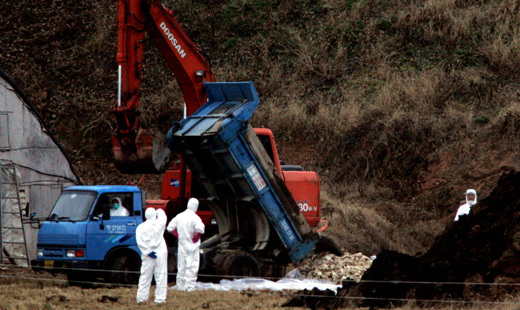
</TD></TR><TR><TD height=3></TD></TR></TBODY></TABLE><!-- ???? --><!-- ???????? --><TABLE cellSpacing=0 cellPadding=0 width="100%" border=0><TBODY><TR><TD class=movie_text style="WORD-BREAK: break-all" bgColor=#8f8f8f>? Slaughtered chickens are buried, due to worries over bird flu being spread.</TD></TR><TR><TD noWrap height=3></TD></TR></TBODY></TABLE><!--???????? --></TD><TD noWrap width=15><!-- Padding - Width --></TD></TR><TR height=15><TD noWrap colSpan=3><!-- Padding - Height --></TD></TR></TBODY></TABLE>
<!-- ### news option END ### -->With the avian influenza found in Iksan, North Jeolla Province confirmed as a highly virulent strain, poultry farms and distributors are trying to prevent a huge drop in sales. The government has stepped in, as well, taking powerful preventive measures to curb a spread of the disease among poultry.


According to poultry farms and officials of the meat distribution industry on November 26, since the outbreak of the disease between November 23 and 25, sales of poultry have decreased nationwide about 10 to 30 percent. When a previous bird flu case was found in South Korea in December 2003, chicken consumption fell more than 40 percent.


In the case of Korea's largest chicken meat provider, Halim, orders of the meat dropped about 10 percent between November 23 and 24 and more than 20 percent on November 25. The Korea Chicken Council (KCC) said that on November 23, industry orders of chicken meat fell about 20 percent overall, but that number was as high as 30 percent on the weekend.


At Homeplus, the nation's second-largest discounter and operated by Samsung Tesco, sales of chicken meat went down about 25 percent between November 23 to 25, compared to the same period last year. Sales of eggs also dropped about 15 percent. However, E-Mart, Korea's biggest discount chain store, which held "chicken meat bargain sales" between November 23 and 29, has witnessed an increase of 93 percent from the same period last year.
The chicken meat distribution industry has prepared a special sale event to help poultry farmers, and it plans to give consumers a proper understanding of bird flu and to inform them that chicken meat on the market is safe. Lee Jae-ha, an official of the KCC said, "As not only infected chickens but also those suspected of being infected are slaughtered, tainted meat can't be circulated. We will let consumers know that chicken meat on the market is safe."

.
</TD></TR></TBODY></TABLE>
 
Re: LEAD) Bird flu newly found in South Korea amid massive quarantine efforts

Re: LEAD) Bird flu newly found in South Korea amid massive quarantine efforts

SKorea reports second apparent bird flu outbreak as Japan bans imports <!-- END HEADLINE --><!-- BEGIN STORY BODY -->Fri Nov 24, 5:12 AM ET


South Korea has announced its second apparent bird flu outbreak this week, as Japan suspended poultry imports from its neighbour, but said it was not the deadly H5N1 strain of the disease.

The agriculture ministry said the death of some 200 chickens at a farm in Pyeongtaek, 70 kilometers (44 miles) south of Seoul, was due to a mild strain of bird flu not lethal to humans.

The ministry said the government would ban the movement of birds from the Pyeongtaek farm, but that sick chickens would not be slaughtered because they usually recover from the mild strain.

On Thursday the ministry announced an apparently more virulent suspected outbreak in the southern city of Iksan, the first suspected bird flu case since the nation declared itself free of the disease last December.

Some 6,000 chicken died in three days at the farm at Seokmae village in Iksan, 250 kilometers south of Seoul, prompting the agriculture ministry to order the culling of the remaining 6,000 birds in the farm.

"They will finish killing and burying the remaining chicken at the farm on Friday," Ko Myung-Keyn, an official from North Jeolla province in charge of livestock quarantine, told AFP Friday.

He said an area within a 500-meter radius of the outbreak, where the affected farm and six others raise a total of 240,000 birds, had been cordoned off.

"If the case is confirmed as a bird flu outbreak, all the birds there would be culled."

The result of blood tests on the affected birds was expected late Saturday.

The ministry has banned shipments to and from the farms in the contaminated area, carried out quarantine measures and imposed restrictions on the movement of people and vehicles there.

Iksan City called for an emergency fund of some 17 million dollars from the central government to increase quarantine activity and provide financial assistance to affected farms, Yonhap news agency said.

It also expanded the cordoned-off zone from an area within a radius of three kilometers to eight kilometers and asked for manpower assistance from police and military authorities to control movements to and from this area, it said.

Iksan is a hub of the country's poultry industry, where 5.2 million chicken are being raised on some 440 farms.

More than 200 poultry farms are within 10 kilometres of the affected one, as is the country's top chicken meat processor Halim, which is supplied by them.

Halim supplies 20 to 25 percent of the country's demand for chicken and also exports cooked chicken to Japan and other countries.

Following the suspected bird flu outbreak, Japan suspended poultry imports and started requiring people arriving from South Korea to disinfect their shoes when entering the country.

The deadly H5N1 strain of avian influenza, which is spread through contact with sick animals, has killed more than 150 people worldwide since late 2003 and triggered mass culls of millions of poultry.

http://news.yahoo.com/s/afp/20061124/hl_afp/healthfluskorea&printer=1
 
Re: LEAD) Bird flu newly found in South Korea amid massive quarantine efforts

Re: LEAD) Bird flu newly found in South Korea amid massive quarantine efforts

niman said:
Commentary

Bird Flu Spread To Three South Korean West Coast Locations
Recombinomics Commentary
November 27, 2006

The agriculture ministry said the death of some 200 chickens at a farm in Pyeongtaek, 70 kilometers (44 miles) south of Seoul, was due to a mild strain of bird flu not lethal to humans.

The ministry said the government would ban the movement of birds from the Pyeongtaek farm, but that sick chickens would not be slaughtered because they usually recover from the mild strain.

On Thursday the ministry announced an apparently more virulent suspected outbreak in the southern city of Iksan, the first suspected bird flu case since the nation declared itself free of the disease last December.

The above comments describe two of the three bird flu outbreaks clustering on the western coast of the South Korean peninsula, 70-210 kilometers south of Seoul. This clustering in time and space increase the likelihood that these outbreaks are linked to wild birds.

The first outbreak has led to a massive cull and quarantine due to the detection of HPAI H5N1. The outbreak described above has been reported as a serotype other than H5N1 or H5N2, but additional details have not been published. Similarly, the limited number of detected infections has suggested that the third outbreak is also low path avian influenza.

In 2003, H3N2, H6N1, and H9N2 were detected in South Korean live markets. while farm outbreaks of H5N1 and H5N2 were also reported in 2003 and 2004 respectively.

The timing and location of the latest series of outbreaks points toward a migratory bird source. More information on the serotypes of the most recent outbreaks, as well as the strain of H5N1 and sequence data would be useful.

.
 
Re: South Korea - H5N1 - Seosan & Pyeongtaek

S Korea plans to kill dogs & pigs over bird flu concerns


After confirming that the outbreak occurred at poultry farm last week was caused by the H5N1 strain, South Korea is now planning to kill a number of birds and other animals like pigs, dogs and cats in order to curb the spread of highly pathogenic form of bird flu.


<LABEL>Picture: </LABEL>
bird%20flu_2_sm.jpg

Get original file (12KB) [1]

<LABEL>Full Article: </LABEL>The country?s agriculture ministry last weak had announced the possible virulent strain of the bird flu virus in Iksan, about 230 km south of Seoul. The ministry had suspected that the Iksan virus that has killed 6,000 chicken since last Sunday was related to the deadly H5NI strain that has killed 140 people worldwide.
Quarantine officials have already killed 125,000 chickens within a 500-metre (1,650-foot) radius of the avian influenza strain affected site in Iksan, in order to block the spread of the deadly virus.
Officials on Saturday ascertained that the outbreak was caused by the H5N1 virus and began slaughtering birds Sunday.
The South Korean authorities expect to cull 236,000 poultry and destroy some 6 million eggs by the end of the week. "We finished culling of all poultry at the infected farm on Saturday and began slaughtering other poultry near the farm from yesterday," said an official at the Agriculture ministry.
The country also intends to slaughter about 300 pigs and 600 dogs and an unspecified number of cats in the area by Thursday, the ministry said.
However, animal health experts have their own opinion about the slaughter of animals like dogs, pigs and cats due to the bird flu strain, which is really unusual in Asia where most countries concentrate solely on destroying poultry at the time of the bird flu outbreak. They suggested the step as ?a bit of an extreme measure? as there was no definitive scientific evidence to suggest that cats or dogs could pass the virus to humans.
Country?s Center of Disease Control and Prevention has started examining the neighborhood villages? farmers to check if the virus may have been passed to humans. No infections have been reported, so far.
Since its outbreak in 2003, bird flu has reportedly killed some 250 people worldwide. This is South Korea's first outbreak in three years of H5N1. The country had slaughtered 5.3 million birds and also cats and dogs during the last known outbreak of bird flu in 2003, in an attempt to prevent the disease from spreading.
A low-grade strain of bird flu has also struck South Korea last week. The viruses found in two different places, however, the Agriculture Ministry said were not the H5N1 strain. The strain killed 200 chickens in Pyeongtaek, 70 kilometers south of Seoul, and some 510 chickens in Yangpyeong, 55 kilometers east of the capital.
Besides culling, quarantine authorities have restricted the shipment of more than 5 million poultry from 221 farms within a 10-km radius of the affected farm. Japan has already suspended South Korean poultry imports.


Bookmark/Search this post with:


<HR noShade SIZE=1>Source URL:
http://www.themoneytimes.com/articles/20061127/s_korea_plans_to_cull_dogs_pigs_over_bird_flu_concerns-id-102247.html
<!-- Output printer friendly links -->Links:
[1] http://www.themoneytimes.com/filess/bird flu_2.jpg
[2] http://del.icio.us/post?url=http://...+to+kill+dogs+%26+pigs+over+bird+flu+concerns
[3] http://digg.com/submit?phase=2&url=...gs_pigs_over_bird_flu_concerns-id-102247.html
 
Re: South Korea - H5N1 - Seosan & Pyeongtaek

No traces of bird flu found in Seosan, ministry says

SEOUL, Nov. 27 (Yonhap) -- The deaths of a huge number of chickens in Seosan of South Choongcheong Province last week was not related to the deadly bird flu virus, South Korea's Agriculture Ministry said Monday.

Chicken farm operators at Seosan, just north of the site of a bird flu outbreak in Iksan, 230 kilometers south of Seoul, have formally requested an investigation by the state veterinary service after more than 1,000 chickens died since Nov. 20 without a clear reason.

http://english.yna.co.kr/Engnews/20061127/460100000020061127231720E9.html
 
Re: South Korea - H5N1 - Seosan & Pyeongtaek

Avian flu outbreak moves up west coast


November 29, 2006 ?? DAEJEON - Two chickens at a farm in Seosan, South Chungcheong province, were confirmed to have been infected with bird flu, the South Chungcheong provincial government said yesterday.

"Two of 80 chicks tested at a farm in Hwacheonri, Seosan, were found positive for bird flu and were referred to the National Veterinary Research Quarantine Service," a provincial government official said.

The infected chicks were among 49,000 chicks sent to Seosan on Nov. 20 by two breeding farms in Iksan, 140 kilometers south of Seosan, where the virulent H5N1 strain of bird flu was first discovered Thursday.

The virus strain in the new outbreak will not be known until this Thursday, authorities said. According to the provincial government, none of the chicks at the farm showed symptoms of the disease.

Until the test results are ready, the provincial government will only keep the chicks under observation and ban their transfer. Other tests are under way at five additional farms who bought chicks from breeding farms in Iksan.

"If the virus is highly pathogenic, most of the chicks at the farm would probably have died. But at this farm, about 5 percent have died, which is about an average rate," said Kim Jong-uk, director at the livestock department of the city government.

Still another bird flu outbreak was confirmed yesterday in Yangpyeong, Gyeonggi province, the second to have been found in the province recently.

A farm owner in Gaegumyeon, Yangpyeong county, reported to the center on Friday that about 800 of his 1,700 chickens had died over three or four days. But the strain of that virus was a low pathogenic form, the center said. The farm has been quarantined and disinfected.

In Seoul, Park Hong-soo, the minister of agriculture, and his colleague Rhyu Si-min at the Health Ministry continued the administration's campaign to assure the public that poultry is safe to eat if cooked.

At a press briefing, the ministers read from a statement that said, "Chickens, ducks and eggs in the bird flu outbreak areas have all been destroyed or banned from trade." Cooked chicken is safe, they reiterated, trying to avert a flight from poultry products by nervous Koreans.

http://joongangdaily.joins.com/200611/28/200611280047598539900090409041.html
 
Re: South Korea - H5N1 - Seosan & Pyeongtaek

additional info...
http://english.hani.co.kr/arti/english_edition/e_national/174704.html


<!--/##### news title ##### --><TABLE cellSpacing=0 cellPadding=0 width=590 border=0><TBODY><TR><TD style="PADDING-RIGHT: 0px; PADDING-LEFT: 0px; PADDING-BOTTOM: 10px; PADDING-TOP: 10px">The deaths of a huge number of chickens in Seosan of South Choongcheong Province last week was not related to the deadly bird flu virus, South Korea's Agriculture Ministry said Monday.


Chicken farm operators at Seosan, just north of the site of a bird flu outbreak in Iksan, 230 kilometers south of Seoul, have formally requested an investigation by the state veterinary service after more than 1,000 chickens died since Nov. 20 without a clear reason.


"After a close investigation, it has been confirmed that the deaths were unrelated to avian influenza virus," a ministry official said.


"The service needs more investigation, but the deaths are highly likely to have been caused by common poultry infections."

The Agriculture Ministry has been on high alert since Saturday, when it was reported that a highly virulent strain of bird flu virus caused a huge number of chickens to die in Iksan. Since Saturday, the ministry has culled nearly 100,000 chickens, pigs, cats and hatchery eggs in the areas near the outbreak site.


A strain of a highly pathogenic strain of the bird flu virus has been cited by the World Health Organization for the deaths of at least 148 people in 10 countries since late 2003. Of the 43 countries to have reported bird flu outbreaks, 28 have not yet fully contained it.


In 2003 and 2004, South Korea destroyed 5.3 million poultry at a cost of about 1.5 billion won (US$1.6 million) to prevent the spread of the disease. No South Koreans have fallen ill from bird flu. SEOUL, Nov. 27 (Yonhap News)
</TD></TR></TBODY></TABLE>
 
Re: South Korea - H5N1 - Seosan & Pyeongtaek

Bird flu shows signs of spreading in South Korea
Posted: 28 November 2006 1154 hrs
<TABLE cellSpacing=0 cellPadding=0 width=260 align=right border=0><TBODY><TR><TD align=right width=20> </TD><TD align=right width=240>
phpTSvxxT.jpg
</TD></TR><TR><TD vAlign=top height=60> </TD><TD class=update vAlign=top height=60><TABLE cellSpacing=0 cellPadding=0 width="100%" border=0><TBODY><TR><TD width=138 bgColor=#f6f6f6>Photos </TD><TD width=47 bgColor=#f6f6f6>1 of 1</TD><TD width=18 bgColor=#f6f6f6><INPUT id=btnPrev disabled onclick=Prev(); type=image height=15 width=18 src="http://www.channelnewsasia.com/images/butt_previous.gif" value="<< Previous"></TD><TD width=19 bgColor=#f6f6f6><INPUT id=bntPlay onclick=Play() type=image height=15 width=19 src="http://www.channelnewsasia.com/images/butt_stop.gif" value="Play - Stop"></TD><TD width=18 bgColor=#f6f6f6><INPUT id=btnNext disabled onclick=Next(); type=image height=15 width=18 src="http://www.channelnewsasia.com/images/butt_next.gif" value=" Next >> "></TD></TR></TBODY></TABLE>
dotline_240.gif

South Korean health officials carry samples of bird flu-infected chickens</TD></TR><TR><TD> </TD><TD class=update> </TD></TR><TR><TD> </TD><TD>http://www.flutrackers.com/forum/</TD></TR></TBODY></TABLE>
SEOUL: The potentially deadly H5NI strain of bird flu has apparently spread to a second poultry farm in South Korea, health authorities said on Tuesday, as a cull of tens of thousands of chickens continued around the first farm.

The second case was reported on a farm in Hwangdeung district, some three kilometres southwest of the farm in Seokmae village where the virus was first discovered last week.

Both farms are on the outskirts of the city of Iksan, 230 kilometres (141 miles) south of Seoul.

"Tests are being conducted after a second suspected case of a highly pathogenic avian flu was found," the agriculture ministry said, adding the results would be known by late Tuesday.

The farm in Hwangdeung reported to health authorities after some 200 of its 12,000 chickens died on Sunday.

"If the case is confirmed as a highly pathogenic case, all the birds within a radius of 500 metres from the second farm would also be culled," a quarantine official at Iksan told AFP.

Three checkpoints manned by quarantine authorities and police were set up around the Hwangdeung farm to control vehicle and people movements, he said.

The agriculture ministry has been culling tens of thousands of poultry and other animals since a highly contagious strain of the H5N1 virus was detected at the farm at Seokmae.

The ministry said more than 170,000 chicken at several farms within a radius of 500 metres from the site of the first infection had been slaughtered and buried during the past two days.

More than 6.6 million eggs and newly hatched chickens produced in the area were also destroyed.

By Thursday the ministry plans to complete the culling of about 236,000 chickens and ducks as well as 300 pigs and 577 dogs.

The agriculture ministry has also confirmed three other outbreaks in other districts but said these were caused by a mild strain of bird flu not lethal to humans.

South Korea was the first country to report avian flu when the latest outbreaks, the largest and most severe on record, began in Asia in mid-2003.

From December 2003 to March 2004, South Korea destroyed 5.3 million ducks and chickens at a cost of 150 billion won (now 160 million dollars) and in December last year declared itself free of the virus. ? AFP/so
 
Back
Top