• FluTrackers.com Inc. does not provide medical advice. Information on this web site is collected from various internet resources, and the FluTrackers board of directors makes no warranty to the safety, efficacy, correctness or completeness of the information posted on this site by any author or poster. The information collated here is for instructional and/or discussion purposes only and is NOT intended to diagnose or treat any disease, illness, or other medical condition. Every individual reader or poster should seek advice from their personal physician/healthcare practitioner before considering or using any interventions that are discussed on this website. By continuing to access this website you agree to consult your personal physican before using any interventions posted on this website, and you agree to hold harmless FluTrackers.com Inc., the board of directors, the members, and all authors and posters for any effects from use of any medication, supplement, vitamin or other substance, device, intervention, etc. mentioned in posts on this website, or other internet venues referenced in posts on this website.
  • We are not asking for any donations. Do not donate to any entity who says they are raising funds for us.

South Korea - H5N1 - Iksan & Yangpyeong

Re: SOUTH KOREA - Suspected bf case at poultry farm

Re: SOUTH KOREA - Suspected bf case at poultry farm

BOXUN: Japan banned the import of South Korea South Korea outbreak of avian flu chicken

"...South Korea began slaughtering poultry avian flu epidemic area "BR>
In view of the outbreak of the avian flu epidemic in South Korea, the Japanese government has decided that the provisional ban chicken imports from South Korea. South Korea and asked for further detailed information.Experts said that the migratory birds spread of the avian flu virus has been regarded as one of the channels. Japan could not rule out the possibility of future recurrence of the epidemic. Japanese government officials, in order to prevent the transmission of the avian flu virus variants lead to a new human influenza. Japan is stepping up efforts to develop a vaccine, it is estimated will be made early next year...."
 
Re: SOUTH KOREA - Suspected bf case at poultry farm

Re: SOUTH KOREA - Suspected bf case at poultry farm

http://english.chosun.com/w21data/html/news/200611/200611240008.html

New Bird Flu Outbreak Suspected in Iksan

Korea has its first suspected case of bird flu in the three years since the H5N1 virus first broke out here in December 2003. The Agriculture Ministry said Thursday it suspects bird flu broke out at a poultry farm in Iksan, North Jeolla Province and is conducting tests. The government thinks the latest case is of a virulent strain that can spread to humans. As a preventive measures, the ministry culled 6,000 chickens at the farm and closed nearby hatcheries. Two hundred and four farms in a 10 km radius around the farm have been quarantined. No human infections were reported.

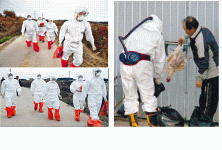
Inspectors from the National Veterinary Research and Quarantine Service and the Korea Center for Disease Control and Prevention on Thursday enter a chicken farm in Iksan, where a an outbreak of bird flu is suspected.

Kim Chang-seob, the ministry?s chief veterinary officer, said the conclusion whether the outbreak is of a virulent strain will available on Saturday, but the case is assumed to be of a deadly strain given the condition of the chickens that dies of the infection.

The affected area houses the chicken farms and processing plants of Halim and Dongwoo, two major chicken producers that account for 30-40 percent of the market. It is therefore going to have an enormous effect on the Korean chicken market. Between December 2003 and March 2004, bird flu cases at 19 poultry farms in 10 cities and counties nationwide killed 5.3 million chickens and ducks and caused financial damage of W150 billion (US$=W930).

An inspector and a farmer on Thursday dispose of culled chickens at a poultry farm in Iksan, where an outbreak of bird flu is suspected.

People must have a direct contact with infected birds to catch avian influenza. Experts say city dwellers are therefore at low risk, but farm workers are advised to wear protective gloves, a mask and goggles, shower carefully after work and keep the farm area clean. In Korea, nine people were infected with bird flu after they participated in poultry inspections and culls in 2003. Visitors to the winter sanctuaries of migratory birds are asked to tour only along official routes and to be careful not to step on feces of migratory birds. The Korea Center for Disease Control and Prevention said avian influenza shows similar symptoms to ordinary flu, including fever above 38 degrees Celsius, cough, a soar throat and respiratory difficulties. He advised people not to touch live poultry and to report to a nearby public health center if they have such symptoms.

Since it was first reported in Thailand and Vietnam in late 2003, the virulent strain of avian influenza has spread to Russia, Mongolia, Europe, Africa and India. A total of 43 countries have reported poultry infected with the deadly strain to the World Health Organization. The H5N1 virus infected at least 258 people over the past three years, killing 153 of them, according to the WHO. Indonesia has been the biggest victim. Since December 2003, 74 Indonesians have been infected and 56 of them died. Vietnam and Thailand have also been on a high bird flu alert. Ninety-three Vietnamese people were infected, the largest number worldwide, and 17 Thais died of bird flu. In China, 14 people were killed and in Egypt six.
 
Re: HPAI H5N1 Confirmed in South Korea

Re: HPAI H5N1 Confirmed in South Korea

http://times.hankooki.com/lpage/biz/200611/kt2006112317452011870.htm
Suspected Bird Flu Reported in Iksan


By Kim Yon-se
Staff Reporter


Quarantine officials enter a village in Iksan, North Cholla Province, Thursday, to examine the area after a suspected outbreak of bird flu was reported at a chicken farm there. /Yonhap
A suspected outbreak of bird flu was reported at a chicken farm in Iksan, North Cholla Province, the Ministry of Agriculture and Forestry said Thursday, affecting a group of brood hens. The ministry said that depending on the type of avian influenza, the highly contagious virus could be transmitted to humans.

The farm is a subcontractor of Korea?s largest chicken meat provider, Halim, which has more than a 30 percent market share. The plant supplies young chicks to Halim by raising thousands of brood hens.

The National Veterinary Research & Quarantine Service detected the suspected bird flu in the provincial city and the ministry has dispatched a group of inspectors for a detailed investigation.

``It will take several days for us to finish investigations into whether it is real avian influenza and of what type,?? said Ministry spokesman Lee Yang-ho. In an emergency news briefing, the ministry said about 6,000 out of 13,000 brood hens in the plant died between last Sunday and Wednesday.

If the government confirms the influenza as a type that can be transmitted to people, it will issue a nationwide bird flu warning, cautioning against the arrival of migratory birds from northern countries.

The bird flu virus, previously limited to Southeast Asia, has been found among migratory birds in China, Russia, Kazakhstan and Mongolia since last year.

Halim, also located in Iksan, shut down its online homepage for several hours after the suspected outbreak was reported.
 
Re: HPAI H5N1 Confirmed in South Korea

Re: HPAI H5N1 Confirmed in South Korea

Pictures.
 

Attachments

  • skorea.gif
    skorea.gif
    250.4 KB · Views: 2
Re: HPAI H5N1 Confirmed in South Korea

Re: HPAI H5N1 Confirmed in South Korea

Sharpe said:
Very strange that they initially said it was a low-path strain that killed 6000 animals. That's a contradiction in itself.

There are two outbreaks in South Korea. H5N1 is HPAI. H5N2 is LPAI. The H5N1 caused the death of 6,000. The H5N2 was another farm in another location.
 
Re: HPAI H5N1 Confirmed in South Korea

Re: HPAI H5N1 Confirmed in South Korea

<TABLE cellSpacing=0 cellPadding=0 width="95%" border=0><TBODY><TR><TD><TABLE cellSpacing=0 cellPadding=0 width="100%" border=0><TBODY><TR><TD class=DetaildTitleGolden id=tdMainHeader width="100%">South Korea confirms H5N1 outbreak</TD><TD vAlign=center></TD><TD vAlign=center align=left></TD></TR><TR><TD id=tdbyLine width="100%" colSpan=3></TD></TR><TR><TD colSpan=3></TD></TR></TBODY></TABLE></TD></TR><TR><TD style="PADDING-RIGHT: 5px"><TABLE height=350 cellSpacing=0 cellPadding=0 width="100%" border=0><TBODY><TR><TD colSpan=2 height=1></TD></TR><TR><TD class=PaddingTop10 id=tdSubHeader vAlign=top colSpan=2 height=60><TABLE cellSpacing=0 cellPadding=0 width="100%" border=0><TBODY><TR><TD vAlign=top><TABLE style="DISPLAY: inline" cellSpacing=0 cellPadding=0 align=right border=0><TBODY><TR><TD align=right>
1_202257_1_5.jpg

Officials had feared that the virulent H5N1 strain was responsible for the outbreak


<TABLE border=0><TBODY><TR></TR></TBODY></TABLE></TD></TR></TBODY></TABLE>South Korea is to slaughter 236,000 poultry after the agriculture ministry confirmed an outbreak of the virulent H5N1 strain of the bird flu virus.

The agriculture ministry said earlier this week it suspected bird flu had killed at least 6,000 chickens at a farm in the south-west of the country that lies on a path taken by migratory birds.

<TABLE border=0><TBODY><TR><TD><INPUT id=Htmlphcontrol1_btnCheckLength style="DISPLAY: none" onclick="return getSelectedText('_KtuluBody1');" type=submit value="Remove Format" name=Htmlphcontrol1:btnCheckLength></TD></TR></TBODY></TABLE><TABLE style="DISPLAY: none" border=0><TBODY><TR><TD><SCRIPT language=javascript>bodyVariable350="Htmlphcontrol1_lblError";</SCRIPT></TD><TD></TD></TR></TBODY></TABLE><TABLE height=10><TBODY><TR><TD></TD></TR></TBODY></TABLE>"It is the H5N1 strain," a ministry official said.

The ministry said in a statement that it ordered the culling of 236,000 poultry within a 500-metre radius of the farm in North Cholla province about 170km from Seoul, the South Korean capital.

<TABLE border=0><TBODY><TR><TD><INPUT id=Htmlphcontrol2_btnCheckLength style="DISPLAY: none" onclick="return getSelectedText('_KtuluBody2');" type=submit value="Remove Format" name=Htmlphcontrol2:btnCheckLength></TD></TR></TBODY></TABLE><TABLE style="DISPLAY: none" border=0><TBODY><TR><TD><SCRIPT language=javascript>bodyVariable300="Htmlphcontrol2_lblError";</SCRIPT></TD><TD></TD></TR></TBODY></TABLE><TABLE height=10><TBODY><TR><TD></TD></TR></TBODY></TABLE><TABLE id=ServicesList style="DISPLAY: inline" cellSpacing=0 cellPadding=0 align=right border=0><TBODY><TR><TD align=middle></TD></TR><TR><TD id=tdRelated align=middle></TD></TR><TR><TD height=5></TD></TR></TBODY></TABLE>Quarantine authorities also banned the shipment of more than five million poultry from 221 farms within a 10km radius of the farm.

There were no reports to suggest local residents or quarantine officials had been infected, another agriculture ministry official said by telephone.

Global outbreak

Between December 2003 and March 2004, about 400,000 poultry at South Korean farms were infected by bird flu.

During that outbreak, the country culled 5.3 million birds and spent about 1.5 trillion won ($1.6 billion) on preventing the disease spreading, officials said.

Subsequent testing in the US indicated that at least nine South Korean workers involved in the cull had been infected with the H5N1 virus, but none developed major illnesses.

Since 2003, outbreaks have been confirmed in around 50 countries and territories, according to the World Organisation for Animal Health.

North Korea had an outbreak at poultry farms near the capital Pyongyang in February 2005, which led it to cull more than 200,000 chickens and vaccinate 1.1 million poultry.

The World Health Organisation said that as of November 13, there had been 258 cases of human infection of the H5N1 strain since 2003, killing 153 people.

Many of the deaths occured in Asia, with 98 deaths in Vietnam and Indonesia, the WHO said.

<TABLE border=0><TBODY><TR><TD></TD></TR></TBODY></TABLE><TABLE height=10><TBODY><TR><TD></TD></TR></TBODY></TABLE>http://english.aljazeera.net/NR/exeres/48F731DA-9D2A-4633-A52B-20DD534F06A8.htm</TD></TR></TBODY></TABLE></TD></TR></TBODY></TABLE></TD><TR><TD id=tdSourceAgency vAlign=center><TABLE width="100%"><TBODY><TR><TD class=SourceTitle vAlign=center width="100%" algin="left">Source: Reuters</TD></TR></TBODY></TABLE></TD></TR></TBODY></TABLE>
 
Re: HPAI H5N1 Confirmed in South Korea

Re: HPAI H5N1 Confirmed in South Korea

Highly pathogenic avian influenza in the Republic of Korea (suspicion)​
(Date of previous outbreak of highly pathogenic avian influenza in the Republic of Korea reported to the OIE: 2004).
Information received on 23 November 2006 from Dr Chang-Seob Kim, Chief Veterinary Officer, Animal Health Division, Ministry of Agriculture and Forestry (MAF), Gwacheon:
Report date:
22 November 2006.
Reason for immediate notification: re-occurrence of a listed disease or infection in a country or zone/compartment following a report declaring the outbreak(s) ended.
Identification of agent: avian influenza virus subtype H5.
Date of first confirmation of the event: 22 November 2006.
Nature of diagnosis: clinical, post-mortem and laboratory.
Location of the outbreak: Iksan city (Jeollabuk-do province).
Number of animals in the outbreak: 6,500 cases, 13,000 susceptible animals, 6,500 deaths.
Description of affected population: a parent stock farm for broiler chickens (45 weeks old).
Laboratory where diagnostic tests were performed: National Veterinary Research and Quarantine Service, Anyang, Kyonggi.
Diagnostic test used: PCR<SUP>(1)</SUP>.
Source of outbreak or origin of infection: unknown or inconclusive.
Control measures undertaken:
<DIR>
- control of wildlife reservoirs;
- stamping out;
- quarantine;
- movement control inside the country (a 10-km radius zone around the infected holding);
- screening;
- zoning.
</DIR>(1) PCR: polymerase chain reaction

http://www.oie.int/Messages/061124KOR.htm
 
Re: HPAI H5N1 Confirmed in South Korea

Re: HPAI H5N1 Confirmed in South Korea

niman said:
There are two outbreaks in South Korea. H5N1 is HPAI. H5N2 is LPAI. The H5N1 caused the death of 6,000. The H5N2 was another farm in another location.

Some media reports indocate the LPAI is not H5N2. In any event, the deaths are from H5N1 (and it is likely to be the Qinghai strain because migratory bird`paths have been mentioned serveral times now.).
 
Last edited:
Re: HPAI H5N1 Confirmed in South Korea

Re: HPAI H5N1 Confirmed in South Korea

Seoul (eCanadaNow) - South Korea is set to slaughter 236,000 poultry after an outbreak of the H5N1 bird flu virus.
This took place at a chicken farm according to the agriculture ministry on Saturday.
The outbreak occured at a chicken farm about 155 miles south of Seoul and resulted in the deaths of 13,000 chickens. 6,700 of them were a direct result of the bird flu infection.
236,000 poultry within a 1,650 foot radius of the outbreak site are now set to be slaughtered to keep the virus from spreading.
The ministry also announced the limited movement of 5 million chickens and ducks from 221 farms within a 0.6 mile radius of the outbreak.
?People can be infected with the virus if they come into direct contact with dead chickens,? said Kwon, the KCDC?s director of the communicable disease control team.
That is why the slaughtering is going to take place.

http://www.ecanadanow.com/science/health/2006/11/25/south-korea-to-slaughter-236000-poultry-after-bird-flu-outbreak/

<SCRIPT type=text/javascript><!--google_ad_client = "pub-7819247354276081";google_ad_width = 300;google_ad_height = 250;google_ad_format = "300x250_as";google_ad_type = "text_image";//2006-11-04: ECN Bottomgoogle_ad_channel = "2333585574";google_color_border = "FFFFFF";google_color_bg = "FFFFFF";google_color_link = "0000FF";google_color_text = "000000";google_color_url = "008000";//--></SCRIPT><SCRIPT src="http://pagead2.googlesyndication.com/pagead/show_ads.js" type=text/javascript></SCRIPT>
 
Re: HPAI H5N1 Confirmed in South Korea

Re: HPAI H5N1 Confirmed in South Korea

...the limited movement...

What does that mean? Are they relocating nearby fowl or are they limiting the movement, ie., preventing transportation to market?

.
 
Re: HPAI H5N1 Confirmed in South Korea

Re: HPAI H5N1 Confirmed in South Korea

AlaskaDenise said:
What does that mean? Are they relocating nearby fowl or are they limiting the movement, ie., preventing transportation to market?

.
I would say that the birds are semi-quarantined until they are tested. I think it is supposed to read a 6.2 mile radius.
 
Re: HPAI H5N1 Confirmed in South Korea

Re: HPAI H5N1 Confirmed in South Korea

<st1:country-region w:st="on"><st1:place w:st="on">South Korea</st1:place></st1:country-region> confirms outbreak of H5N1 bird flu<o:p></o:p>
Case is the nation?s first in 3 years; ministry orders 236,000 poultry culled<o:p></o:p>
http://www.msnbc.msn.com/id/15890121/ <o:p></o:p>
Updated: 11:21 a.m. ET Nov 25, 2006<o:p></o:p>
<st1:City w:st="on">SEOUL</st1:City> - <st1:country-region w:st="on"><st1:place w:st="on">South Korea</st1:place></st1:country-region> said on Saturday a bird flu outbreak at a poultry farm was caused by the highly virulent H5N1 strain of the virus, in the country's first case for three years of the infection that can kill humans.<o:p></o:p>
The Agriculture Ministry said earlier this week it suspected bird flu had killed 6,000 chickens at a farm in the southwest of the country that lies on a path for migratory birds.<o:p></o:p>
"It is the H5N1 strain," a ministry official said by telephone on Saturday, after test results.
<o:p> </o:p>
The ministry ordered the culling of 236,000 poultry within a 1,640-foot radius of the farm in North Cholla province about 100 miles from <st1:place w:st="on"><st1:City w:st="on">Seoul</st1:City></st1:place>, a ministry statement said.<o:p></o:p>
Quarantine authorities also banned the shipment of more than 5 million poultry from 221 farms within a 6.2-mile radius of the farm.<o:p></o:p>
No people appear infected
<o:p> </o:p>
There were no reports to suggest local residents or quarantine officials had been infected, another Agriculture Ministry official said by telephone.<o:p></o:p>
Between December 2003 and March 2004, about 400,000 poultry at South Korean farms were infected by bird flu.<o:p></o:p>
During that outbreak, the country culled 5.3 million birds and spent about $1.6 billion on preventing the disease spreading, officials said.<o:p></o:p>
Subsequent testing in the <st1:place w:st="on"><st1:country-region w:st="on">United States</st1:country-region></st1:place> indicated at least nine South Korean workers involved in the cull had been infected with the H5N1 virus, but none developed major illnesses.
<o:p> </o:p>
Since 2003, outbreaks have been confirmed in around 50 countries and territories, according to the World Organization for Animal Health.<o:p></o:p>
<st1:country-region w:st="on">North Korea</st1:country-region> had an outbreak at poultry farms near the capital <st1:City w:st="on"><st1:place w:st="on">Pyongyang</st1:place></st1:City> in February 2005, which led it to cull more than 200,000 chickens and vaccinate 1.1 million poultry.<o:p></o:p>
The World Health Organization said that by Nov. 13, there had been 258 cases of human infection of the H5N1 strain since 2003, killing 153 people. Many of the victims were Asians, with 98 deaths in <st1:country-region w:st="on">Vietnam</st1:country-region> and <st1:place w:st="on"><st1:country-region w:st="on">Indonesia</st1:country-region></st1:place>, WHO said.
<o:p> </o:p>
<o:p> </o:p>
(c) Reuters 2006. All rights reserved. Republication or redistribution of Reuters content, including by caching, framing or similar means, is expressly prohibited without the prior written consent of Reuters. Reuters and the Reuters sphere logo are registered trademarks and trademarks of the Reuters group of companies around the world
<o:p> </o:p>
 
Re: HPAI H5N1 Confirmed in South Korea

Re: HPAI H5N1 Confirmed in South Korea

http://www.medicalnewstoday.com/healthnews.php?newsid=57512


South Korea Confirms H5N1 Bird Flu Outbreak

Main Category: Bird Flu / Avian Flu News
Article Date: 25 Nov 2006 - 20:00pm (PST)

After an H5N1 bird flu outbreak was confirmed by South Korean authorities, 236,000 poultry will be slaughtered in Iksan, about 145 miles south of the capital, Seoul. A strict quarantine has been established around the immediate vicinity of the affected area.

Alarm bells rang earlier on this week when 6,000 poultry suddenly died at a farm in Iksan. Authorities culled all poultry and eggs in the farm and imposed a 10 km quarantine around the area.

The last time South Korea had a bird flu outbreak was almost three years ago, when over five million birds were slaughtered.

Japan has suspended the imports of poultry from South Korea. People arriving to Japan from South Korea now have to have the soles of their shoes disinfected.

Scientists fear the H5N1 bird flu virus strain may mutate and become easily human transmissible. So far, it is difficult for humans to catch bird flu from birds, and even harder for infected people to infect others.

Written by: Christian Nordqvist
Editor: Medical News Today
 
Re: HPAI H5N1 Confirmed in South Korea

Re: HPAI H5N1 Confirmed in South Korea

http://times.hankooki.com/lpage/nation/200611/kt2006112618121511990.htm


<TABLE cellSpacing=0 cellPadding=0 width=600 border=0><TBODY><TR><TD vAlign=top align=left width=590 colSpan=4>Farmers Take Fright Over Bird Flu
</TD></TR><TR><TD width=5>
kt_space.gif
</TD><TD vAlign=top width=360>By Kim Tong-hyung
Staff Reporter


Farmers in North Cholla Province are scrambling to put up defenses after the health authorities found bird flu in dead chickens at a farm in Iksan, the country??s first outbreak since 2003.

Although the government urges calm over the discovery of bird flu, identified as the H5N1 strain that could be fatal to humans, there is mounting concern over public health safety and economic losses, since the area is the country??s largest poultry supplier.

Health officials and farm workers yesterday have begun culling about 236,000 chickens and chickens at six Iksan poultry farms in a bid to stave off the spread of the H5N1.

Authorities have banned the sale or transport of chickens from the area, and checkpoints have been setup to inspect trucks.

``We are planning to establish more checkpoints at traffic points and mountain roads connecting the villages with the help of the police and the military.

We are also deploying more quarantine workers to the area,???? said an official from the North Cholla Provincial Government, adding that authorities plan to double the current eight checkpoints surrounding the affected area soon.

``We hope that the bird flu outbreak in Iksan is an isolated case, but we are preparing for the worst case scenario,???? said the official.

An initial three kilometer quarantine zone was setup around the outbreak site in Iksan late Saturday, surrounded by a 10 kilometer surveillance zone, which covers more than 200 poultry farms in Iksan, Sochon and Kumgang.

Farmers in the affected areas are restricted from moving poultry, eggs and other products.

The farms within the surveillance zone raise more than 50 million chickens and ducks, and the economic costs could be around 150 billion won ($160 million) to 200 billion won should the farmers be forced to kill the birds.

On Saturday, the Ministry of Agriculture and Forestry confirmed that the H5N1 bird flu virus was found in some 6,500 dead chickens at a farm in Iksan.

The potentially lethal H5N1 virus, the same type that hit the country in December of 2003, is an epidemic among birds that could mutate and spread to humans in direct contact with them.

The disease has claimed 151 lives around the world, mostly in Asia, since first emerging in Hong Kong in 2003, the Ministry of Health and Welfare said. The death toll accounts for more than half the people who were treated for H5N1 infections.

Symptoms range from fever, sore throat, cough, respiratory illnesses and possible organ failure.

This February, the Center for Disease Control and Prevention (CDC) reported that four quarantine workers, involved in culling operations on poultry farms after the bird flu outbreak in 2003, tested positive for the H5N1 virus.

However, none of the four suffered flu-liked symptoms or any other illnesses believed to be linked to bird flu, the state-run agency said.

During the last outbreak in 2003, health officials were forced to kill 5.3 million chickens at 19 poultry farms in South Chungchong Province, resulting in 1.5 billion won ($1.6 million) in economic losses.

Between December 2003 and March of the following year, domestic poultry consumption was down some 60 percent from normal levels.
The government is trying to downplay concerns over health, saying that it is safe to eat poultry meat that is cooked for more than five minutes at 75 degrees Centigrade and above.

thkim@koreatimes.co.kr
11-26-2006 18:12​
</TD></TR></TBODY></TABLE>
 
Re: HPAI H5N1 Confirmed in South Korea

Re: HPAI H5N1 Confirmed in South Korea

Google-translated from simplified Chinese:

South Korea confirmed that the avian flu epidemic caused by the H5N1 highly pathogenic virus

2006 年 11 月 27 日 10:43 China Daily website

Global Online: November 25 South Korean Ministry of Agriculture and Forestry confirmed. North of the country Iksan City Road testing the bird flu epidemic was eventually diagnosed as caused by the H5N1 highly pathogenic avian flu virus. To control the epidemic, the South Koreans began to kill 25,26 within a radius of 500 meters of nearly 20 million chickens and even pigs. Dogs and other animals have also been implicated.

According to South Korean media reported on the 26th, according to the National Institute of Scientific Veterinary Quarantine Laboratory, South Korea Ministry of Agriculture and Forestry on the 25th decided to affected areas within a radius of 500 meters of six farmhouses Lane all killed 236,000 chickens and ducks and other poultry. At 14:00 on the 25th, immunization of Iksan City Department policy focus of the first killed the two farms of more than 6,000 chickens and dogs. Meanwhile the destruction of the affected areas within a three kilometer radius of 6 million eggs and duck.

At 9:00 on the 26th, the focus of another 186,000 chickens within a radius of 500 meters were killed Meanwhile 577 of 300 pigs and dogs were also "lost." The Administration has provided 10 km radius of a bird flu epidemic area "warning area" to prohibit the movement of poultry and poultry, disinfect restricting access, and require the warning area, the poultry farmers to immediately declare its poultry apparent difference might arise. According to the authorities, a total of 221 family farms throughout the warning area, raising a total of more than 500 million chickens and ducks If the spread of the epidemic, they would be "ruthless."

This outbreak of the H5N1 bird flu occurred in the first 19 to 22 this month, Farm focus of the group's 6,000 chickens died in a few days. The test results showed that it is from December 2003 to April 2004 in South Korea 10 cities, Quite to the same type of avian influenza that has killed the 19 South Korean farms 5.3 million chickens and ducks. 1500 caused economic losses of 957 billion won.

Experts said that the human race had only direct contact with poultry with bird flu will be infected with avian flu, and, virus in temperatures above 75 degrees Celsius heat 5 minutes can be completely eliminated. So food cooked poultry system will not lead to the spread of avian flu. (Kang)

http://news.sina.com.cn/w/2006-11-27/104310607924s.shtml
 
Re: South Korea - H5N1 - Iksan

Re: South Korea - H5N1 - Iksan

Thanks to Treyfish...
http://www.news.gov.hk/en/category/healthandcommunity/061127/txt/061127en05009.htm

<TABLE cellSpacing=0 cellPadding=0 width=490 border=0><TBODY><TR><TD>November 27, 2006</TD></TR><TR><TD>Avian flu</TD></TR><TR><TD vAlign=top width=496>South Korean poultry imports suspended

</TD></TR><TR><TD class=theme_text vAlign=top align=left>The Centre for Food Safety has suspended processing applications for importing poultry and poultry products from South Korea, following confirmation of an H5N1 avian flu outbreak there.

Hong Kong imported 900 tonnes of frozen poultry meat and offal from South Korea in January-August.

The centre will seek further information on the case.

.
</TD></TR></TBODY></TABLE>
 
Re: South Korea - H5N1 - Iksan

Re: South Korea - H5N1 - Iksan

Bird flu has now been reported in four locations west and south of the South Korean capital.
 
Re: South Korea - H5N1 - Iksan

Re: South Korea - H5N1 - Iksan

Iksan, Seosan, Pyontaek & ?
 
Re: South Korea - H5N1 - Iksan & Yangpyeong

I am running behind on commentaris for South Korea, and additional reports of deaths continue to come in. I suspect the outbreak is considerably worse than described in initial media reports.
 
Back
Top