

Michael Coston
Editor, Senior Moderator
South Carolina: SCDNR Reports Multiple Die Offs Of Ducks Due to HPAI H5

#17,835
It's a quiet Christmas morning, and while the last week of December and the first week of January are often barren of much news (and fewer journal articles are published), we do have an interesting report from the Facebook page of South Carolina's Department of Natural Resources (SCDNR).
They are reporting `multiple' duck die offs, across 3 counties (see map above), which preliminary testing have confirmed HPAI H5 in at least two. Test results are pending on other outbreaks.
First their brief announcement, after which I'll have a bit more on avian flu detection in the wild.
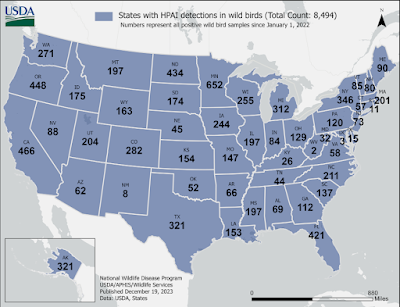
Wild bird die offs from HPAI H5 are nothing new, as the USDA has reported on nearly 8,500 such events since January 1st 2022 (see map below). While Minnesota, California, Oregon, and Florida lead the list with > 400 outbreaks each, there are some states (e.g. West Virginia, New Mexico) only reporting single digits.
There is even greater disparity in the reporting of mammalian wildlife (excludes domestic animals & pets) with HPAI H5 (see map below). Only 20 states have reported finding cases, with Wisconsin, Colorado, and California leading the pack.

Despite huge losses in the poultry industryin November and December, I've seen media reports suggesting that the level of environmental HPAI H5 is down in North America this fall, because the number of avian and mammalian outbreaks reported in 2023 is less than in 2022.
Perhaps.
But it depends on how hard each state, province, or territory are looking - how diligently they are testing - and how willing they are to report their findings. And while it is difficult to quantify, it does appear that some states may be more `invested' in reporting avian and mammalian infections than others.
While I'd like to be comforted by a genuine downward trend, as Dr. Carl Sagan used to remind us:
An absence of evidence isn't necessarily evidence of absence.
https://afludiary.blogspot.com/2023/12/south-carolina-scdnr-reports-multiple.html
#17,835
It's a quiet Christmas morning, and while the last week of December and the first week of January are often barren of much news (and fewer journal articles are published), we do have an interesting report from the Facebook page of South Carolina's Department of Natural Resources (SCDNR).
They are reporting `multiple' duck die offs, across 3 counties (see map above), which preliminary testing have confirmed HPAI H5 in at least two. Test results are pending on other outbreaks.
First their brief announcement, after which I'll have a bit more on avian flu detection in the wild.

Within the last two weeks, the SCDNR and the United States Department of Agriculture’s (USDA) Animal and Plant Health Inspection Service (APHIS) have received numerous calls concerning an apparent die-off of Wood Ducks in waterfowl impoundments and river swamps in Clarendon, Colleton, and Williamsburg Counties. Preliminary testing indicates two of these die-off events can be attributed to highly pathogenic Eurasian H5 avian influenza (HPAI). Results are currently pending from additional die-off locations.
Hunters should be aware that this type of HPAI virus is considered a low risk to people, but it can be a danger to the poultry industry, which is an important part of South Carolina’s agricultural economy.
See the following link for more information on HPAI in SC, including: https://www.aphis.usda.gov/.../anima.../fsc_hpai_hunters.pdf
Hunters should be aware that this type of HPAI virus is considered a low risk to people, but it can be a danger to the poultry industry, which is an important part of South Carolina’s agricultural economy.
See the following link for more information on HPAI in SC, including: https://www.aphis.usda.gov/.../anima.../fsc_hpai_hunters.pdf
Wild bird die offs from HPAI H5 are nothing new, as the USDA has reported on nearly 8,500 such events since January 1st 2022 (see map below). While Minnesota, California, Oregon, and Florida lead the list with > 400 outbreaks each, there are some states (e.g. West Virginia, New Mexico) only reporting single digits.
There is even greater disparity in the reporting of mammalian wildlife (excludes domestic animals & pets) with HPAI H5 (see map below). Only 20 states have reported finding cases, with Wisconsin, Colorado, and California leading the pack.

Despite huge losses in the poultry industryin November and December, I've seen media reports suggesting that the level of environmental HPAI H5 is down in North America this fall, because the number of avian and mammalian outbreaks reported in 2023 is less than in 2022.
Perhaps.
But it depends on how hard each state, province, or territory are looking - how diligently they are testing - and how willing they are to report their findings. And while it is difficult to quantify, it does appear that some states may be more `invested' in reporting avian and mammalian infections than others.
While I'd like to be comforted by a genuine downward trend, as Dr. Carl Sagan used to remind us:
An absence of evidence isn't necessarily evidence of absence.
https://afludiary.blogspot.com/2023/12/south-carolina-scdnr-reports-multiple.html