Ronan Kelly
Retired 2020
Link to 2013 thread; http://www.flutrackers.com/forum/showthread.php?t=200432
Influenza surveillance report - South Africa
Report compiled on 06 May 2014
Influenza surveillance programmes
The data presented in this report are generated from influenza surveillance programmes: the Influenza-like illness (ILI) at primary health clinics and Viral Watch (VW) sites, Severe Acute Respiratory Illness (SARI) and the respiratory consultations and hospitalisations surveillance system.
ILI surveillance at primary health care clinics was started in 2012 at 2 clinics in two provinces, 4 additional clinics were added in 2013.
The Viral Watch (VW) is a sentinel influenza surveillance programme started in 1984 in Gauteng and expanded from 2005 onward to include all 9 provinces in South Africa. The majority (90%) of the sentinel sites are general practitioners. Respiratory specimens (throat, nasal swabs or nasopharyngeal aspirates) are collected from patients of all ages meeting the ILI case definition, which is an acute respiratory illness with a measured temperature of ≥ 38 ˚C, or a history of fever, and cough, with onset within the past 10 days prior to consultation.
The Severe Acute Respiratory Illness (SARI) surveillance program is a prospective sentinel hospital-based surveillance program. It was established in 2009 and is currently conducted at 4 sentinel sites (public hospitals) in 3 provinces of South Africa. Hospitalised patients meeting the surveillance case definition of acute respiratory illness are prospectively enrolled. Clinical and epidemiologic data are collected using standardised questionnaires. Information on in-hospital management and outcome is collected. Upper respiratory tract samples (oropharyngeal and nasopharyngeal swabs in cases ≥5 years old or nasopharyngeal aspirate in cases < 5 years of age) are tested for the presence of influenza and other respiratory viruses using RT-PCR.
The respiratory consultations and hospitalisations surveillance system collects anonymous influenza- and pneumonia-associated outpatient consultations and hospitalisations data from one private hospital group in 7 provinces (Gauteng, North West, Free State, Mpumalanga, Eastern and Western Cape and KwaZulu-Natal). These data on the number of consultations and hospitalisations are compared to the influenza season as described by the Viral Watch and SARI programmes.
...
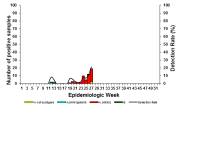
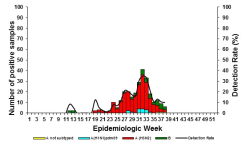
Figure 1. Number of positive samples* by influenza types and subtypes and detection rate by week
*Specimens from patients hospitalised with severe acute respiratory infections at 5 sentinel sites in 4 provinces
...
Table 2. Cumulative number of influenza type and subtype and total number of samples collected by province
Province // B // A not subtyped // A(H1N1)pdm09 // A (H3N2) // Total samples
Eastern Cape // 4 // 0 // 2 // 0 // 6
Free State // 4 // 0 // 0 // 0 // 3 (sic)
Gauteng // 52 // 0 // 0 // 0 // 49 (sic)
KwaZulu-Natal // 15 // 1 // 0 // 0 // 4 (sic)
Limpopo // 8 // 0 // 0 // 0 // 0 // (sic)
Mpumalanga // 2 // 0 // 0 // 0 // 7
Northern Cape // 0 // 0 // 0 // 0 // 0
North West // 0 // 0 // 0 // 0 // 1
Western Cape // 38 // 0 // 3 // 3 // 14 (sic)
Total: // 123 // 1 // 5 // 2 // 84 (sic - I'm not sure how you can have more positives than samples - Ro)
...
http://www.nicd.ac.za/?page=seasonal_influenza&id=72
Influenza surveillance report - South Africa
Report compiled on 06 May 2014
Influenza surveillance programmes
The data presented in this report are generated from influenza surveillance programmes: the Influenza-like illness (ILI) at primary health clinics and Viral Watch (VW) sites, Severe Acute Respiratory Illness (SARI) and the respiratory consultations and hospitalisations surveillance system.
ILI surveillance at primary health care clinics was started in 2012 at 2 clinics in two provinces, 4 additional clinics were added in 2013.
The Viral Watch (VW) is a sentinel influenza surveillance programme started in 1984 in Gauteng and expanded from 2005 onward to include all 9 provinces in South Africa. The majority (90%) of the sentinel sites are general practitioners. Respiratory specimens (throat, nasal swabs or nasopharyngeal aspirates) are collected from patients of all ages meeting the ILI case definition, which is an acute respiratory illness with a measured temperature of ≥ 38 ˚C, or a history of fever, and cough, with onset within the past 10 days prior to consultation.
The Severe Acute Respiratory Illness (SARI) surveillance program is a prospective sentinel hospital-based surveillance program. It was established in 2009 and is currently conducted at 4 sentinel sites (public hospitals) in 3 provinces of South Africa. Hospitalised patients meeting the surveillance case definition of acute respiratory illness are prospectively enrolled. Clinical and epidemiologic data are collected using standardised questionnaires. Information on in-hospital management and outcome is collected. Upper respiratory tract samples (oropharyngeal and nasopharyngeal swabs in cases ≥5 years old or nasopharyngeal aspirate in cases < 5 years of age) are tested for the presence of influenza and other respiratory viruses using RT-PCR.
The respiratory consultations and hospitalisations surveillance system collects anonymous influenza- and pneumonia-associated outpatient consultations and hospitalisations data from one private hospital group in 7 provinces (Gauteng, North West, Free State, Mpumalanga, Eastern and Western Cape and KwaZulu-Natal). These data on the number of consultations and hospitalisations are compared to the influenza season as described by the Viral Watch and SARI programmes.
...
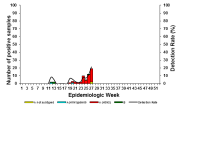
Figure 1. Number of positive samples* by influenza types and subtypes and detection rate by week
*Specimens from patients hospitalised with severe acute respiratory infections at 5 sentinel sites in 4 provinces
...
Table 2. Cumulative number of influenza type and subtype and total number of samples collected by province
Province // B // A not subtyped // A(H1N1)pdm09 // A (H3N2) // Total samples
Eastern Cape // 4 // 0 // 2 // 0 // 6
Free State // 4 // 0 // 0 // 0 // 3 (sic)
Gauteng // 52 // 0 // 0 // 0 // 49 (sic)
KwaZulu-Natal // 15 // 1 // 0 // 0 // 4 (sic)
Limpopo // 8 // 0 // 0 // 0 // 0 // (sic)
Mpumalanga // 2 // 0 // 0 // 0 // 7
Northern Cape // 0 // 0 // 0 // 0 // 0
North West // 0 // 0 // 0 // 0 // 1
Western Cape // 38 // 0 // 3 // 3 // 14 (sic)
Total: // 123 // 1 // 5 // 2 // 84 (sic - I'm not sure how you can have more positives than samples - Ro)
...
http://www.nicd.ac.za/?page=seasonal_influenza&id=72