

JimO
Well-known member
http://health.mo.gov/living/healthcondiseases/communicable/influenza/pdf/Week71112.pdf
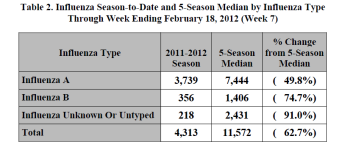
The Week 7 report indicates a perplexing trend in Missouri. As can be seen below, the total number of positive flu tests are 63% below the 5-yr median.
However, the number of P&I deaths in Week 7 are 27% higher than the 5-yr median, which is the opposite of what would be expected based on the number of positive tests. Furthermore, the season to date P&I deaths have now exceeded last season, even though the %ILI data indicate that flu season is just getting started in Missouri.

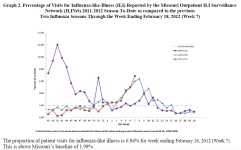
Based on the # of positive flu tests, one would expect the %ILI in Missouri to be below average for this time of year. Conversely, given the elevated number of P&I deaths, one would expect the %ILI to be higher than past seasons.
Although there is an increasing trend in %ILI that in Week 7 exceeds levels since 2009-10, this increase is a leading indicator, while P&I deaths are a trailing indicator. So, the %ILI from 3-4 weeks ago (which was close to baseline) would not suggest that higher P&I deaths were imminent.
The same trends are evident since Week 1 - a fraction of positive tests from the 5-yr median and a 25% or more increase in P&I deaths over the 5-yr median. The only real difference is the increasing trend of %ILI over that period from near baseline to roughly 3x baseline.
Lastly, Missouri does not report the total number of flu tests taken (unless I am missing it), so one cannot calculate the %positive. Thus, fewer positives can either represent fewer tests or a lower percentage of respiratory infection from flu. However, the report does have the following statement:
"A total of 16 specimens were received by the State Public Health Laboratory for viral testing during week 7. Ten were positive for Influenza A (H3), two were positive for Influenza A 2009 (H1N1), three were negative for influenza, and one was unsatisfactory."
Although 16 samples are only a fraction of the total number that must have been taken, the 12 positive samples represents a 75% positive rate for those tested by the State Lab.
My bottom line questions are - Do the data suggest that some other deadly respiratory agent is circulating? Is the information skewed due to a reduced number of samples tested? Is there some demographic explanation for the increased P&I deaths this season? Or perhaps some environmental or weather explanation? There seems to be a lot of "walking pneumonia" going around. Could we be seeing the emergence of an antibiotic resistent bacterium that causes respiratory infection?
Since AH3 is the dominant strain this season, could it be possible that we are seeing a more deadly variant, such as the one CDC refers to as H3N2v? It is interesting that no new H3N2v isolates have been reported by CDC since the West Virginia cases. Has the CDC published any H3N2 sequences recently?
I think that it is worth trying to sort this out.
The Week 7 report indicates a perplexing trend in Missouri. As can be seen below, the total number of positive flu tests are 63% below the 5-yr median.
However, the number of P&I deaths in Week 7 are 27% higher than the 5-yr median, which is the opposite of what would be expected based on the number of positive tests. Furthermore, the season to date P&I deaths have now exceeded last season, even though the %ILI data indicate that flu season is just getting started in Missouri.
Based on the # of positive flu tests, one would expect the %ILI in Missouri to be below average for this time of year. Conversely, given the elevated number of P&I deaths, one would expect the %ILI to be higher than past seasons.
Although there is an increasing trend in %ILI that in Week 7 exceeds levels since 2009-10, this increase is a leading indicator, while P&I deaths are a trailing indicator. So, the %ILI from 3-4 weeks ago (which was close to baseline) would not suggest that higher P&I deaths were imminent.
The same trends are evident since Week 1 - a fraction of positive tests from the 5-yr median and a 25% or more increase in P&I deaths over the 5-yr median. The only real difference is the increasing trend of %ILI over that period from near baseline to roughly 3x baseline.
Lastly, Missouri does not report the total number of flu tests taken (unless I am missing it), so one cannot calculate the %positive. Thus, fewer positives can either represent fewer tests or a lower percentage of respiratory infection from flu. However, the report does have the following statement:
"A total of 16 specimens were received by the State Public Health Laboratory for viral testing during week 7. Ten were positive for Influenza A (H3), two were positive for Influenza A 2009 (H1N1), three were negative for influenza, and one was unsatisfactory."
Although 16 samples are only a fraction of the total number that must have been taken, the 12 positive samples represents a 75% positive rate for those tested by the State Lab.
My bottom line questions are - Do the data suggest that some other deadly respiratory agent is circulating? Is the information skewed due to a reduced number of samples tested? Is there some demographic explanation for the increased P&I deaths this season? Or perhaps some environmental or weather explanation? There seems to be a lot of "walking pneumonia" going around. Could we be seeing the emergence of an antibiotic resistent bacterium that causes respiratory infection?
Since AH3 is the dominant strain this season, could it be possible that we are seeing a more deadly variant, such as the one CDC refers to as H3N2v? It is interesting that no new H3N2v isolates have been reported by CDC since the West Virginia cases. Has the CDC published any H3N2 sequences recently?
I think that it is worth trying to sort this out.