Re: Solar flare to blast Earth's atmosphere; could impact GPS, power grids
Re: Solar flare to blast Earth's atmosphere; could impact GPS, power grids
Solar Storms, CMEs & FEMA
# 5320
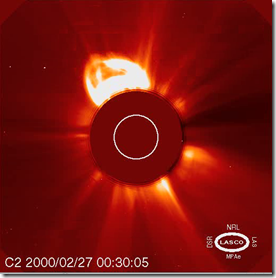
CME Feb 2000 ? Credit
SOHO
Over the past 48 hours activity on our sun - which has been in a prolonged quiescent period called a
solar minimum for nearly 5 years - has increased signaling our approach to a
solar maximum expected sometime in
2012 or
2013.
Our sun is a variable star, and it goes through many major, and minor cycles. The best documented of these is the 11-year/22-year sunspot cycle.
Roughly every 11 years (it runs anywhere from 9 to 14 years), the sun experiences a magnetic pole shift at the time of solar maximum ? a period of high sunspot and solar flare activity.
Every 22 years, the cycle completes, and the poles return to their `original? position.
Our sun has, since 2006, been in a solar minimum or quiescent phase. Very few sunspots and solar flares.
Regular readers will remember that three times last year I wrote about solar storms, and their potential for harm to our infrastructure.
Yesterday, the newswires were filled with stories about a large (
although not particularly severe)
Coronal Mass Ejection (CME) headed for earth. From the United States
Space Weather Prediction Center, we get this update.
 February 16, 2011 -- The calm before the storm. Three CMEs are enroute, all a part of the Radio Blackout events on February 13, 14, and 15 (UTC). The last of the three seems to be the fastest and may catch both of the forerunners about mid to late day tomorrow, February 17. Watch this space for updates on the impending -- G2, possibly periods of G3 -- geomagnetic storming.
Watch Today's Space Weather for the most recent activity.
?s are essentially huge bubbles (
millions of tons, actually) of
magnetized plasma that during times of heightened solar activity, are occasionally ejected from sun at great speed. And when they are directed at earth, they can cause severe
geomagnetic storms.
The most famous, and extreme example occurred in 1859 and is known as
The Carrington Event.
While they pose no direct physical danger to us on the surface
(we are protected by the earths magnetic field and atmosphere), they can wreak havoc with electronics, power generation, and communications.
So today would seem a good day to review solar storms, their impact, and how
FEMA,
NASA, and other agencies are preparing for them.
And what you should be doing to prepare, as well.
Although a
G2-G3 level geomagnetic storm poses little threat, the scale goes up to a
G5.
And while rare, when those occur, the potential for damage is enormous. You can view the entire scale at
NOAA Space Weather Scales, but I?ve excerpted the G5 description.
G 5
Extreme
Power systems: : widespread voltage control problems and protective system problems can occur, some grid systems may experience complete collapse or blackouts. Transformers may experience damage.
Spacecraft operations: may experience extensive surface charging, problems with orientation, uplink/downlink and tracking satellites.
Other systems: pipeline currents can reach hundreds of amps, HF (high frequency) radio propagation may be impossible in many areas for one to two days, satellite navigation may be degraded for days, low-frequency radio navigation can be out for hours, and aurora has been seen as low as Florida and southern Texas (typically 40? geomagnetic lat.)**.
A year ago
FEMA held a major table-top exercise in anticipation of the upcoming solar maximum, and according to a tweet from FEMA Director
Craig Fugate yesterday, they now include a solar weather update in their daily briefings.
A 30 page PDF file is available for download from the FEMA library on this exercise which envisioned a
`near worst-case scenario?.
Managing Critical Disasters in the Transatlantic Domain - The Case of a Geomagnetic Storm
The United States (U.S.) Federal Emergency Management Agency (FEMA), the Swedish Civil Contingencies Agency (MSB), and the U.S. National Oceanic and Atmospheric Administration (NOAA) planned and hosted The Workshop on Managing Critical Disasters in the Transatlantic Domain ? The Case of a Geomagnetic Storm in Boulder, Colorado, on February 23-24, 2010.
The overarching goals of the Geomagnetic Storm Workshop were to allow senior government officials and representatives of both public and private entities from the U.S., Sweden, and the European Union (EU) to compare and contrast the current plans, policies, and procedures used to prepare for and respond to a widespread disaster in the U.S. and EU. The workshop also provided a means to discuss communications between the U.S. and EU in the event of a catastrophic disaster with Transatlantic implications.
An excerpt from this report?s forward reads:
Unlike natural hazards that we have faced in the past, disasters caused by abnormal solar activity could pose a worldwide threat and disrupt energy supplies, air transport, telecommunications, and other critical infrastructure.
Addressing such a large-scale disaster in purely national terms is not sufficient and requires international collaboration.
Last year
NPR produced a news report, and a brief
All Things Considered audio report on this exercise.
The
impact scenario used in this `
near? worst-case exercise reads:
An intense geomagnetic storm began on February 25, 2010, during a particularly cold weather outbreak in the Northeastern U.S. and Northern Europe. Significant electric power grid problems occurred, and a massive power fluctuation affected the transmission grid. Within one hour, cascading power outages were reported throughout the eastern and mid-Atlantic U.S. and eastern Canada.
Power stations reported numerous generator step-up transformers and transmission transformers out of commission, with projected replacements and repairs taking weeks and even months. This raised immediate concern of a critical infrastructure collapse with loss of water distribution, sewage disposal, hospital care, phone service, and fuel resupply. Satellite outages were reported, and cell phones experienced significant service disruptions.
Significant problems were also reported in Northern Europe. Power outages were reported in large areas of southern Sweden, Scotland, Northern England, and the upper tip of Northern Europe. The power outage's effects on international air transport and financial markets were widespread.
The extreme geomagnetic storm lasted for 24 hours, ending late on February 26. Full recovery of the U.S. power grid is expected to take six months. Many populated areas are expected to be without power for weeks or months.
While sounding a bit like science-fiction, and being used as fodder by
prophesy/ Mayan 2012/ End-of-the-World fringe websites, the truth is large and potentially disruptive solar storms do occur on
rare occasions ? usually at the time of a solar maximum.
NASA, while admitting that a serious solar storm could happen practically anytime, also cautions that the next big one could be
many decades away. It is a genuine threat, they say, but the timing is impossible to predict.
You can read it for free online at the above link.
Last year
Space.com produced a spectacular 18 minute video entitled
Attack of the Sun, which may be viewed on
YouTube.
All of which brings us to what you can do to protect your family, your business, and your community should a
`worst-case? geomagnetic storm strike the earth.
While I wouldn?t advise anyone to lie awake at night worrying about such a rare event, it is another good reason to take general `all threats? preparedness seriously.
So if you are well prepared for an
earthquake, a
hurricane, or a
pandemic . . . you are automatically in a better position to weather the disruptions caused by a solar storm.
Some resources to get you started on the road to `
all threats? preparedness include:
And a few of my (
many) preparedness essays include:
You can search this blog for more preparedness information by
clicking this link.
As we approach the solar maximum in 2013, you can expect to be hearing more and more stories about heightened sunspot, solar flare, and CME activity.



