• FluTrackers.com Inc. does not provide medical advice. Information on this web site is collected from various internet resources, and the FluTrackers board of directors makes no warranty to the safety, efficacy, correctness or completeness of the information posted on this site by any author or poster. The information collated here is for instructional and/or discussion purposes only and is NOT intended to diagnose or treat any disease, illness, or other medical condition. Every individual reader or poster should seek advice from their personal physician/healthcare practitioner before considering or using any interventions that are discussed on this website. By continuing to access this website you agree to consult your personal physican before using any interventions posted on this website, and you agree to hold harmless FluTrackers.com Inc., the board of directors, the members, and all authors and posters for any effects from use of any medication, supplement, vitamin or other substance, device, intervention, etc. mentioned in posts on this website, or other internet venues referenced in posts on this website.
  • We are not asking for any donations. Do not donate to any entity who says they are raising funds for us.

Singapore MOH Updates

Ronan Kelly

Retired 2020
Singapore
Home > Breaking News > Singapore > Story
May 27, 2010
Flu epidemic imminent
Vaccinations advised; many patients exhibiting more severe symptoms
By Salma Khalik, Health Correspondent

IT IS epidemic season in Singapore: The number of cases of flu has gone through the roof.

Although this is a traditionally high season for influenza and colds - collectively called acute respiratory infection - the number of people with the sniffles has been at epidemic, or near-epidemic, levels for the past six weeks.

Last week, for instance, 18,420 people sought treatment for the flu at polyclinics alone - or about 4,000 more patients a week than the norm for this time of the year.

Read the full exclusive story in Thursday's edition of The Straits Times.
http://www.straitstimes.com/BreakingNews/Singapore/Story/STIStory_532011.html
 
Re: Flu epidemic imminent

Re: Flu epidemic imminent

Current Influenza Situation in Singapore
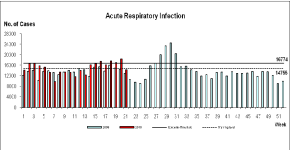
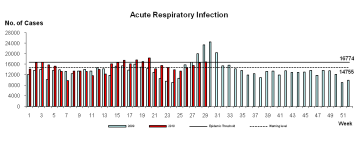
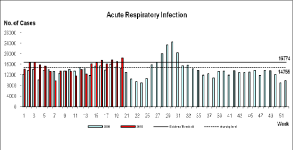
Some indicators for E-week 20 (16 - 22 May 2010) are as follows:
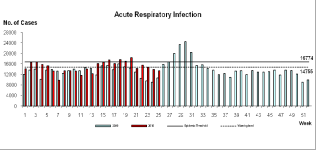
The number of patients seeking treatment at polyclinics for Acute Respiratory Infections (ARI) was 18,420 during E-week 20 (daily average of 3,349 over 5.5 working days), compared to 17,062 during E-week 19 (daily average of 3,102 over 5.5 working days).

The proportion of Influenza A (H1N1-2009) detected among patients with influenza-like illness (ILI) in the community during E-week 20 was 29% (preliminary).

Overall, the influenza activity in Singapore remains high.
http://www.h1n1.gov.sg/

singapore.png
https://www.moh.gov.sg/mohcorp/uploadedImages/Web_Parts/Home/ARI Eweek 20_2010.png

captions are : 2009, 2010, epidenic threshold, warning level
 
Last edited:
Re: Flu epidemic imminent

Re: Flu epidemic imminent

Source: http://health.asiaone.com/Health/News/Story/A1Story20100529-219117.html

Number of flu cases near epidemic levels

By Salma Khalik

IT IS epidemic season in Singapore: The number of cases of flu has gone through the roof.

Although this is a traditionally high season for influenza and colds - collectively called acute respiratory infection - the number of people with the sniffles has been at epidemic, or near-epidemic, levels for the past six weeks.

Last week, for instance, 18,420 people sought treatment for the flu at polyclinics alone - or about 4,000 more patients a week than the norm for this time of the year.

Private clinics are also seeing more patients with runny noses, fevers, aching bones and sore throats.

The Raffles Medical chain of more than 40 GP clinics has seen the number of such cases jump by about 20 per cent.

Doctors say many of their flu patients are exhibiting more severe symptoms.

Dr Chng Shih Kiat, deputy medical director at Raffles Medical, said: 'They tend to be more serious and prolonged, with complications such as sinusitis, resulting in antibiotics being prescribed.'

More worrying is the higher number of patients turning up with pneumonia, a more severe form of upper respiratory tract infection, he added.

Pneumonia is the third-biggest killer here - after cancer and heart disease - accounting for more than 2,000 deaths in 2008. No figures on fatalities for last year or numbers for this year are available.


Dr Leo Yee Sin, clinical director of the Communicable Disease Centre, said there is a definite increase in flu cases, and that many involve the pandemic H1N1 strain, which created a health scare worldwide last year, but eventually proved to be milder than originally thought.

According to Ministry of Health (MOH) figures, 29 per cent of patients here with flu-like symptoms last week had this bug.

(2 of 2)


There has been one H1N1-related death this month. The victim was a 49-year-old Chinese man who died on May 15. The Singapore permanent resident had a history of hypertension, heart problems and diabetes.

His death brings the number of people who succumbed to H1N1 in Singapore to 26.

Another 111 severely ill patients survived after some time in a hospital intensive care unit.


People at the greatest risk of H1N1 are pregnant women and those with underlying medical problems such as asthma or diabetes, people who are very fat or have low immunity.

An MOH spokesman advised vaccinations, especially for people at higher risk of developing complications.

'Vaccination remains the most effective way to prevent influenza infection,' she said.

Those who want to get protection can visit a polyclinic and get the triple-strain seasonal flu vaccine being offered there for under $26.

The vaccine protects against H1N1 and the two other major circulating strains here - Influenza A (H3N2) and B.

The Health Promotion Board has been running a series of advertisements exhorting people to practice good hygiene to prevent the flu bug from spreading.

Meanwhile, another epidemic is also making the rounds here. Hand, foot and mouth disease (HFMD), a disease that mostly affects very young children, has reached almost epidemic levels over the past two weeks. Last week, there were 667 cases reported.


However, there is relief ahead.

Most schools will close for the mid-year holidays from tomorrow, and this will go some way towards breaking the transmission of the disease, since HFMD is often passed between young children in classrooms or childcare centres.
 
Re: Flu epidemic imminent

Re: Flu epidemic imminent

INFLUENZA PANDEMIC (H1N1) (35): SINGAPORE
*****************************************
A ProMED-mail post
<http://www.promedmail.org>
ProMED-mail is a program of the
International Society for Infectious Diseases
<http://www.isid.org>

Date: Thu 27 May 2010
Source: Xinhua News Agency [edited]
<http://news.xinhuanet.com/english2010/health/2010-05/27/c_13318803.htm>


The epidemic season has hit Singapore as the number of flu cases
surged through the roof, local newspaper The Straits Times reported
Thursday [27 May 2010]. Although this has been a traditionally high
season for influenza and colds collectively called acute respiratory
infection, the number of people with the sniffles has been at
epidemic, or near-epidemic levels for the past 6 weeks. A high of 18
420 people sought treatment for the flu at government health
polyclinics last week [week of 17 may 2010], or 4000 more patients a
week than the norm for this time of the year.

Many of the flu cases involve the pandemic A (H1N1) strain, which
created a health scare worldwide last year [2009], but eventually
proved to be milder than originally thought. According to the Ministry
of Health, 29 percent of patients [in Singapore] with flu-like
symptoms last week [week of 17 May 2010] had this bug [influenza
pandemic (H1N1) virus infection].

Also worrying is the higher number of patients turning up with
pneumonia, a more severe form of upper respiratory tract infection.
Pneumonia is the 3rd biggest killer in Singapore, after cancer and
heart disease accounting for more than 2000 deaths in 2008.

--
Communicated by:
ProMED-mail Rapporteur Mary Marshall

[According to the WHO Pandemic (H1N1) 2009 - update 101
(<http://www.who.int/csr/don/2010_05_21/en/index.html>), in Asia the
most active areas of pandemic influenza virus transmission are in
parts of South and Southeast Asia, particularly in Bangladesh,
Malaysia, and Singapore.

In Malaysia, limited data suggests that a 2nd period of active
pandemic influenza virus transmission has been occurring since early
April 2010, but overall activity may have recently stabilized and does
not appear to exceed pandemic influenza activity seen during an
earlier period of transmission lasting from July until early September
2009.

In Singapore, levels of ARI [acute respiratory infectious] have
remained elevated since mid April 2010; during the most recent
reporting week, levels of ARI exceeded the epidemic threshold and the
proportion of patients with ILI [influenza-like illness] testing
positive for pandemic influenza virus infection was 39 percent.

In Bangladesh increased co-circulation of pandemic influenza and
seasonal influenza type B viruses has been detected since mid April
2010 but now appears to have stabilized.

Low level circulation of pandemic influenza continues to persist in
Thailand and in the western and southern parts of India; sporadic
detection of pandemic influenza continue to be reported in Cambodia
and in the Philippines.

In East Asia, only sporadic detections of pandemic influenza virus are
being reported; seasonal influenza type B viruses have been
predominant in this region, however circulation appears to be
declining in China and the Republic of Korea. - Mod.CP]


http://www.promedmail.org/pls/otn/f..._BACK_PAGE,F2400_P1001_PUB_MAIL_ID:1000,82979
 
Re: Flu epidemic imminent

Re: Flu epidemic imminent

Current Influenza Situation in Singapore

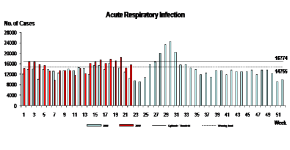
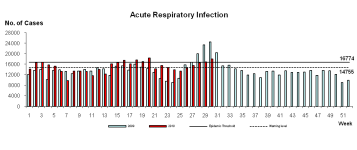
Some indicators for E-week 21 (23 ? 29 May 2010) are as follows:

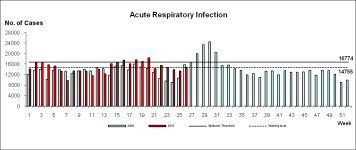
The number of patients seeking treatment at polyclinics for Acute Respiratory Infections (ARI) was 14,318 during E-week 21 (daily average of 3,182 over 4.5 working days), compared to 18,420 during E-week 20 (daily average of 3,349 over 5.5 working days).

The proportion of Influenza A (H1N1-2009) detected among patients with influenza-like illness (ILI) in the community during E-week 21 was 34% (preliminary).

Overall, the influenza activity in Singapore remains high.
http://www.moh.gov.sg/mohcorp/default.aspx

week 21.PNG
https://www.moh.gov.sg/mohcorp/uploadedImages/Home/ARI_Eweek 21.png
 
Re: Flu epidemic imminent

Re: Flu epidemic imminent

Current Influenza Situation in Singapore

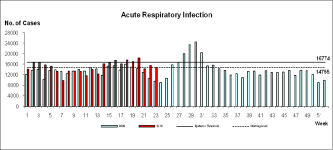
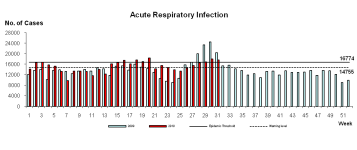
Some indicators for E-week 22 (30 May ? 5 June 2010) are as follows:

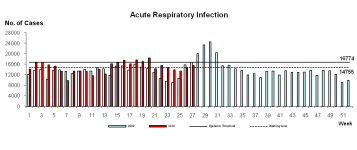
The number of patients seeking treatment at polyclinics for Acute Respiratory Infections (ARI) was 15,577 during E-week 22 (daily average of 2,832 over 5.5 working days), compared to 14,318 during E-week 21 (daily average of 3,182 over 4.5 working days).

The proportion of Influenza A (H1N1-2009) detected among patients with influenza-like illness (ILI) in the community during E-week 22 was 25% (preliminary).

Overall, the influenza activity in Singapore remains high.
http://www.moh.gov.sg/mohcorp/default.aspx

Sing.PNG
https://www.moh.gov.sg/mohcorp/uploadedImages/Web_Parts/Home/ARI EWeek 22.gif
 
Re: Flu epidemic imminent

Re: Flu epidemic imminent

Current Influenza Situation in Singapore

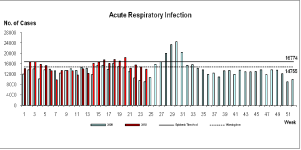
Some indicators for E-week 23 (6 - 12 June 2010) are as follows:

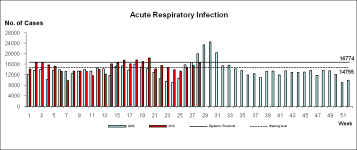
The number of patients seeking treatment at polyclinics for Acute Respiratory Infections (ARI) was 14,844 during E-week 23 (daily average of 2,699 over 5.5 working days), compared to 15,577 during E-week 22 (daily average of 2,832 over 5.5 working days).

The proportion of Influenza A (H1N1-2009) detected among patients with influenza-like illness (ILI) in the community during E-week 23 was 28% (preliminary).

Overall, the influenza activity in Singapore remains high.
http://www.moh.gov.sg/mohcorp/default.aspx

untitled.PNG
http://www.moh.gov.sg/mohcorp/uploadedImages/ARI_Eweek 23.png
 
Re: Flu epidemic imminent

Re: Flu epidemic imminent

Current Influenza Situation in Singapore

Some indicators for E-week 24 (13 ? 19 June 2010) are as follows:

The number of patients seeking treatment at polyclinics for Acute Respiratory Infections (ARI) was 13,929 during E-week 24 (daily average of 2,533 over 5.5 working days), compared to 14,844 during E-week 23 (daily average of 2,699 over 5.5 working days).

The proportion of Influenza A (H1N1-2009) detected among patients with influenza-like illness (ILI) in the community during E-week 24 was 19% (preliminary).

Overall, the influenza activity in Singapore remains high.
http://www.moh.gov.sg/mohcorp/default.aspx

Sing.PNG
 
Re: Singapore MOH Updates (was: Flu epidemic imminent)

Re: Singapore MOH Updates (was: Flu epidemic imminent)

Current Influenza Situation in Singapore

Some indicators for E-week 25 (20 ? 26 June 2010) are as follows:

The number of patients seeking treatment at polyclinics for Acute Respiratory Infections (ARI) was 13,433 during E-week 25 (daily average of 2,422 over 5.5 working days), compared to 13,929 during E-week 24 (daily average of 2,533 over 5.5 working days).

The proportion of Influenza A (H1N1-2009) detected among patients with influenza-like illness (ILI) in the community during E-week 25 was 15% (preliminary).

Overall, the influenza activity in Singapore is decreasing.
http://www.moh.gov.sg/mohcorp/default.aspx

Sing.PNG
http://www.moh.gov.sg/mohcorp/uploadedImages/Web_Parts/Home/ARI Eweek 25 2010.png
 
Re: Singapore MOH Updates (was: Flu epidemic imminent)

Re: Singapore MOH Updates (was: Flu epidemic imminent)

Current Influenza Situation in Singapore


Some indicators for E-week 26 (27 June ? 3 Jul 2010) are as follows:

The number of patients seeking treatment at polyclinics for Acute Respiratory Infections (ARI) was 13,576 during E-week 26 (daily average of 2,650 over 5.5 working days), compared to 13,433 during E-week 25 (daily average of 2,442 over 5.5 working days).

The proportion of Influenza A (H1N1-2009) detected among patients with influenza-like illness (ILI) in the community during E-week 26 was 16% (preliminary).

Overall, the influenza activity in Singapore remains unchanged.

http://www.moh.gov.sg/mohcorp/default.aspx

Sing.PNG
http://www.moh.gov.sg/mohcorp/uploadedImages/Web_Parts/Home/ARI E-Week 26 2010.png
 
Re: Singapore MOH Updates (was: Flu epidemic imminent)

Re: Singapore MOH Updates (was: Flu epidemic imminent)

Current Influenza Situation in Singapore


Some indicators for E-week 27 (4 Jul - 10 Jul 2010) are as follows:

The number of patients seeking treatment at polyclinics for Acute Respiratory Infections (ARI) was 15,597 during E-week 27 (daily average of 2,836 over 5.5 working days), compared to 13,576 during E-week 26 (daily average of 2,650 over 5.5 working days).

The proportion of Influenza A (H1N1-2009) detected among patients with influenza-like illness (ILI) in the community during E-week 27 was 14% (preliminary).

Overall, the influenza activity in Singapore remains unchanged.

http://www.moh.gov.sg/mohcorp/default.aspx

Sing.PNG

http://www.moh.gov.sg/mohcorp/uploadedImages/Web_Parts/Home/ARI E-Week 27 2010.png
 
Re: Singapore MOH Updates (was: Flu epidemic imminent)

Re: Singapore MOH Updates (was: Flu epidemic imminent)

Current Influenza Situation in Singapore

Some indicators for E-week 28 (11 - 17 Jul 2010) are as follows:

The number of patients seeking treatment at polyclinics for Acute Respiratory Infections (ARI) was 16,589 during E-week 28 (daily average of 3,016 over 5.5 working days), compared to 15,597 during E-week 27 (daily average of 2,836 over 5.5 working days).

The proportion of Influenza A (H1N1-2009) detected among patients with influenza-like illness (ILI) in the community during E-week 28 was 15% (preliminary).

Overall, the influenza activity in Singapore remains unchanged.

http://www.moh.gov.sg/mohcorp/default.aspx
Sing.PNG
 
Re: Singapore MOH Updates

Current Influenza Situation in Singapore
Some indicators for E-week 29 (18 - 24 Jul 2010) are as follows:

The number of patients seeking treatment at polyclinics for Acute Respiratory Infections (ARI) was 16,891 during E-week 29 (daily average of 3,071 over 5.5 working days), compared to 16,589 during E-week 28 (daily average of 3,016 over 5.5 working days).

The proportion of cases with Influenza-Like Illness (ILI) among the polyclinic ARI cases remained low at 3%.

Among patients with ILI in the community, 30% had influenza A (H3N2), 7% had pandemic influenza A (H1N1) and 9% had influenza B (preliminary).
http://www.moh.gov.sg/mohcorp/diseases.aspx?id=24616

Sing.PNG
http://www.moh.gov.sg/mohcorp/uploadedImages/Web_Parts/Home/ARI Eweek 29 2010.png
 
Re: Singapore MOH Updates

http://www.moh.gov.sg/mohcorp/diseases.aspx?id=24616

Influenza indicators for E-week 30 (25 ? 31 Jul 2010) are as follows:

The number of patients seeking treatment at polyclinics for Acute Respiratory Infections (ARI) was 18,005 during E-week 30 (daily average of 3,274 over 5.5 working days), compared to 16,891 during E-week 29 (daily average of 3,071 over 5.5 working days)


The proportion of cases with Influenza-Like Illness (ILI) among the polyclinic ARI cases remained low at 2%.

Among patients with ILI in the community, 21% had influenza B, 10% had pandemic influenza A (H1N1) and 7% had influenza A (H3N2) (preliminary).

Overall, the influenza activity in Singapore remains unchanged.

Last updated on 3 Aug10

Sing.PNG
http://www.moh.gov.sg/mohcorp/uploa...ns/H1N1/Chart1_ARI polyclinic attendances.png
 
Re: Singapore MOH Updates

Current Influenza Situation in Singapore
http://www.moh.gov.sg/mohcorp/diseases.aspx?id=24616

Influenza indicators for E-week 31 (1 - 7 Aug 2010) are as follows:

The number of patients seeking treatment at polyclinics for Acute Respiratory Infections (ARI) was 17,711 in E-week 31 (daily average of 3,220 over 5.5 working days), compared to 18,005 during E-week 30 (daily average of 3,274 over 5.5 working days).


Sing.PNG

The proportion of cases with Influenza-Like Illness (ILI) among the polyclinic ARI cases remained low at 3%.
Among patients with ILI in the community, 29% had influenza B, 11% had influenza A (H3N2) and 7% had pandemic influenza A (H1N1) (preliminary).


Overall, the influenza activity in Singapore remains unchanged.


Last updated on 11 Aug 10
 
Re: Singapore MOH Updates

WEEKLY INFECTIOUS DISEASE BULLETIN
EPIDEMIOLOGICAL WEEK 35
29 Aug - 4 Sep 2010

Biggest issues this week; 24 cases of salmonellosis, 147 cases of Dengue, 10 cases of malaria, 1,060 cases of HFMD (down 3 weeks in a row, but still 5-600% more than last year). 4 cases of invasive pneumonococcal disease, cumulative 202 cases versus 177 for same period in 2009.

13,872 clinic visits for ARI. (about the same as last year, below warning level)
Conjunctivitis visits remain high at 534, but well below warning level.

Full report at; http://www.moh.gov.sg/mohcorp/uploa...tious_Diseases_Bulletin/2010/2010_week_35.pdf
 
Re: Singapore MOH Updates

WEEKLY INFECTIOUS DISEASE BULLETIN
EPIDEMIOLOGICAL WEEK 36
5 -11 Sep 2010

Biggest issues this week: 23 cases of salmonellosis, 121 cases of dengue, 691 cases of HFMD (down again, but still very high), 6 cases of melioidosis (total 49 vs historical median 41), 5 invasive pneumococcal disease.

10,103 clinic visits for ARI (below the median)

full report at; http://www.moh.gov.sg/mohcorp/uploa...tious_Diseases_Bulletin/2010/2010_week_36.pdf
 
Back
Top