

Install the app
How to install the app on iOS
Follow along with the video below to see how to install our site as a web app on your home screen.
Note: This feature may not be available in some browsers.
-
FluTrackers.com Inc. does not provide medical advice. Information on this web site is collected from various internet resources, and the FluTrackers board of directors makes no warranty to the safety, efficacy, correctness or completeness of the information posted on this site by any author or poster. The information collated here is for instructional and/or discussion purposes only and is NOT intended to diagnose or treat any disease, illness, or other medical condition. Every individual reader or poster should seek advice from their personal physician/healthcare practitioner before considering or using any interventions that are discussed on this website. By continuing to access this website you agree to consult your personal physican before using any interventions posted on this website, and you agree to hold harmless FluTrackers.com Inc., the board of directors, the members, and all authors and posters for any effects from use of any medication, supplement, vitamin or other substance, device, intervention, etc. mentioned in posts on this website, or other internet venues referenced in posts on this website.
-
We are not asking for any donations. Do not donate to any entity who says they are raising funds for us.
You are using an out of date browser. It may not display this or other websites correctly.
You should upgrade or use an alternative browser.
You should upgrade or use an alternative browser.
Sierra Leone - Mpox outbreak 2025
- Thread starter Mary Wilson
- Start date
Pathfinder
Editor, Senior Moderator
Pathfinder
Editor, Senior Moderator
Mpox in Sierra Leone: what’s behind the recent surge and why west Africa is at risk
Published: June 23, 2025 10:08am EDT
Author
As of 17 June 2025, there have been over 4,000 confirmed cases of mpox and 25 deaths in Sierra Leone, raising the possibility that the virus will spread to neighbouring countries and spark a larger outbreak throughout the densely populated region of west Africa. Cases in Sierra Leone appear to be spreading from person to person, mainly among young men and women.
The Conversation Africa asked Jia Kangbai, an infectious-diseases epidemiologist at Njala University in Freetown, what’s behind the upsurge and how it can be stopped.
What is mpox and how is it transmitted?
Mpox (formerly monkeypox) is a disease caused by the mpox virus. It is a member of the Orthopoxvirus genus. Other members of this genus include small pox and chicken pox. Initially, close physical contact with an infected person was the recognised mode of contracting the virus. With the emergence of various subclades (Clade 1a and 1b, Clade 2a and 2b) of MPXV, sexual transmission of mpox has been documented in several studies.
What’s behind the recent outbreak in Sierra Leone?
The index case for the current mpox outbreak in Sierra Leone is a young man with a documented immunocompromised condition who had gone to the northern town of Lungi in December 2024 to spend Christmas Holiday with his wife. Two days after arrival in Lungi he had unprotected sex with one of the female hotel workers and later developed high fever, muscle and body pains, and swollen lymph nodes. He was later transferred to the capital Freetown where he was diagnosed positive for mpox. He was then admitted at the Connaught Hospital, Freetown, where he was successfully treated.
Sierra Leone’s international airport is located at Lungi. The town is also bustling with international tourists. It is possible that the current outbreak was imported from West Africa; it is also possible that cryptic MPXV transmission has been ongoing in Sierra Leone. Cryptic transmission is a situation when the virus is circulating within a population in low levels so much so that when there is an outbreak it is difficult to identify the source.
In our current study in Sierra Leone, we are running genomic sequencing on specimen obtained from this index case to know the source of the mpox outbreak.
This is a laboratory method used to determine the entire genetic makeup of a specific organism or cell type.
This method can be used to find changes in areas of the genome. These changes may help scientists understand how specific diseases form. Results of genomic sequencing may also be used to diagnose and treat disease.
How worried should Sierra Leoneans be about mpox?
Sierra Leoneans are visibly worried by the increasing number of mpox cases and deaths that have been recorded within four months of active mpox case surveillance. More worrying now for most Sierra Leoneans is the increasing number of commercial sex workers and people with multiple sex partners who are self-reporting for mpox.
Most of the mpox cases in Sierra Leone belong to these sub-populations. This implies that for an effective containment of the mpox outbreak in Sierra Leone special attention needs to be paid to these sub-populations.
...
https://theconversation.com/mpox-in...t-surge-and-why-west-africa-is-at-risk-259286
Published: June 23, 2025 10:08am EDT
Author

- Jia B. Kangbai
Senior lecturer, Njala University
As of 17 June 2025, there have been over 4,000 confirmed cases of mpox and 25 deaths in Sierra Leone, raising the possibility that the virus will spread to neighbouring countries and spark a larger outbreak throughout the densely populated region of west Africa. Cases in Sierra Leone appear to be spreading from person to person, mainly among young men and women.
The Conversation Africa asked Jia Kangbai, an infectious-diseases epidemiologist at Njala University in Freetown, what’s behind the upsurge and how it can be stopped.
What is mpox and how is it transmitted?
Mpox (formerly monkeypox) is a disease caused by the mpox virus. It is a member of the Orthopoxvirus genus. Other members of this genus include small pox and chicken pox. Initially, close physical contact with an infected person was the recognised mode of contracting the virus. With the emergence of various subclades (Clade 1a and 1b, Clade 2a and 2b) of MPXV, sexual transmission of mpox has been documented in several studies.
What’s behind the recent outbreak in Sierra Leone?
The index case for the current mpox outbreak in Sierra Leone is a young man with a documented immunocompromised condition who had gone to the northern town of Lungi in December 2024 to spend Christmas Holiday with his wife. Two days after arrival in Lungi he had unprotected sex with one of the female hotel workers and later developed high fever, muscle and body pains, and swollen lymph nodes. He was later transferred to the capital Freetown where he was diagnosed positive for mpox. He was then admitted at the Connaught Hospital, Freetown, where he was successfully treated.
Sierra Leone’s international airport is located at Lungi. The town is also bustling with international tourists. It is possible that the current outbreak was imported from West Africa; it is also possible that cryptic MPXV transmission has been ongoing in Sierra Leone. Cryptic transmission is a situation when the virus is circulating within a population in low levels so much so that when there is an outbreak it is difficult to identify the source.
In our current study in Sierra Leone, we are running genomic sequencing on specimen obtained from this index case to know the source of the mpox outbreak.
This is a laboratory method used to determine the entire genetic makeup of a specific organism or cell type.
This method can be used to find changes in areas of the genome. These changes may help scientists understand how specific diseases form. Results of genomic sequencing may also be used to diagnose and treat disease.
How worried should Sierra Leoneans be about mpox?
Sierra Leoneans are visibly worried by the increasing number of mpox cases and deaths that have been recorded within four months of active mpox case surveillance. More worrying now for most Sierra Leoneans is the increasing number of commercial sex workers and people with multiple sex partners who are self-reporting for mpox.
Most of the mpox cases in Sierra Leone belong to these sub-populations. This implies that for an effective containment of the mpox outbreak in Sierra Leone special attention needs to be paid to these sub-populations.
...
https://theconversation.com/mpox-in...t-surge-and-why-west-africa-is-at-risk-259286
Pathfinder
Editor, Senior Moderator
Pathfinder
Editor, Senior Moderator
(Screenshot)
Special Briefing on Mpox and other Health Emergencies || July 17, 2025
https://www.youtube.com/watch?v=RG9-8ehU4jU
Pathfinder
Editor, Senior Moderator
(screenshot)
Special Briefing on Mpox and other Health Emergencies || July 31, 2025
https://www.youtube.com/watch?v=fB0uDbvMjLw
Pathfinder
Editor, Senior Moderator
EU Health Task Force deploys ECDC experts to Sierra Leone to support the mpox outbreak response
News
15 Aug 2025
The EU Health Task Force (EUHTF) has deployed two ECDC experts to Freetown, Sierra Leone, via the DG ECHO Union Civil Protection Mechanism (UCPM) to support the national response to the ongoing mpox clade IIb outbreak.
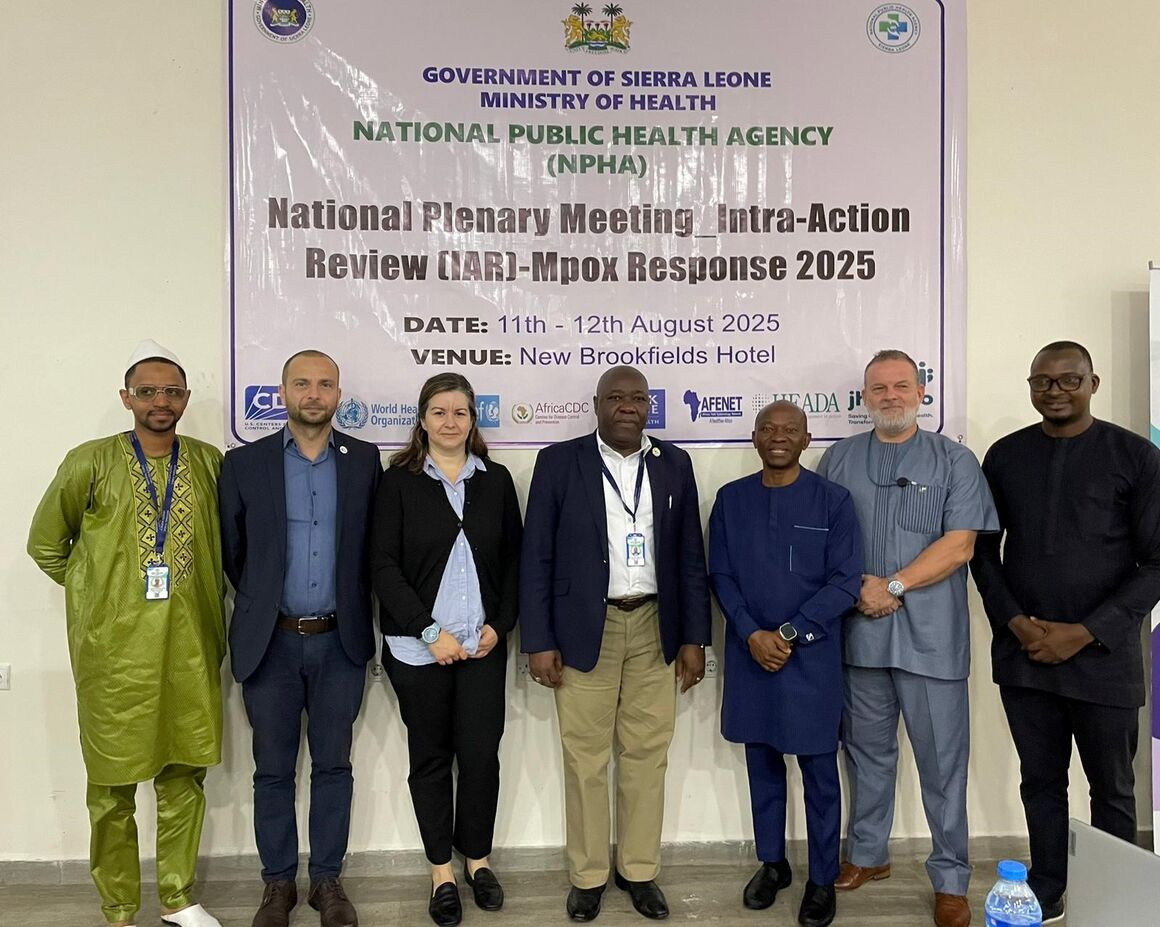
This two-week mission comes at a critical time as the Sierra Leone Ministry of Health and National Public Health Agency (NPHA) review their three-month Action Plan aiming to contain and end this outbreak.
The two experts, an epidemiologist and a risk communicator , are working closely with national stakeholders, including the Sierra Leone Ministry of Health, Africa CDC colleagues, and with the support of the EU Delegation in Freetown.
The epidemiologist is supporting detailed outbreak investigations and data analysis to generate actionable insights for response strategies. She also contributes to situation analyses to facilitate evidence-based decision-making.
Meanwhile, the risk communicator is assisting with the development of culturally tailored public health messaging, supporting knowledge, attitudes and practices (KAP) studies, and strengthening the capacity at the national and district level.
Working alongside local health professionals, paramount chiefs, district councils, and development partners, the experts are contributing to a coordinated effort to control the outbreak and protect communities across Sierra Leone.
https://www.ecdc.europa.eu/en/news-...s-sierra-leone-support-mpox-outbreak-response
News
15 Aug 2025
The EU Health Task Force (EUHTF) has deployed two ECDC experts to Freetown, Sierra Leone, via the DG ECHO Union Civil Protection Mechanism (UCPM) to support the national response to the ongoing mpox clade IIb outbreak.
This two-week mission comes at a critical time as the Sierra Leone Ministry of Health and National Public Health Agency (NPHA) review their three-month Action Plan aiming to contain and end this outbreak.
The two experts, an epidemiologist and a risk communicator , are working closely with national stakeholders, including the Sierra Leone Ministry of Health, Africa CDC colleagues, and with the support of the EU Delegation in Freetown.
The epidemiologist is supporting detailed outbreak investigations and data analysis to generate actionable insights for response strategies. She also contributes to situation analyses to facilitate evidence-based decision-making.
Meanwhile, the risk communicator is assisting with the development of culturally tailored public health messaging, supporting knowledge, attitudes and practices (KAP) studies, and strengthening the capacity at the national and district level.
Working alongside local health professionals, paramount chiefs, district councils, and development partners, the experts are contributing to a coordinated effort to control the outbreak and protect communities across Sierra Leone.
https://www.ecdc.europa.eu/en/news-...s-sierra-leone-support-mpox-outbreak-response
Pathfinder
Editor, Senior Moderator
U.S. Hands Sierra Leone 67,000 More Mpox Vaccines to Seal Final Victory.
Writer: John T. Allieu SLENA Correspondent
John T. Allieu SLENA Correspondent
1 day ago
Freetown: How uplifting it is to receive that final push just when victory is in sight! That is exactly the momentum Sierra Leone’s Ministry of Health has gained with the donation of an additional 67,000 doses of Mpox vaccines from the U.S. Government.
Receiving the consignment on behalf of the Government and people of Sierra Leone, at a ceremony held at the ministry Conference Hall, Minister of Health Dr. Austin Demby (PhD, MPH) expressed gratitude to the United States, underscoring how critical this support is in the nation’s drive to hit and sustain zero Mpox cases.
Dr. Demby noted: “We’ve moved from 2,000 active Mpox cases a few months ago, to just 63 cases currently. That shows how far we have come. But now is not the time to celebrate, it is the time to be cautiously optimistic and stay focused on defeating this outbreak once and for all.”
...
https://www.slena.gov.sl/post/u-s-hands-sierra-leone-67-000-more-mpox-vaccines-to-seal-final-victory
Writer: John T. Allieu SLENA Correspondent
John T. Allieu SLENA Correspondent
1 day ago
Freetown: How uplifting it is to receive that final push just when victory is in sight! That is exactly the momentum Sierra Leone’s Ministry of Health has gained with the donation of an additional 67,000 doses of Mpox vaccines from the U.S. Government.
Receiving the consignment on behalf of the Government and people of Sierra Leone, at a ceremony held at the ministry Conference Hall, Minister of Health Dr. Austin Demby (PhD, MPH) expressed gratitude to the United States, underscoring how critical this support is in the nation’s drive to hit and sustain zero Mpox cases.
Dr. Demby noted: “We’ve moved from 2,000 active Mpox cases a few months ago, to just 63 cases currently. That shows how far we have come. But now is not the time to celebrate, it is the time to be cautiously optimistic and stay focused on defeating this outbreak once and for all.”
...
https://www.slena.gov.sl/post/u-s-hands-sierra-leone-67-000-more-mpox-vaccines-to-seal-final-victory

Shiloh
Editor, Senior Moderator
Source: https://www.newsghana.com.gh/sierra-leone-battles-major-mpox-outbreak-amid-healthcare-strain/
Sierra Leone Battles Major Mpox Outbreak Amid Healthcare Strain
By News Ghana -
December 11, 2025
Sierra Leone is confronting a significant mpox outbreak that has spread across all 16 districts since the first case was confirmed on January 10, 2025, placing severe pressure on an already fragile health system and prompting urgent coordinated action from government agencies, local clinics, and international partners led by the World Health Organisation (WHO).
The outbreak was declared a public health emergency three days after the first confirmed case, and by early June had produced 3,922 confirmed cases. The country now accounts for over 50 percent of all new confirmed mpox cases in Africa, with 80 percent of cases concentrated in Freetown, the capital.
The index patient travelled to the airport town of Lungi in Port Loko District between late December 2024 and early January 2025. Initial symptoms led community health workers to diagnose malaria, and only weeks later did laboratory testing reveal mpox infection.
The country faces longstanding challenges including high maternal and child health needs, limited healthcare infrastructure, and shortages of healthcare workers and essential medicines. By early May, only 60 staffed isolation beds were available nationwide. Factors such as cross border movement, limited immunity in parts of the population, and gaps in surveillance and contact tracing have contributed to the current spread...
Sierra Leone Battles Major Mpox Outbreak Amid Healthcare Strain
By News Ghana -
December 11, 2025
Sierra Leone is confronting a significant mpox outbreak that has spread across all 16 districts since the first case was confirmed on January 10, 2025, placing severe pressure on an already fragile health system and prompting urgent coordinated action from government agencies, local clinics, and international partners led by the World Health Organisation (WHO).
The outbreak was declared a public health emergency three days after the first confirmed case, and by early June had produced 3,922 confirmed cases. The country now accounts for over 50 percent of all new confirmed mpox cases in Africa, with 80 percent of cases concentrated in Freetown, the capital.
The index patient travelled to the airport town of Lungi in Port Loko District between late December 2024 and early January 2025. Initial symptoms led community health workers to diagnose malaria, and only weeks later did laboratory testing reveal mpox infection.
The country faces longstanding challenges including high maternal and child health needs, limited healthcare infrastructure, and shortages of healthcare workers and essential medicines. By early May, only 60 staffed isolation beds were available nationwide. Factors such as cross border movement, limited immunity in parts of the population, and gaps in surveillance and contact tracing have contributed to the current spread...