• FluTrackers.com Inc. does not provide medical advice. Information on this web site is collected from various internet resources, and the FluTrackers board of directors makes no warranty to the safety, efficacy, correctness or completeness of the information posted on this site by any author or poster. The information collated here is for instructional and/or discussion purposes only and is NOT intended to diagnose or treat any disease, illness, or other medical condition. Every individual reader or poster should seek advice from their personal physician/healthcare practitioner before considering or using any interventions that are discussed on this website. By continuing to access this website you agree to consult your personal physican before using any interventions posted on this website, and you agree to hold harmless FluTrackers.com Inc., the board of directors, the members, and all authors and posters for any effects from use of any medication, supplement, vitamin or other substance, device, intervention, etc. mentioned in posts on this website, or other internet venues referenced in posts on this website.
  • We are not asking for any donations. Do not donate to any entity who says they are raising funds for us.

Should Fever Be the Main Screening Tool in School H1N1 Decision Making?

Legadillo

Resident
Most of us are aware of the symptoms of H1N1. The one symptom getting the most attention lately, especially with some of the new federal measures aimed at schools is FEVER. However, my concern is exactly how many cases present with fever?

There is an outbreak of Swine Flu here in my area (Bryan County, Georgia) and the school criteria for quarantine and being allowed to stay home is fever (I guess otherwise they won't be excused, who knows). Yet, I remembered that one of the unique features of H1N1 is that 1/3 of cases present with NO fever, according to the below New York Times article. Moreover, some of the people I am aware of that have been confirmed here had NO fever but had all the other symptoms, including diarrhea, malaise and vomiting and participated in many activities, such as church missions, trips to the mall, etc..... believing they DID NOT pose a threat. :eek:

I am curious to know what scientific studies support the below article because I think it is critical to develop a more effective and comprehensive screening tool for school nurses and doctors to use. Furthermore, I think if this is indeed the case, the federal criteria based primarily on fever could be problematic and exclude a huge number of spreaders in our schools.

http://www.nytimes.com/2009/08/08/health/08flu.html?em


Many Swine Flu Cases Have No Fever

Published: May 12, 2009

Many people suffering from swine influenza, even those who are severely ill, do not have fever, an odd feature of the new virus that could increase the difficulty of controlling the epidemic, said a leading American infectious-disease expert who examined cases in Mexico last week.

In April, medical workers at Taoyuan Airport, in northern Taiwan, checked passengers for fever.
Fever is a hallmark of influenza, often rising abruptly to 104 degrees at the onset of illness. Because many infectious-disease experts consider fever the most important sign of the disease, the presence of fever is a critical part of screening patients.

But about a third of the patients at two hospitals in Mexico City where the American expert, Dr. Richard P. Wenzel, consulted for four days last week had no fever when screened, he said.

“It surprised me and my Mexican colleagues, because the textbooks say that in an influenza outbreak the predictive value of fever and cough is 90 percent,” Dr. Wenzel said by telephone from Virginia Commonwealth University in Richmond, where he is chairman of the department of internal medicine.

While many people with severe cases went on to develop fever after they were admitted, about half of the milder cases did not; nearly all patients had coughing and malaise, Dr. Wenzel said.

Also, about 12 percent of patients at the two Mexican hospitals had severe diarrhea in addition to respiratory symptoms like coughing and breathing difficulty, said Dr. Wenzel, who is also a former president of the International Society for Infectious Diseases. He said many such patients had six bowel movements a day for three days.

Dr. Wenzel said he had urged his Mexican colleagues to test the stools for the presence of the swine virus, named A(H1N1). “If the A(H1N1) virus goes from person to person and there is virus in the stool, infection control will be much more difficult,” particularly if it spreads in poor countries, he said.

The doctor said he had also urged his Mexican colleagues to perform tests to determine whether some people without symptoms still carried the virus.

He also said he had examined patients and data at the invitation of Dr. Samuel Ponce de León, who directs Mexico’s national vaccination program.

Dr. Wenzel said that an unusual feature of the Mexican epidemic, which complicates the understanding of it, was that “in recent months five different influenza viruses have been circulating in Mexico simultaneously.”

Pneumonia rates at one of the hospitals Dr. Wenzel visited, the National Institute for Respiratory Diseases, reached 120 per week recently compared with 20 per week during the past two years, suggesting a possible relation to the swine flu.

The pneumonias that the flu patients developed did not resemble the staphylococcal lung infections that were believed to be a common complication in the 1918-1919 influenza pandemic, Dr. Wenzel said.

He said the two Mexican hospitals were well prepared for an outbreak of respiratory disease. Mexican doctors activated a program to allay anxiety among staff members, offering the staff information, a hot line, psychological support and medical examinations.

“This aspect of epidemic response is not well appreciated in the United States in my estimation, yet is critical for success,” Dr. Wenzel said. “We haven’t put nearly enough into managing fear among health workers.”

http://www.nytimes.com/2009/05/13/health/13fever.html

Is anyone aware of a recent study supporting this article?

Also: read what some of the new federal measures are concerning schools:


Swine Flu Should Not Close Most Schools, Federal Officials Say

Published: August 7, 2009

Most schools should be able to stay open even if swine flu outbreaks occur again this fall, government officials said Friday as they issued recommendations for dealing with the illness when the school year starts.

Decisions about whether to close schools should be made locally, the officials said, and “should balance the goal of reducing the number of people who become seriously ill or die from influenza with the goal of minimizing social disruption and safety risks to children,” which sometimes occur when schools close.

The nation has 130,000 schools, 55 million students and 7 million staff members. Closing schools may mean that parents have to stay home or find child care, which some cannot afford. People in essential jobs, like health care, may be stuck at home during outbreaks when they are most needed. In some cases, children may wind up being left home alone or going to the mall, where they can spread the H1N1 flu virus.

The secretaries of education, homeland security and health and human services described the guidelines for schools with grades kindergarten through 12 on Friday at a news briefing in Washington, along with the director of the Centers for Disease Control and Prevention. Guidelines for colleges and employers are set to be issued on Aug. 23.

“It’s now clear that closure of schools is rarely indicated, even if H1N1 is in the school,” said Dr. Thomas R. Frieden, director of the disease control centers, though he added that closings might be necessary if so many people were sick that the school could not function, or if parents persisted in sending sick children to school.

Education Secretary Arne Duncan said that some schools “will have to close,” and that administrators should be making plans to continue schooling at home, via telephones and the Internet.

Emphasizing that vaccination is the best way to prevent the spread of the flu, Health and Human Services Secretary Kathleen Sebelius said the vaccine against the H1N1 virus should be ready by October. People will probably need two shots of the new vaccine, in addition to one shot for seasonal flu. Children and young people ages 6 months to 24 years are to be given priority for the H1N1 vaccine, and vaccination clinics may be set up in some schools.

The advice to schools includes telling staff members and students to stay home when they are sick and not to return for at least 24 hours after the fever goes away. This differs from earlier guidelines, which advised staying home for seven days.

Schools are also urged to set up a separate room where students and staff members who do come to school sick can stay until they can be sent home. They should be given masks to wear, and so should the people looking after them.

Special schools for sick children or pregnant teenagers, both high-risk groups, may need to close, Dr. Frieden said.

The guidelines also say that if the flu becomes more severe, additional measures may be needed, like screening staff members and students daily, telling people at high risk and those with sick family members to stay home, and increasing the distance between people at school by moving the desks farther apart.
 
Re: Should Fever Be the Main Screening Tool in School H1N1 Decision Making?

Simple answer, NO! This is snipped from an email I sent to our school district's Health Coordinator last night...

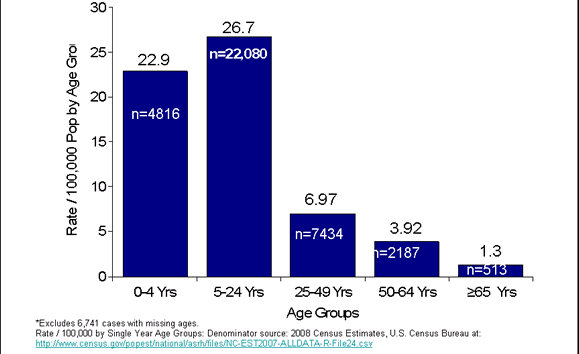
The statistics with respect to age distribution for H1N1 and the accumulating clinical data has special significance for school aged children. <o:p></o:p>
<o:p> </o:p>
Graph A (below) shows the estimated rate of novel H1N1 cases per 100,000 people reported to CDC in the <st1:place w:st="on"><st1:country-region w:st="on">United States</st1:country-region></st1:place> by age group from April 15 to <st1:date w:st="on" ls="trans" month="7" day="24" year="2009">July 24, 2009</st1:date>.<o:p></o:p>
<o:p> </o:p>
cid:image001.jpg@01CA17C0.C12641B0
<o:p></o:p>
qa_graphA.gif

<o:p> </o:p>
<o:p> </o:p>
I assume you have read or will soon be reading the latest recommendations by the CDC in re schools found here: http://www.cdc.gov/h1n1flu/schools/technicalreport.htm<o:p></o:p>
<o:p> </o:p>
?Some persons with laboratory-confirmed influenza do not have a fever (between 10% and 40% of people). Therefore, absence of fever does not indicate absence of infection. In a higher severity situation, schools should send home persons with symptoms of acute respiratory infection (that is, any two of the following: sore throat, cough, runny nose [new and unexplained by allergies], or fever).?<o:p></o:p>
 
Re: Should Fever Be the Main Screening Tool in School H1N1 Decision Making?

Thanks Niko! Case and point. So you addressed my next argument for our school district which is, why need we focus primarily or only on fever when making decisions but take appropriate measures based on all presenting factors (other symptoms, family with flu, etc..). :)


The problem here, of which I am sure you are aware is that based on the new federal measures, fever is the main criteria on which many are to base their decisions (taken from the above snip, "The advice to schools includes telling staff members and students to stay home when they are sick and not to return for at least 24 hours after the fever goes away. This differs from earlier guidelines, which advised staying home for seven days".).

So, I believe that the quote from the CDC that you higlighted (“Some persons with laboratory-confirmed influenza do not have a fever (between 10% and 40% of people). Therefore, absence of fever does not indicate absence of infection. In a higher severity situation, schools should send home persons with symptoms of acute respiratory infection (that is, any two of the following: sore throat, cough, runny nose [new and unexplained by allergies], or fever) should be more emphaiszed so people are not mislead, such as the case example I presented in the initial post, which reads:

"...some of the people I am aware of that have been confirmed here had NO fever but had all the other symptoms, including diarrhea, malaise and vomiting and participated in many activities, such as church missions, trips to the mall, etc..... believing they DID NOT pose a threat."


We're on the same page but more need to be aware!
 
Re: Should Fever Be the Main Screening Tool in School H1N1 Decision Making?

We're on the same page but more need to be aware!

Which is why I am attempting to do my small part by communicating with the people in my district that have influence over local policy. After sending a request for information regarding local policy to the coordinator, I received an email referring me to the 2007 pandemic plans for procedures to be followed :rolleyes:. It became obvious to me that the one person responsible for implementing protocols was unaware of the latest statistics and guidelines. So, I followed with the email from which I snipped my previous post. Needless to say, I am not confident about sending my children off to school in 8 days!
 
Re: Should Fever Be the Main Screening Tool in School H1N1 Decision Making?

If we added the 1-2 days of infectiousness before the appearance of any symptoms, that drove us to much wider closures.

Obviously, the health vertics of every country knows very well all about the varying symptoms and the above, but don't want suggest, or order, to the downstream, stricter measures.

They decided to act as there are no pandemic at all, only measures which must be done with eye-spoted illnessed, or high temp.

Somebody don't like the word conspiracy, so it can be picked any other word which fit good such societies worldwide (exceptions excluded, if exists) behaviour.
 
Re: Should Fever Be the Main Screening Tool in School H1N1 Decision Making?

Which is why I am attempting to do my small part by communicating with the people in my district that have influence over local policy.

Yes, that is what I did as well. I hope to be active in the county pandemic planning committee (just invited to be a part of it) after learning that some of the teachers weren't aware of a pandemic plan at my kids school (they just started yesterday and there is currently an outbreak here) that led to my calls to the school superintendent, a visit to the school nurse and making contact with the director of health for our county. I hope that more measures can be taken and an education campaign can be launched that actually reaches the kids and families instead of stopping at the administrator level, which is what happened here.

So, I guess that makes it our civic duty to hel push the information to the front lines or demand others to bring it forth, especially since we've come down to the wire time wise!

Go for it Niko and Good Luck!
 
Re: Should Fever Be the Main Screening Tool in School H1N1 Decision Making?

If we added the 1-2 days of infectiousness before the appearance of any symptoms, that drove us to much wider closures.

Obviously, the health vertics of every country knows very well all about the varying symptoms and the above, but don't want suggest, or order, to the downstream, stricter measures.

They decided to act as there are no pandemic at all, only measures which must be done with eye-spoted illnessed, or high temp.

Somebody don't like the word conspiracy, so it can be picked any other word which fit good such societies worldwide (exceptions excluded, if exists) behaviour.

I have often been guilty of looking to national or international plans for answers. However, I have come to agree with the quote "All politics is local" (attributed to Tip O'Neill but actually 1st said by his father). I keep hoping that some really important person will get in front of a camera and tell it like it is on national TV over and over... Then, my family friends and neighbors will realize that "swine flu" is not to be taken lightly. As we are racing toward the fall/autumn, I can not in good conscience stand by and assume that some well informed and prepared person or administration will watch over my children. Better late than never, I have kicked into high gear and have contacted anyone I can find that has the ability to affect policies in my school and community.
 
Re: Should Fever Be the Main Screening Tool in School H1N1 Decision Making?

Yes, that is what I did as well. I hope to be active in the county pandemic planning committee (just invited to be a part of it) after learning that some of the teachers weren't aware of a pandemic plan at my kids school (they just started yesterday and there is currently an outbreak here) that led to my calls to the school superintendent, a visit to the school nurse and making contact with the director of health for our county. I hope that more measures can be taken and an education campaign can be launched that actually reaches the kids and families instead of stopping at the administrator level, which is what happened here.

So, I guess that makes it our civic duty to hel push the information to the front lines or demand others to bring it forth, especially since we've come down to the wire time wise!

Go for it Niko and Good Luck!

Back at 'cha :tiphat:
 
Re: Should Fever Be the Main Screening Tool in School H1N1 Decision Making?

I have kicked into high gear and have contacted anyone I can find that has the ability to affect policies in my school and community.

I agree Niko.

I had done this homework at the 2005/06, and recently.

As you can easily assume from many posts here at FT, the results were "as usual".

I do not aspect any changings until the public health higher, and lower, levels decide to change the vinile LP enaugh to buzz the state/local/town/logistic/hospital/GP decisional factors.


Remember? "It is not worst than seasonal flu", and "no travel restrictions/closures (WHO)" are needed.
 
Re: Should Fever Be the Main Screening Tool in School H1N1 Decision Making?

Here's an excerpt from a NYT article published yesterday:

Dr. Wenzel, a former president of the International Society for Infectious Diseases, said he had observed a broad spectrum of illness from human swine influenza: people who experienced few or no symptoms to those who rapidly developed complications and died.

The standard definition of influenza includes a fever. But an odd feature of the new virus is the lack of fever in a significant proportion of documented cases, even after some patients become seriously ill. In Chile, it was about half, in Mexico City about a third and elsewhere, less, Dr. Wenzel said. Lack of fever has been noted by other observers in several Canadian cases.

Analysis of data from specimens yet to be tested may shed light on how often infected individuals who have no fever spread the virus.


Full text: http://www.flutrackers.com/forum/showthread.php?t=120704
 
Re: Should Fever Be the Main Screening Tool in School H1N1 Decision Making?

August 11, 2009

The Doctor's World Seeking Lessons in Swine Flu Fight

By LAWRENCE K.

ALTMAN, M.D.

As the three-month-old outbreak of swine flu raises havoc during the winter season in the Southern Hemisphere, officials in the United States are carefully seeking clues from there to deal with its likely return in this country in the fall, before a vaccine can protect large numbers of people.

Although much about the swine flu pandemic and the virus remains unknown, experts say this outbreak has exposed several weaknesses in the world’s ability to respond to the sudden emergence of a widespread illness.

Over all, the pandemic’s severity has been “moderate” compared with past influenza pandemics, the World Health Organization says, although it has spread with “unprecedented speed” to at least 168 countries. And although influenza typically strikes in colder months, the swine flu virus, A(H1N1), has swept through summer camps in the United States and Canada. That pattern has led to the prevailing belief that many more people will get swine flu than seasonal influenza this fall and winter, but that the country could face outbreaks of both strains, perhaps at different times.

One of the weaknesses that officials and experts point to is that despite years of planning it is evident that the infrastructure of the health departments in many countries, including the United States, is inadequate (in varying degrees) to deal with the sudden appearance of a new strain of influenza. Also, the number of beds in hospital intensive-care units and emergency rooms is limited, as is equipment like mechanical respirators to help patients breathe when the virus attacks the lungs.

Another problem is communication.

Officials and experts say they have learned a lot about human swine influenza. But relatively little of that information, including periodic summaries of what has been learned since the beginning of the pandemic, has been reported and published. Some experts said researchers were waiting to publish in journals, which can take months or longer. Journals impose severe penalties for disclosing information before publication, although they say they exempt matters of public health importance. Whatever the reason, delays in reporting such information can hamper plans for public health responses.

Few experts can match the personal overview that Dr. Richard P. Wenzel, chairman of the department of internal medicine at Virginia Commonwealth University in Richmond, has had of the swine flu virus’s activity in the United States, Mexico and four South American countries. At the invitation of former trainees in those countries and aided by some travel support from industry, he has visited them to observe cases, advise on control measures and critique their data.

Dr. Wenzel, a former president of the International Society for Infectious Diseases, said he had observed a broad spectrum of illness from human swine influenza: people who experienced few or no symptoms to those who rapidly developed complications and died.

The standard definition of influenza includes a fever. But an odd feature of the new virus is the lack of fever in a significant proportion of documented cases, even after some patients become seriously ill. In Chile, it was about half, in Mexico City about a third and elsewhere, less, Dr. Wenzel said. Lack of fever has been noted by other observers in several Canadian cases.

Analysis of data from specimens yet to be tested may shed light on how often infected individuals who have no fever spread the virus.


Epidemiologists stress the need for rigorous methodology to produce the solid data that is crucial for planning. For example, a need exists to account for the several-week delay that can occur between the onset of symptoms and death in influenza and other illnesses. Failure to take that time lag into account can seriously underestimate the death rate, depending on when in the course of the pandemic the information is obtained.

So absence of fever among substantial proportions of patients, when fever is specified in the definition, can cause serious underestimation of case totals.

Also, absence of fever limits the usefulness of thermal scans to identify people who have the virus and thus control the pandemic.

Diarrhea is a symptom that appears to be occurring in a larger percentage of cases than in seasonal influenza, giving clear reason to reinforce the importance of frequent hand washing.

Dr. Wenzel said he had urged his doctor hosts to test patients’ stools to determine how often the virus is present and the extent to which it is responsible for transmission.

Few such studies have been done, and there are reports that laboratories have received samples inadequate for testing.

Little specific information is available about when infected people stop shedding the virus, and thus stop spreading the illness. That information is particularly needed for those with impaired immune systems from H.I.V. infection, chemotherapy and anti-rejection drugs used in organ transplants.

Mexican doctors found the swine influenza virus on the hands of workers, on tables next to patients’ beds, on other hard surfaces and on a computer mouse, Dr. Wenzel said. So, he added, “infection control in hospitals must be assiduous to prevent spread, particularly those with impaired immune systems.”

The course of illness can become life-threatening in just a few hours among patients who had shown only mild symptoms, Dr. Wenzel said, but his visits showed that “doctors know little about what treatment works in severe cases.”

Mexican and Argentinian doctors have noted that cases peak over a four-week period, drop substantially over succeeding weeks to very low numbers, and then pop up elsewhere in the countries, Dr. Wenzel said.

Two more unusual features of the new virus are that pregnancy, particularly in the third trimester, and obesity seem to increase the risk for complications of the infection.

Dr. Anthony E. Fiore, an influenza epidemiologist at the Centers for Disease Control and Prevention in Atlanta, said that “we were unable to find” published articles that looked at obesity as a risk factor.

Studies are under way, he said, to clarify whether obesity is an independent risk factor for complications of influenza or whether obese people have conditions like heart disease, asthma and other chronic lung ailments that put them at such risk.

Dr. William Schaffner, chairman of preventive medicine at Vanderbilt University in Nashville, said many people were reluctant to acknowledge that they or family members are obese. The 10 centers in a C.D.C.-sponsored program to track influenza hospitalizations, he said, have started collecting information on height, weight and body index to better determine obesity’s predisposition to complications.

Doctors actively involved in patient care are hampered by the lack of a standard, reliable rapid test to determine if a patient has swine influenza or some other respiratory illness. The diagnosis of swine influenza A(H1N1) has to be made through special tests known as P.C.R., for polymerase chain reaction. The tests are used in research laboratories but otherwise are generally available only through local and state health departments.

The P.C.R. tests, even if offered by a commercial laboratory, generally cannot be done in time to help a doctor determine whether a patient in an office, a clinic or a hospital has seasonal or swine influenza — a factor in determining what treatment to offer.

That situation has imposed new demands for local and state health departments that are working under severe budget restraints. Health departments doing the tests may be able to tell medical practitioners about swine influenza activity in geographical regions, but not in individual cases.

“We are stuck diagnostically,” Dr. Schaffner said. He added, “While we have increased expectations of what public health departments can do, and the science behind it, we do not have the infrastructure to do it.”

For example, last spring, Dr. Schaffner’s team at Vanderbilt conducted drills to retest their pandemic plans and learned that while some things worked very well, others had problems.

The area assigned for setting up an expanded outpatient clinic no longer existed because a new building had been constructed. “So we had to quickly find a new place,” Dr. Schaffner said. In addition, some elements of the pandemic plan had not been completed because the staff had been busy with other things.

The drills also showed the need to better plan for replacing absent hospital administrators “who are critical in determining which phase of your pandemic plan you are going to move into.”

Dr. Schaffner is trying to alert other institutions to the kinds of gaps identified by Vanderbilt, which has strived to be well prepared.

Health professionals and the public, Dr. Schaffner said, should be receiving more information in a timelier way about what has been learned about the swine influenza pandemic. Some such information is often reported at scientific meetings, but the summer is the doldrums for such gatherings.

Speaking about some of the gaps in clinical and epidemiological details, Dr. Schaffner said that “it is worth being tough and saying how come we do not know more.”

http://www.nytimes.com/2009/08/11/health/11docs.html?_r=1&pagewanted=print
 
Re: Should Fever Be the Main Screening Tool in School H1N1 Decision Making?

#11:
"One of the weaknesses that officials and experts point to is that despite years of planning it is evident that the infrastructure of the health departments in many countries, including the United States, is inadequate (in varying degrees) to deal with the sudden appearance of a new strain of influenza. Also, the number of beds in hospital intensive-care units and emergency rooms is limited, as is equipment like mechanical respirators to help patients breathe when the virus attacks the lungs.

Another problem is communication.

Officials and experts say they have learned a lot about human swine influenza. But relatively little of that information, including periodic summaries of what has been learned since the beginning of the pandemic, has been reported and published. Some experts said researchers were waiting to publish in journals, which can take months or longer. Journals impose severe penalties for disclosing information before publication, although they say they exempt matters of public health importance. Whatever the reason, delays in reporting such information can hamper plans for public health responses."
 
Re: Should Fever Be the Main Screening Tool in School H1N1 Decision Making?

I want to emphasize a couple of points from the original NYT article because they are getting overlooked. I have no idea how many "milder" cases are hospitalized but I would assume not many. So since many of the severe cases did develop fever, that changes the 1/3% that's being quoted often and likely puts Mexico City more in line with what the rest of the country is seeing.

But about a third of the patients at two hospitals in Mexico City where the American expert, Dr. Richard P. Wenzel, consulted for four days last week had no fever when screened, he said.

While many people with severe cases went on to develop fever after they were admitted, about half of the milder cases did not

Then we have this. Just a reminder of all those who are almost positive about re-infections of panflu, there have been 5 different flu viruses circulating.

Dr. Wenzel said that an unusual feature of the Mexican epidemic, which complicates the understanding of it, was that “in recent months five different influenza viruses have been circulating in Mexico simultaneously.”
 
Re: Should Fever Be the Main Screening Tool in School H1N1 Decision Making?

Then we have this. Just a reminder of all those who are almost positive about re-infections of panflu, there have been 5 different flu viruses circulating.
Quote:
Dr. Wenzel said that an unusual feature of the Mexican epidemic, which complicates the understanding of it, was that “in recent months five different influenza viruses have been circulating in Mexico simultaneously.”

If that's the reason, is it an Mexico specificity - why so many diferent virus are there simultaneously, an usual Mexican area yearly situation, or another strange event?.

What is about other countries in the north hem. in the last few summer months,
if there were reports of suspected re-infections from the posts:
are there many simultaneous diferent flu virus circulating also;
a result of same virus re-infections only, or other bugs mix?
 
Re: Should Fever Be the Main Screening Tool in School H1N1 Decision Making?

I bumped this thread so I could retract my quoted statement about "5 viruses have been circulating". I didn't realize the article I quoted from was dated May 12 so the "5 viruses" probably isn't relevant now.

I'm puzzled by the fact that the NYT is still quoting info from a May 12 interview like it's current news.
 
Re: Should Fever Be the Main Screening Tool in School H1N1 Decision Making?

CDC says, "If influenza severity increases, schools should consider instituting active fever and respiratory infection symptom screening of students and staff when they arrive at school. At the beginning of the school day, all students and staff should be asked about suggestive symptoms such as fever, cough, runny nose, and sore throat during the previous 24 hours. Some persons with laboratory-confirmed influenza do not have a fever (between 10% and 40% of people). Therefore, absence of fever does not indicate absence of infection."

http://www.cdc.gov/h1n1flu/schools/technicalreport.htm
 
Re: Should Fever Be the Main Screening Tool in School H1N1 Decision Making?

CDC says, "If influenza severity increases, schools should consider instituting active fever and respiratory infection symptom screening of students and staff when they arrive at school. At the beginning of the school day, all students and staff should be asked about suggestive symptoms such as fever, cough, runny nose, and sore throat during the previous 24 hours. Some persons with laboratory-confirmed influenza do not have a fever (between 10% and 40% of people). Therefore, absence of fever does not indicate absence of infection."

http://www.cdc.gov/h1n1flu/schools/technicalreport.htm

In a perfect world, they could just close schools for September and October until a vaccine is ready, thereby reducing traditional breeding grounds. However doing that would kill the economy and create more distruption than the current strain of H1N1.
 
Re: Should Fever Be the Main Screening Tool in School H1N1 Decision Making?

In a perfect world, they could just close schools for September and October until a vaccine is ready, thereby reducing traditional breeding grounds. However doing that would kill the economy and create more distruption than the current strain of H1N1.


Would it?

For the above disruption the world countries were supposed to be prepared from the 2005, and they didn't even now, 4 years after.

About the parents, they could act as their childrens have 4 months of summer hollidays north. The teachers also.

If they elevate the children/students studying at the levels of national security, instead as an ordinary transmission of cognitions, they can finance and prepare the instalment of TV/internet didactic teaching, as exists already for private payed audience.

Economy killers have diferent proveniences than from mere studying institutions closures.

So the closures could quite well be done in our imperfect world also, even if I could contemplate why many folks gets used to the same patern from year to year.
There is no natural reasons why schools can't be closed, or switched to teleschools (even in rurals, by TV lectures and inner tests) until enaugh good vaccines came, but maybe they wouldn't be in time even by November, so they insists with schools anyway ...

(Sorry if raw language expressions were used)
 
Re: Should Fever Be the Main Screening Tool in School H1N1 Decision Making?

This is from the US Air Force week 28 update; I was surprised at how few met ILI case definition. For whatever reason, Mexico continues to report higher percents ~ around 82% with fever.
----------------------------------------

For lab confirmed cases of Influenza A, the Influenza A/H1N1 (novel) and A/H1 (seasonal) had similar proportions of cases that met the ILI case definition: 362 (22.8%) and 141 (22.5%) respectively compared to 85 (18%) Influenza A/H3 cases.

While a greater proportion of A/H1N1 (novel) cases reported fever (71% vs 65% A/H1 (seasonal) and 69% A/H3), when comparing temperature means across groups, there was minimal difference (101.6?F A/H1N1 (novel) vs 101.7?F A/H1 (seasonal) and 101.4?F A/H3).

Week 28 http://tinyurl.com/qqr8eu
 
Re: Should Fever Be the Main Screening Tool in School H1N1 Decision Making?

In a perfect world, they could just close schools for September and October until a vaccine is ready, thereby reducing traditional breeding grounds. However doing that would kill the economy and create more distruption than the current strain of H1N1.

Summer vacation doesn't kill the economy, nor create disruption.

In rural areas where schools are far apart, when a school burns down it may take 1 to 2 months to get portables set up, resupply the school, and to resume teaching. It works.

If school were postponed, they would need to slide the schedule into next summer - now that would disturb the extra income plans of teachers.

What price will we assign to the life of a child?

.
 
Back
Top Bottom