
• FluTrackers.com Inc. does not provide medical advice. Information on this web site is collected from various internet resources, and the FluTrackers board of directors makes no warranty to the safety, efficacy, correctness or completeness of the information posted on this site by any author or poster. The information collated here is for instructional and/or discussion purposes only and is NOT intended to diagnose or treat any disease, illness, or other medical condition. Every individual reader or poster should seek advice from their personal physician/healthcare practitioner before considering or using any interventions that are discussed on this website. By continuing to access this website you agree to consult your personal physican before using any interventions posted on this website, and you agree to hold harmless FluTrackers.com Inc., the board of directors, the members, and all authors and posters for any effects from use of any medication, supplement, vitamin or other substance, device, intervention, etc. mentioned in posts on this website, or other internet venues referenced in posts on this website.
  • We are not asking for any donations. Do not donate to any entity who says they are raising funds for us.

sequence evolution of H3N2 HA

AlaskaDenise

In Memoriam
I found this interesting diagram. It may relate to some ongoing discussions.
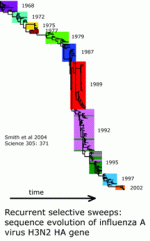
influenza-tree-colored3.gif

from http://phe.rockefeller.edu/barcode/blog/2006/12/

(snipped)

I am intrigued by a time series of influenza A hemagglutinin gene evolution which reflects competition between virus and host and wonder if there might be some kind of competition that helps drive mitochondrial sequence evolution forward and at the same time suppresses variation. It is exciting there will be an EMBO workshop ?Molecular Biodiversity and DNA Barcodes? May 2007 in Rome which may help answer scientific questions posed by DNA barcode data.

.​
 
Re: sequence evolution of H3N2 HA

These recurrent sweeps are mentioned in a recent Nature article:

The genomic and epidemiological dynamics of human influenza A virus. Andrew Rambaut, Oliver G. Pybus, Martha I. Nelson, Cecile Viboud, Jeffery K. Taubenberger & Edward C. Holmes. Nature 453, 615-619 (29 May 2008) | doi:10.1038/nature06945.

The evolutionary interaction between influenza A virus and the human immune system, manifest as 'antigenic drift' of the viral haemagglutinin, is one of the best described patterns in molecular evolution. However, little is known about the genome-scale evolutionary dynamics of this pathogen. Similarly, how genomic processes relate to global influenza epidemiology, in which the A/H3N2 and A/H1N1 subtypes co-circulate, is poorly understood. Here through an analysis of 1,302 complete viral genomes sampled from temperate populations in both hemispheres, we show that the genomic evolution of influenza A virus is characterized by a complex interplay between frequent reassortment and <b>periodic selective sweeps.</b> The A/H3N2 and A/H1N1 subtypes exhibit different evolutionary dynamics, with diverse lineages circulating in A/H1N1, indicative of weaker antigenic drift. These results suggest a sink?source model of viral ecology in which new lineages are seeded from a persistent influenza reservoir, which we hypothesize to be located in the tropics, to sink populations in temperate regions.


Periodic selective sweeps = influenza vaccine mismatch from previous serial (use) seasons in temperate climates??

Also, the authors seem to suggest that one subtype predominates in a season, although this seems to be in direct opposition to conclusions in several articles mapping *successive subtype waves* within seasons.

For instance, when Niman was chit-chatting about Hawaiian isolates, I visited the state public health site to view 2007-08 data and saw the same pattern as mentioned in a recent publication, of sequential rise and fall of Type AH1N1, H3N2 and Type B, with three overlapping peaks.

The publication that compared recent season-to-season variations in the three subtypes also noted that some countries experience overlapping waves of two of three subtypes.
 
Re: sequence evolution of H3N2 HA

...authors seem to suggest that one subtype predominates in a season...
Past discussions here have indicated that one strain is the norm, and in 1979 (when H1N1 reappeared) it couldn't gather enough strength to be the single influenza circulating due to prior H1N1 immunity of persons over the age of 22.

Is there a chance that the "A/H3N2 and A/H1N1 subtypes exhibit different evolutionary dynamics" to lessen competition? It would be similar to animals species which evolve with unique specialties to avoid competing for the same resource.

.
 
Re: sequence evolution of H3N2 HA

here is the abstract and other papers who quote this
(e.g. the recent papaer about (lack of) recombination in human flu)

http://www.sciencemag.org/cgi/content/abstract/305/5682/371

this is "antigenic" evolution, changes of amino-acids = proteins
driven by selection.

We also have "genetic" evolution, changes on the nucleotid-level,
most of which are synonymous and not so much affected by
selection pressure.
I don't think we have similar behaviour on the nucleotid-level
 
Re: sequence evolution of H3N2 HA

here is the abstract and other papers who quote this
(e.g. the recent papaer about (lack of) recombination in human flu)

http://www.sciencemag.org/cgi/content/abstract/305/5682/371

this is "antigenic" evolution, changes of amino-acids = proteins
driven by selection.

We also have "genetic" evolution, changes on the nucleotid-level,
most of which are synonymous and not so much affected by
selection pressure.
I don't think we have similar behaviour on the nucleotid-level
The genetics without genes papers remain highly suspect.
 
Back
Top