• FluTrackers.com Inc. does not provide medical advice. Information on this web site is collected from various internet resources, and the FluTrackers board of directors makes no warranty to the safety, efficacy, correctness or completeness of the information posted on this site by any author or poster. The information collated here is for instructional and/or discussion purposes only and is NOT intended to diagnose or treat any disease, illness, or other medical condition. Every individual reader or poster should seek advice from their personal physician/healthcare practitioner before considering or using any interventions that are discussed on this website. By continuing to access this website you agree to consult your personal physican before using any interventions posted on this website, and you agree to hold harmless FluTrackers.com Inc., the board of directors, the members, and all authors and posters for any effects from use of any medication, supplement, vitamin or other substance, device, intervention, etc. mentioned in posts on this website, or other internet venues referenced in posts on this website.
  • We are not asking for any donations. Do not donate to any entity who says they are raising funds for us.

Seasonal Influenza Outbreaks 2008 (excluding Hong Kong)

Status
Not open for further replies.
Re: Seasonal Influenza Outbreaks 2008 (excluding Hong Kong)

European Influenza Surveillance Scheme starts to post weekly bulletin for Inter-season influenza activity. See the site of EISS at http://www.eiss.org/cgi-files/bulletin_v2.cgi.

This week, low level of influenza activity.

And:
(...)
? Network comments (where available)
* Norway - One influenza A(H1N1) case seen in Oslo, SE Norway, has been characterised by genotyping as not resistant to oseltamivir.
A further two cases of influenza A infection have been reported from Vest-Agder county, SE Norway.
(...)
-
-----
 
Re: Seasonal Influenza Outbreaks 2008 (excluding Hong Kong)

Source: http://news.xinhuanet.com/english/2008-06/04/content_8308047.htm

Influenza cases in Singapore up slightly
www.chinaview.cn 2008-06-04 00:29:14

SINGAPORE, June 3 (Xinhua) -- The number of cases of influenza in Singapore rose slightly last week over the week before, figures from the Ministry of Health (MOH) showed on Tuesday.

The ministry said on its website that there were 11,003 cases last week, up from nearly 10,800 in the previous week.

However, compared to the numbers earlier in May, flu cases have actually dropped. In fact, the number of cases this year is lower compared to the same period in 2007.


Local TV Channel Tuesday quoted doctors as saying that travelers are urged to get vaccinated against the flu if they are heading to Australia or New Zealand as it is now the winter season.

Doctor Wong Kin Chan was quoted as saying, "Right now we are smack in the center of the Southern Hemisphere 2008, so you should be taking a flu vaccine for Southern Hemisphere 2008 and not Northern Hemisphere 2007/2008."

Travelers are advised to get the flu jab at the start of the season when the new vaccinations come out or at least two to four weeks before they travel, while the elderly, children and those with diabetes or lung disease are also advised to get vaccinated as they are susceptible to influenza.
 
Re: Seasonal Influenza Outbreaks 2008 (excluding Hong Kong)

Drug-resistant bug kills young and healthy in U.S.
Tue Jun 3, 2008 7:51pm EDT
By Maggie Fox, Health and Science Editor

WASHINGTON (Reuters) -

A germ that usually causes pimples or skin rashes caused fatal pneumonia in at least 24 otherwise young and healthy people during the 2006-2007 flu season and doctors need to watch for it, U.S. researchers said on Tuesday.

Many of the cases were caused by a drug-resistant form called methicillin-resistant Staphylococcus aureus or MRSA, said the team led by the U.S. Centers for Disease Control and Prevention.

Some of the patients died within four days and many were not initially treated for MRSA, which suggests their doctors had no idea what they had at first, said the CDC's Dr. Alexander Kallen, who led the study.

"It's obviously very concerning," Kallen said in a telephone interview. "This is a disease that can strike otherwise very healthy people -- adults and children. Also this is a disease that follows influenza."

That has implications for planning for the flu season and also preparing for a possible flu pandemic, said Kallen.

His team checked reports of community-acquired pneumonia caused by Staph aureus between November 1, 2006, and April 30, 2007. "Overall, 51 cases were reported from 19 states," they wrote in the Annals of Emergency Medicine.

"More than three-quarters (79 percent) of the staph-caused pneumonia patients were infected with MRSA," Kallen said.

On average the patients were 16 years old. One-third had confirmed influenza but 40 percent were perfectly healthy.

They said 24 patients died, an average of four days after being diagnosed with pneumonia.

Patients who had flu were about twice as likely to die from the staph-caused pneumonia.

"The key message to realize is that during the winter season, especially when influenza is circulating, physicians need to be thinking about this as a cause."

Staph aureus is common -- about 30 percent of people are colonized with it at any given time, meaning they have the bacteria living on their skin or in their noses but are not ill.

"You shake hands with someone and you get MRSA and MRSA colonizes you," Kallen said.

It can get into the lungs sometimes and cause disease.

Some studies have shown that when people are infected with flu, the virus can help shut down natural processes for keeping the lungs clear and allow the bacteria to grow there.

Kallen said MRSA-caused pneumonia may not be getting more common, but doctors are now keeping an eye out for it and reporting it. "This probably overrepresents the true picture of MRSA," Kallen said.

-
http://www.reuters.com/article/heal...0603?feedType=RSS&feedName=healthNews&sp=true
------
 
Re: Seasonal Influenza Outbreaks 2008 (excluding Hong Kong)

[EISS, EUROPEAN UNION, SEASONAL INFLUENZA, UPDATES] EISS - Inter-season Electronic Bulletin - Week 23 : 02/06/2008-08/06/2008 - 13 June 2008, Issue N? 265 - Sporadic laboratory confirmed cases of influenza in Europe in recent weeks

? Summary:
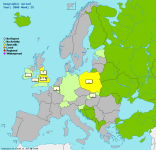
Seasonal influenza activity in Europe has now come to and end and the number of laboratory confirmed cases of influenza is now very low (18 in the past two weeks).
Ten countries reported an assessment of the geographical spread of influenza activity in week 23/2008: England reported sporadic activity and nine countries reported no influenza activity.

In week 22/2008 and 23/2008, there were a total of 18 influenza virus detections in Europe (see graph and table for further details): in England (6), Hungary (1), Ireland (1), Norway (6) and Slovakia (4).

All detections were reported from non-sentinel sources, i.e. detected through the routine activities of diagnostic laboratories.

There were 16 (89%) detections of influenza B virus and two (11%) of influenza A virus (not subtyped).

During the 2007-2008 season, influenza A was dominant in the first half of the season and influenza B was dominant towards the end of the season (as of week 09/2008).

In the month of May 2008 (defined as week 19-22/2008), influenza B remained the dominant virus type with 156 detections (87%).

However, whereas influenza A(H1N1) was clearly the predominant influenza A subtype during the 2007-2008 season (97% of subtyped A viruses), the subtype A(H1) and A(H3) were detected at the same levels in May (two detections of each along with 19 A un-subtyped viruses).

There have been no reports of unusual influenza activity in Europe at a community level (i.e. in a region or local area such as a city, county or district) since week 16/2008.

? Background:
The Inter-season Electronic Bulletin presents and comments influenza activity based on virological data reported to EISS. The Inter-season Electronic Bulletin will be published between week 21/2008 and week 39/2008.

The spread of influenza virus strains and their epidemiological impact in Europe are being monitored by EISS in collaboration with the WHO Collaborating Centre in London (United Kingdom) and the European Centre for Disease Prevention and Control in Stockholm (Sweden). (...)
-
-------
 

Attachments

  • 2008_23_v2_thumb[1].png
    2008_23_v2_thumb[1].png
    96.8 KB · Views: 0
Re: Seasonal Influenza Outbreaks 2008 (excluding Hong Kong)

Australian Capital Territory urges common sense to curb common cold
Posted 11 hours 21 minutes ago

The ACT Government is trying a new approach to stop a major outbreak of influenza this winter.

The Government will begin doing a letterbox drop of a health flier with some simple tips on how to stop colds and flus from spreading.

Last year 400 people were diagnosed with influenza, compared to just 80 in 2006.

Health Minister Katy Gallagher says she hopes the campaign will help take some pressure off the hospital's emergency departments.

"One of the things we can do within the home is take those personal hygiene measures more seriously during this time and try and stop the spread of illness," she said.

"The other issue is that if you are unwell with colds or flus or virus, that you don't go to work and you keep the kids home from school."
-
http://www.abc.net.au/news/stories/2008/06/21/2281803.htm
------
 
Re: Seasonal Influenza Outbreaks 2008 (excluding Hong Kong)

NSW hospitals ready for flu season: Iemma
Posted Mon Jun 23, 2008 11:23am AEST
Updated Mon Jun 23, 2008 11:41am AEST

New South Wales hospitals are gearing up for an expected increase in winter admissions.

Between July and September, the number of people admitted to hospital typically increases by six per cent, depending on the severity of flu outbreaks.

Influenza levels this year are reportedly tracking at normal rates.

Premier Morris Iemma says a number of strategies are in place this year to ease the pressure on emergency departments.

"We've got hundreds of extra beds, more nurses, more doctors and a better system of management to provide faster and better health care this winter," he said.

"For example, we are opening what are called specialised medical assessment units, there are 16 opened, 14 more to come."

Health Minister Reba Meagher says the state's hospitals are well prepared, but it is hard to predict the severity of influenza outbreaks.

"The flu is the x factor in determining how busy our hospitals will be over winter," she said.

"Last year was a particularly virulent strain of the flu. To date we're tracking fairly normally but we must maintain vigilance on that."
-
http://www.abc.net.au/news/stories/2008/06/23/2282639.htm
------
 
Re: Seasonal Influenza Outbreaks 2008 (excluding Hong Kong)

Seasonal Influenza – European Status - Oseltamivir Resistance

Resistance to oseltamivir (Tamiflu) in some European influenza virus samples

As the influenza season is over, all data on the WHO, ECDC and EISS web-sites will now be updated only monthly with the next update at the end of July. Data can be expected to change because of testing of specimens taken earlier in the season.

Updated 25th June 2008 – next update at the end of July

In late January 2008, antiviral drug susceptibility surveillance of seasonal influenza viruses carried out in Europe (the EU-EEA-EFTA countries) by the EU-funded VIRGIL network and National Influenza Centres revealed that some of the A (H1N1) viruses circulating this season (winter 2007-8) were resistant to the antiviral drug, oseltamivir through mutation at position 274 in the viral neuraminidase gene.

Analysis of 2813 A(H1N1) viruses [They were 2748 in the last update - IOH] from 24 European (European Union, EEA/EFTA) countries isolated between November 2007 and late June 2008 (data archived on June 25th) showed that 701 [they were 680 in the last update - IOH] were resistant to oseltamivir, but retained sensitivity to zanamivir and amantadine. [Total isolates (Diff.)=65 ; Total resistant (Diff.)=21 ; Ratio = 32% - IOH]

The data are shown as a figure with a linked table (http://ecdc.europa.eu/Health_topics/influenza/antivirals_graph.html).

It should be noted that the influenza season has now finished in Europe so that new detections like this and other changes in the totals are the result of testing of specimens from during the season and checking of data for example to eliminate duplicates.

The proportion of A(H1N1) viruses that are oseltamivir resistant varied significantly across Europe (http://ecdc.europa.eu/Health_topics/influenza/antivirals_graph.html).

The highest proportion of resistant viruses to date have been in Norway where 184 (67%) of the 273 samples are resistant to oseltamivir, whereas no resistant viruses have been detected in five of the 24 countries.

Due to back testing of specimens previously collected some results are now available for Poland and the figures have changed notably for Belgium where now 17 of 32 A(H1N1) specimens show the marker for resistance giving a percentage of 53%.

Surveillance in previous years by the Virgil Project (http://www.virgil-net.org/) found <1% of circulating viruses to be resistant

The predominant influenza A viruses in Europe in winter 07/08 were A(H1N1) viruses, antigenically similar to the A/Solomon Islands/3/2006 virus included in the 2007/08 N Hemisphere vaccine.

As the season progressed influenza B viruses started to circulate and then predominated. There were only limited circulation of other influenza A in Europe.

Further details on country to country virus distribution this season are available on the European Influenza Surveillance Scheme (http://www.eiss.org/index.cgi)(EISS) weekly update as well as in Influenza News (http://ecdc.europa.eu/Health_topics/influenza/news.html).

Following the observation of a high level of resistance to oseltamivir in the A(H1N1) viruses circulating in Norway, the Norwegian authorities notified their EU partners and the World Health Organization (WHO) of this situation at the end of January.

The Norwegian Public Health Institute also published an advisory to doctors (http://www.fhi.no/eway/default.aspx...:0:0&MainLeft_5588=5544:67376::1:5569:1:::0:0) and the public.

The country with the second highest proportion is now Belgium followed by France with 231 (47%) of 495 specimens showing the marker for oseltamivir resistance.

This is then followed by the Netherlands and Luxembourg with proportions of 30% and 26% respectively.

There is no evidence that the appearance of these new viruses are related to use of oseltamivir which is currently seemingly not widely prescribed in most European countries. ECDC is now working with the manufacturer and national authorities to gather more information on routine oseltamivir use in Europe.

Experts from the European Centre for Disease Prevention and Control (ECDC), the European Commission, the European Influenza Surveillance Scheme and the World Health Organization (WHO) are currently assessing the significance of the data from the EISS VIRGIL network. An interim European risk assessment has been published by ECDC (http://ecdc.europa.eu/pdf/080127_os.pdf) and comments on this are welcomed to influenza@ecdc.europa.eu.

Global surveillance has started coordinated by WHO and has this has found evidence of similarly resistant viruses in North America and the Far East.

As the influenza season is over all data including that on the WHO web-site (http://www.who.int/csr/disease/influenza/h1n1_table/en/index.html) this ECDC website and the EISS web-site will now be updated only monthly with the next update at the end of July.

Although sporadic low level transmission of drug resistant viruses may have taken place since 1999 when the Neuraminidase Inhibitor drugs first were licensed, the 07/08 winter season is the first time there has been widespread and sustained transmission of such viruses in the community. Similar viruses have been seen before, but usually following treatment. Such viruses previously have not been able to readily transmit and have rapidly disappeared.

Clinical experience in Norway and elsewhere suggests that people who become ill with an oseltamivir resistant strain of A(H1N1) have a similar spectrum of illness to those infected with “normal” seasonal influenza A which can cause severe disease or death in vulnerable people (older people, those with debilitating illnesses and the very young). This is now being investigated in national studies and international studies coordinated by ECDC.

At this stage the significance of these findings remains uncertain. The emergence of drug resistance in the context of limited drug use is unexpected, and the extent of future circulation is difficult to predict. ECDC, WHO, EISS, VIRGIL and authorities in the member states are undertaking intensive surveillance and progress will be reported through this and other relevant web-pages. A summary of the arrangements for the EU EEA & EFTA Countries (http://ecdc.europa.eu/Health_topics/influenza/080305_ose_seasonal.html) is on the ECDC web-site this is also available in a pdf version as a briefing for policy makers in the EU and EEA/EFTA Member States (http://ecdc.europa.eu/Health_topics/influenza/Briefing_policymakers_EU_ EEA.pdf)

For information on seasonal influenza and how to protect yourself against it.(http://ecdc.europa.eu/Health_topics/influenza/facts.html)

Data were provided by the European Influenza Surveillance Scheme http://www.eiss.org/index.cgi and the VIRGIL Project http://www.virgil-net.org/ ECDC would like to thank all countries, virologists, clinicians and others for contributing data. Funding for the VIRGIL project comes from the European Union FP6 Research Programme
-
http://www.ecdc.europa.eu/Health_topics/influenza/news/news_Influenza_080626.html
------
 
Re: Seasonal Influenza Outbreaks 2008 (excluding Hong Kong)

[SEASONAL INFLUENZA, EISS, EUROPEAN UNION, UPDATES] EISS - Inter-season Electronic Bulletin - Week 25 : 16/06/2008-22/06/2008 - 27 June 2008, Issue N? 266 - Sporadic laboratory confirmed cases of influenza in Europe

? Summary:
Influenza virus detections are sporadic in Europe at the moment. In week 24/2008 there were eight detections of influenza virus and in week 25/2008 there were six.

Ten countries reported an assessment of the geographical spread of influenza activity in week 25/2008: England and Poland reported sporadic activity and eight countries reported no influenza activity.

In week 24/2008, a total of eight influenza viruses were detected in Europe: six in England and two in Spain. All were detected in specimens from non-sentinel sources, i.e. from hospitals or non-sentinel physicians.

A total of six specimens tested positive for influenza virus in week 25/2008: three in England, one in Germany and two in the Netherlands.

All specimens except the one from Germany, which was from the sentinel surveillance system, were from non-sentinel sources (see graph and table for further details).

In the last eight weeks (week 18-25/2008), there was a total of 246 influenza virus detections in Europe: 206 (84%) influenza B viruses, 6 (2%) influenza A (H1) viruses and 10 (4%) influenza A(H3) viruses were detected, along with 24 (10%) A un-subtyped viruses.
There have been no reports of unusual influenza activity in Europe at a community level (i.e. in a region or local area such as a city, county or district) since week 16/2008.
? Background:
The Inter-season Electronic Bulletin presents and comments influenza activity based on virological data reported to EISS. In weeks 24/2008 and 25/2008, a total of 12 countries reported virological data to EISS. The Inter-season Electronic Bulletin will be published between week 21/2008 and week 39/2008.

The spread of influenza virus strains and their epidemiological impact in Europe are being monitored by EISS in collaboration with the WHO Collaborating Centre in London (United Kingdom) and the European Centre for Disease Prevention and Control in Stockholm (Sweden).
-
-----
 

Attachments

  • 2008_25_v2.png
    2008_25_v2.png
    32.1 KB · Views: 0
Re: Seasonal Influenza Outbreaks 2008 (excluding Hong Kong)

[DENMARK] Influenza season 2007-2008

Influenza sentinel surveillance commenced in week 40, 2007.

This season, an average of 116 GPs have reported weekly. We would like to take this opportunity to thank the participating doctors for their efforts.

The influenza activity in Denmark remained low throughout the entire season with slightly increased activity in week 51 of 2007 and in weeks 1, 5, 6 and 8 of 2008.

Subsequently, influenza activity decreased to the level expected for the season.

During the same period, the SSI influenza laboratory has tested secretion samples for influenza virus. Among the samples tested, 206 were submitted by the sentinel doctors. Positive findings with virus strain typing are shown in Table 1.

In the 2007-2008 season, a total of 48 influenza A H1N1 virus cases were diagnosed by the sentinel surveillance, the subtype was A/Solomon/03/06-like.

Furthermore, eight cases of A H3N2 virus of the A/Wisconsin/67/05-like type were found. All identified influenza B virus was related to the B/Florida/04/06-like type, Yamagata lineage.

Resistance to oseltamivir
In 2007-2008 resistance to the anti-influenza agent oseltamivir was found in H1N1 virus in Europe for the first time.

The resistance frequency varied between countries from few and up to 70%.
In Denmark, resistance to 3 of 57 strains (5%) was detected.

Vaccination coverage
In the 2007-2008 season, the SSI sold 720,718 doses of influenza vaccine. Due to technical problems, the statement concerning coverage of the free influenza vaccination offer is not currently available.

The offer of free influenza vaccina?tion to persons above 65 years, chronically ill following medical assessment and early retirement pensioners will start in the next influenza season on 1 October 2008.

Influenza vaccine 2008-2009
On the basis of the strains in circulation, the WHO recommends that the vaccine composition for the next (2008-2009) season be changed to the following:
- A/Brisbane/59/2007 (H1N1)-like virus
- A/Brisbane/10/2007 (H3N2)-like virus
- B/Florida/4/2006-like virus.

(S. Glismann, A. H. Christiansen, Department of Epidemiology, L. P. Nielsen, SSI Influenza Lab.)
-
http://www.ssi.dk/sw57616.asp
------
 
Re: Seasonal Influenza Outbreaks 2008 (excluding Hong Kong)

Vaccinate children now against flu: doctors
Posted Mon Jul 7, 2008 7:37am AEST
Updated Mon Jul 7, 2008 7:52am AEST

Doctors are urging parents to take up the offer of a free flu vaccine for children aged under the age of five.

The Health Department says about 45 per cent of eligible children in Perth have had their first shot, but some have not gone back for the vital second jab.

Two doses are required for the vaccine to be effective.

Dr Richard Choong from the Australian Medical Association says it is not too late.

"We can still vaccinate and I would encourage all parents to bring their kids in if they haven't already been vaccinated," he said.

"The government's offering free vaccines for five and under, and, for those older, I think that the parents need to consider whether they want to have the vaccinations because it is available at a small cost from the pharmacy."

Chronic illnesses
The Health Department's s Paul Van Buynder says 80 per cent of seniors have had shots.

However, he says there has been a low rate of vaccination for those with chronic illnesses.

"Flu vaccination in people with chronic conditions like asthma has been very disappointing, and has been most years," he said.

"We would urge everybody with a chronic medical condition to make sure they have a flu vaccine."

Hospitals are reporting few cases of flu at this stage but last year's season hit WA late and was at its worst in August and September.
-
http://www.abc.net.au/news/stories/2008/07/07/2295921.htm
-----
 
Re: Seasonal Influenza Outbreaks 2008 (excluding Hong Kong)

(1) [ECDC, SEASONAL INFLUENZA, AVIAN INFLUENZA, EGYPT, POULTRY, ANTIVIRALS, PANDEMIC PREPAREDNESS] EUROPEAN CENTRE OF DISEASES PREVENTION AND CONTROL - INFLUENZA NEWS, EXCERPTS

(1a) AVIAN INFLUENZA
There are fluctuating reports in the media of influenza A(H5N1) and other avian influenza infections in birds and humans.
ECDC monitors these carefully as part of its epidemic intelligence work. However without laboratory confirmation ECDC only rarely mentions these media reports in this output.

(1b) AVIAN INFLUENZA ? ANIMAL HEALTH ? EGYPT
7th July 2008
The Egyptian authorities have provided summarised information to the OIE on 19 outbreaks of Highly pathogenic avian influenza A(H5N1) in poultry farms and backyard poultry between February and June 2008.
The majority of the reported outbreaks were in the Nile delta area in the north of the country.
The OIE report states that over 100,00 birds have either been killed by the infection or destroyed as part of containment efforts.

ECDC comment:
The Egyptian authorities continue to work hard to control infection, and it is positive that the disease outbreaks continue to be reported to the OIE.
However the summary information presented in the latest report to the OIE highlights the widespread dissemination of AI infection in Egypt, and the difficult task that the authorities face in containing an infection that most observers now consider to be endemic in at least some parts of the country.
So far in 2008, there have been 7 human cases and 3 deaths due to A (H5N1) in Egypt, which is the second highest country incidence of infection this year.

(1c) P.H. DEVELOPMENTS ? PANDEMIC INFLUENZA ? PREPAREDNESS - Report on a Member State workshop to consider international avian and pandemic strategy
In May, the UK Government held a workshop to consider how to carry forward its ongoing commitment to support the international community in preventing avian influenza and improving global pandemic preparedness. A report of the workshop has recently been published. (see link below)
The workshop sessions focused on four themes: the interoperability of plans; the major challenges of the next 3-5 years including development of the New Delhi Avian Influenza and Pandemic Preparedness Ministerial Meeting Road Map (1); the roles and priority functions of international players; and the UK?s role in funding and supporting international activities.
The workshop report focuses on more overarching planning issues rather than detailed planning and preparedness needs, and also focuses on collaborative efforts across all sectors with very little mention of health sector planning.
However, the workshop concluded that there remained several important areas where more work is needed at the global level to improve preparedness.
These are highlighted in the report but include
  • greater consistency and interoperability of plans at international level.
  • improved business continuity planning and cross-sectoral planning to ensure continuity of essential supplies and services
  • increased legitimacy of the global consensus on pandemic preparedness activities agreed at the Intergovernmental conference in New Delhi, India in 2007 (1).
  • The need to continued and sustained funding, and overarching organisation. Pandemic planning and avian influenza control would also benefit from more effective regional coordination,
  • Recognition that there were benefits in taking a holistic approach to pandemic planning to improve general disaster management, but that there was a danger that over-reliance on generic planning, and particularly including emerging infectious diseases as a planning focus, could dilute the impact of pandemic planning.
The document also highlights mechanisms by which an individual Member State (in this case the UK) could contribute to improve global pandemic preparedness and avian influenza control.

ECDC comment (9/07/08):
Although the document was developed in the UK, the conclusions have broad application.
These focus on the need for more global planning activities across governments and societal planning in general.
This is also something that ECDC has identified as a need in EU/EEA countries, and UNSIC has also given prominence to this area in its reports on the status of global pandemic preparedness. (2) (3)
The possible mechanisms by which the Member State concerned could facilitate improvements to global pandemic preparedness are also likely to be applicable to other Member States in the EU.
See: Report on UK international avian and pandemic influenza strategy workshop held in London on 12th May 2008
1) New Delhi International Conference on Avian and Pandemic Influenza: Vision and Road Map, proposed by the host country India (http://www.undg.org/docs/8368/avianroadmap.pdf)
2) ECDC Technical report: Pandemic Influenza Preparedness in the EU/EEA
Status report as of Autumn 2007, Stockholm, December 2007
3) UN System Influenza Coordinator (UNSIC) & World Bank: Responses to avian influenza and state of pandemic readiness. Third global progress report- December 2007. http://www.undg.org/docs/8097/12-18-07-UN-WB-AHI-Progress-Report-final.doc

(1d) P.H. DEVELOPMENTS ? SEASONAL INFLUENZA ? VACCINES & ANTIVIRALS - Influenza A(H1N1) virus resistance to oseltamivir, summary of the global situation
The WHO has published the preliminary findings from available data on the Global prevalence of oseltamivir resistance in H1N1 viruses.
From the last quarter of 2007 until 13 June 2008, a total of 6978 influenza A(H1N1) viruses have been tested for oseltamivir resistance worldwide and 1077 (15%) were found to be resistant.
Fifty-two countries and territories reported on the test results, the majority of countries being from the European Region.
In their summary report, WHO noted that the number of viruses tested varied considerably by country/territory, ranging from 1?1544, leading to difficulties in the interpretation of comparative data for some countries/territories or Regions.
Data from the European Region of WHO indicated that the situation was highly variable so that though 25% of the A(H1N1) isolates tested showed resistance this statistic was quite misleading locally.
Finland, France, Luxemburg, the Netherlands, Norway, the Russian Federation and Ukraine all reported a prevalence of 25% or greater of oseltamivir-resistant A(H1N1) viruses with Norway reporting the highest prevalence (67%) but equally some countries seemed to be almost free of resistant A(H1N1) viruses[1].
None of the H1N1 viruses from the WHO Eastern Mediterranean Region (11 tested) or the African Region (77 tested) showed the resistance, that is none had the specific NA mutation (H274Y).
Thailand was the only country that submitted data from the South-East Asia Region of WHO and only one 1 resistant virus out of 13 A(H1N1) viruses was found.
In the Western Pacific Region of WHO, China, Hong Kong Special Administrative Region reported a prevalence of 11% oseltamivir resistance in A(H1N1) viruses, while Japan reported a relatively low prevalence (3%), despite having the world's largest per capita use of oseltamivir in clinical practice.
Australia reported three resistant viruses, two of which were isolated from presumed imported cases.
China, Guam, Malaysia, Mongolia, New Zealand, the Philippines, Singapore and the Republic of Korea did not find any resistant viruses.
In the WHO Region of the Americas, Canada and the United States of America reported prevalence rates of 26% and 11%, respectively. Of the 20 viruses tested from countries in Central America, three were found to be resistant, all of which were from Monserrat [2, 3].
The summary table will be updated on a monthly basis, unless the situation changes.

ECDC comment (09/07/2008):
While the seasonal influenza epidemic has come to an end in Europe, efforts are being made by the Members States and international organisations to retrospectively analyse the data available on cases of A(H5N1) viruses resistant to oseltamivir in order to answer some of the most relevant scientific and public health questions.
From the data available it seems unlikely that there was a direct link between oseltamivir exposure and emergence of resistance at the individual patient level and, being the use of oseltamivir limited in most European countries, at community level.
Whether infections with an oseltamivir resistant A(H1N1) virus were associated with different clinical features than infections with oseltamivir susceptible A(H1N1) virus is also under investigation in national studies and international studies coordinated by ECDC.
Continuous monitoring of the global situation by WHO would allow to evaluate whether the oseltamivir resistant A(H1N1) viruses will continue to circulate and further spread thus providing crucial information for future antiviral prophylaxis and treatment policies.
For example it will be important to see if these viruses appear in the Southern Hemisphere when its winter season commences shortly. ECDC and WHO European Region are convening a consultation in the autumn to review the situation ahead of the next European influenza season.

(1e) P.H. DEVELOPMENTS - SEASONAL INFLUENZA- TRAINING
ECDC launches a call for tender to develop training programmes on the prevention and control of human seasonal influenza.
ECDC launches call for tender ECDC has recently launched a call for tender to develop reference curriculum, training materials and a pilot course on ?Design and implementation of programmes of human seasonal influenza prevention and control?.
Details of the call for tender, including technical specification, and deadlines for applications are available on the ECDC website. See http://ecdc.europa.eu/Competitions/PROC_2008_010/index.html

(1f) Meetings and workshops - Birdflu2008: Avian Influenza and Human Health, Oxford, UK. 10-11 September 2008
The first annual Oxford avian influenza conference, BirdFlu2008, will address most aspects of basic and applied research on avian influenza viruses and their potential health and socio-economic impact on humans.
Conference information can be found at: http://www.libpubmedia.co.uk/Conferences/BirdFlu2008/Home.htm

3rd ESWI European Influenza Conference, Vilamoura, Portugal. 14-17 September 2008.
The European Scientific Working group on Influenza (EWSI) - an independent group of European scientists promoting the study of influenza ? will hold its third European Influenza Conference in the autumn of 2008.
Conference information can be found at: http://www.eswiconference.org/

International Ministerial Conference on Avian and Pandemic Influenza, Sharm el-Sheikh, Egypt. 24-26 October 2008.
This meeting organised by the Government of Egypt is the sixth in a series of high level meetings that began in Washington in October 2005, followed by Beijing (January 2006), Vienna (June 2006) Bamako (December 2006) and Delhi (November 2007). The Delhi meeting established a Road Map for countries to progress AI prevention and pandemic planning during 2008.
The Ministerial meeting in Egypt is supported by many bodies including the European Union, United Nations, WHO, United States international aid (USAID), the World Bank, the two major global animal health organisations (OIE & FAO) and the African Union.
The focus is to assess the current epidemiological situation and progress since Delhi, and review the effectiveness of the strategies applied and remap the way forward in global avian and pandemic flu preparedness and response for 2009. A group from the UN Development programme (UNDP) is in the process of preparing a report for the meeting. Its last report is available at http://www.undg.org/docs/8097/12-18-07-UN-WB-AHI-Progress-Report-final.doc
A web-site for the conference in Egypt has now been activated http://www.imcapi2008.gov.eg/
-
------

 
Re: Seasonal Influenza Outbreaks 2008 (excluding Hong Kong)

Thankss IOH for this article. I find this interesting, considering it is for Seasonal Influenza, but when you go to the link, it talks about more serious things....

(1e) P.H. DEVELOPMENTS - SEASONAL INFLUENZA- TRAINING
ECDC launches a call for tender to develop training programmes on the prevention and control of human seasonal influenza.
ECDC launches call for tender ECDC has recently launched a call for tender to develop reference curriculum, training materials and a pilot course on ?Design and implementation of programmes of human seasonal influenza prevention and control?.
Details of the call for tender, including technical specification, and deadlines for applications are available on the ECDC website. See http://ecdc.europa.eu/Competitions/PROC_2008_010/index.html

From the link:

1. What is the ECDC?
The European Centre for Disease prevention and Control (ECDC) was established by the European Parliament and Council Regulation 851/2004 of 21 April 2004 to identify, assess and communicate current and emerging threats to human health from communicable disease. Within this broad mission statement, the main technical tasks of the Centre fall into the following four categories:
1. Scientific opinions, bringing together technical expertise in specific fields through its various EU-wide networks and via ad hoc scientific panels;
2. Technical assistance and communication about its activities and results, and disseminating information tailored to meet the needs of its different audiences
3. Epidemiological surveillance and networking of laboratories, i.e. the development of epidemiological surveillance at European level and the maintenance of networks of reference laboratories
4. Early Warning and Response based on ?round the clock? availability of specialists in communicable diseases.
 
Re: Seasonal Influenza Outbreaks 2008 (excluding Hong Kong)

Australia

Pilgrims taken to hospital with flu-like illness

July 15, 2008

A FLU-LIKE illness has struck down eight World Youth Day (WYD) pilgrims staying at a Sydney school, the Ambulance Service of NSW says.

Three of the sick pilgrims may be taken to hospital, an ambulance spokeswoman said. The remainder were being assessed on-site.

A general practitioner is being arranged to visit Oakhill College on Old Northern Road in Castle Hill, where the WYD pilgrims are staying during the Catholic youth festival that officially began today.

Their nationality has not been confirmed and WYD organisers refused to comment on the matter.

A spokeswoman at the Catholic high school in Sydney's northwest said she had been directed to refer all inquiries to WYD.

http://www.theaustralian.news.com.au/story/0,25197,24023070-26103,00.html
 
Re: Seasonal Influenza Outbreaks 2008 (excluding Hong Kong)

Australia

Over 50 pilgrims quarantined amid flu scare

July 16, 2008

Map: Castle Hill 2154
More than 50 World Youth Day pilgrims have been isolated in two centres in Sydney to prevent an outbreak of influenza.

Forty-two people are being treated and assessed at Oakhill College at Castle Hill in the city's north-west and other pilgrims are being treated at Olympic Park in Homebush.

New South Wales Health officials say the pilgrims have voluntarily gone into isolation after discussing the dangers of a flu outbreak with doctors and paramedics.

Acting deputy chief health officer Jeremy McAnulty says so far 11 cases of flu have been confirmed.

"By explaining to pilgrims with influenza the nature of it, what it means for them but also the risk of spreading it to other people, it's important they're aware of the rationale for the isolation," he said.

"So far we've found people to be cooperative with that, so that's good news."

http://www.abc.net.au/news/stories/2008/07/16/2305919.htm
 
Re: Seasonal Influenza Outbreaks 2008 (excluding Hong Kong)

[Weekly Epidemiological Record - WHO]
Influenza

This summary provides an updated report of seasonal influenza activity for weeks 26?27.

It does not include reports of avian influenza in humans, which are available at http://www.who.int/csr/disease/avian_influenza/fr/index.html

During weeks 26?27, the level of overall influenza activity in the world increased.

In the southern hemisphere, a considerable increase in both influenza activity and detection of influenza viruses was observed.

Influenza B and A (H3N2) circulated.

Countries in the northern hemisphere reported sporadic or no activity.

-- Argentina. Regional influenza activity was reported. Mostly influenza B viruses were detected but influenza A also circulated.

-- China, Hong Kong Special Administrative Region. A mild increase in influenza activity continued, with mostly A (H3) viruses detected but also A (H1) viruses. All viruses detected from infl uenza B were of B/Yamagata
lineage.

-- New Zealand. Regional influenza activity was reported, with mostly influenza A (H3) viruses circulating. Influenza B viruses were also detected. Northland health district had the highest consultation rate of influenzalike illness.

-- Other reports. Between weeks 26 and 27, sporadic influenza activity was detected in Canada (A, B), Chile (A, B), the Islamic Republic of Iran (B), Norway (B) and Panama (A, B) Cameroon, Mongolia, Oman, Poland, Portugal, Slovenia and Switzerland reported no influenza activity.
-
http://www.who.int/wer/2008/wer8329.pdf
------
 
Re: Seasonal Influenza Outbreaks 2008 (excluding Hong Kong)

German isolates this season:

Virusisolat,Entnahme,A/NewCaledonia/20/99-IS,A/SolomonIslands/3/2006-IS
---------------------------------------------------
A/Berlin/98/07,19.12.2007,10,160
A/Rheinland-Pfalz/63/07,19.12.2007,20,320
A/Brandenburg/29/07,19.12.2007,80,320
A/Niedersachsen/63/07,20.12.2007,80,640
A/Baden-Württemberg/1/08,02.01.2008,80,640
A/Thüringen/1/08,02.01.2008,80,640
A/Baden-Württemberg/5/08,09.01.2008,40,320
A/Berlin/2/08,14.01.2008,40,320
A/Sachsen/3/08,15.01.2008,40,320
A/Nordrhein-Westfahlen/1/08,15.01.2008,40,320


...waiting for the final report from this season...
 
Status
Not open for further replies.
Back
Top