• FluTrackers.com Inc. does not provide medical advice. Information on this web site is collected from various internet resources, and the FluTrackers board of directors makes no warranty to the safety, efficacy, correctness or completeness of the information posted on this site by any author or poster. The information collated here is for instructional and/or discussion purposes only and is NOT intended to diagnose or treat any disease, illness, or other medical condition. Every individual reader or poster should seek advice from their personal physician/healthcare practitioner before considering or using any interventions that are discussed on this website. By continuing to access this website you agree to consult your personal physican before using any interventions posted on this website, and you agree to hold harmless FluTrackers.com Inc., the board of directors, the members, and all authors and posters for any effects from use of any medication, supplement, vitamin or other substance, device, intervention, etc. mentioned in posts on this website, or other internet venues referenced in posts on this website.
  • We are not asking for any donations. Do not donate to any entity who says they are raising funds for us.

Seasonal Flu 2008 - 2009

Re: Seasonal Flu 2008 - 2009

Quote:
Quote:
<TABLE cellSpacing=0 cellPadding=6 width="100%" border=0><TBODY><TR><TD class=alt2 style="BORDER-RIGHT: 1px inset; BORDER-TOP: 1px inset; BORDER-LEFT: 1px inset; BORDER-BOTTOM: 1px inset">...our fear is that viruses swap intelligence.... </TD></TR></TBODY></TABLE>
Good terms. :D
___

Yes, the "microscopic level bug intelligence" (uhm maybe, but where is it sited ...) :)

Comparing the above with some folks unwillingness of admiting that animals also have intelligence it is a big step forward ...
:D
 
Re: Seasonal Flu 2008 - 2009

EISS - Weekly Electronic Bulletin Week 12 - 27 March 2009: Influenza activity high in the Russian Federation while continuing to decline or remain low in most western, central and northern European countries.

EISS - Weekly Electronic Bulletin Week 12 : 16/03/2009-22/03/2009 - 27 March 2009, Issue N? 298 Influenza activity high in the Russian Federation while continuing to decline or remain low in most western, central and northern European countries


-- Summary:

In week 12/2009, the Russian Federation continued to report high influenza activity in four of seven regions. Several other countries in eastern, central, northern and southern Europe reported medium intensity activity, while in all countries in western Europe the seasonal epidemic is over. While influenza A(H3) continues to be the predominant circulating virus overall this season, influenza B virus detections are currently dominant in over 50% of the countries. However, total weekly virus detections have declined to 22% of peak level detections in week 05/2009.


-- Epidemiological situation - week 12/2009:

For the intensity indicator, the national network levels of influenza-like illness (ILI) and/or acute respiratory infection (ARI) were high in Croatia and in four of seven regions of the Russian Federation, medium in 13 countries, and low in the other 25 countries that reported this indicator. In the Russian Federation, the Northwest, Urals and Siberian regions, but not Volga, all reported an increasing trend; all other countries reporting high or medium intensity reported a stable or decreasing trend.

For the geographical spread indicator, widespread influenza activity was reported in four countries, regional activity in five countries, local activity in six countries and sporadic or no activity in the remaining 23 countries.


-- Cumulative epidemiological situation - 2008-2009 season (weeks 40/2008-12/2009):

Since week 49/2008 consultation rates for ILI and/or ARI have risen above baseline levels in most western and central European countries following a general west to east progression. High influenza intensity, again with peak activity following a general west to east progression, has been reported in 15 countries since week 51/2008. Generally, the highest consultation rates have been in the 0-4 and 5-14 age groups, but Ireland, UK, Norway and Romania have reported their highest ILI consultation rates in the 15-64 age group. In most countries in western, central, northern and southern Europe the seasonal epidemic appears to be over, with consultation rates for ILI and/or ARI having returned to baseline levels.


-- Virological situation - week 12/2009:

The total number of respiratory specimens collected by sentinel physicians in week 12/2009 was 1261, of which 274 (22%) were positive for influenza virus: 89 type A (48 subtype H3, one subtype H1 and 40 not subtyped) and 185 type B. In addition, 533 non-sentinel source specimens (e.g. specimens collected for diagnostic purposes in hospitals) were reported positive for influenza virus: 396 type A (171 subtype H3, 67 subtype H1 and 158 not subtyped) and 137 type B. Compared to week 11, the number of type B detections has increased slightly, accounting for 322 (40%) of 807 influenza-positive sentinel and non-sentinel specimens overall and exceeded type A detections for the week in 20 countries. Influenza B was the only virus type detected in 16 out of 27 (59.2%) countries reporting influenza virus detections. Overall, total weekly virus detections have now declined to 22% of the peak level detections in week 05/2009.


-- Cumulative virological situation - 2008-2009 season (weeks 40/2008-12/2009):

Of 26457 virus detections (sentinel and non-sentinel) since week 40/2008, 23289 (88%) were type A (10294 subtype H3, 1142 subtype H1 and 11853 not subtyped) and 3168 (12%) were type B. Based on the antigenic and/or genetic characterisation of 3110 influenza viruses, 2337 (75.1%) were reported as A/Brisbane/10/2007 (H3N2)-like, 161 (5.2%) as A/Brisbane/59/2007 (H1N1)-like, 24 (0.8%) as B/Florida/4/2006-like (B/Yamagata/16/88 lineage) and 588 (18.9%) as B/Malaysia/2506/2004-like (B/Victoria/2/87 lineage). More detailed antigenic and genetic analyses have shown that B/Victoria/2/87 lineage viruses were either B/Malaysia/2506/2004-like or B/Brisbane/60/2008-like, the prototype vaccine strain recommended by WHO for inclusion in the 2009-10 vaccine (WER 2009; 84(9): 65-76).

Influenza isolates from 18 countries were assessed for antiviral drug susceptibility.

All influenza A(H3N2) viruses tested were sensitive to oseltamivir and zanamivir, but resistant to M2 inhibitors.

Ninety-eight percent of influenza A(H1N1) viruses analysed were resistant to oseltamivir while all those tested against zanamivir were sensitive. One A(H1N1) virus was M2 inhibitor resistant, but sensitive to the neuraminidase inhibitors. The small number of influenza B viruses analysed were sensitive to oseltamivir and zanamivir.


-- Comment:

High intensity influenza activity has been maintained in four of the seven regions of the Russian Federation, with an increasing trend reported in three of these regions. Medium intensity influenza activity, with a decreasing trend is reported in the central region while the far eastern and southern regions both report low intensity activity.

While A(H3N2) is still the dominant influenza virus circulating in the European region, including the Russian Federation, the proportion of type B influenza virus detections per week remains substantial in a few countries (Estonia, Finland, France, Germany and Spain). Of the influenza B viruses that were antigenically and/or genetically characterised, 96% (588/612) were B/Victoria lineage. With the exception of these B/Victoria lineage viruses, the viruses circulating are similar to the three components - A(H1N1), A(H3N2) and B/Yamagata lineage - included in the 2008/2009 Northern Hemisphere influenza vaccine. The mismatch of these B/Victoria/2/87 lineage viruses with the current vaccine is unlikely to be of public health significance and overall this season?s vaccine is expected to be effective.


-- Background:

The Weekly Electronic Bulletin presents and comments on influenza activity in the 53 countries that report to EISS. Of these countries, 35 reported both clinical and virological data, one reported virological data only and four reported clinical data only to EISS in week 12/2009. The spread of influenza viruses and their epidemiological impact in Europe are being monitored by the network under the aegis of the European Centre for Disease Prevention and Control in Stockholm (Sweden) and the WHO Regional Office for Europe in Copenhagen (Denmark), in collaboration with the WHO Collaborating Centre for Reference and Research on Influenza in London (UK).


-- Other bulletins:

The EISS bulletin is prepared using reports from GP consultations and other sources, depending on individual country arrangements. It is important to recognise that different health care systems and types of measurement should also be considered when assessing the impact of influenza.


-- Map

The map presents the intensity of influenza activity and the geographical spread as assessed by each of the networks in EISS.

<table style="width: auto;"><tbody><tr><td></td></tr><tr><td style="font-family: arial,sans-serif; font-size: 11px; text-align: right;">From MAPS</td></tr></tbody></table>

<table style="width: auto;"><tbody><tr><td></td></tr><tr><td style="font-family: arial,sans-serif; font-size: 11px; text-align: right;">From MAPS</td></tr></tbody></table>

<table style="width: auto;"><tbody><tr><td></td></tr><tr><td style="font-family: arial,sans-serif; font-size: 11px; text-align: right;">From MAPS</td></tr></tbody></table>

<table style="width: auto;"><tbody><tr><td></td></tr><tr><td style="font-family: arial,sans-serif; font-size: 11px; text-align: right;">From MAPS</td></tr></tbody></table>

Europe Year 2009 / Week 12

A = Dominant virus A
H1N1 = Dominant virus A(H1N1)
H3N2 = Dominant virus A(H3N2)
H1N2 = Dominant virus A(H1N2)
B = Dominant virus B
A & B = Dominant virus A & B
= : stable clinical activity
+ : increasing clinical activity
- : decreasing clinical activity
Low = no influenza activity or influenza at baseline levels
Medium = usual levels of influenza activity
High = higher than usual levels of influenza activity
Very high = particularly severe levels of influenza activity
No activity = no evidence of influenza virus activity (clinical activity remains at baseline levels)
Sporadic = isolated cases of laboratory confirmed influenza infection
Local outbreak = increased influenza activity in local areas (e.g. a city) within a region,or outbreaks in two or more institutions (e.g. schools) within a region. Laboratory confirmed.
Regional activity = influenza activity above baseline levels in one or more regions witha population comprising less than 50% of the country's total population. Laboratory confirmed.
Widespread = influenza activity above baseline levels in one or more regions with a populationcomprising 50% or more of the country's population. Laboratory confirmed.
Finland : Where available, the epidemiological data are provided by a health-care district in South-Western Finland (the health-care district serves 54,000 inhabitants i.e. approximately onepercent of the Finnish population).


-- Network comments (where available)

- Denmark. Note: Week 12, shift from influenza A to influenza B Victoria-like as dominant influenza in Denmark.
- Italy. Low influenza activity is reported. One influenza B virus has been detected during this week.
- The former Yugoslav Republic of Macedonia. Mandatory data.
- Switzerland. Influenza activity is below threshold now.
-
<cite cite="http://www.eiss.org/cgi-files/bulletin_v2.cgi">EISS - Bulletin Review</cite>
 
Re: Seasonal Flu 2008 - 2009

<table border="1"> <caption> INFLUENZA VIRUSES ISOLATED BY
WHO/NREVSS Collaborating Laboratories
2008 - 2009 Season
</caption> <tbody><tr> <th id="header1" width="70">Week</th> <th id="header2" width="90">A(H1)</th> <th id="header3" width="70">A(H3)</th> <th id="header4" width="70">A(Unk)</th> <th id="header5" width="70"> B </th> <th id="header6" align="right">Total # Tested</th> <th id="header7" align="right">% Positive</th> </tr> <tr><td headers="header1" align="right"> 40 </td> <td headers="header2" align="right"> 3 </td> <td headers="header3" align="right"> 0 </td> <td headers="header4" align="right"> 8 </td> <td headers="header5" align="right"> 6 </td> <td headers="header6" align="right"> 2598 </td> <td headers="header7" align="right"> 0.65 </td></tr> <tr><td headers="header1" align="right"> 41 </td> <td headers="header2" align="right"> 4 </td> <td headers="header3" align="right"> 4 </td> <td headers="header4" align="right"> 8 </td> <td headers="header5" align="right"> 6 </td> <td headers="header6" align="right"> 2632 </td> <td headers="header7" align="right"> 0.84 </td></tr> <tr><td headers="header1" align="right"> 42 </td> <td headers="header2" align="right"> 13 </td> <td headers="header3" align="right"> 3 </td> <td headers="header4" align="right"> 15 </td> <td headers="header5" align="right"> 6 </td> <td headers="header6" align="right"> 2746 </td> <td headers="header7" align="right"> 1.35 </td></tr> <tr><td headers="header1" align="right"> 43 </td> <td headers="header2" align="right"> 22 </td> <td headers="header3" align="right"> 0 </td> <td headers="header4" align="right"> 24 </td> <td headers="header5" align="right"> 14 </td> <td headers="header6" align="right"> 3198 </td> <td headers="header7" align="right"> 1.88 </td></tr> <tr><td headers="header1" align="right"> 44 </td> <td headers="header2" align="right"> 12 </td> <td headers="header3" align="right"> 3 </td> <td headers="header4" align="right"> 21 </td> <td headers="header5" align="right"> 5 </td> <td headers="header6" align="right"> 3320 </td> <td headers="header7" align="right"> 1.23 </td></tr> <tr><td headers="header1" align="right"> 45 </td> <td headers="header2" align="right"> 32 </td> <td headers="header3" align="right"> 2 </td> <td headers="header4" align="right"> 23 </td> <td headers="header5" align="right"> 11 </td> <td headers="header6" align="right"> 3920 </td> <td headers="header7" align="right"> 1.73 </td></tr> <tr><td headers="header1" align="right"> 46 </td> <td headers="header2" align="right"> 25 </td> <td headers="header3" align="right"> 2 </td> <td headers="header4" align="right"> 23 </td> <td headers="header5" align="right"> 12 </td> <td headers="header6" align="right"> 4145 </td> <td headers="header7" align="right"> 1.5 </td></tr> <tr><td headers="header1" align="right"> 47 </td> <td headers="header2" align="right"> 27 </td> <td headers="header3" align="right"> 1 </td> <td headers="header4" align="right"> 31 </td> <td headers="header5" align="right"> 23 </td> <td headers="header6" align="right"> 4540 </td> <td headers="header7" align="right"> 1.81 </td></tr> <tr><td headers="header1" align="right"> 48 </td> <td headers="header2" align="right"> 40 </td> <td headers="header3" align="right"> 1 </td> <td headers="header4" align="right"> 46 </td> <td headers="header5" align="right"> 24 </td> <td headers="header6" align="right"> 4636 </td> <td headers="header7" align="right"> 2.39 </td></tr> <tr><td headers="header1" align="right"> 49 </td> <td headers="header2" align="right"> 43 </td> <td headers="header3" align="right"> 5 </td> <td headers="header4" align="right"> 57 </td> <td headers="header5" align="right"> 14 </td> <td headers="header6" align="right"> 5355 </td> <td headers="header7" align="right"> 2.22 </td></tr> <tr><td headers="header1" align="right"> 50 </td> <td headers="header2" align="right"> 71 </td> <td headers="header3" align="right"> 9 </td> <td headers="header4" align="right"> 66 </td> <td headers="header5" align="right"> 37 </td> <td headers="header6" align="right"> 5788 </td> <td headers="header7" align="right"> 3.16 </td></tr> <tr><td headers="header1" align="right"> 51 </td> <td headers="header2" align="right"> 73 </td> <td headers="header3" align="right"> 19 </td> <td headers="header4" align="right"> 108 </td> <td headers="header5" align="right"> 56 </td> <td headers="header6" align="right"> 6057 </td> <td headers="header7" align="right"> 4.23 </td></tr> <tr><td headers="header1" align="right"> 52 </td> <td headers="header2" align="right"> 71 </td> <td headers="header3" align="right"> 12 </td> <td headers="header4" align="right"> 152 </td> <td headers="header5" align="right"> 51 </td> <td headers="header6" align="right"> 5829 </td> <td headers="header7" align="right"> 4.91 </td></tr> <tr><td headers="header1" align="right"> 53 </td> <td headers="header2" align="right"> 113 </td> <td headers="header3" align="right"> 19 </td> <td headers="header4" align="right"> 170 </td> <td headers="header5" align="right"> 48 </td> <td headers="header6" align="right"> 6237 </td> <td headers="header7" align="right"> 5.61 </td></tr> <tr><td headers="header1" align="right"> 01 </td> <td headers="header2" align="right"> 165 </td> <td headers="header3" align="right"> 26 </td> <td headers="header4" align="right"> 281 </td> <td headers="header5" align="right"> 82 </td> <td headers="header6" align="right"> 6678 </td> <td headers="header7" align="right"> 8.3 </td></tr> <tr><td headers="header1" align="right"> 02 </td> <td headers="header2" align="right"> 196 </td> <td headers="header3" align="right"> 22 </td> <td headers="header4" align="right"> 419 </td> <td headers="header5" align="right"> 96 </td> <td headers="header6" align="right"> 6775 </td> <td headers="header7" align="right"> 10.82 </td></tr> <tr><td headers="header1" align="right"> 03 </td> <td headers="header2" align="right"> 340 </td> <td headers="header3" align="right"> 44 </td> <td headers="header4" align="right"> 618 </td> <td headers="header5" align="right"> 186 </td> <td headers="header6" align="right"> 7517 </td> <td headers="header7" align="right"> 15.8 </td></tr> <tr><td headers="header1" align="right"> 04 </td> <td headers="header2" align="right"> 556 </td> <td headers="header3" align="right"> 76 </td> <td headers="header4" align="right"> 894 </td> <td headers="header5" align="right"> 359 </td> <td headers="header6" align="right"> 8954 </td> <td headers="header7" align="right"> 21.05 </td></tr> <tr><td headers="header1" align="right"> 05 </td> <td headers="header2" align="right"> 674 </td> <td headers="header3" align="right"> 52 </td> <td headers="header4" align="right"> 1357 </td> <td headers="header5" align="right"> 670 </td> <td headers="header6" align="right"> 11402 </td> <td headers="header7" align="right"> 24.14 </td></tr> <tr><td headers="header1" align="right"> 06 </td> <td headers="header2" align="right"> 811 </td> <td headers="header3" align="right"> 63 </td> <td headers="header4" align="right"> 1335 </td> <td headers="header5" align="right"> 909 </td> <td headers="header6" align="right"> 12334 </td> <td headers="header7" align="right"> 25.28 </td></tr> <tr><td headers="header1" align="right"> 07 </td> <td headers="header2" align="right"> 806 </td> <td headers="header3" align="right"> 64 </td> <td headers="header4" align="right"> 1037 </td> <td headers="header5" align="right"> 884 </td> <td headers="header6" align="right"> 11159 </td> <td headers="header7" align="right"> 25.01 </td></tr> <tr><td headers="header1" align="right"> 08 </td> <td headers="header2" align="right"> 647 </td> <td headers="header3" align="right"> 57 </td> <td headers="header4" align="right"> 913 </td> <td headers="header5" align="right"> 1031 </td> <td headers="header6" align="right"> 10983 </td> <td headers="header7" align="right"> 24.11 </td></tr> <tr><td headers="header1" align="right"> 09 </td> <td headers="header2" align="right"> 408 </td> <td headers="header3" align="right"> 43 </td> <td headers="header4" align="right"> 811 </td> <td headers="header5" align="right"> 995 </td> <td headers="header6" align="right"> 9501 </td> <td headers="header7" align="right"> 23.76 </td></tr> <tr><td headers="header1" align="right"> 10 </td> <td headers="header2" align="right"> 223 </td> <td headers="header3" align="right"> 32 </td> <td headers="header4" align="right"> 577 </td> <td headers="header5" align="right"> 827 </td> <td headers="header6" align="right"> 7941 </td> <td headers="header7" align="right"> 20.89 </td></tr> <tr><td headers="header1" align="right"> 11 </td> <td headers="header2" align="right"> 158 </td> <td headers="header3" align="right"> 27 </td> <td headers="header4" align="right"> 339 </td> <td headers="header5" align="right"> 580 </td> <td headers="header6" align="right"> 5161 </td> <td headers="header7" align="right"> 21.39 </td></tr> </tbody></table>​
[FONT=Verdana, Arial, Helvetica, sans-serif][SIZE=-1] Return to Current Report[/SIZE][/FONT]
 
Re: Seasonal Flu 2008 - 2009

From Italy (Centro Interuniversitario per lo Studio dell'Influenza, CIRI, link: http://www.influciri.it ).

alb-093.jpg


torta_pos.jpg
 
Re: Seasonal Flu 2008 - 2009

Increase in reports of Influenza B, Peak in mid March
Source: http://www.cabrain.net/news/article/newsId/21311.html

According to the surveillance of the National Institute of Infectious Diseases
(NIID), reports of influenza B virus isolation was in increase and presumably
peaked in the 11th week (March 9-15).

As of February 15, reports of influenza A-H1N1 (A Soviet) virus isolation is on
the top with 1576 cases or 56.1%, followed by A-H3N2(A Hongkong) with 898
cases or 32.0% and B type with 335 cases or 11.9%.
As of March 15, B type increased to 761 cases or 16.3% of 4671 reports in
total. (See graph below)

In this flu season, the number of patients per survey point peaked at 37.45
(total number of reports at 178,991) in the 4th week (Jan. 19-25). Then it
decreased to reach 12.05 in the 8th week (Feb. 16-22) but increased again
in 9th week (Feb. 23- Mar. 1) to reach 16.50 in the 11th week, and
decreased again to 15.63 in the 12th week (Mar. 16-22).

It seems that in the first wave (peak in the 4th week ), A-H1N1 was
predominant while B type was predominant in the 2nd wave (peak in the
11th week).


Percentage by type
percentagebytype.JPG

ML Flu DB supports the above article.
type_graph.png


______________________________
SN1987A
 
Re: Seasonal Flu 2008 - 2009

EISS - Bulletin Review. Two regions of the Russian Federation report high influenza activity, while activity has returned to out of season levels or further declined in the rest of Europe

EISS - Weekly Electronic Bulletin Week 13 : 23/03/2009-29/03/2009 - 03 April 2009, Issue N? 299 Two regions of the Russian Federation report high influenza activity, while activity has returned to out of season levels or further declined in the rest of Europe


-- Summary:

In week 13/2009, only two (North Western and Urals) of the seven regions of the Russian Federation reported high influenza activity and four countries (Belarus, Croatia, Hungary and Lithuania) reported decreased intensity compared to the previous week.

While most countries have indicated decreasing trends, associated with the seasonal epidemic being effectively over in western European countries, several countries in eastern, central, northern and southern Europe reported medium influenza activity.

Influenza A(H3) continues to be the predominant circulating virus in week 13/2009 as for the season as a whole, while the observed increase in proportion of influenza B virus detections since week 4/2009 has decreased in week 13/2009.


-- Epidemiological situation - week 13/2009:

For the intensity indicator, the national network levels of influenza-like illness (ILI) and/or acute respiratory infection (ARI) were medium in 11 countries and low in the other 27 countries that reported this indicator.

While the Russian Federation reported medium intensity as a whole two regions, North Western and Urals, continued to report high intensity, but with decreasing trends for consultation rates. All other countries (and regions) reported decreasing or stable trends.

For the geographical spread indicator, widespread influenza activity was reported in three countries, regional activity in three countries, local activity in six countries and sporadic or no activity in the remaining 27 countries.


-- Cumulative epidemiological situation - 2008-2009 season (weeks 40/2008-13/2009):

Since week 49/2008 consultation rates for ILI and/or ARI rose above baseline levels in most European countries following a general west to east progression. High influenza intensity has been reported in 15 countries, also following a general west to east progression, since week 51/2008. Generally, the highest consultation rates have been in the 0-4 and 5-14 age groups, but Ireland, UK, Norway and Romania have reported their highest ILI consultation rates in the 15-64 age group.

In most countries in western, central, northern and southern Europe the seasonal epidemic appears to be over, with consultation rates for ILI and/or ARI having returned to baseline levels.


-- Virological situation - week 13/2009:

The total number of respiratory specimens collected by sentinel physicians in week 13/2009 was 1126, of which 238 (21%) were positive for influenza virus: 111 type A (71 subtype H3, four subtype H1 and 36 not subtyped) and 127 type B. In addition, 377 non-sentinel source specimens (e.g. specimens collected for diagnostic purposes in hospitals) were reported positive for influenza virus: 281 type A (119 subtype H3, 48 subtype H1 and 114 not subtyped) and 96 type B.

The number of influenza detections dropped by 24% (807 to 615) compared to week 12 and was approximately 20% of the peak level in week 05/2009.

The proportion of type B detections has decreased from 40% (week 12) to 36% (223 of 615 influenza-positive sentinel and non-sentinel specimens) but exceeded type A detections in 20 countries and was the only virus type detected in eight out of 32 (25%) countries.


-- Cumulative virological situation - 2008-2009 season (weeks 40/2008-13/2009):

Of 27247 virus detections (sentinel and non-sentinel) since week 40/2008, 23748 (87%) were type A (10544 subtype H3, 1202 subtype H1 and 12002 not subtyped) and 3499 (13%) were type B.

Based on the antigenic and/or genetic characterisation of 4999 influenza viruses, 3974 (79%) were reported as A/Brisbane/10/2007 (H3N2)-like, 196 (4%) as A/Brisbane/59/2007 (H1N1)-like, 43 (1%) as B/Florida/4/2006-like (B/Yamagata/16/88 lineage) and 786 (16%) as B/Malaysia/2506/2004-like (B/Victoria/2/87 lineage).

More detailed antigenic and genetic analyses have shown that B/Victoria/2/87 lineage viruses were either B/Malaysia/2506/2004-like or B/Brisbane/60/2008-like, the prototype vaccine strain recommended by WHO for inclusion in the 2009-10 vaccine (WER 2009; 84(9): 65-76).

Influenza isolates from 19 countries were assessed for antiviral drug susceptibility.

All influenza A(H3N2) viruses tested were sensitive to oseltamivir and zanamivir,
and all but one of 415 tested were resistant to M2 inhibitors.

Ninety-eight percent of influenza A(H1N1) viruses analysed were resistant to oseltamivir
while all those tested against zanamivir were sensitive. One A(H1N1) virus was M2 inhibitor-resistant, but sensitive to the neuraminidase inhibitors.

The small number of influenza B viruses analysed were sensitive to oseltamivir and zanamivir.


-- Comment:

While weekly detections of influenza virus in all countries have continued to fall, A(H3N2) remains the dominant influenza virus circulating in the European region, including the Russian Federation. The proportion of type B influenza virus detections, which showed a rising trend since week 4/2009 (4%) to week 12/2009 (40%), has now dropped to 36% in week 13/2009. Of influenza B viruses that have been antigenically and/or genetically characterised, 95% (786/829) were B/Victoria lineage. With the exception of these B/Victoria lineage viruses, most of the viruses characterised are similar to the three components - A(H1N1), A(H3N2) and B/Yamagata lineage - included in the 2008/2009 Northern Hemisphere influenza vaccine. The mismatch of these B/Victoria/2/87 lineage viruses with the current vaccine is unlikely to be of public health significance and overall vaccine used this season is expected to have been effective.


-- Background:

The Weekly Electronic Bulletin presents and comments on influenza activity in the 53 countries that report to EISS. Of these countries, 36 reported both clinical and virological data, two reported virological data only and two reported clinical data only to EISS in week 13/2009. The spread of influenza viruses and their epidemiological impact in Europe are being monitored by the network under the aegis of the European Centre for Disease Prevention and Control in Stockholm (Sweden) and the WHO Regional Office for Europe in Copenhagen (Denmark), in collaboration with the WHO Collaborating Centre for Reference and Research on Influenza in London (UK).


-- Other bulletins:

The EISS bulletin is prepared using reports from GP consultations and other sources, depending on individual country arrangements. It is important to recognise that different health care systems and types of measurement should also be considered when assessing the impact of influenza.


-- Map

The map presents the intensity of influenza activity and the geographical spread as assessed by each of the networks in EISS.

<table style="width: auto;"><tbody><tr><td></td></tr><tr><td style="font-family: arial,sans-serif; font-size: 11px; text-align: right;">From Drop Box</td></tr></tbody></table>

<table style="width: auto;"><tbody><tr><td></td></tr><tr><td style="font-family: arial,sans-serif; font-size: 11px; text-align: right;">From Drop Box</td></tr></tbody></table>

<table style="width: auto;"><tbody><tr><td></td></tr><tr><td style="font-family: arial,sans-serif; font-size: 11px; text-align: right;">From Drop Box</td></tr></tbody></table>

<table style="width: auto;"><tbody><tr><td></td></tr><tr><td style="font-family: arial,sans-serif; font-size: 11px; text-align: right;">From Drop Box</td></tr></tbody></table>

Europe Year 2009 / Week 13

A = Dominant virus A
H1N1 = Dominant virus A(H1N1)
H3N2 = Dominant virus A(H3N2)
H1N2 = Dominant virus A(H1N2)
B = Dominant virus B
A & B = Dominant virus A & B
= : stable clinical activity
+ : increasing clinical activity
- : decreasing clinical activity
Low = no influenza activity or influenza at baseline levels
Medium = usual levels of influenza activity
High = higher than usual levels of influenza activity
Very high = particularly severe levels of influenza activity
No activity = no evidence of influenza virus activity (clinical activity remains at baseline levels)
Sporadic = isolated cases of laboratory confirmed influenza infection
Local outbreak = increased influenza activity in local areas (e.g. a city) within a region,or outbreaks in two or more institutions (e.g. schools) within a region. Laboratory confirmed.
Regional activity = influenza activity above baseline levels in one or more regions with a population comprising less than 50% of the country's total population. Laboratory confirmed.
Widespread = influenza activity above baseline levels in one or more regions with a population comprising 50% or more of the country's population. Laboratory confirmed.
Finland : Where available, the epidemiological data are provided by a health-care district in South-Western Finland (the health-care district serves 54,000 inhabitants i.e. approximately one percent of the Finnish population).


-- Network comments (where available)

- Bulgaria. During last week the number of positive for influenza viruses samples is increasing. From total of 25 samples obtained from hospitalized children up to age of five, three A/H3 and two B positive for influenza were detected. The detection of RSV continues.

- Italy. Low influenza activity is reported. Only 1 A/H3 influenza virus has been detected during this week.

- Switzerland. Influenza B viruses continued to be detected. However, medical consultations are below threshold now.
-
<cite cite="http://www.eiss.org/cgi-files/bulletin_v2.cgi">EISS - Bulletin Review</cite>
 
Re: Seasonal Flu 2008 - 2009

Source: http://www.stuff.co.nz/dominion-post/news/2316038/Kiwis-catch-drug-resistant-strains-of-flu

Kiwis catch drug-resistant strains of flu
By REBECCA PALMER - The Dominion Post
Last updated 05:00 06/04/2009

Four people have been found to have flu viruses resistant to the drug Tamiflu and health experts say growing anti-viral resistance underlines the importance of immunisation.

Environmental Science and Research virologist Sue Huang, head of the WHO national influenza centre in Upper Hutt, said none of the four Kiwis had taken Tamiflu, which is used to treat the disease within the first two days after symptoms appear.

That suggested they had contracted the drug-resistant virus from someone who had travelled overseas.

"It's most likely the virus travelled down to New Zealand."


The first New Zealand cases of resistance were picked up last August, the most recent in January.

Dr Huang said resistance had so far been limited to the H1N1 strain, which is one of the most common flu viruses in humans. In Hong Kong and the United States, the proportion of Tamiflu-resistant H1N1 had grown from 10 per cent to nearly 100 per cent in a year, she said.

The rapid increase in resistance overseas suggested New Zealand would experience a similar pattern.

That reinforced the message that vaccinations were the primary method of protection.

"It doesn't really matter about the Tamiflu-resistant strains if you have the vaccination."


This year's vaccine contains:

* Influenza A/Brisbane (H1N1)-like strain

* Influenza A/Brisbane (H3N2)-like strain

* Influenza B/Florida

It is available from doctors and is free until the end of June for people over 65 and those under 65 with long-term conditions such as heart disease, diabetes, cancers and asthma.

In recent years, fears of an H5N1 "bird flu" epidemic have prompted thousands of Kiwis to stock up on Tamiflu, which is available over the counter at pharmacies.

But Dr Huang said that this year it would be important for people to check which strains of the flu were dominant in a community before taking Tamiflu.

People should ask their doctors which strain they had. Those who had H3N2 or B strains would still find the drug effective, but there was no point using it against a drug-resistant H1N1 strain.

The National Influenza Strategy Group, which promotes immunisation, has warned this flu season could be deadlier than usual, after several mild seasons. The Brisbane strains killed six Australian children last year.

Dr Huang said there was no evidence yet of a "super nasty" strain. "But the virus changes are very fast and very unpredictable."


The Government has a stockpile of more than 1.2 million doses of Tamiflu, as one of the country's main defences in a pandemic. Health Ministry national emergency planning co-ordinator Steve Brazier said the ministry was aware of `resistance issues" but did not believe any action was warranted yet.
 
Re: Seasonal Flu 2008 - 2009

Kiwis catch drug-resistant strains of flu
By REBECCA PALMER - The Dominion Post
Last updated 05:00 06/04/2009
...
"It doesn't really matter about the Tamiflu-resistant strains if you have the vaccination."
...
But Dr Huang said that this year it would be important for people to check which strains of the flu were dominant in a community before taking Tamiflu.

People should ask their doctors which strain they had. Those who had H3N2 or B strains would still find the drug effective, but there was no point using it against a drug-resistant H1N1 strain.
...
"But the virus changes are very fast and very unpredictable."
...

"if you have the MATCHED vaccination"

"People should ask their doctors which strain they had."


Maybe at NZ are better fast-ready to lab it, but to got the information of the exact flu (sub)strain name of the infected in the Tamiflu 24-48h schedule (after the first signs) from your GP (or else but some chip fast test) would be imaginary or fogging only ...
 
Re: Seasonal Flu 2008 - 2009

EISS - 10 April 2009, Issue N? 300 Influenza activity in Europe is coming to an end for the 2008-2009 season.

EISS - Weekly Electronic Bulletin Week 14 : 30/03/2009-05/04/2009 - 10 April 2009, Issue N? 300 Influenza activity in Europe is coming to an end for the 2008-2009 season: only two regions of the Russian Federation report high influenza activity while activity has returned to out of season levels


-- Summary:

In week 14/2009, only two (Northwestern and Urals) of the seven regions of the Russian Federation reported high influenza activity. All other countries (and regions) in Europe, including all of the EU/EEA, reported decreasing influenza activity or baseline activity. Total weekly influenza virus detections have been declining since week 04/2009, indicating that influenza activity is coming to an end in Europe for the 2008-2009 season.


-- Epidemiological situation - week 14/2009:

For the intensity indicator, the national network levels of influenza-like illness (ILI) and/or acute respiratory infection (ARI) were medium in eight countries and low in the other 27 countries that reported this indicator. While the Russian Federation reported medium intensity as a whole two regions, Northwestern and Urals, continued to report high intensity, but with decreasing trends for consultation rates. All other countries (and regions) reported decreasing or stable trends at baseline levels of clinical activity, with the exception of Luxembourg which reported an increase in consultation rates but still had baseline levels of influenza actvity.

For the geographical spread indicator, widespread influenza activity was only reported in Croatia, regional activity in three countries, local activity in six countries and sporadic or no activity in the remaining 25 countries.


-- Cumulative epidemiological situation - 2008-2009 season (weeks 40/2008-14/2009):

Since week 49/2008 consultation rates for ILI and/or ARI rose above baseline levels in most European countries following a general west to east progression. High influenza intensity has been reported in 16 countries, also following a general west to east progression, since week 51/2008.

Generally, the highest consultation rates have been in the 0-4 and 5-14 age groups, but Ireland, UK, Norway and Romania have reported their highest ILI consultation rates in the 15-64 age group.

In most countries in western, central, northern and southern Europe the seasonal epidemic appears to be over, with consultation rates for ILI and/or ARI having returned to baseline levels.


-- Virological situation - week 14/2009:

The total number of respiratory specimens collected by sentinel physicians in week 14/2009 was 875, of which 167 (19%) were positive for influenza virus: 70 type A (21 subtype H3, four subtype H1 and 45 not subtyped) and 97 type B. In addition, 306 non-sentinel source specimens (e.g. specimens collected for diagnostic purposes in hospitals) were reported positive for influenza virus: 204 type A (94 subtype H3, 53 subtype H1 and 57 not subtyped) and 102 type B.


-- Cumulative virological situation - 2008-2009 season (weeks 40/2008-14/2009):

Of 28158 virus detections (sentinel and non-sentinel) since week 40/2008, 24261 (86%) were type A (10681 subtype H3, 1272 subtype H1 and 12308 not subtyped) and 3897 (14%) were type B.

Based on the antigenic and/or genetic characterisation of 3220 influenza viruses, 2268 (70%) were reported as A/Brisbane/10/2007 (H3N2)-like, 154 (5%) as A/Brisbane/59/2007 (H1N1)-like, 33 (1%) as B/Florida/4/2006-like (B/Yamagata/16/88 lineage) and 765 (24%) as B/Malaysia/2506/2004-like (B/Victoria/2/87 lineage).

More detailed antigenic and genetic analyses have shown that B/Victoria/2/87 lineage viruses were either B/Malaysia/2506/2004-like or B/Brisbane/60/2008-like, the prototype vaccine strain recommended by WHO for inclusion in the 2009-10 vaccine (WER 2009; 84(9): 65-76).

Influenza virus isolates from 19 countries were assessed for antiviral drug susceptibility.

All influenza A(H3N2) viruses tested were sensitive to oseltamivir and zanamivir, and all but one of those tested were resistant to M2 inhibitors.

Ninety-eight percent of influenza A(H1N1) viruses analysed were resistant to oseltamivir while all those tested against zanamivir were sensitive.

One A(H1N1) virus was M2 inhibitor-resistant, but sensitive to the neuraminidase inhibitors.


The small number of influenza B viruses analysed were sensitive to oseltamivir and zanamivir.


-- Comment:

Influenza activity in Europe is coming to an end. Only two regions of Russia (Northwestern and Urals) reported high influenza activity in week14/2009. In all other countries (and regions), influenza activity is declining and in many areas of Europe (e.g. Western Europe) the seasonal epidemic is effectively over with consultation rates for ILI and/or ARI at baseline levels.Influenza A(H3N2) has been the dominant virus in Europe, accounting for an estimated 77% of total viruses typed/subtyped this season.

Detections of influenza A virus peaked in week 04/2009 and influenza B virus detections peaked around week 11/2009. Of influenza B viruses that have been antigenically and/or genetically characterised, 96% (765/798) were B/Victoria lineage.

With the exception of these B/Victoria lineage viruses, most of the viruses characterised are similar to the three components - A(H1N1), A(H3N2) and B/Yamagata lineage - included in the 2008/2009 Northern Hemisphere influenza vaccine. The mismatch of these B/Victoria/2/87 lineage viruses with the current vaccine is unlikely to be of public health significance and vaccine used this season is expected to have been effective.


-- Background:

The Weekly Electronic Bulletin presents and comments on influenza activity in the 53 countries that report to EISS. Of these countries, 32 reported both clinical and virological data, four reported virological data and four reported clinical data only to EISS in week 14/2009. The spread of influenza viruses and their epidemiological impact in Europe are being monitored by the network under the aegis of the European Centre for Disease Prevention and Control in Stockholm (Sweden) and the WHO Regional Office for Europe in Copenhagen (Denmark), in collaboration with the WHO Collaborating Centre for Reference and Research on Influenza in London (UK).


-- Other bulletins:

The EISS bulletin is prepared using reports from GP consultations and other sources, depending on individual country arrangements. It is important to recognise that different health care systems and types of measurement should also be considered when assessing the impact of influenza.


-- Map

The map presents the intensity of influenza activity and the geographical spread as assessed by each of the networks in EISS.

<table style="width: auto;"><tbody><tr><td></td></tr><tr><td style="font-family: arial,sans-serif; font-size: 11px; text-align: right;">From MAPS</td></tr></tbody></table>

<table style="width: auto;"><tbody><tr><td></td></tr><tr><td style="font-family: arial,sans-serif; font-size: 11px; text-align: right;">From MAPS</td></tr></tbody></table>

<table style="width: auto;"><tbody><tr><td></td></tr><tr><td style="font-family: arial,sans-serif; font-size: 11px; text-align: right;">From MAPS</td></tr></tbody></table>

<table style="width: auto;"><tbody><tr><td></td></tr><tr><td style="font-family: arial,sans-serif; font-size: 11px; text-align: right;">From MAPS</td></tr></tbody></table>

Europe Year 2009 / Week 14

A = Dominant virus A
H1N1 = Dominant virus A(H1N1)
H3N2 = Dominant virus A(H3N2)
H1N2 = Dominant virus A(H1N2)
B = Dominant virus B
A & B = Dominant virus A & B
= : stable clinical activity
+ : increasing clinical activity
- : decreasing clinical activity
Low = no influenza activity or influenza at baseline levels
Medium = usual levels of influenza activity
High = higher than usual levels of influenza activity
Very high = particularly severe levels of influenza activity
No activity = no evidence of influenza virus activity (clinical activity remains at baseline levels)
Sporadic = isolated cases of laboratory confirmed influenza infection
Local outbreak = increased influenza activity in local areas (e.g. a city) within a region,or outbreaks in two or more institutions (e.g. schools) within a region. Laboratory confirmed.
Regional activity = influenza activity above baseline levels in one or more regions witha population comprising less than 50% of the country's total population. Laboratory confirmed.
Widespread = influenza activity above baseline levels in one or more regions with a population comprising 50% or more of the country's population. Laboratory confirmed.
Finland : Where available, the epidemiological data are provided by a health-care district in South-Western Finland (the health-care district serves 54,000 inhabitants i.e. approximately onepercent of the Finnish population).


-- Network comments (where available)

- Italy
. Low influenza activity is reported. During this week 2 A/H3 and 5 B influenza viruses have been detected.

- The former Yugoslav Republic of Macedonia. Mandatory data

- Russian Federation. On the week 14 morbidity decrease was observed in all regions of Russia, that was partly connected with school holidays. However, in 2 regions of the country, the Urals and the North-West, morbidity was qualified as high, because its level exceeded 900 cases per 100 000 of population.

- Slovenia. Higher number of influenza A/H1 in week 14 are due to the localized outbreak in one nursing facility for the handicapped children. No A/H1 was detected outside this facility.
-
<cite cite="http://www.eiss.org/cgi-files/bulletin_v2.cgi">EISS - Bulletin Review</cite>
 
Re: Seasonal Flu 2008 - 2009

14.04.2009

Onishchenko told about the epidemic of influenza


Influenza epidemic in Russia is declining, and its recurrence is unlikely. Such information-sharing supervisor Rospotrebnadzor, Chief State Sanitary Doctor of Russia Gennady Onishchenko.

"Incidence of influenza in Russia's regions has continued to fall. Excess epidemic threshold is currently observed in the 11 cities and three Russian regions. As compared to last week, so at nine cities and two smaller entity," - he said.

There are currently exceeding a threshold incidence of epidemic influenza noted in Ryazan, Barnaul, Astrakhan, Ulyanovsk, Irkutsk, Arkhangelsk, Chelyabinsk, Nizhny Novgorod, Ivanovo, Tula, Chelyabinsk Oblast and Belgorod, Smolensk, and Kemerovo.

In Ryazan, where the epidemic period of recovery lasted for 4 weeks - from mid-February to mid-March - the reduction of morbidity began with the 3rd decade of March and the end of the month the situation was characterized as neepidemicheskaya.

According to Rospotrebnadzor of the Chelyabinsk region, last week was nearly 23 thousand cases of respiratory infections. Of these, 641 cases of influenza. High levels of morbidity continues to occur in Chelyabinsk. They noted the excess of thresholds for all age groups except for children aged 7-14 years. In the regional center registered 10.7 thousand cases of ARI. In medical institutions admitted 77 people, including 72 children.

According to Onishchenko, in St. Petersburg exceeded the epidemic threshold is saved at the expense of morbidity in children. "In Moscow, the situation with influenza is calm," - said Onischenko. He noted that the medical prognosis, the epidemic of influenza in Russia will be completed in April, said Interfax.

http://74.125.93.132/translate_c?hl...rev=_t&usg=ALkJrhjg5w6SZisV-PiLsB8p5rSnbuwfQw
 
Re: Seasonal Flu 2008 - 2009

SC infant hospitalized for a month with the flu


By Nathan Stewart
Photo Journalists
Published: April 15, 2009
Ronnie shehan and his only son cole have been through a lot in the past seven weeks. His infant son cole came down with Type A influenza; or, the flu. Cole had to be put on an ECMO machine that bypasses his heart and lungs.
Dr. Fred Tecklenburg works in the pediatric intensive care at MUSC, he says this is only the second time they have had to use ecmo for a case of the flu.
?But litterally in the last month, weve had three previously healthy children who have had life threatening illnesses?
Prevention, Tecklenburg says, should not be done through antiviral medicine but through through flu vaccines. Something he recomeneds for children as well as the care taker.
For more information on enfluenza and how to protect yourself visit the MUSC website.
 
Re: Seasonal Flu 2008 - 2009

Source: http://www.the-news.net/cgi-bin/google.pl?id=1006-10

(Portugal) Cold and flu killed up to 1,500 last winter
18/4/2009

This winter between 1,200 and 1,500 people died from cold and flu-related viruses, which despite causing chaos in hospitals, contradicted specialists? predictions that the outbreak would cause a higher death toll.


According to a study by the National Health Institute (Insa) the flu epidemic was most felt during the last four weeks of 2008 and the first six weeks of this year.

?The estimate regarding flu fatalities is not as catastrophic as was expected, and is in fact quite low?, said Paulo Nogueira, coordinator of Insa?s Epidemiology Department?s daily death surveillance system.


?Flu is an illness that can kill?, stressed M?rio Carreira, of the General Health Board, underlining that there is always an excess in figures concerning flu estimates.

The majority of fatal victims are the elderly or sufferers of chronic diseases like serious diabetes, heart problems, serious liver or kidney diseases, fibroses of the lungs, etc.

During the winter of 1998/99 flu-related deaths hit an all-time high, with around 252 people per every 100,000 inhabitants being infected with the virus.

That winter nearly 35,000 people over the age of 65 died from flu. The previous winter, of 1997/98, the flu virus had killed around 28,000 people.

An international health contingency plan for the flu epidemic, which was produced in 2006, calculated that in Portugal the virus killed an average of 1,773 people per year, between 1990 and 1998.

That figure has since risen and in 2003 the flu virus killed 3,822 people.

Last year?s cold start to the winter would not have helped those struggling with flu.

According to monthly weather bulletins issued by the Met Office, last November registered the third coldest minimum temperature since records began back in 1931.

The average night temperature in Portugal was 4.7? Celsius, 3.2? below the minimum figure weathermen have grown accustomed to seeing during the month of November.

Overall, November 2008 was only behind the same month in 1956 (4.35?) and 1971 (4.69?) which were the only occasions when cooler temperatures were recorded in Portugal during November.

Maximums temperatures also dropped, and were 1.58? beneath averages, the sixth lowest ever, the coldest since 1976.

Edition: 1006
 
Re: Seasonal Flu 2008 - 2009

EISS - Bulletin Review. 17 April 2009, Issue N? 301: Influenza activity in most of Europe is coming to an end for the 2008-2009 season.

EISS - Weekly Electronic Bulletin Week 15 : 06/04/2009-12/04/2009 - 17 April 2009, Issue N? 301: Influenza activity in most of Europe is coming to an end for the 2008-2009 season


-- Summary:

In week 15/2009, all countries and regions in Europe, including all of the EU/EEA, reported decreasing influenza activity or baseline activity. One of the seven regions of the Russian Federation reported high influenza activity in week 15/2009, but has passed its peak two weeks ago. Sentinel virus detections have decreased from 1577 in week 04 to 46 in the current week.


-- Epidemiological situation - week 15/2009:

For the intensity indicator, the national network levels of influenza-like illness (ILI) and/or acute respiratory infection (ARI) were medium in six countries and low in the other 26 countries that reported this indicator. While the Russian Federation reported medium intensity as a whole, one region (Urals) continued to report high intensity. All countries (and regions) presented decreasing or stable trends at baseline levels of clinical activity.

For the geographical spread indicator, regional activity was reported in two countries, local activity in four countries and sporadic or no activity in the remaining 25 countries.


-- Cumulative epidemiological situation - 2008-2009 season (weeks 40/2008-15/2009):

Since week 49/2008 consultation rates for ILI and/or ARI rose above baseline levels in most European countries following a general west to east progression. High influenza intensity has been reported in 16 countries since week 51/2008.

Generally, the highest consultation rates have been in the 0-4 and 5-14 age groups, but Ireland, UK, Norway and Romania have reported their highest ILI consultation rates in the 15-64 age group.

In most countries in western and central Europe the seasonal epidemic appears to be over, with consultation rates for ILI and/or ARI having returned to baseline levels. In Eastern Europe, e.g. the Russian Federation, the influenza activity has passed its peak and is declining. Five countries reported no more than sporadic influenza activity during this season: Bulgaria, Cyprus, Kazakhstan, Montenegro and Scotland.


-- Virological situation - week 15/2009:

The total number of respiratory specimens collected by sentinel physicians in week 15/2009 was 243, of which 46 (19%) were positive for influenza virus: 14 type A (six subtype H3, one subtype H1 and 7 not subtyped) and 32 type B.

In addition, 200 non-sentinel source specimens (e.g. specimens collected for diagnostic purposes in hospitals) were reported positive for influenza virus: 127 type A (42 subtype H3, 36 subtype H1 and 49 not subtyped) and 73 type B.


-- Cumulative virological situation - 2008-2009 season (weeks 40/2008-15/2009):

Of 28,495 virus detections (sentinel and non-sentinel) since week 40/2008, 24,428 (86%) were type A (10,744 subtype H3, 1315 subtype H1 and 12,369 not subtyped) and 4067 (14%) were type B.

The number of influenza A virus detections peaked during week 04, and the peak for influenza B was seen in weeks 10 and 11.

Based on the antigenic and/or genetic characterization of 3505 influenza viruses, 2443 (70%) were reported as A/Brisbane/10/2007 (H3N2)-like, 154 (4%) as A/Brisbane/59/2007 (H1N1)-like, 37 (1%) as B/Florida/4/2006-like (B/Yamagata/16/88 lineage) and 871 (25%) as B/Malaysia/2506/2004-like (B/Victoria/2/87 lineage).

More detailed antigenic and genetic analyses have shown that B/Victoria/2/87 lineage viruses resembled either B/Malaysia/2506/2004-like or B/Brisbane/60/2008-like, the prototype vaccine strain recommended by WHO for inclusion in the 2009-10 vaccine (WER 2009; 84(9): 65-76).

Influenza virus isolates from 19 countries were assessed for antiviral drug susceptibility.

All influenza A(H3N2) viruses tested were sensitive to oseltamivir and zanamivir, and all but one of those tested were resistant to M2 inhibitors.

Ninety-eight percent of influenza A(H1N1) viruses analysed were resistant to oseltamivir while all those tested against zanamivir were sensitive. One A(H1N1) virus was M2 inhibitor-resistant, but sensitive to the neuraminidase inhibitors. The small number of influenza B viruses analysed were sensitive to oseltamivir and zanamivir.


-- Comment:

Influenza activity in Europe is coming to an end, with most influenza virus detections occurring between weeks 48 and 15, or during 20 weeks in total.

The influenza activity has returned to baseline levels for many countries in Europe. One region of Russia (Urals) reported high influenza activity in week 15/2009, but activity is decreasing.

Influenza A(H3N2) has been the dominant virus in Europe, accounting for an estimated 76% of total virus detections this season. Of influenza B viruses that have been antigenically and/or genetically characterized, 96% (871/908) were B/Victoria lineage. With the exception of these B/Victoria lineage viruses, most of the viruses characterized are similar to the three components - A(H1N1), A(H3N2) and B/Yamagata lineage - included in the 2008/2009 Northern Hemisphere influenza vaccine. The mismatch of these B/Victoria/2/87 lineage viruses with the current vaccine is unlikely to be of public health significance and vaccine used this season is expected to have been effective.


-- Background:

The Weekly Electronic Bulletin presents and comments on influenza activity in the 53 countries that report to EISS. Of these countries, 30 reported both clinical and virological data, three reported virological data and one reported clinical data only to EISS in week 15/2009. The spread of influenza viruses and their epidemiological impact in Europe are being monitored by the network under the aegis of the European Centre for Disease Prevention and Control in Stockholm (Sweden) and the World Health Organization (WHO) Regional Office for Europe in Copenhagen (Denmark), in collaboration with the WHO Collaborating Centre for Reference and Research on Influenza in London (UK).


-- Other bulletins:

The EISS bulletin is prepared using reports from GP consultations and other sources, depending on individual country arrangements. It is important to recognise that different health care systems and types of measurement should also be considered when assessing the impact of influenza.


-- Map

The map presents the intensity of influenza activity and the geographical spread as assessed by each of the networks in EISS.

<table style="width: auto;"><tbody><tr><td></td></tr><tr><td style="font-family: arial,sans-serif; font-size: 11px; text-align: right;">From MAPS</td></tr></tbody></table>

<table style="width: auto;"><tbody><tr><td></td></tr><tr><td style="font-family: arial,sans-serif; font-size: 11px; text-align: right;">From MAPS</td></tr></tbody></table>

<table style="width: auto;"><tbody><tr><td></td></tr><tr><td style="font-family: arial,sans-serif; font-size: 11px; text-align: right;">From MAPS</td></tr></tbody></table>

<table style="width: auto;"><tbody><tr><td></td></tr><tr><td style="font-family: arial,sans-serif; font-size: 11px; text-align: right;">From MAPS</td></tr></tbody></table>

Europe Year 2009 / Week 15

A = Dominant virus A
H1N1 = Dominant virus A(H1N1)
H3N2 = Dominant virus A(H3N2)
H1N2 = Dominant virus A(H1N2)
B = Dominant virus B
A & B = Dominant virus A & B
= : stable clinical activity
+ : increasing clinical activity
- : decreasing clinical activity
Low = no influenza activity or influenza at baseline levels
Medium = usual levels of influenza activity
High = higher than usual levels of influenza activity
Very high = particularly severe levels of influenza activity
No activity = no evidence of influenza virus activity (clinical activity remains at baseline levels)
Sporadic = isolated cases of laboratory confirmed influenza infection
Local outbreak = increased influenza activity in local areas (e.g. a city) within a region,or outbreaks in two or more institutions (e.g. schools) within a region. Laboratory confirmed.
Regional activity = influenza activity above baseline levels in one or more regions with a population comprising less than 50% of the country's total population. Laboratory confirmed.
Widespread = influenza activity above baseline levels in one or more regions with a population comprising 50% or more of the country's population. Laboratory confirmed.
Finland : Where available, the epidemiological data are provided by a health-care district in South-Western Finland (the health-care district serves 54,000 inhabitants i.e. approximately one percent of the Finnish population).


-- Network comments (where available)

- Georgia
. No samples of week 15 has been received at our lab, only specimens from regions of Georgia collected during the whole season were received. Work on those samples still continue and results will be submitted by the end of week 16.

- Italy. No influenza positive samples have been detected.

- Kyrgyzstan: sentinel samples from Bishkek we found using immunofluorescence 1 samples paragripp 1 type, adenovirus 1

- Slovenia. Higher number of influenza A/H1 in week 15 are still due to the localized outbreak in one nursing facility for the handicapped children. No A/H1 was detected outside this facility.

- Switzerland. Influenza activity remained sporadic with few influenza B virus detected in 1/2 samples.
-
<cite cite="http://www.eiss.org/cgi-files/bulletin_v2.cgi">EISS - Bulletin Review</cite>
 
Re: Seasonal Flu 2008 - 2009

<table border="0" cellpadding="0" cellspacing="0" width="100%"><tbody><tr><td align="center" bgcolor="#efefef" valign="middle">[FONT=Arial, Helvetica, Verdana]April 17, 2009 / 58(14);369-374[/FONT]</td></tr> <tr> <td bgcolor="#efefef">
spacer.gif
</td></tr> </tbody></table> <!-- closing 1px line --> <table border="0" cellpadding="0" cellspacing="0" width="100%"> <tbody><tr> <td bgcolor="#333333" valign="middle" width="630">
spacer.gif
</td> </tr> </tbody></table> <!--webbot bot="Include" i-checksum="38575" endspan --> <table border="0" cellpadding="0" cellspacing="0" width="100%"><tbody><tr><td rowspan="2" width="10">
spacer.gif
</td> <!-- report Title --> <td valign="top" width="100%">
spacer.gif

<!-- content area --> <!-- body area --> Update: Influenza Activity --- United States, September 28, 2008--April 4, 2009, and Composition of the 2009--10 Influenza Vaccine

This report summarizes U.S. influenza activity* from September 28, 2008, the start of the 2008--09 influenza season, through April 4, 2009, and reports on the 2009--10 influenza vaccine strain selection. Low levels of influenza activity were reported from October through early January. Activity increased from mid-January and peaked in mid-February. Influenza A (H1N1) viruses have predominated overall this season, but influenza B viruses have been isolated more frequently than influenza A viruses since mid-March. Widespread oseltamivir resistance was detected among circulating influenza A (H1N1) viruses and a high level of adamantane resistance was identified among influenza A (H3N2) viruses.
Viral Surveillance
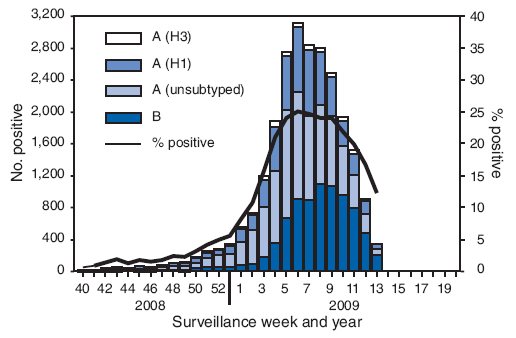
From September 28, 2008, to April 4, 2009, World Health Organization (WHO) and National Respiratory and Enteric Virus Surveillance System (NREVSS) collaborating laboratories in the United States tested 173,397 respiratory specimens for influenza viruses, 24,793 (14.3%) of which were positive (Figure 1). Of these, 16,686 (67.3%) were positive for influenza A viruses, and 8,107 (32.7%) were positive for influenza B viruses. Of the 16,686 specimens positive for influenza A viruses, 6,735 (40.4%) were subtyped by real-time reverse transcription-polymerase chain reaction or by virus culture; 6,049 (89.8%) of these were influenza A (H1N1) viruses, and 686 (10.2%) were influenza A (H3N2) viruses. The percentage of specimens testing positive for influenza first exceeded the seasonal threshold of 10% during the week ending January 17, 2009, and peaked at 25.0% during the week ending February 14, 2009. For the week ending April 4, 2009, 12.3% of specimens tested for influenza were positive. The relative proportion of influenza B viruses increased during February and March, and since the week ending March 14, 2009, >50% of the positive influenza specimens have been influenza B.
Antigenic Characterization
WHO collaborating laboratories in the United States are requested to submit a subset of their influenza virus isolates to CDC for further antigenic characterization. CDC has antigenically characterized 945 influenza viruses collected by U.S. laboratories during the 2008--09 season, including 594 influenza A (H1N1), 88 influenza A (H3N2), and 263 influenza B viruses. All 594 influenza A (H1N1) viruses are related to the influenza A (H1N1) component of the 2008--09 influenza vaccine (A/Brisbane/59/2007). All 88 influenza A (H3N2) viruses are related to the influenza A (H3N2) vaccine component (A/Brisbane/10/2007). Influenza B viruses currently circulating can be divided into two distinct lineages represented by the B/Yamagata/16/88 and B/Victoria/02/87 viruses. Among the 263 influenza B viruses tested, 50 (19.0%) belong to the B/Yamagata lineage and are related to the vaccine strain (B/Florida/04/2006); the remaining 213 (81.0%) belong to the B/Victoria lineage and are not related to the vaccine strain.
Composition of the 2009--10 Influenza Vaccine
WHO recommended that the 2009--10 Northern Hemisphere trivalent influenza vaccine contain A/Brisbane/59/2007-like (H1N1), A/Brisbane/10/2007-like (H3N2), and B/Brisbane/60/2008-like (B/Victoria lineage) viruses. The Food and Drug Administration's Vaccines and Related Biological Products Advisory Committee recommended these same vaccine strains be included in the 2009--10 influenza vaccine for the United States (1). Only the influenza B component represents a change from the 2008--09 vaccine formulation. These recommendations were based on antigenic and genetic analyses of recently isolated influenza viruses, epidemiologic data, post-vaccination serologic studies in humans, and the availability of candidate vaccine strains and reagents.
Antiviral Resistance of Influenza Virus Isolates
CDC conducts surveillance for resistance of circulating influenza viruses to licensed influenza antiviral medications: adamantanes (amantadine and rimantadine) and neuraminidase inhibitors (zanamivir and oseltamivir). Since October 1, 2008, of the 699 influenza A (H1N1) viruses from 44 states tested for neuraminidase inhibitor resistance, 694 (99.3%) were resistant to oseltamivir; all were sensitive to zanamivir (Table). All 103 influenza A (H3N2) and all 274 influenza B viruses tested were sensitive to oseltamivir and zanamivir. Three influenza A (H1N1) viruses (0.4%) and all 100 (100%) influenza A (H3N2) viruses tested were resistant to adamantanes (amantadine and rimantadine). The adamantanes are not effective against influenza B viruses. None of the influenza A (H1N1) viruses tested were resistant to both oseltamivir and adamantanes.
Novel Influenza A Viruses
A case of human infection with a novel influenza A virus was reported by the Iowa Department of Public Health during the week ending February 28, 2009. A male aged 3 years was infected with a swine influenza A (H1N1) virus. An investigation revealed that the child had close contact with ill pigs. The child has fully recovered from the illness, and no additional cases were identified among the child's contacts or other persons exposed to the ill pigs. This is the third human infection with swine influenza virus identified in the United States this influenza season. None of the cases were related to occupation. The other two human infections with swine influenza identified during the 2008--09 influenza season occurred in a person aged 14 years from Texas and a person aged 19 years from South Dakota (2,3).

State-Specific Activity Levels
During the week ending April 4, 2009, widespread influenza activity† was reported by four states (Alabama, New York, Virginia, and Washington). Regional influenza activity was reported by 18 states (Alaska, Arizona, California, Colorado, Connecticut, Hawaii, Idaho, Kentucky, Montana, Nevada, New Hampshire, New Jersey, North Carolina, North Dakota, Oregon, Pennsylvania, Rhode Island, and Tennessee). Local influenza activity was reported by 20 states, sporadic activity was reported by the District of Columbia and seven states, and one state did not report Regional influenza activity was reported for the first time this season during the week ending December 20, 2008 (by Massachusetts and New Jersey), and widespread activity was reported for the first time during the week ending January 10, 2009 (by Virginia). To date this season, regional or widespread influenza activity has been reported during at least 1 week by 49 states.
Outpatient Illness Surveillance
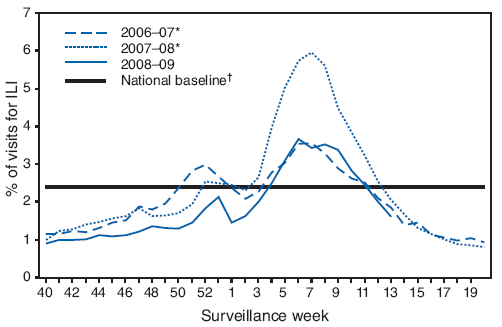
Since September 28, 2008, the weekly percentage of outpatient visits for influenza-like illness (ILI)§ reported by approximately 1,500 U.S. health-care providers in 50 states, New York City, Chicago, the District of Columbia, and the U.S. Virgin Islands that comprise the U.S. Outpatient ILI Surveillance Network (ILINet), has ranged from 0.9% during the week ending October 4, 2008, to 3.7% for the week ending February 14, 2009. For the week ending April 4, 2009, the weekly percentage of outpatient visits for ILI was 1.6% (Figure 2). This is below the national baseline of 2.4%.¶ One of the nine surveillance regions (Mountain) reported an ILI percentage above its region-specific baseline.
Pneumonia- and Influenza-Related Mortality
For the week ending April 4, 2009, pneumonia and influenza was reported as an underlying or contributing cause of death for 7.4% of all deaths reported through the 122 Cities Mortality Reporting System. This is below the epidemic threshold of 7.8% for that week. Since September 28, 2008, the weekly percentage of deaths attributed to pneumonia and influenza ranged from 6.1% to 7.6%, and remained below the epidemic threshold.**
Influenza-Associated Hospitalizations
Hospitalizations associated with laboratory-confirmed influenza infections are monitored by two population-based surveillance networks, the New Vaccine Surveillance Network (NVSN) and the Emerging Infections Program (EIP).†† From October 12, 2008, to March 21, 2009, the preliminary laboratory-confirmed influenza-associated hospitalization rate for children aged 0--4 years in the NVSN was 1.46 per 10,000.
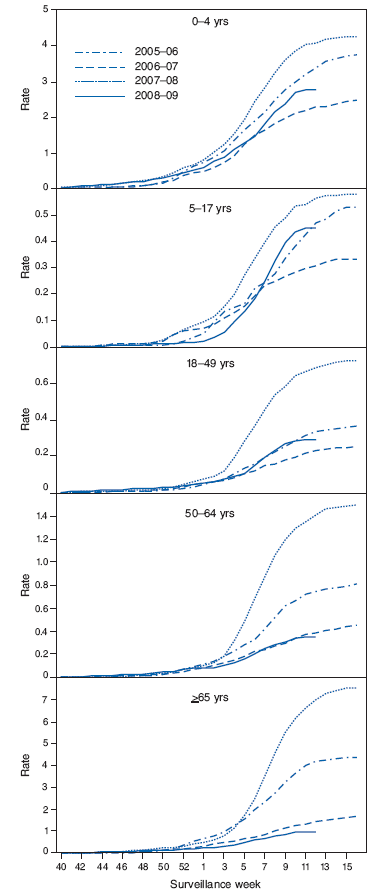
From October 1, 2008, to March 28, 2009, preliminary rates of laboratory-confirmed influenza-associated hospitalization reported by the EIP for children aged 0--4 years and 5--17 years were 2.8 and 0.5 per 10,000, respectively (Figure 3). For adults aged 18--49 years, 50--64 years, and ≥65 years, the rates were 0.3, 0.4, and 1.0 per 10,000, respectively. Differences in the rate estimates between the NVSN and the EIP systems likely result from the different case-finding methods and the different populations monitored.
Influenza-Associated Pediatric Mortality
Since September 28, 2008, CDC has received 45 reports of influenza-associated pediatric deaths that occurred during the current season. Of the 27 decedents who had specimens collected for bacterial culture from normally sterile sites, 12 (44.4%) were positive; Staphylococcus aureus was identified in eight of the 12 children. Three of the S. aureus isolates were sensitive to methicillin, and five were methicillin resistant. Among the 12 children with bacterial coinfections, all were aged ≥5 years, and 10 (83.3%) were aged ≥12 years. An increase in the number of influenza-associated pediatric deaths with S. aureus coinfections was first recognized during the 2006--07 influenza season (4).
Of the 36 decedents aged >6 months for whom patient vaccination status was known, five (13.9%) had been vaccinated against influenza according to 2008 Advisory Committee on Immunization Practices recommendations (5). These data are provisional and subject to change as more information becomes available.
Reported by: WHO Collaborating Center for Surveillance, Epidemiology, and Control of Influenza. P Peebles, L Brammer, MPH, S Epperson, MPH, L Blanton, MPH, R Dhara, MPH, T Wallis, MS, L Finelli, DrPH, L Gubareva, PhD, J Bresee, MD, A Klimov, PhD, N Cox, PhD, Influenza Div, National Center for Immunization and Respiratory Diseases, CDC.
Editorial Note:

From September 28, 2008, through early January 2009, the United States experienced low levels of influenza activity. Activity increased in mid-January, peaked in mid-February, and remained high until mid-March. Since mid-March, influenza levels have been decreasing nationally.
Preliminary data from the U.S. virologic surveillance networks (WHO and NREVSS collaborating laboratories), the percentage of deaths attributable to pneumonia and influenza, and the percentage of outpatient visits for ILI suggest that this season has been less severe than the 2007--08 season and is more similar to the 2005--06 and 2006--07 seasons. The percentage of specimens tested for influenza that were positive peaked at 25.0% during the week ending February 14, 2009, compared with 31.6% in 2007--08, 27.7% in 2006--07, and 22.6% in 2005--06. To date during this season, the percentage of deaths attributable to pneumonia and influenza peaked at 7.6% and has not exceeded the epidemic threshold. By comparison, pneumonia and influenza mortality peaked at 9.1%, 7.9%, and 7.8% during the 2007--08, 2006--07, and 2005--06 seasons, respectively. The epidemic threshold for pneumonia and influenza deaths was exceeded for 9 consecutive weeks during the 2007--08 season and for only 1 week during both the 2005--06 and 2006--07 seasons. The percentage of outpatient visits for ILI peaked at 3.7% this season, compared with 6.0% in 2007--08, 3.6% in 2006--07, and 3.1% in 2005--06.
During this influenza season, a high level of resistance to the antiviral drug oseltamivir was detected among circulating influenza A (H1N1) viruses. Since October 1, 2008, 99.3% of influenza A (H1N1) viruses tested were resistant to oseltamivir. To date, influenza A has accounted for 67.3% of all influenza viruses identified, and influenza A (H1N1) has accounted for 89.8% of the influenza A viruses that were subtyped. No oseltamivir resistance has been detected among influenza A (H3N2) or B viruses currently circulating in the United States; however, all the influenza A (H3N2) viruses tested were resistant to adamantanes. The adamantanes are not effective against influenza B viruses. None of the influenza A (H1N1) viruses tested were resistant to both oseltamivir and the adamantanes, and all influenza viruses tested this season have been susceptible to zanamivir. CDC issued interim guidelines for the use of influenza antiviral medications on December 19, 2008. Health-care providers should review their local surveillance data if available to determine which types (A or B) and subtypes of influenza A (H1N1 or H3N2) are most prominent in their community and consider using diagnostic tests to distinguish influenza A from influenza B. When an influenza A (H1N1) virus infection or exposure is suspected, zanamivir is the preferred medication; combination therapy of oseltamivir and rimantidine is an acceptable alternative (6).
Since early February, the relative proportion of influenza B viruses has been increasing each week, and more than half of influenza viruses identified since the week ending March 14, 2009, were influenza B. Approximately 80% of influenza B viruses tested have not been related to the influenza B vaccine strain. However, all influenza B viruses this season have been susceptible to oseltamivir and zanamivir. Health-care providers should be aware of these recent increases in influenza B viruses and of the differences in antiviral resistance patterns compared with influenza A (H1N1) viruses. When an influenza B infection or exposure is detected, treatment with oseltamivir or zanamivir is recommended. However, when the type or subtype is unknown, zanamivir is the preferred medication; combination therapy of oseltamivir and rimantidine also is acceptable (6).
To date this season, the cumulative laboratory-confirmed, influenza-associated hospitalization rate reported by EIP among persons aged ≥50 years has been lower than rates reported for the previous three seasons, but most similar to the 2006--07 season. Historically, excess mortality has been lower in seasons during which influenza A (H1N1) or influenza B predominated than during seasons in which influenza A (H3N2) has predominated (7). During the current and 2006--07 seasons, influenza A (H1N1) has been the prominent virus subtype circulating, which could partly explain the lower influenza-associated hospitalization rates among persons aged ≥50 years observed during these two seasons.
Vaccination remains the best method for preventing influenza virus infection and its complications. Influenza vaccination can prevent influenza infections from strains that are sensitive or resistant to antiviral medications. Thus far this season, all the influenza A viruses that have been characterized, including oseltamivir-resistant (H1N1) viruses, are antigenically related to the components in the vaccine. However, approximately 80% of influenza B viruses tested are from a distinct lineage that is not related to the vaccine strain. Limited or no protection is expected when the vaccine and circulating virus strains are from different lineages (8,9). The composition of the 2009--10 influenza vaccine includes the same influenza A (H1N1 and H3N2) components, and a change in the influenza B component from the Yamagata to the Victoria lineage.
Influenza surveillance reports for the United States are posted weekly online at http://www.cdc.gov/flu/weekly/flu
activity
.htm during the influenza season from October to mid-May. Additional information regarding influenza viruses, influenza surveillance, the influenza vaccine, and avian influenza is available at http://www.cdc.gov/flu.
Acknowledgments

This report is based, in part, on data contributed by participating state and territorial health departments and state public health laboratories, World Health Organization collaborating laboratories, National Respiratory and Enteric Virus Surveillance System collaborating laboratories, the U.S. Outpatient ILI Surveillance Network, the Emerging Infections Program, the New Vaccine Surveillance Network, the Influenza Associated Pediatric Mortality Surveillance System, and the 122 Cities Mortality Reporting System.
References


  1. Food and Drug Administration. Influenza virus vaccine 2009--2010 season. Available at http://www.fda.gov/cber/flu/flu2009.htm.
  2. CDC. Influenza activity---United States and worldwide, September 28--November 29, 2008. MMWR 2008;57:1329--32.
  3. CDC. Influenza activity---United States, September 28, 2008--January 31, 2009. MMWR 2009;58:115--9.
  4. Finelli L, Fiore A, Dhara R, et al. Influenza-associated pediatric mortality in the United States: increase of Staphylococcus aureus coinfection. Pediatrics 2008;122:805--11.
  5. CDC. Recommendations of the Advisory Committee on Immunization Practices (ACIP), 2008. MMWR 2008;57(No. RR-7).
  6. CDC. CDC issues interim recommendations for the use of influenza antiviral medications in the setting of oseltamivir resistance among circulating influenza A (H1N1) viruses, 2008--09 influenza season. Atlanta, GA: US Department of Health and human services, CDC; 2008. Available at http://www2a.cdc.gov/han/archivesys/viewmsgv.asp?alertnum=00279.
  7. Thompson WW, Shay DK, Weintraub E, et al. Mortality associated with influenza and respiratory syncytial virus in the United States. JAMA 2003;289:179--86.
  8. Belongia E, Kieke B, Donahue J, et al. Effectiveness of inactivated influenza vaccines varied substantially with antigenic match from the 2004--2005 season to the 2006--2007 season. J Infect Dis 2009;199:159--67.
  9. Skowronski D, De Serres G, Dickinson J, et al. Component-specific effectiveness of trivalent influenza vaccine as monitored through a sentinel surveillance network in Canada, 2006--2007. J Infect Dis 2009;199:168--79.
* The CDC influenza surveillance system collects five categories of information from nine data sources: 1) viral surveillance (World Health Organization collaborating U.S. laboratories, the National Respiratory and Enteric Virus Surveillance System, and novel influenza A virus case reporting), 2) outpatient illness surveillance (U.S. Outpatient ILI Surveillance Network), 3) mortality (122 Cities Mortality Reporting System and influenza-associated pediatric mortality reports), 4) hospitalizations (Emerging Infections Program and New Vaccine Surveillance Network), and 5) summary of geographic spread of influenza (state and territorial epidemiologist reports).
† Levels of activity are 1) no activity; 2) sporadic: isolated laboratory-confirmed influenza cases or a laboratory-confirmed outbreak in one institution, with no increase in influenza-like illness (ILI) activity; 3) local: increased ILI, or at least two institutional outbreaks (ILI or laboratory-confirmed influenza) in one region with recent laboratory evidence of influenza in that region; virus activity no greater than sporadic in other regions; 4) regional: increased ILI activity or institutional outbreaks (ILI or laboratory-confirmed influenza) in at least two but less than half of the regions in the state with recent laboratory evidence of influenza in those regions; and 5) widespread: increased ILI activity or institutional outbreaks (ILI or laboratory-confirmed influenza) in at least half the regions in the state with recent laboratory evidence of influenza in the state.
§ Defined as a temperature of ≥100.0°F (≥37.8°C), oral or equivalent, and cough and/or sore throat, in the absence of a known cause other than influenza.
¶ The national and regional baselines are the mean percentage of visits for ILI during noninfluenza weeks for the previous three seasons plus two standard deviations. A noninfluenza week is a week during which <10% of specimens tested positive for influenza. National and regional percentages of patient visits for ILI are weighted on the basis of state population. Use of the national baseline for regional data is not appropriate.
** The seasonal baseline proportion of pneumonia and influenza deaths is projected using a robust regression procedure in which a periodic regression model is applied to the observed percentage of deaths from pneumonia and influenza that were reported by the 122 Cities Mortality Reporting System during the preceding 5 years. The epidemic threshold is 1.645 standard deviations above the seasonal baseline.
†† NVSN conducts surveillance in Monroe County, New York; Hamilton County, Ohio; and Davidson County, Tennessee. NVSN provides population-based estimates of laboratory-confirmed influenza hospitalization rates in children aged <5 years admitted to NVSN hospitals with fever or respiratory symptoms. Children are prospectively enrolled, and respiratory samples are collected and tested by viral culture and reverse transcription-polymerase chain reaction (RT-PCR). EIP currently conducts surveillance for laboratory-confirmed, influenza-related hospitalizations in 61 counties and Baltimore, Maryland. The EIP catchment area includes 13 metropolitan areas: San Francisco, California; Denver, Colorado; New Haven, Connecticut; Atlanta, Georgia; Baltimore, Maryland; Minneapolis/St. Paul, Minnesota; Albuquerque, New Mexico; Las Cruces, New Mexico; Santa Fe, New Mexico; Albany, New York; Rochester, New York; Portland, Oregon; and Nashville, Tennessee. Hospital laboratory, admission, and discharge databases, and infection-control logs are reviewed to identify persons with a positive influenza test (i.e., viral culture, direct fluorescent antibody assays, RT-PCR, serology, or a commercial rapid antigen test) from testing conducted as part of their routine care.

FIGURE 1. Number (N = 24,793) and percentage of respiratory specimens testing positive for influenza reported by World Health Organization and National Respiratory and Enteric Virus Surveillance System collaborating laboratories, by type, and surveillance week - United States, September 28, 2008-April 4, 2009

m814a4f1.gif


Return to top.
<table class="data-table"> <tbody> <tr> <td class="header-row" colspan="8"> TABLE. Number and percentage of influenza viruses tested for resistance to influenza antiviral medications, by virus type --- United States, October 1, 2008--April 4, 2009
</td> </tr> <tr valign="bottom"> <th class="column-head" rowspan="2" scope="col"> Virus
</th> <th class="column-head" rowspan="2" scope="col">
No. of isolates tested​
</th> <th class="column-head" colspan="2" scope="col">
Resistant to oseltamivir*​
</th> <th class="column-head" rowspan="2" scope="col">
No. of isolates tested​
</th> <th class="column-head" colspan="2" scope="col">
Resistant to adamantanes​
</th> </tr> <tr> <th class="column-head" scope="col">
No.​
</th> <th class="column-head" scope="col">
(%)​
</th> <th class="column-head" scope="col">
No.​
</th> <th class="column-head" scope="col">
(%)​
</th> </tr> <tr> <td class="data-row" scope="row"> Influenza A (H1N1)
</td> <td class="data-row" align="right"> 699
</td> <td class="data-row" align="right"> 694
</td> <td class="data-row" align="right"> (99.3)
</td> <td class="data-row" align="right"> 683
</td> <td class="data-row" align="right"> 3
</td> <td class="data-row" align="right"> (0.4)
</td> </tr> <tr> <td class="data-row" scope="row"> Influenza A (H3N2)
</td> <td class="data-row" align="right"> 103
</td> <td class="data-row" align="right"> 0
</td> <td class="data-row" align="right"> (0)
</td> <td class="data-row" align="right"> 100
</td> <td class="data-row" align="right"> (100)
</td> </tr> <tr> <td class="last-row" scope="row"> Influenza B
</td> <td class="last-row" align="right"> 274
</td> <td class="last-row" align="right"> 0
</td> <td class="last-row" align="right"> (0)
</td> <td class="last-row" align="right"> -†
</td> <td class="last-row" align="right"> -
</td> </tr> <tr> <td class="footnote-row" colspan="8" scope="row"> * None of the tested isolates were resistant to zanamivir.
† The adamantanes (amantadine and rimantadine) are not effective against influenza B viruses.
</td> </tr> </tbody> </table>
Return to top.
FIGURE 2. Percentage of visits for influenza-like illness (ILI) reported by U.S. Outpatient Influenza-like Illness Surveillance Network (ILINet), by surveillance week - United States, September 28, 2008-April 4, 2009 and 2006-07 and 2007-08 influenza seasons

m814a4f2.gif

* The 2006-07 and 2007-08 seasons did not have a week 53; therefore the week 53 data point for those seasons is an average of weeks 52 and 1.
† The national and regional baselines are the mean percentage of visits for ILI during noninfluenza weeks for the previous three seasons plus two standard deviations. A noninfluenza week is a week during which <10% of specimens tested positive for influenza. National and regional percentages of patient visits for ILI are weighted on the basis of state population. Use of the national baseline for regional data is not appropriate.


Return to top.
FIGURE 3. Cumulative laboratory-confirmed influenza hospitalization rates,* by age group† and surveillance week - Emerging Infections Program, United States, October 1, 2008-March 28, 2009, and preceding three influenza seasons

m814a4f3.gif

* Per 10,000 population.
† Scales differ among age groups.


http://www.cdc.gov/mmwr/preview/mmwrhtml/mm5814a4.htm

</td></tr></tbody></table>

 
Re: Seasonal Flu 2008 - 2009

#454:
"WHO recommended that the 2009--10 Northern Hemisphere trivalent influenza vaccine contain ..."

April 2009 - December 2009 = 8 months before


The almost 1 year previous strain prediction time schedule story persisted.
 
Back
Top