
• FluTrackers.com Inc. does not provide medical advice. Information on this web site is collected from various internet resources, and the FluTrackers board of directors makes no warranty to the safety, efficacy, correctness or completeness of the information posted on this site by any author or poster. The information collated here is for instructional and/or discussion purposes only and is NOT intended to diagnose or treat any disease, illness, or other medical condition. Every individual reader or poster should seek advice from their personal physician/healthcare practitioner before considering or using any interventions that are discussed on this website. By continuing to access this website you agree to consult your personal physican before using any interventions posted on this website, and you agree to hold harmless FluTrackers.com Inc., the board of directors, the members, and all authors and posters for any effects from use of any medication, supplement, vitamin or other substance, device, intervention, etc. mentioned in posts on this website, or other internet venues referenced in posts on this website.
  • We are not asking for any donations. Do not donate to any entity who says they are raising funds for us.

Seasonal Flu 2008 - 2009

Re: Seasonal Flu 2008 - 2009

EISS - Weekly Electronic Bulletin Week 8 - 27 February 2009, Issue N? 294 - Influenza activity increasing in central and eastern Europe while continuing to decrease in western Europe

EISS - Weekly Electronic Bulletin Week 8 : 16/02/2009-22/02/2009 - 27 February 2009, Issue N? 294 - Influenza activity increasing in central and eastern Europe while continuing to decrease in western Europe


-- Summary:

In week 08/2009, influenza activity remained little changed across Europe compared to last week. Most countries in central Europe continue to report medium intensity activity, and activity is low but increasing in eastern Europe.

Influenza activity is generally declining in western Europe.

Influenza A(H3) continues to be the predominant circulating virus although the proportion of influenza B virus detections continues to increase.

All the A(H3N2) viruses tested for antiviral resistance were resistant to M2 inhibitors but susceptible to neuraminidase inhibitors.


-- Epidemiological situation - week 08/2009:

For the intensity indicator, the national network levels of influenza-like illness (ILI) and/or acute respiratory infection (ARI) were high in Slovakia for the first time this season, medium in 20 countries, and low in the other twelve countries that reported this indicator.

The majority of countries reporting increasing trends for the intensity indicator in week 08/2009 were located in central and eastern Europe, while most countries in western Europe reported unchanged or decreasing intensity compared to the previous week. There has been a sharp increase in consultation rates in Greece where influenza virus type B is now the dominant type and influenza A detections continue to decrease.

For the geographical spread indicator, widespread influenza activity was reported in nine countries, regional activity in nine countries, local activity in six countries and sporadic or no activity in the remaining ten countries.


-- Cumulative epidemiological situation - 2008-2009 season (weeks 40/2008-08/2009):

Since week 49/2008 consultation rates for ILI and/or ARI rose above baseline levels in most western and central European countries following a general west to east progression. High influenza intensity, again following a general west to east progression, has been reported in 13 countries since week 51/2008, but intensity has declined in all but Slovakia.

Generally, the highest consultation rates have been in the 0-4 and 5-14 age groups, but Ireland, UK, Norway and Romania have reported their highest ILI consultation rates in the 15-64 age group.


-- Virological situation - week 08/2009:

The total number of respiratory specimens collected by sentinel physicians in week 08/2009 was 1960, of which 518 (26%) were positive for influenza virus: 349 type A (133 subtype H3, 9 subtype H1 and 207 not subtyped) and 169 type B.

In addition, 674 non-sentinel source specimens (e.g. specimens collected for diagnostic purposes in hospitals) were reported positive for influenza virus: 584 type A (150 subtype H3, 61 subtype H1 and 373 not subtyped) and 90 type B.

A total of 13 countries reported that influenza virus type B, generally in combination with influenza virus type A subtype H3, was dominant in week 08/2009.


-- Cumulative virological situation - 2008-2009 season (weeks 40/2008-08/2009):

Of 20698 virus detections (sentinel and non-sentinel) since week 40/2008, 19280 (93%) were type A (7843 subtype H3, 703 subtype H1 and 10734 not subtyped) and 1418 (7%) were type B.

Based on the antigenic and/or genetic characterisation of 2784 influenza viruses, 2441 (87.7%) were reported as A/Brisbane/10/2007 (H3N2)-like, 117 (4.2%) as A/Brisbane/59/2007 (H1N1)-like, 28 (1.0%) as B/Florida/4/2006-like (B/Yamagata/16/88 lineage) and 198 (7.1%) as B/Malaysia/2506/2004-like (B/Victoria/2/87 lineage) .

Twelve countries have reported antiviral susceptibility data.

All influenza A(H3N2) viruses tested were sensitive to oseltamivir (324) and zanamivir (303), but resistant to M2 inhibitors (198).

Ninety-eight percent of influenza A(H1N1) viruses analysed (150/153) were resistant to oseltamivir, but all those tested against zanamivir and M2 inhibitors were sensitive. The small number of influenza B viruses analysed (27) were sensitive to oseltamivir and zanamivir.


-- Comment:

Influenza activity continued to decline in western Europe and has continued to increase in several countries in central (Greece and Slovakia) and eastern (Lithuania, Russia and Ukraine) Europe, following a general west-to-east trend.

For Russia as a whole, influenza activity is increasing; by region, influenza activity is increasing in all regions except the Far East where it appears to be declining. Activity has decreased to baseline levels in countries that experienced the influenza epidemic first this season (Ireland, Portugal, the UK).

Whilst A(H3N2) continues to be the dominant influenza virus circulating in the Europe region, the proportion of type B influenza virus detections per week continues to show a rising trend, with an increasing number of countries reporting type B as the dominant or co-dominant virus type.

Antigenic and/or genetic characterisation indicates that, with the exception of the B/Victoria lineage viruses (7.1% of the viruses subjected to antigenic and/or genetic characterisation), the viruses circulating are similar to the three components - A(H1N1), A(H3N2) and B/Yamagata lineage - included in the 2008/2009 Northern Hemisphere influenza vaccine.


-- Background:

The Weekly Electronic Bulletin presents and comments on influenza activity in the 53 countries that report to EISS.

Of these countries, 32 reported both clinical and virological data, four reported virological data only and two reported clinical data only to EISS in week 08/2009. The spread of influenza virus strains and their epidemiological impact in Europe are being monitored by the network under the aegis of the European Centre for Disease Prevention and Control in Stockholm (Sweden) and the WHO Regional Office for Europe in Copenhagen (Denmark), in collaboration with the WHO Collaborating Centre for Reference and Research on Influenza in London (UK).


-- Other bulletins:

The EISS bulletin is prepared using reports from GP consultations and other sources, depending on individual country arrangements. It is important to recognise that different health care systems and types of measurement should also be considered when assessing the impact of influenza.


-- Map

The map presents the intensity of influenza activity and the geographical spread as assessed by each of the networks in EISS.

<table style="width: auto;"><tbody><tr><td></td></tr><tr><td style="font-family: arial,sans-serif; font-size: 11px; text-align: right;">From Drop Box</td></tr></tbody></table>

<table style="width: auto;"><tbody><tr><td></td></tr><tr><td style="font-family: arial,sans-serif; font-size: 11px; text-align: right;">From Drop Box</td></tr></tbody></table>

<table style="width: auto;"><tbody><tr><td></td></tr><tr><td style="font-family: arial,sans-serif; font-size: 11px; text-align: right;">From Drop Box</td></tr></tbody></table>

<table style="width: auto;"><tbody><tr><td></td></tr><tr><td style="font-family: arial,sans-serif; font-size: 11px; text-align: right;">From Drop Box</td></tr></tbody></table>

Europe Year 2009 / Week 8

A = Dominant virus A
H1N1 = Dominant virus A(H1N1)
H3N2 = Dominant virus A(H3N2)
H1N2 = Dominant virus A(H1N2)
B = Dominant virus B
A & B = Dominant virus A & B
= : stable clinical activity
+ : increasing clinical activity
- : decreasing clinical activity
Low = no influenza activity or influenza at baseline levels
Medium = usual levels of influenza activity
High = higher than usual levels of influenza activity
Very high = particularly severe levels of influenza activity
No activity = no evidence of influenza virus activity (clinical activity remains at baseline levels)
Sporadic = isolated cases of laboratory confirmed influenza infection
Local outbreak = increased influenza activity in local areas (e.g. a city) within a region,or outbreaks in two or more institutions (e.g. schools) within a region. Laboratory confirmed.
Regional activity = influenza activity above baseline levels in one or more regions witha population comprising less than 50% of the country's total population. Laboratory confirmed.
Widespread = influenza activity above baseline levels in one or more regions with a populationcomprising 50% or more of the country's population. Laboratory confirmed.
Finland : Where available, the epidemiological data are provided by a health-care district inSouth-Western Finland (the health-care district serves 54,000 inhabitants i.e. approximately onepercent of the Finnish population).


-- Network comments (where available)

- Italy. During this week, the number of influenza positive samples remarkably decreased. Only 5 type A influenza viruses (3 H3 and 2 H1) were isolated.
- The former Yugoslav Republic of Macedonia. Mandatory reporting
- Russian Federation. 12 (66.7%) strains of influenza A(H1N1) virus from 16 viruses of this subtype isolated earlier in Vladivostok and analyzed during week 8 appeared to be resistant to oseltamivir.
- Serbia. All B viruses detected in week 8. originated from the southern parts of Serbia. In additions to A (H3) viruses detected up to now, the number of type B viruses continues to show rising trends, from north to south part of country.
- Switzerland. Influenza activity is now decreasing in Switzerland. Influenza B viruses started to predominate now.
-
<cite cite="http://www.eiss.org/cgi-files/bulletin_v2.cgi">EISS - Bulletin Review</cite>
 
Re: Seasonal Flu 2008 - 2009

<table border="1"> <caption> INFLUENZA VIRUSES ISOLATED BY
WHO/NREVSS Collaborating Laboratories
2008 - 2009 Season
</caption> <tbody><tr> <th id="header1" width="70">Week</th> <th id="header2" width="90">A(H1)</th> <th id="header3" width="70">A(H3)</th> <th id="header4" width="70">A(Unk)</th> <th id="header5" width="70"> B </th> <th id="header6" align="right">Total # Tested</th> <th id="header7" align="right">% Positive</th> </tr> <tr><td headers="header1" align="right"> 40 </td> <td headers="header2" align="right"> 3 </td> <td headers="header3" align="right"> 0 </td> <td headers="header4" align="right"> 8 </td> <td headers="header5" align="right"> 6 </td> <td headers="header6" align="right"> 2612 </td> <td headers="header7" align="right"> 0.65 </td></tr> <tr><td headers="header1" align="right"> 41 </td> <td headers="header2" align="right"> 4 </td> <td headers="header3" align="right"> 4 </td> <td headers="header4" align="right"> 8 </td> <td headers="header5" align="right"> 6 </td> <td headers="header6" align="right"> 2645 </td> <td headers="header7" align="right"> 0.83 </td></tr> <tr><td headers="header1" align="right"> 42 </td> <td headers="header2" align="right"> 13 </td> <td headers="header3" align="right"> 3 </td> <td headers="header4" align="right"> 15 </td> <td headers="header5" align="right"> 6 </td> <td headers="header6" align="right"> 2775 </td> <td headers="header7" align="right"> 1.33 </td></tr> <tr><td headers="header1" align="right"> 43 </td> <td headers="header2" align="right"> 22 </td> <td headers="header3" align="right"> 0 </td> <td headers="header4" align="right"> 24 </td> <td headers="header5" align="right"> 14 </td> <td headers="header6" align="right"> 3201 </td> <td headers="header7" align="right"> 1.87 </td></tr> <tr><td headers="header1" align="right"> 44 </td> <td headers="header2" align="right"> 11 </td> <td headers="header3" align="right"> 2 </td> <td headers="header4" align="right"> 21 </td> <td headers="header5" align="right"> 5 </td> <td headers="header6" align="right"> 3345 </td> <td headers="header7" align="right"> 1.17 </td></tr> <tr><td headers="header1" align="right"> 45 </td> <td headers="header2" align="right"> 30 </td> <td headers="header3" align="right"> 2 </td> <td headers="header4" align="right"> 23 </td> <td headers="header5" align="right"> 11 </td> <td headers="header6" align="right"> 3936 </td> <td headers="header7" align="right"> 1.68 </td></tr> <tr><td headers="header1" align="right"> 46 </td> <td headers="header2" align="right"> 25 </td> <td headers="header3" align="right"> 2 </td> <td headers="header4" align="right"> 23 </td> <td headers="header5" align="right"> 12 </td> <td headers="header6" align="right"> 4162 </td> <td headers="header7" align="right"> 1.49 </td></tr> <tr><td headers="header1" align="right"> 47 </td> <td headers="header2" align="right"> 27 </td> <td headers="header3" align="right"> 1 </td> <td headers="header4" align="right"> 31 </td> <td headers="header5" align="right"> 23 </td> <td headers="header6" align="right"> 4517 </td> <td headers="header7" align="right"> 1.82 </td></tr> <tr><td headers="header1" align="right"> 48 </td> <td headers="header2" align="right"> 40 </td> <td headers="header3" align="right"> 1 </td> <td headers="header4" align="right"> 46 </td> <td headers="header5" align="right"> 24 </td> <td headers="header6" align="right"> 4614 </td> <td headers="header7" align="right"> 2.41 </td></tr> <tr><td headers="header1" align="right"> 49 </td> <td headers="header2" align="right"> 41 </td> <td headers="header3" align="right"> 4 </td> <td headers="header4" align="right"> 57 </td> <td headers="header5" align="right"> 14 </td> <td headers="header6" align="right"> 5322 </td> <td headers="header7" align="right"> 2.18 </td></tr> <tr><td headers="header1" align="right"> 50 </td> <td headers="header2" align="right"> 70 </td> <td headers="header3" align="right"> 9 </td> <td headers="header4" align="right"> 66 </td> <td headers="header5" align="right"> 36 </td> <td headers="header6" align="right"> 5663 </td> <td headers="header7" align="right"> 3.2 </td></tr> <tr><td headers="header1" align="right"> 51 </td> <td headers="header2" align="right"> 73 </td> <td headers="header3" align="right"> 17 </td> <td headers="header4" align="right"> 107 </td> <td headers="header5" align="right"> 56 </td> <td headers="header6" align="right"> 5932 </td> <td headers="header7" align="right"> 4.27 </td></tr> <tr><td headers="header1" align="right"> 52 </td> <td headers="header2" align="right"> 70 </td> <td headers="header3" align="right"> 12 </td> <td headers="header4" align="right"> 150 </td> <td headers="header5" align="right"> 51 </td> <td headers="header6" align="right"> 5729 </td> <td headers="header7" align="right"> 4.94 </td></tr> <tr><td headers="header1" align="right"> 53 </td> <td headers="header2" align="right"> 108 </td> <td headers="header3" align="right"> 17 </td> <td headers="header4" align="right"> 167 </td> <td headers="header5" align="right"> 47 </td> <td headers="header6" align="right"> 6009 </td> <td headers="header7" align="right"> 5.64 </td></tr> <tr><td headers="header1" align="right"> 01 </td> <td headers="header2" align="right"> 153 </td> <td headers="header3" align="right"> 25 </td> <td headers="header4" align="right"> 240 </td> <td headers="header5" align="right"> 76 </td> <td headers="header6" align="right"> 6384 </td> <td headers="header7" align="right"> 7.74 </td></tr> <tr><td headers="header1" align="right"> 02 </td> <td headers="header2" align="right"> 173 </td> <td headers="header3" align="right"> 20 </td> <td headers="header4" align="right"> 365 </td> <td headers="header5" align="right"> 86 </td> <td headers="header6" align="right"> 6062 </td> <td headers="header7" align="right"> 10.62 </td></tr> <tr><td headers="header1" align="right"> 03 </td> <td headers="header2" align="right"> 237 </td> <td headers="header3" align="right"> 38 </td> <td headers="header4" align="right"> 496 </td> <td headers="header5" align="right"> 141 </td> <td headers="header6" align="right"> 6238 </td> <td headers="header7" align="right"> 14.62 </td></tr> <tr><td headers="header1" align="right"> 04 </td> <td headers="header2" align="right"> 370 </td> <td headers="header3" align="right"> 56 </td> <td headers="header4" align="right"> 668 </td> <td headers="header5" align="right"> 231 </td> <td headers="header6" align="right"> 7138 </td> <td headers="header7" align="right"> 18.56 </td></tr> <tr><td headers="header1" align="right"> 05 </td> <td headers="header2" align="right"> 378 </td> <td headers="header3" align="right"> 24 </td> <td headers="header4" align="right"> 938 </td> <td headers="header5" align="right"> 424 </td> <td headers="header6" align="right"> 8370 </td> <td headers="header7" align="right"> 21.08 </td></tr> <tr><td headers="header1" align="right"> 06 </td> <td headers="header2" align="right"> 272 </td> <td headers="header3" align="right"> 12 </td> <td headers="header4" align="right"> 620 </td> <td headers="header5" align="right"> 409 </td> <td headers="header6" align="right"> 5380 </td> <td headers="header7" align="right"> 24.41 </td></tr> </tbody></table>​
[FONT=Verdana, Arial, Helvetica, sans-serif][SIZE=-1] Return to Current Report[/SIZE][/FONT]
 
Re: Seasonal Flu 2008 - 2009

2008-2009 Influenza Season Week 7 ending February 21, 2009
(All data are preliminary and may change as more reports are received.) Synopsis:

During week 7 (February 15-21, 2009), influenza activity increased slightly in the United States.

  • One thousand four hundred five (24.6%) specimens tested by U.S. World Health Organization (WHO) and National Respiratory and Enteric Virus Surveillance System (NREVSS) collaborating laboratories and reported to CDC/Influenza Division were positive for influenza.
  • The proportion of deaths attributed to pneumonia and influenza (P&I) was below the epidemic threshold.
  • Eight influenza-associated pediatric deaths were reported.
  • The proportion of outpatient visits for influenza-like illness (ILI) was above the national baseline. ILI decreased nationally and in six of the nine regions compared to the previous week. The East North Central, East South Central, Mountain, New England, South Atlantic, West North Central, and West South Central regions reported ILI above their region-specific baselines.
  • Twenty-seven states reported widespread influenza activity, 17 states reported regional activity; the District of Columbia and six states reported local influenza activity; and Puerto Rico reported sporadic influenza activity.
<table class="table" align="center" border="0" cellpadding="3" cellspacing="0"> <caption>National and Regional Summary of Select Surveillance Components

</caption> <tbody><tr valign="top"> <th rowspan="2" valign="bottom" width="85">
Region​
</th> <th colspan="3" align="center" width="300" nowrap="nowrap">Data for current week</th> <th colspan="5" align="center" width="276" nowrap="nowrap">Data cumulative for the season</th> </tr> <tr valign="top"> <th align="center" width="72">Out-patient ILI*</th> <th align="center" width="72">% positive for flu†</th> <th align="center" width="96">Number of jurisdictions reporting regional or widespread activity‡</th> <th align="center" width="48" nowrap="nowrap">A (H1)</th> <th align="center" width="48" nowrap="nowrap">A (H3)</th> <th align="center" width="60">A Unsub-typed</th> <th align="center" width="48" nowrap="nowrap">B</th> <th align="center" width="72">Pediatric Deaths</th> </tr> <tr> <td align="left" width="85">Nation</td> <td align="center" width="72" nowrap="nowrap">Elevated</td> <td align="center" width="72" nowrap="nowrap">24.6 % </td> <td align="center" width="96" nowrap="nowrap">44 of 51 </td> <td align="center" width="48" nowrap="nowrap">2,918</td> <td align="center" width="48" nowrap="nowrap">328</td> <td align="center" width="60" nowrap="nowrap">5,843</td> <td align="center" width="48" nowrap="nowrap">2,546</td> <td align="center" width="72" nowrap="nowrap">17</td> </tr> <tr> <td align="left" width="85">New England</td> <td align="center" width="72" nowrap="nowrap">Elevated</td> <td align="center" width="72" nowrap="nowrap">24.8 % </td> <td align="center" width="96" nowrap="nowrap">6 of 6</td> <td align="center" width="48" nowrap="nowrap">229</td> <td align="center" width="48" nowrap="nowrap">23</td> <td align="center" width="60" nowrap="nowrap">641</td> <td align="center" width="48" nowrap="nowrap">236</td> <td align="center" width="72" nowrap="nowrap">1</td> </tr> <tr> <td align="left" width="85">Mid-Atlantic</td> <td align="center" width="72" nowrap="nowrap">Normal</td> <td align="center" width="72" nowrap="nowrap">16.0 % </td> <td align="center" width="96" nowrap="nowrap">3 of 3</td> <td align="center" width="48" nowrap="nowrap">256</td> <td align="center" width="48" nowrap="nowrap">30</td> <td align="center" width="60" nowrap="nowrap">660</td> <td align="center" width="48" nowrap="nowrap">268</td> <td align="center" width="72" nowrap="nowrap">2</td> </tr> <tr> <td align="left" width="85">East North Central</td> <td align="center" width="72" nowrap="nowrap">Elevated</td> <td align="center" width="72" nowrap="nowrap">45.9 % </td> <td align="center" width="96" nowrap="nowrap">4 of 5</td> <td align="center" width="48" nowrap="nowrap">449</td> <td align="center" width="48" nowrap="nowrap">47</td> <td align="center" width="60" nowrap="nowrap">73</td> <td align="center" width="48" nowrap="nowrap">154</td> <td align="center" width="72" nowrap="nowrap">0</td> </tr> <tr> <td align="left" width="85">West North Central</td> <td align="center" width="72" nowrap="nowrap">Elevated</td> <td align="center" width="72" nowrap="nowrap">22.1 % </td> <td align="center" width="96" nowrap="nowrap">6 of 7</td> <td align="center" width="48" nowrap="nowrap">436</td> <td align="center" width="48" nowrap="nowrap">21</td> <td align="center" width="60" nowrap="nowrap">395</td> <td align="center" width="48" nowrap="nowrap">136</td> <td align="center" width="72" nowrap="nowrap">0</td> </tr> <tr> <td align="left" width="85">South Atlantic</td> <td align="center" width="72" nowrap="nowrap">Elevated</td> <td align="center" width="72" nowrap="nowrap">24.4 % </td> <td align="center" width="96" nowrap="nowrap">8 of 9</td> <td align="center" width="48" nowrap="nowrap">560</td> <td align="center" width="48" nowrap="nowrap">44</td> <td align="center" width="60" nowrap="nowrap">791</td> <td align="center" width="48" nowrap="nowrap">506</td> <td align="center" width="72" nowrap="nowrap">2</td> </tr> <tr> <td align="left" width="85">East South Central</td> <td align="center" width="72" nowrap="nowrap">Elevated</td> <td align="center" width="72" nowrap="nowrap">16.9 % </td> <td align="center" width="96" nowrap="nowrap">4 of 4</td> <td align="center" width="48" nowrap="nowrap">57</td> <td align="center" width="48" nowrap="nowrap">5</td> <td align="center" width="60" nowrap="nowrap">13</td> <td align="center" width="48" nowrap="nowrap">34</td> <td align="center" width="72" nowrap="nowrap">1</td> </tr> <tr> <td align="left" width="85">West South Central</td> <td align="center" width="72" nowrap="nowrap">Elevated</td> <td align="center" width="72" nowrap="nowrap">27.9 % </td> <td align="center" width="96" nowrap="nowrap">1 of 4</td> <td align="center" width="48" nowrap="nowrap">326</td> <td align="center" width="48" nowrap="nowrap">23</td> <td align="center" width="60" nowrap="nowrap">2,644</td> <td align="center" width="48" nowrap="nowrap">1,064</td> <td align="center" width="72" nowrap="nowrap">6</td> </tr> <tr> <td align="left" width="85">Mountain</td> <td align="center" width="72" nowrap="nowrap">Elevated</td> <td align="center" width="72" nowrap="nowrap">13.2 % </td> <td align="center" width="96" nowrap="nowrap">7 of 8</td> <td align="center" width="48" nowrap="nowrap">189</td> <td align="center" width="48" nowrap="nowrap">93</td> <td align="center" width="60" nowrap="nowrap">401</td> <td align="center" width="48" nowrap="nowrap">54</td> <td align="center" width="72" nowrap="nowrap">5</td> </tr> <tr> <td align="left" width="85">Pacific</td> <td align="center" width="72" nowrap="nowrap">Normal</td> <td align="center" width="72" nowrap="nowrap">12.9 % </td> <td align="center" width="96" nowrap="nowrap">5 of 5</td> <td align="center" width="48" nowrap="nowrap">416</td> <td align="center" width="48" nowrap="nowrap">42</td> <td align="center" width="60" nowrap="nowrap">225</td> <td align="center" width="48" nowrap="nowrap">94</td> <td align="center" width="72" nowrap="nowrap">0</td> </tr> </tbody></table> * Elevated means the % of visits for ILI is at or above the national or region-specific baseline
† National data is for current week; regional data is for the most recent three weeks.
‡ Includes all 50 states and the District of Columbia
U.S. Virologic Surveillance:

WHO and NREVSS collaborating laboratories located in all 50 states and Washington D.C. report to CDC the number of respiratory specimens tested for influenza each week. The results of tests performed during the current week and cumulative totals for the season are summarized in the table below.
<table class="table" align="center" border="0" cellpadding="3" cellspacing="0"> <tbody><tr> <th align="left" width="200">
</th> <th align="center" width="150" nowrap="nowrap">Week 7 </th> <th align="center" width="150" nowrap="nowrap">Cumulative for the Season</th> </tr> <tr> <td align="left" width="200">No. of specimens tested</td> <td align="center" width="150" nowrap="nowrap">5,715</td> <td align="center" width="150" nowrap="nowrap">115,870</td> </tr> <tr> <td align="left" width="200">No. of positive specimens (%)</td> <td align="center" width="150" nowrap="nowrap">1,405 (24.6%)</td> <td align="center" width="150" nowrap="nowrap">11,635 (10.0%)</td> </tr> <tr> <td colspan="3" align="left">Positive specimens by type/subtype</td> </tr> <tr> <td align="left" width="170"> Influenza A</td> <td align="center" width="150" nowrap="nowrap">950 (67.6%)</td> <td align="center" width="150" nowrap="nowrap">9,089 (78.1%)</td> </tr> <tr> <td align="left" width="170"> A (H1)</td> <td align="center" width="150" nowrap="nowrap"> 297 (31.3%)</td> <td align="center" width="150" nowrap="nowrap"> 2,918 (32.1%)</td> </tr> <tr> <td align="left" width="170"> A (H3)</td> <td align="center" width="150" nowrap="nowrap"> 31 (3.3%)</td> <td align="center" width="150" nowrap="nowrap"> 328 (3.6%)</td> </tr> <tr> <td align="left" width="170"> A (unsubtyped)</td> <td align="center" width="150" nowrap="nowrap"> 622 (65.5%)</td> <td align="center" width="150" nowrap="nowrap"> 5,843 (64.3%)</td> </tr> <tr> <td align="left" width="170"> Influenza B</td> <td align="center" width="150" nowrap="nowrap">455 (32.4%)</td> <td align="center" width="150" nowrap="nowrap"> 2,546 (21.9%)</td> </tr> </tbody></table> Since week 1 (the week ending January 10, 2009), when influenza activity began to increase nationally, influenza A (H1) viruses have predominated circulation nationally each week and for the season overall in all regions. Since week 1, 90% of subtyped influenza A viruses reported to CDC were influenza A (H1).
<center>
image071.gif

View WHO-NREVSS Regional Bar Charts| View Chart Data | View Full Screen </center> Composition of the 2009-10 Influenza Vaccine:

WHO has recommended vaccine strains for the 2009-10 Northern Hemisphere trivalent influenza vaccine, and FDA has made the same recommendations for the U.S. influenza vaccine. Both agencies recommend that the vaccine contain A/Brisbane/59/2007-like (H1N1), A/Brisbane/10/2007-like (H3N2), and B/Brisbane/60/2008-like (B/Victoria lineage) viruses. Only the influenza B component has been changed from the 2008-09 vaccine formulation. This recommendation was based on surveillance data related to epidemiology and antigenic characteristics, serological responses to 2008-09 vaccines, and the availability of candidate strains and reagents.
Antigenic Characterization:

CDC has antigenically characterized 476 influenza viruses [325 influenza A (H1), 37 influenza A (H3) and 114 influenza B viruses] collected by U.S. laboratories since October 1, 2008.
All 325 influenza A (H1) viruses are related to the influenza A (H1N1) component of the 2008-09 influenza vaccine (A/Brisbane/59/2007). All 37 influenza A (H3N2) viruses are related to the A (H3N2) vaccine component (A/Brisbane/10/2007).
Influenza B viruses currently circulating can be divided into two distinct lineages represented by the B/Yamagata/16/88 and B/Victoria/02/87 viruses. Thirty-three influenza B viruses tested belong to the B/Yamagata lineage and are related to the vaccine strain (B/Florida/04/2006). The remaining 81 viruses belong to the B/Victoria lineage and are not related to the vaccine strain.
Data on antigenic characterization should be interpreted with caution given that antigenic characterization data is based on hemagglutination inhibition (HI) testing using a panel of reference ferret antisera and results may not correlate with clinical protection against circulating viruses provided by influenza vaccination.
Annual influenza vaccination is expected to provide the best protection against those virus strains that are related to the vaccine strains, but limited to no protection may be expected when the vaccine and circulating virus strains are so different as to be from different lineages, as is seen with the two lineages of influenza B viruses.
Antiviral Resistance:

Since October 1, 2008, 325 influenza A (H1N1), 54 influenza A (H3N2), and 125 influenza B viruses have been tested for resistance to the neuraminidase inhibitors (oseltamivir and zanamivir). Three hundred twenty-five influenza A (H1N1) and 54 influenza A (H3N2) viruses have been tested for resistance to the adamantanes (amantadine and rimantadine). The results of antiviral resistance testing performed on these viruses are summarized in the table below.
<table class="table" align="center" border="0" cellpadding="3" cellspacing="0"> <tbody><tr> <th rowspan="1" align="left" width="160">
</th> <th align="center" width="100" nowrap="nowrap">Isolates tested (n)</th> <th colspan="2" align="center" width="200" nowrap="nowrap">Resistant Viruses,
Number (%)
</th> <th align="center" width="100" nowrap="nowrap">Isolates tested (n)</th> <th align="center" width="120" nowrap="nowrap">Resistant Viruses, Number (%)</th> </tr> <tr> <th align="left" width="160">
</th> <th align="center" width="100" nowrap="nowrap">
</th> <th align="center" width="100" nowrap="nowrap">Oseltamivir</th> <th align="center" width="100" nowrap="nowrap">Zanamivir</th> <th align="center" width="100" nowrap="nowrap">
</th> <th align="center" width="120" nowrap="nowrap">Adamantanes</th> </tr> <tr> <td align="left" width="160" nowrap="nowrap">Influenza A (H1N1)</td> <td align="center" width="100" nowrap="nowrap">325</td> <td align="center" width="100" nowrap="nowrap">321 (98.8%)</td> <td align="center" width="100" nowrap="nowrap">0 (0)</td> <td align="center" width="100" nowrap="nowrap">325</td> <td align="center" width="120" nowrap="nowrap">2 (0.6%)</td> </tr> <tr> <td align="left" width="160" nowrap="nowrap">Influenza A (H3N2)</td> <td align="center" width="100" nowrap="nowrap">54</td> <td align="center" width="100" nowrap="nowrap">0 (0)</td> <td align="center" width="100" nowrap="nowrap">0 (0)</td> <td align="center" width="100" nowrap="nowrap">54</td> <td align="center" width="120" nowrap="nowrap">54 (100%)</td> </tr> <tr> <td align="left" width="160" nowrap="nowrap">Influenza B</td> <td align="center" width="100" nowrap="nowrap">125</td> <td align="center" width="100" nowrap="nowrap">0 (0)</td> <td align="center" width="100" nowrap="nowrap">0 (0)</td> <td align="center" width="100" nowrap="nowrap">N/A*</td> <td align="center" width="120" nowrap="nowrap">N/A*</td> </tr> </tbody></table> <sup>*The adamantanes (amantadine and rimantadine) are not effective against influenza B viruses.</sup>

Influenza A (H1N1) viruses from 35 states have been tested for antiviral resistance to oseltamivir so far this season. To date, all influenza A (H3N2) viruses tested are resistant to the adamantanes and all oseltamivir-resistant influenza A (H1N1) viruses tested are sensitive to the adamantanes. Influenza activity in the United States increased this week with influenza A (H1N1) viruses predominating overall. However, the level of activity and the relative proportion of circulating virus types or subtypes have varied by region and may vary over the course of the season. This presents challenges for the selection of antiviral medications for the treatment and chemoprophylaxis of influenza and highlights the importance of testing patients for influenza and consulting local surveillance data when evaluating patients with acute respiratory infections during the influenza season. CDC issued interim recommendations for the use of influenza antiviral medications in the setting of oseltamivir resistance among circulating influenza A (H1N1) viruses on December 19, 2008. These interim recommendations are available at http://www2a.cdc.gov/HAN/ArchiveSys/ViewMsgV.asp?AlertNum=00279
Pneumonia and Influenza (P&I) Mortality Surveillance

During week 7, 7.4% of all deaths reported through the 122-Cities Mortality Reporting System were due to P&I. This percentage is below the epidemic threshold of 8.0% for week 7.
<center>
picurve07.gif

View Full Screen</center> Influenza-Associated Pediatric Mortality

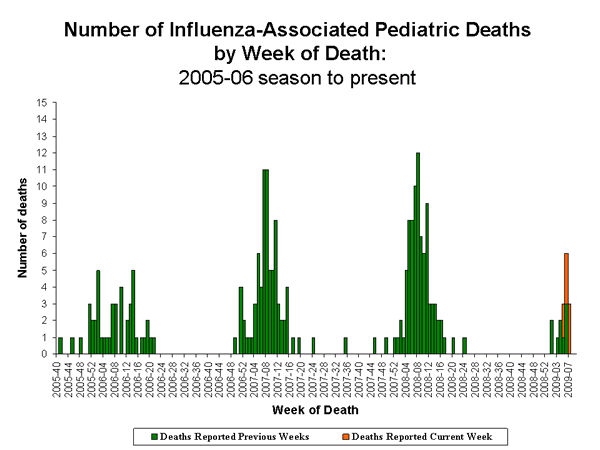
Eight influenza-associated pediatric deaths were reported to CDC during week 7 (Arizona, Colorado [2], Massachusetts and Texas [4]). The deaths reported this week occurred between February 1 and February 18, 2009. Since September 28, 2008, CDC has received 17 reports of influenza-associated pediatric deaths that occurred during the current season.
Bacterial coinfections were confirmed in 10 (58.8%) of the 17 children; Staphylococcus aureus was identified in eight (80.0%) of the ten children. Three of the S. aureus isolates were sensitive to methicillin, four were methicillin resistant, and one had no sensitivity results reported. Eight (80.0%) of the 10 children with bacterial coinfections were 12 years of age or older. An increase in the number of influenza-associated pediatric deaths with bacterial coinfections was first recognized during the 2006-07 influenza season. In January 2008, interim testing and reporting recommendations were released regarding influenza and bacterial coinfections in children and are available at (http://www2a.cdc.gov/HAN/ArchiveSys/ViewMsgV.asp?AlertNum=00268).
<center>
IPD07_small.gif

View Full Screen</center> Influenza-Associated Hospitalizations

Laboratory-confirmed influenza-associated hospitalizations are monitored in two population-based surveillance networks: the Emerging Infections Program (EIP) and the New Vaccine Surveillance Network (NVSN). These two systems provide updates of surveillance data every two weeks.
No influenza-associated hospitalizations have been reported from the New Vaccine Surveillance Network this season. Due to case identification methods utilized in this study, a delay exists from the date of hospitalization to the date of report. An update will be provided in subsequent weeks as epidemiologic information and testing results are obtained.
During October 1, 2008 – February 14, 2009, preliminary laboratory-confirmed influenza-associated hospitalization rates reported by the EIP for children aged 0-4 years and 5-17 years were 1.0 per 10,000 and 0.1 per 10,000, respectively. For adults aged 18-49 years, 50-64 years, and = 65 years, the rates were 0.1 per 10,000, 0.1 per 10,000, and 0.4 per 10,000, respectively.
<center>
EIP07_small.gif

View Full Screen</center> Outpatient Illness Surveillance:

Nationwide during week 7, 3.2% of patient visits reported through the U.S. Outpatient Influenza-like Illness Surveillance Network (ILINet) were due to influenza-like illness (ILI). This percentage is above the national baseline of 2.4%.
<center>
image072.gif

View Sentinel Providers Regional Charts | View Chart Data |View Full Screen
</center>
On a regional level, the percentage of visits for ILI decreased in six of the nine regions compared to the previous week and ranged from 1.9% to 5.9%. Seven of nine surveillance regions reported ILI percentages above their region specific baselines.
<table class="table" align="center" border="0" cellpadding="3" cellspacing="0"> <tbody><tr> <th align="left" width="80">Region</th> <th align="center" width="60" nowrap="nowrap">New England</th> <th align="center" width="60" nowrap="nowrap">Mid Atlantic</th> <th align="center" width="60" nowrap="nowrap">East North Central</th> <th align="center" width="60" nowrap="nowrap">West North Central</th> <th align="center" width="60" nowrap="nowrap">South Atlantic</th> <th align="center" width="60" nowrap="nowrap">East South Central</th> <th align="center" width="60" nowrap="nowrap">West South Central</th> <th align="center" width="60" nowrap="nowrap">Mountain</th> <th align="center" width="60" nowrap="nowrap">Pacific</th> </tr> <tr> <td align="left" width="80" nowrap="nowrap">Reported ILI (%)</td> <td align="center" width="60" nowrap="nowrap">2.9</td> <td align="center" width="60" nowrap="nowrap">2.8</td> <td align="center" width="60" nowrap="nowrap">2.6</td> <td align="center" width="60" nowrap="nowrap">1.9</td> <td align="center" width="60" nowrap="nowrap">3.6</td> <td align="center" width="60" nowrap="nowrap">2.7</td> <td align="center" width="60" nowrap="nowrap">5.9</td> <td align="center" width="60" nowrap="nowrap">3.0</td> <td align="center" width="60" nowrap="nowrap">2.9</td> </tr> <tr> <td align="left" width="80" nowrap="nowrap">Region-Specific Baseline</td> <td align="center" width="60" nowrap="nowrap">1.5</td> <td align="center" width="60" nowrap="nowrap">2.9</td> <td align="center" width="60" nowrap="nowrap">1.9</td> <td align="center" width="60" nowrap="nowrap">1.7</td> <td align="center" width="60" nowrap="nowrap">2.2</td> <td align="center" width="60" nowrap="nowrap">2.5</td> <td align="center" width="60" nowrap="nowrap">4.8</td> <td align="center" width="60" nowrap="nowrap">1.5</td> <td align="center" width="60" nowrap="nowrap">3.0</td> </tr> </tbody></table> Geographic Spread of Influenza as Assessed by State and Territorial Epidemiologists:

During week 7, the following influenza activity was reported:

  • Widespread influenza activity was reported by 27 states (Alabama, Arizona, Colorado, Connecticut, Delaware, Florida, Georgia, Indiana, Iowa, Maine, Maryland, Massachusetts, Mississippi, Nevada, New Hampshire, New Jersey, New Mexico, New York, North Carolina, Ohio, Pennsylvania, Rhode Island, South Carolina, Tennessee, Texas, Vermont, and Virginia).
  • Regional influenza activity was reported by 17 states (Alaska, California, Hawaii, Idaho, Kansas, Kentucky, Michigan, Minnesota, Montana, Nebraska, North Dakota, Oregon, South Dakota, Washington, West Virginia, Wisconsin, and Wyoming).
  • Local influenza activity was reported by the District of Columbia and six states (Arkansas, Illinois, Louisiana, Missouri, Oklahoma, and Utah).
  • Sporadic activity was reported by Puerto Rico.

usmap07_small.jpg

<script type="text/javascript"> var stamp = new Date() var movieurl = "/flu/weekly/smallmap/SmallFluActivity_v2.swf?c=FluMap&n=" + stamp.getTime(); var so = new SWFObject(movieurl, "Banner", "620", "420", "7"); so.write("flashALTcontent"); so.addParam("scale", "noorder"); so.addParam("allowScriptAccess","sameDomain"); so.addParam("wmode", "transparent"); so.addParam("quality", "best"); so.addParam("salign", "r"); so.addParam("type", "application/x-shockwave-flash"); </script>
--------------------------------------------------------------------------------
A description of surveillance methods is available at: http://www.cdc.gov/flu/weekly/fluactivity.htm
<script type="text/javascript"> <!-- function popupnr(mylink, windowname, refocus) { var mywin, href; if (typeof(mylink) == 'string') href=mylink; else href=mylink.href; mywin = window.open('', windowname, 'width=450,height=550,scrollbars=yes'); // if opened the window if ( mywin.closed || (! mywin.document.URL) || (mywin.document.URL.indexOf("about") == 0) ) mywin.location=href; else if (refocus) mywin.focus(); return false; } //--> </script>
 
Re: Seasonal Flu 2008 - 2009

<table border="1"> <caption> INFLUENZA VIRUSES ISOLATED BY
WHO/NREVSS Collaborating Laboratories
2008 - 2009 Season
</caption> <tbody><tr> <th id="header1" width="70">Week</th> <th id="header2" width="90">A(H1)</th> <th id="header3" width="70">A(H3)</th> <th id="header4" width="70">A(Unk)</th> <th id="header5" width="70"> B </th> <th id="header6" align="right">Total # Tested</th> <th id="header7" align="right">% Positive</th> </tr> <tr><td headers="header1" align="right"> 40 </td> <td headers="header2" align="right"> 3 </td> <td headers="header3" align="right"> 0 </td> <td headers="header4" align="right"> 8 </td> <td headers="header5" align="right"> 6 </td> <td headers="header6" align="right"> 2615 </td> <td headers="header7" align="right"> 0.65 </td></tr> <tr><td headers="header1" align="right"> 41 </td> <td headers="header2" align="right"> 4 </td> <td headers="header3" align="right"> 4 </td> <td headers="header4" align="right"> 8 </td> <td headers="header5" align="right"> 6 </td> <td headers="header6" align="right"> 2655 </td> <td headers="header7" align="right"> 0.83 </td></tr> <tr><td headers="header1" align="right"> 42 </td> <td headers="header2" align="right"> 13 </td> <td headers="header3" align="right"> 3 </td> <td headers="header4" align="right"> 15 </td> <td headers="header5" align="right"> 6 </td> <td headers="header6" align="right"> 2777 </td> <td headers="header7" align="right"> 1.33 </td></tr> <tr><td headers="header1" align="right"> 43 </td> <td headers="header2" align="right"> 22 </td> <td headers="header3" align="right"> 0 </td> <td headers="header4" align="right"> 24 </td> <td headers="header5" align="right"> 14 </td> <td headers="header6" align="right"> 3213 </td> <td headers="header7" align="right"> 1.87 </td></tr> <tr><td headers="header1" align="right"> 44 </td> <td headers="header2" align="right"> 12 </td> <td headers="header3" align="right"> 2 </td> <td headers="header4" align="right"> 21 </td> <td headers="header5" align="right"> 5 </td> <td headers="header6" align="right"> 3353 </td> <td headers="header7" align="right"> 1.19 </td></tr> <tr><td headers="header1" align="right"> 45 </td> <td headers="header2" align="right"> 30 </td> <td headers="header3" align="right"> 2 </td> <td headers="header4" align="right"> 23 </td> <td headers="header5" align="right"> 11 </td> <td headers="header6" align="right"> 3946 </td> <td headers="header7" align="right"> 1.67 </td></tr> <tr><td headers="header1" align="right"> 46 </td> <td headers="header2" align="right"> 25 </td> <td headers="header3" align="right"> 2 </td> <td headers="header4" align="right"> 23 </td> <td headers="header5" align="right"> 12 </td> <td headers="header6" align="right"> 4171 </td> <td headers="header7" align="right"> 1.49 </td></tr> <tr><td headers="header1" align="right"> 47 </td> <td headers="header2" align="right"> 27 </td> <td headers="header3" align="right"> 1 </td> <td headers="header4" align="right"> 31 </td> <td headers="header5" align="right"> 23 </td> <td headers="header6" align="right"> 4526 </td> <td headers="header7" align="right"> 1.81 </td></tr> <tr><td headers="header1" align="right"> 48 </td> <td headers="header2" align="right"> 40 </td> <td headers="header3" align="right"> 1 </td> <td headers="header4" align="right"> 47 </td> <td headers="header5" align="right"> 24 </td> <td headers="header6" align="right"> 4627 </td> <td headers="header7" align="right"> 2.42 </td></tr> <tr><td headers="header1" align="right"> 49 </td> <td headers="header2" align="right"> 41 </td> <td headers="header3" align="right"> 5 </td> <td headers="header4" align="right"> 57 </td> <td headers="header5" align="right"> 14 </td> <td headers="header6" align="right"> 5343 </td> <td headers="header7" align="right"> 2.19 </td></tr> <tr><td headers="header1" align="right"> 50 </td> <td headers="header2" align="right"> 70 </td> <td headers="header3" align="right"> 9 </td> <td headers="header4" align="right"> 66 </td> <td headers="header5" align="right"> 36 </td> <td headers="header6" align="right"> 5671 </td> <td headers="header7" align="right"> 3.19 </td></tr> <tr><td headers="header1" align="right"> 51 </td> <td headers="header2" align="right"> 73 </td> <td headers="header3" align="right"> 17 </td> <td headers="header4" align="right"> 107 </td> <td headers="header5" align="right"> 56 </td> <td headers="header6" align="right"> 5946 </td> <td headers="header7" align="right"> 4.25 </td></tr> <tr><td headers="header1" align="right"> 52 </td> <td headers="header2" align="right"> 71 </td> <td headers="header3" align="right"> 12 </td> <td headers="header4" align="right"> 153 </td> <td headers="header5" align="right"> 51 </td> <td headers="header6" align="right"> 5839 </td> <td headers="header7" align="right"> 4.92 </td></tr> <tr><td headers="header1" align="right"> 53 </td> <td headers="header2" align="right"> 111 </td> <td headers="header3" align="right"> 17 </td> <td headers="header4" align="right"> 169 </td> <td headers="header5" align="right"> 47 </td> <td headers="header6" align="right"> 6194 </td> <td headers="header7" align="right"> 5.55 </td></tr> <tr><td headers="header1" align="right"> 01 </td> <td headers="header2" align="right"> 159 </td> <td headers="header3" align="right"> 26 </td> <td headers="header4" align="right"> 275 </td> <td headers="header5" align="right"> 80 </td> <td headers="header6" align="right"> 6574 </td> <td headers="header7" align="right"> 8.21 </td></tr> <tr><td headers="header1" align="right"> 02 </td> <td headers="header2" align="right"> 188 </td> <td headers="header3" align="right"> 20 </td> <td headers="header4" align="right"> 410 </td> <td headers="header5" align="right"> 90 </td> <td headers="header6" align="right"> 6625 </td> <td headers="header7" align="right"> 10.69 </td></tr> <tr><td headers="header1" align="right"> 03 </td> <td headers="header2" align="right"> 287 </td> <td headers="header3" align="right"> 39 </td> <td headers="header4" align="right"> 593 </td> <td headers="header5" align="right"> 159 </td> <td headers="header6" align="right"> 7261 </td> <td headers="header7" align="right"> 14.85 </td></tr> <tr><td headers="header1" align="right"> 04 </td> <td headers="header2" align="right"> 513 </td> <td headers="header3" align="right"> 91 </td> <td headers="header4" align="right"> 756 </td> <td headers="header5" align="right"> 257 </td> <td headers="header6" align="right"> 8317 </td> <td headers="header7" align="right"> 19.44 </td></tr> <tr><td headers="header1" align="right"> 05 </td> <td headers="header2" align="right"> 471 </td> <td headers="header3" align="right"> 35 </td> <td headers="header4" align="right"> 1217 </td> <td headers="header5" align="right"> 508 </td> <td headers="header6" align="right"> 10246 </td> <td headers="header7" align="right"> 21.77 </td></tr> <tr><td headers="header1" align="right"> 06 </td> <td headers="header2" align="right"> 522 </td> <td headers="header3" align="right"> 34 </td> <td headers="header4" align="right"> 1157 </td> <td headers="header5" align="right"> 663 </td> <td headers="header6" align="right"> 10256 </td> <td headers="header7" align="right"> 23.17 </td></tr> <tr><td headers="header1" align="right"> 07 </td> <td headers="header2" align="right"> 297 </td> <td headers="header3" align="right"> 31 </td> <td headers="header4" align="right"> 622 </td> <td headers="header5" align="right"> 455 </td> <td headers="header6" align="right"> 5715 </td> <td headers="header7" align="right"> 24.58 </td></tr> </tbody></table>​
[FONT=Verdana, Arial, Helvetica, sans-serif][SIZE=-1] Return to Current Report[/SIZE][/FONT]
<!-- #################################### --> <!-- BEGIN SiteCatalyst/Omniture code here--> <!-- Version: 1.2 - Date Created: 08/04/2004--> <script language="JavaScript" type="text/javascript"> <!-- var s_pageName=document.title var s_channel="CDC Flu" var s_prop1= s_pageName + " ^ " + s_channel var s_code=' '//--> </script> <script language="JavaScript" src="http://www.cdc.gov/JScript/s_code.js" type="text/javascript"></script> <script language="JavaScript" type="text/javascript"> <!-- var s_wd=window,s_tm=new Date;if(s_code!=' '){s_code=s_dc( 'cdcgov');if(s_code)document.write(s_code)}else document.write('<im'+'g src="http://mtrics.cdc.gov/b/ss/cdcgov/1/G.5--FB/s'+s_tm.getTime()+'?[AQB]' +'&j=1.0&[AQE]" height="1" width="1" border="0" alt="" />') //--> </script>
s3845919381502
 
Re: Seasonal Flu 2008 - 2009

CIDRAP >> CDC reports 8 more pediatric flu deaths

CDC reports 8 more pediatric flu deaths

Lisa Schnirring * Staff Writer
Feb 27, 2009 (CIDRAP News) ?

The number of pediatric influenza deaths outstripped last week's spike, and three more states reported widespread activity, the US Centers for Disease Control and Prevention (CDC) said today in its weekly surveillance update.


The CDC received eight reports of influenza-related deaths in children during the week ending Feb 21, bringing the seasonal total to 17. Four of the deaths occurred in Texas, 2 in Colorado, and 1 each in Arizona and Massachusetts.

Bacterial coinfections have been confirmed in 10 (59%) of the 17 children. Staphylococcus aureus was identified in 8 of the 10 children?3 of the isolates were sensitive to methicillin, 4 were not, and results were not reported for 1. Eight of the 10 children who had coinfections were age 12 or older.

After noting a sharp increase in the number of S aureus infections in children who had the flu during the 2006-07 season, the CDC in January 2008 released interim testing and reporting recommendations regarding influenza and bacterial coinfections in children.

In other developments, the number of states reporting widespread flu activity rose to 27, 3 more than the previous week. Seventeen states reported regional activity, which is up 4 from last week's report.

Of the influenza A/H1N1 samples from 35 states that have been tested, nearly all (98.8%) showed resistance to oseltamivir (Tamiflu). Slightly more than a third of the influenza B viruses that were tested match the Yamagata lineage included in this year's vaccine, and the remaining samples were from the Victoria lineage.
-
<cite cite="http://www.cidrap.umn.edu/cidrap/content/influenza/general/news/feb2709pediatric-jw.html">CIDRAP >> CDC reports 8 more pediatric flu deaths</cite>
 
Re: Seasonal Flu 2008 - 2009

flu-A sequenced in USA:
2006/7: 3912*H1 and 2368*H3
2007/8: 2175*H1 and 6115*H3

USA-flu-A-genomes uploaded to genbank
2006: 7(H1N1)+25(H3N2)
2007: 299(H1N1)+79(H3N2)
2008: 3(H1N1)+47(H3N2)


there is a clear deficit for H1N1 genomes since season 2007/8 ,
the season when the Oseltamivir resistance emerged.

But this is important to track, where and how it began.

So, don't they want us to know this ?
Even after more than 1 year ?


the resistant strain which is dominant this season was first seen
in USA early 2008:
A/Memphis/03/2008/01/15(H1N1)
A/North Carolina/02/2008/02/05(H1N1)
and there are no viruses from this strain found elsewhere and published at genbank

so the virus spread from USA or survived in USA ?
while the current wisdom is that flu usually is newly introduced each season from SE-Asia
to USA and then dies in summer
 
Re: Seasonal Flu 2008 - 2009

EISS - Weekly Electronic Bulletin - 06 March 2009, Issue N? 295 - Declining influenza activity in western and central Europe accompanied by an increase in the relative prevalence of type B viruses.

EISS - Weekly Electronic Bulletin Week 9 : 23/02/2009-01/03/2009 - 06 March 2009, Issue N? 295 - Declining influenza activity in western and central Europe accompanied by an increase in the relative prevalence of type B viruses.


-- Summary:

In week 09/2009, influenza activity was little changed across Europe compared to the previous week.

Most countries in central/eastern Europe continue to report medium influenza intensity while activity continues to decline to low levels in western Europe.

While influenza A(H3) continues to be the predominant circulating virus, the proportion of influenza B virus detections continues to increase, notably for the B/Victoria/2/87 lineage viruses.


-- Epidemiological situation - week 09/2009:

For the intensity indicator, the national network levels of influenza-like illness (ILI) and/or acute respiratory infection (ARI) were high in Croatia and Slovakia, medium in 18 countries, and low in the other seventeen countries that reported this indicator.

Intensity levels for the majority of countries across Europe were unchanged compared to week 08/2009 while a few western European countries reported lower intensity.

Five of the seven regions of the Russian Federation show increasing activity while the remaining two (Central and Far Eastern) show a decrease in influenza activity.

For the geographical spread indicator, widespread influenza activity was reported in 11 countries, regional activity in nine countries, local activity in six countries and sporadic or no activity in the remaining 13 countries.


-- Cumulative epidemiological situation - 2008-2009 season (weeks 40/2008-09/2009):

Since week 49/2008 consultation rates for ILI and/or ARI have risen above baseline levels in most western and central European countries following a general west to east progression. High influenza intensity, again following a general west to east progression, has been reported in 13 countries since week 51/2008, but intensity has declined in all but Croatia and Slovakia.

Generally, the highest consultation rates have been in the 0-4 and 5-14 age groups, but Ireland, UK, Norway and Romania have reported their highest ILI consultation rates in the 15-64 age group.


-- Virological situation - week 09/2009:

The total number of respiratory specimens collected by sentinel physicians in week 09/2009 was 1850, of which 423 (23%) were positive for influenza virus: 228 type A (91 subtype H3, 14 subtype H1 and 123 not subtyped) and 195 type B.

In addition, 735 non-sentinel source specimens (e.g. specimens collected for diagnostic purposes in hospitals) were reported positive for influenza virus: 584 type A (206 subtype H3, 79 subtype H1 and 299 not subtyped) and 151 type B.

The number of type B detections has continued to rise and surpassed type A detections for the week in ten countries (England, Estonia, Germany, Greece, Netherlands, Northern Ireland, Serbia, Slovakia, Spain and Turkey).


-- Cumulative virological situation - 2008-2009 season (weeks 40/2008-09/2009):

Of 22410 virus detections (sentinel and non-sentinel) since week 40/2008, 20556 (92%) were type A (8419 subtype H3, 867 subtype H1 and 11270 not subtyped) and 1854 (8%) were type B.

Based on the antigenic and/or genetic characterisation of 3153 influenza viruses, 2656 (84.2%) were reported as A/Brisbane/10/2007 (H3N2)-like, 142 (4.5%) as A/Brisbane/59/2007 (H1N1)-like, 37 (1.1%) as B/Florida/4/2006-like (B/Yamagata/16/88 lineage) and 318 (10.2%) as B/Malaysia/2506/2004-like (B/Victoria/2/87 lineage).

More detailed antigenic and genetic analyses have shown that B/Victoria/2/87 lineage viruses are either B/Malaysia/2506/2004-like or B/Brisbane/60/2008-like, the prototype vaccine strain recommended by WHO for inclusion in the 2009-10 vaccine (WER, 2009, 84(9), pp65-76).

Influenza isolates from 12 countries have been assessed for antiviral susceptibility.

All influenza A(H3N2) viruses tested were sensitive to oseltamivir (352) and zanamivir (331), but resistant to M2 inhibitors (225).

Ninety-eight percent of influenza A(H1N1) viruses analysed (185/188) were resistant to oseltamivir, but all those tested against zanamivir (188) and M2 inhibitors (60) were sensitive.

The small number of influenza B viruses analysed (27) were sensitive to oseltamivir and zanamivir.


-- Comment:

Influenza activity has continued to decline in western Europe and is below baseline levels in countries that experienced the influenza epidemic first this season (Ireland, Portugal, the UK).

For many of the remaining countries activity has shown relatively little change compared to week 08/2009 although some central European countries as well as in a large part of the Russian Federation increased activity has been reported.

While A(H3N2) is still the dominant influenza virus circulating in the Europe region, the proportion of type B influenza virus detections per week continues to show a rising trend, with an increasing number of countries reporting type B as the dominant or co-dominant virus type.

The proportion of B/Victoria lineage viruses has risen to 90% (318/355) for those type B viruses that have been antigenically and/or genetically characterised.

With the exception of these B/Victoria lineage viruses, the viruses circulating are similar to the three components - A(H1N1), A(H3N2) and B/Yamagata lineage - included in the 2008/2009 Northern Hemisphere influenza vaccine.


-- Background:

The Weekly Electronic Bulletin presents and comments on influenza activity in the 53 countries that report to EISS. Of these countries, 34 reported both clinical and virological data, four reported virological data only and two reported clinical data only to EISS in week 09/2009. The spread of influenza virus strains and their epidemiological impact in Europe are being monitored by the network under the aegis of the European Centre for Disease Prevention and Control in Stockholm (Sweden) and the WHO Regional Office for Europe in Copenhagen (Denmark), in collaboration with the WHO Collaborating Centre for Reference and Research on Influenza in London (UK).


-- Other bulletins:

The EISS bulletin is prepared using reports from GP consultations and other sources, depending on individual country arrangements. It is important to recognise that different health care systems and types of measurement should also be considered when assessing the impact of influenza.


-- Map

The map presents the intensity of influenza activity and the geographical spread as assessed by each of the networks in EISS.

<table style="width: auto;"><tbody><tr><td></td></tr><tr><td style="font-family: arial,sans-serif; font-size: 11px; text-align: right;">From MAPS</td></tr></tbody></table>

Europe Year 2009 / Week 9


A = Dominant virus A
H1N1 = Dominant virus A(H1N1)
H3N2 = Dominant virus A(H3N2)
H1N2 = Dominant virus A(H1N2)
B = Dominant virus B
A & B = Dominant virus A & B
= : stable clinical activity
+ : increasing clinical activity
- : decreasing clinical activity
Low = no influenza activity or influenza at baseline levels
Medium = usual levels of influenza activity
High = higher than usual levels of influenza activity
Very high = particularly severe levels of influenza activity
No activity = no evidence of influenza virus activity (clinical activity remains at baseline levels)
Sporadic = isolated cases of laboratory confirmed influenza infection
Local outbreak = increased influenza activity in local areas (e.g. a city) within a region,or outbreaks in two or more institutions (e.g. schools) within a region. Laboratory confirmed.
Regional activity = influenza activity above baseline levels in one or more regions witha population comprising less than 50% of the country's total population. Laboratory confirmed.
Widespread = influenza activity above baseline levels in one or more regions with a populationcomprising 50% or more of the country's population. Laboratory confirmed.
Finland : Where available, the epidemiological data are provided by a health-care district inSouth-Western Finland (the health-care district serves 54,000 inhabitants i.e. approximately onepercent of the Finnish population).


-- Network comments (where available)

- Finland. 310 patients with respiratory tract infections were seen at the surveillance site during week 9, down from 360 during week 8. The proportion of respiratory patients has remained stable at approximately 17 % during the last three weeks.

- Italy. Influenza activity continues to decrease all over the country. Just one influenza A/H3N2 and one influenza B virus detected during this week.

- Russian Federation. A total of 41(83.7%) influenza A(H1N1) viruses from 49 ones tested which were isolated in Vladivostok and Moscow appeared to be resistant to oseltamivir.

- Switzerland. Influenza activity is decreasing in Switzerland. Influenza A and B viruses have been detected.
-
<cite cite="http://www.eiss.org/cgi-files/bulletin_v2.cgi">EISS - Bulletin Review</cite>
 
Re: Seasonal Flu 2008 - 2009

Flu patients increased in 9th week (March 3-5) Excerpts
Source: http://medical.nikkeibp.co.jp/leaf/all/special/pandemic/topics/200903/509713.html
Source: http://medical.nikkeibp.co.jp/leaf/all/special/pandemic/topics/200903/509692.html

After decreased for four consecutive weeks, the number of flu patients in Japan turned to a rise in the nineth week (Feb 23 thru Mar 1). The total number of flu patients reported by survey points increased by approx. 7000 from 57,681 last week to 64,528 this week. The number of patients per survey point per day also rose from 12.05 to 13.49. No prefecture is above the alarm level (30 patients per point・day) but 38 prefectures are still above the caution level (10 patients per point・day).

According to the ML flu database*, influenza A peaked at the end of January and was dropping since. On the other hand, reports of influenza B gradually increased and surpassed influenza A on February 16. ML flu DB also shows the number of patients in a rise because of influenza B.(See Chart 1 below)
Influenza B may rise more and peak some time in March, similarly to the 2006/07 season. (See Chart 2 below)

*ML flu database (http://ml-flu.children.jp/) is a private online database of influenza information, started in winter 2000. 300 volunteers of doctors now provide clinical level information to the database in order to share quick information on influenza.


<center>
Influenza in 2008/2009 season
<img src=" http://medical.nikkeibp.co.jp/all/special/pandemic/topics/200903/images/thumb_509692_2009_03_04ml.jpg" border="0" alt="" /><br />
Influenza A: blue line, Influenza B: red line

<center>
Influenza in 2001/2002 season thru 2007/2008
<img src=" http://medical.nikkeibp.co.jp/all/special/pandemic/topics/200903/images/thumb_509692_81225mm01.gif" border="0" alt="" /><br />
Influenza A: gray line, Influenza B: orange line
<left>
___________________
SN1987A
 
Re: Seasonal Flu 2008 - 2009

ECDC. Monitoring of Influenza antiviral resistance in EU during 2008-09 season (March 11, 2009)

Monitoring of Influenza antiviral resistance in EU during 2008-09 season

[Original text is available at this LINK. EDITED.]

Monitoring of antiviral resistance in EU for the season 2008-09 is currently ongoing. The coordinators of The Community Network of Reference Laboratories for Human Influenza in Europe (CNRL), routinely collect, analyze and disseminate information on antiviral resistance from Influenza viruses isolated from 25 European (European Union, EEA/EFTA) countries.

The analysis of resistance against Neuraminidase Inhibitors and Adamantanes is done by measuring IC50 values and/or by genotyping of viruses for detection of known drug resistance mutations.

Summary information on antiviral resistance in EU will be published weekly in the EISS bulletin (LINK) (also featured in the weekly ECDC influenza News)


<table style="width: auto;"><tbody><tr><td></td></tr><tr><td style="font-family: arial,sans-serif; font-size: 11px; text-align: right;">From TABLES</td></tr></tbody></table>
 
Re: Seasonal Flu 2008 - 2009

March 13, 2009

Widespread flu reported
GOSHEN ? The state is currently facing a widespread influenza season with preliminary tests indicated the flu may have contributed to the recent death of a child in Orange County, the county Health Department reported Thursday.
New York State has had five pediatric deaths this season associated with the flu.
The county Health Department still recommends that persons should get a flu shot if they have not already received one this winter. The vaccine is an important step at reducing influenza, but officials said other preventative measures include frequent hand washing, covering the mouth and nose while coughing and sneezing and staying away from others while sick.
Children under the age of nine who have never had a flu shot before will require a second follow-up shot, health officials said.

http://www.midhudsonnews.com/News/2009/March09/13/flu-13Mar09.html
 
Re: Seasonal Flu 2008 - 2009

EISS - Weekly Electronic Bulletin Week 10 - 13 March 2009, Issue N? 296 Influenza activity increasing in eastern Europe while continuing to decline in most western and central countries.

EISS - Weekly Electronic Bulletin Week 10 : 02/03/2009-08/03/2009 - 13 March 2009, Issue N? 296 Influenza activity increasing in eastern Europe while continuing to decline in most western and central countries


-- Summary:

In week 10/2009, influenza activity was little changed across Europe compared to the previous week. Most countries in central/eastern Europe continue to report medium influenza intensity while activity continues to decline to low levels in western Europe. While influenza A(H3) continues to be the predominant circulating virus, the proportion of influenza B virus detections continues to increase.


-- Epidemiological situation - week 10/2009:

For the intensity indicator, the national network levels of influenza-like illness (ILI) and/or acute respiratory infection (ARI) were high in Croatia and Greece, medium in 16 countries, and low in the other 19 countries that reported this indicator. Intensity levels for the majority of countries across Europe were unchanged compared to week 09/2009 while the majority of western European countries reported lower intensity. Croatia, Estonia, Greece, Romania, Turkey, Ukraine and five of the seven regions of the Russian Federation, show increasing activity.

For the geographical spread indicator, widespread influenza activity was reported in 10 countries, regional activity in seven countries, local activity in eight countries and sporadic or no activity in the remaining 12 countries.


-- Cumulative epidemiological situation - 2008-2009 season (weeks 40/2008-10/2009):

Since week 49/2008 consultation rates for ILI and/or ARI have risen above baseline levels in most western and central European countries following a general west to east progression. High influenza intensity, again following a general west to east progression, has been reported in 14 countries since week 51/2008, Greece reported high intensity this season for the first time in week ten, however intensity has declined in all other countries except Croatia.

Generally, the highest consultation rates have been in the 0-4 and 5-14 age groups, but Ireland, UK, Norway and Romania have reported their highest ILI consultation rates in the 15-64 age group.


-- Virological situation - week 10/2009:

The total number of respiratory specimens collected by sentinel physicians in week 10/2009 was 1747, of which 472 (27%) were positive for influenza virus: 222 type A (118 subtype H3, 3 subtype H1 and 101 not subtyped) and 250 type B. In addition, 644 non-sentinel source specimens (e.g. specimens collected for diagnostic purposes in hospitals) were reported positive for influenza virus: 512 type A (251 subtype H3, 72 subtype H1 and 189 not subtyped) and 132 type B. The number of type B detections has continued to rise and surpassed type A detections for the week in 18 countries.


-- Cumulative virological situation - 2008-2009 season (weeks 40/2008-10/2009):

Of 24045 virus detections (sentinel and non-sentinel) since week 40/2008, 21694 (90%) were type A (9033 subtype H3, 955 subtype H1 and 11706 not subtyped) and 2351 (10%) were type B.

Based on the antigenic and/or genetic characterisation of 3056 influenza viruses, 2440 (79.8%) were reported as A/Brisbane/10/2007 (H3N2)-like, 161 (5.3%) as A/Brisbane/59/2007 (H1N1)-like, 22 (0.7%) as B/Florida/4/2006-like (B/Yamagata/16/88 lineage) and 433 (14.2%) as B/Malaysia/2506/2004-like (B/Victoria/2/87 lineage).

More detailed antigenic and genetic analyses have shown that B/Victoria/2/87 lineage viruses are either B/Malaysia/2506/2004-like or B/Brisbane/60/2008-like, the prototype vaccine strain recommended by WHO for inclusion in the 2009-10 vaccine (WER 2009; 84(9): 65-76).

Influenza isolates from 17 countries have been assessed for antiviral susceptibility.
All influenza A(H3N2) viruses tested were sensitive to oseltamivir and zanamivir, but resistant to M2 inhibitors.

Ninety-eight percent of influenza A(H1N1) viruses analysed were resistant to oseltamivir, all those tested against zanamivir and all but one tested against M2 inhibitors were sensitive. The M2 inhibitor resistant A(H1N1) virus was sensitive to the neuraminidase inhibitors. The small number of influenza B viruses analysed were sensitive to oseltamivir and zanamivir.


-- Comment:

Influenza activity has continued to decline in western Europe and is below baseline levels in most countries. For many of the remaining countries activity has shown relatively little change compared to week 09/2009 although some central and eastern European countries as well as in a large part of the Russian Federation increased activity has been reported.

While A(H3N2) is still the dominant influenza virus circulating in the Europe region, the proportion of type B influenza virus detections per week continues to show a rising trend, with an increasing number of countries reporting type B as the dominant or co-dominant virus type.

The proportion of B/Victoria lineage viruses has risen to 95% (433/455) for those type B viruses that have been antigenically and/or genetically characterised. With the exception of these B/Victoria lineage viruses, the viruses circulating are similar to the three components - A(H1N1), A(H3N2) and B/Yamagata lineage - included in the 2008/2009 Northern Hemisphere influenza vaccine.

The seeming mismatch of these B/Victoria/2/87 lineage viruses with the current vaccine is unlikely to be of public health significance and overall this season?s vaccine can be expected to be effective.


-- Background:

The Weekly Electronic Bulletin presents and comments on influenza activity in the 53 countries that report to EISS. Of these countries, 34 reported both clinical and virological data, four reported virological data only and two reported clinical data only to EISS in week 10/2009. The spread of influenza virus strains and their epidemiological impact in Europe are being monitored by the network under the aegis of the European Centre for Disease Prevention and Control in Stockholm (Sweden) and the WHO Regional Office for Europe in Copenhagen (Denmark), in collaboration with the WHO Collaborating Centre for Reference and Research on Influenza in London (UK).


-- Other bulletins:

The EISS bulletin is prepared using reports from GP consultations and other sources, depending on individual country arrangements. It is important to recognise that different health care systems and types of measurement should also be considered when assessing the impact of influenza.


-- Map

The map presents the intensity of influenza activity and the geographical spread as assessed by each of the networks in EISS.

<table style="width: auto;"><tbody><tr><td></td></tr><tr><td style="font-family: arial,sans-serif; font-size: 11px; text-align: right;">From MAPS</td></tr></tbody></table>

<table style="width: auto;"><tbody><tr><td></td></tr><tr><td style="font-family: arial,sans-serif; font-size: 11px; text-align: right;">From MAPS</td></tr></tbody></table>

<table style="width: auto;"><tbody><tr><td></td></tr><tr><td style="font-family: arial,sans-serif; font-size: 11px; text-align: right;">From MAPS</td></tr></tbody></table>

<table style="width: auto;"><tbody><tr><td></td></tr><tr><td style="font-family: arial,sans-serif; font-size: 11px; text-align: right;">From MAPS</td></tr></tbody></table>

Europe Year 2009 / Week 10


A = Dominant virus A
H1N1 = Dominant virus A(H1N1)
H3N2 = Dominant virus A(H3N2)
H1N2 = Dominant virus A(H1N2)
B = Dominant virus B
A & B = Dominant virus A & B
= : stable clinical activity
+ : increasing clinical activity
- : decreasing clinical activity
Low = no influenza activity or influenza at baseline levels
Medium = usual levels of influenza activity
High = higher than usual levels of influenza activity
Very high = particularly severe levels of influenza activity
No activity = no evidence of influenza virus activity (clinical activity remains at baseline levels)
Sporadic = isolated cases of laboratory confirmed influenza infection
Local outbreak = increased influenza activity in local areas (e.g. a city) within a region,or outbreaks in two or more institutions (e.g. schools) within a region. Laboratory confirmed.
Regional activity = influenza activity above baseline levels in one or more regions witha population comprising less than 50% of the country's total population. Laboratory confirmed.
Widespread = influenza activity above baseline levels in one or more regions with a populationcomprising 50% or more of the country's population. Laboratory confirmed.
Finland : Where available, the epidemiological data are provided by a health-care district in South-Western Finland (the health-care district serves 54,000 inhabitants i.e. approximately onepercent of the Finnish population).


-- Network comments (where available)

- Italy. Only two influenza viruses were identified and/or isolated during last week.
- Russian Federation. As a result of 21 strains of influenza A(H3) virus testing it was shown that all isolates from St. Petersburg and Kaliningrad were drift variants of the reference virus A/Brisbane/10/07 and reacted with antiserum to these strains up to 1/4 - 1/16 of homologous titer. All 19 isolates of influenza B virus belonged to the Victoria lineage. Four of ten influenza A(H1) viruses and 22 of 28 influenza A(H3) viruses isolated in Russia appeared to be resistant to rimantadine.
- Switzerland. Influenza activity continued to decrease. Influenza B are detected in majority.
-
<cite cite="http://www.eiss.org/cgi-files/bulletin_v2.cgi">EISS - Bulletin Review</cite>
 
Re: Seasonal Flu 2008 - 2009


Ningxia University North Campus controllability happen "influenza B"

Source: China Radio Net | Time: March 17, 2009

Ningxia University North Campus
HONG Yinchuan message March 17 (Reporter GUO Chang-jiang, XU much)
Last night, Ningxia University, School of Chemistry and Chemical Engineering, North Campus has 18 students who happen unexplained cases of upper respiratory tract infection and was sent to Ningxia Autonomous Region People's Hospital observation and treatment. Department of Health diagnosed as a control of the "B influenza" caused. As of 10:00, 6 cases have continued observation, and the rest have been discharged. It is understood that at Ningxia University Hospital where there is no other similar situation of Chemistry and Chemical Engineering.

This morning, when the reporter arrived at the north campus of Ningxia University, the gate has been closed for security personnel, banned from entering. According to introduction, the school has been in the office areas, classrooms and other regional use of ultraviolet radiation, such as spraying disinfectant消杀bacteria. School students to give hair a special message, please have the symptoms of students in speed to the designated location checks to keep the dynamic condition.

Ningxia People's Hospital opened a special green channel. Such patients, will be free to the rapid isolation rooms, treatment observation. It is understood that the night of observation of treatment

18 students and the prevalence of symptoms very similar to the common cold, the body temperature slightly, the general body at 37,38 degrees. Among them, the students have 5,6 at the temperature above 38 degrees.

This morning, 18 students have been carried out pathological examination, one of
Example 6 continued observation, and the rest have been discharged. At the same time, Nanjing has started at all the big scope for bacteria消杀and clean campus job.

Video: http://video.nxtv.cn/flashapp/player.swf?host=video.nxtv.cn&p=4A4069C
 
Re: Seasonal Flu 2008 - 2009

Ningxia University North Campus is currently 6 people happen influenza Hospital for observation

2009-3-17 18:02
by Editor


Ningxia University North Campus of the current influenza happened 6 person be hospitalized for observation Ningxia Net News WWW.NXNEWS.NET 【2009-3-17 13:29:05】 Ningxia News Forum News Reporter hearing March 17 from the Ningxia Hui Autonomous Region Health Department Emergency Response Office was informed that the evening of March 16, Ningxia University, North Campus students found unexplained upper respiratory tract infections by the autonomous regional health department initially diagnosed as influenza B (18 cases). As at 10:00 on the 17th and continue to be hospitalized for observation 6 cases, and the rest have been discharged. The following is issued on the source】 【Ningxia News Network
I witnessed:封校is now closed for disinfection. And does not allow students to go out or go home. The evening of March 16, I go north of Education be closed to observe the two school buildings and found a dozen ambulances, squad cars and a number of Lanzhou Military Region's air force has linked the military vehicle license, asked me to go was told no comment, at location near the rear window, a thick smell of the disinfectant smell.
 
Re: Seasonal Flu 2008 - 2009

Number of flu cases increase after slow start to influenza season

Wednesday, March 18, 2009
TULSA, Okla. ? Doctors say they're seeing an increase in the number of flu cases in Oklahoma after a slow start to the influenza season.
"We typically tend to peak in late January or early February," said Laurence Burnsed, chief of the state Health Department's Communicable Disease Division. "We've seen a lighter season overall. It's certainly less intense than we've seen the last couple of seasons."
Just more than a month ago, physicians at St. John Urgent Care centers saw few cases of influenza or influenzalike illnesses, said Dr. Jason Lepak, co-medical director of St. John's urgent care facilities.
"Clearly, in the last two to three weeks, we've seen a significant explosion of cases throughout the Tulsa area and surrounding counties," he said.
-snip-
Lepak said the dominant strain this year is influenza A, although influenza B has been seen.
"Unfortunately, some of our rapid tests used to detect influenza only detects the A and B strains," he said. "The reality is, if you test negative on the flu test, you could have C, D or other serotypes."
Some other common "mimickers" of the influenza virus are the common cold, rhinovirus and parainfluenza, Lepak said.
He also noted that the influenza A strain has mutated so that it is resistant to the common antiviral, Tamiflu.
-snip-
http://seattletimes.nwsource.com/html/living/2008880073_apfluseason.html
 
Re: Seasonal Flu 2008 - 2009

Thailand


Influenza B: Get ready to battle it

March 18th, 2009 - 10:19 pm ICT by GD <!-- Email to friend --> - <script type="text/javascript"><!-- google_ad_client = "pub-7046344781760701"; /* right inline block newsportal */ google_ad_slot = "1348447094"; google_ad_width = 300; google_ad_height = 250; //--> </script> <script style="display: none;" src="http://pagead2.googlesyndication.com/pagead/show_ads.js" type="text/javascript"> </script>
Influenza B has finally set in. According to a recent survey by the health department Influenza B has recorded the highest rates in the recent years. Before it invades your life get ready to battle it.
-snip-
http://www.thaindian.com/newsportal/health/influenza-b-get-ready-to-battle-it_100168245.html
 
Re: Seasonal Flu 2008 - 2009

Flu outbreak arrives late, hits hard in region?s schools
Published: 03/19/09

A late flu outbreak is sweeping through Western Washington schools, keeping hundreds of kids home with high fevers, hacking coughs and body aches.
Last week, 13 Pierce County schools reported that more than 10 percent of their student bodies absent because of the flu or flu-like symptoms. This week, as of Wednesday, nine schools in the county had passed the 10 percent threshold.

-snip-
On a positive note, Winans said, most of the current cases involve a strain called influenza B, which typically occurs at the end of the flu season and is a sign the season is near an end.
-snip-

http://www.thenewstribune.com/health/story/677077.html
 
Re: Seasonal Flu 2008 - 2009

#415:
"Lepak said the dominant strain this year is influenza A, although influenza B has been seen.
"Unfortunately, some of our rapid tests used to detect influenza only detects the A and B strains," he said. "The reality is, if you test negative on the flu test, you could have C, D or other serotypes."
Some other common "mimickers" of the influenza virus are the common cold, rhinovirus and parainfluenza, Lepak said."

#...:
"unexplained upper respiratory tract infections by the autonomous regional health department initially diagnosed as influenza B"
...
"influenza-like illness (ILI) and/or acute respiratory infection (ARI)"


Seems that in slow motion we would rich a point of switching from a bf strain preparedness to the human flu strains or unknown ARI preparedness.

What a usefull conventional microbial wide specter name this named Acute Respiratory Infection ...
 
Re: Seasonal Flu 2008 - 2009

ECDC Health Content - Outbreaks of Influenza-like illness in Hong Kong and public health action ? Risk from ?seasonal? influenza to Europeans travelling to Hong Kong and other Tropical areas

Outbreaks of Influenza-like illness in Hong Kong and public health action ? Risk from ?seasonal? influenza to Europeans travelling to Hong Kong and other Tropical areas

During the last month, Hong Kong has been in the active phase of its first annual influenza season which, like other years, is expected to decline in April before rising again in mid-summer.


The predominant virus strains are the same as elsewhere in the Northern hemisphere, i.e. a mix of influenza A/H3N2, A/H1N1 and B. The epidemiological picture is well described on a continuous basis by the Centre for Health Protection (CHP) of the Department of Health on the Influenza Pages of its website taking care to choose seasonal influenza where there is always particular emphasis on prevention and the outbreaks taking place in schools and other institutions (1).

Last year at this time ECDC published a short threat assessment on the situation in Hong Kong following some high profile deaths in children associated with influenza (2). This noted the threat that seasonal influenza poses each year and that travellers to Hong Kong and other tropical areas should consider. A survey of travellers from Europe to subtropical and tropical countries has found that influenza was one of the most frequent vaccine-preventable infection they acquired. These infections occurred mainly outside the domestic European epidemic season and so tended to be unexpected (3).


ECDC Comment 18/03/09:

What is unusual in Hong Kong among tropical areas is that it has good active continuous surveillance for seasonal influenza. It is suspected but not proven that other tropical areas experience the same or similar patterns. In the light of the above it seems wise that persons who would be in the conventional risks groups or otherwise be recommended for influenza by their national authorities or simply wish to avoid the risk of acquiring seasonal influenza while travelling should consider whether they should be immunised before travelling to tropical areas like Hong Kong. A question that can then arise is whether to have Southern or Northern hemisphere vaccine. At present the two vaccines are identical so the answer is ?either?.

1) Press release issued by the authorities of Hong Kong
2) ECDC threat assessment. Influenza situation in Hong Kong, China. 14 March 2008
3) Mutsch M, Tavernini M, Marx A, Gregory V, Lin YP, Hay AJ, Tschopp A, Steffen R. Influenza virus infection in travellers to tropical and subtropical countries. Clin Infect Dis 2005; 40: 1282-7.
-
<cite cite="http://ecdc.europa.eu/en/health_content/episu/090319_av_seasonal.aspx">ECDC Health Content</cite>
 
Re: Seasonal Flu 2008 - 2009

EISS - Weekly Electronic Bulletin Week 11 - 20 March 2009, Issue N? 297 Influenza activity high in the Russian Federation while being low or continuing to decline in most western, central and northern European countries

EISS - Weekly Electronic Bulletin Week 11 : 09/03/2009-15/03/2009 - 20 March 2009, Issue N? 297 Influenza activity high in the Russian Federation while being low or continuing to decline in most western, central and northern European countries


-- Summary:

In week 11/2009, the Russian Federation reported high influenza activity for the first time this season. Other countries in eastern Europe as well as some in central, northern and south eastern Europe maintained medium intensity levels whereas all countries in western Europe continued to report low levels. While influenza A(H3) remains the predominant circulating virus overall, influenza B virus detections are currently dominant in some countries.


-- Epidemiological situation - week 11/2009:

For the intensity indicator, the national network levels of influenza-like illness (ILI) and/or acute respiratory infection (ARI) were high in Croatia, Greece and, for the first time this season, in the Russian Federation (five of seven regions), medium in 12 countries, and low in the other 21 countries. Of the countries with a medium or high intensity level, Belarus, Bulgaria, Romania and the Urals region of the Russian Federation reported an increasing trend. Overall, most countries reported stable or decreasing trends.

For the geographical spread indicator, widespread influenza activity was reported in six countries, regional activity in seven countries, local activity in six countries and sporadic or no activity in the remaining 16 countries.


-- Cumulative epidemiological situation - 2008-2009 season (weeks 40/2008-11/2009):

Since week 49/2008 consultation rates for ILI and/or ARI have risen above baseline levels in most European countries following a general west to east progression. High influenza intensity has been reported in 15 countries since week 51/2008. In most of western and central Europe, the season now seems to be over. Generally, the highest consultation rates have been in the 0-4 and 5-14 age groups, but Ireland, the United Kingdom, Norway and Romania have reported their highest ILI consultation rates in the 15-64 age group.


-- Virological situation - week 11/2009:

The total number of respiratory specimens collected by sentinel physicians in week 11/2009 was 1463, of which 342 (23%) were positive for influenza virus: 153 type A (72 subtype H3, three subtype H1 and 78 not subtyped) and 189 type B. In addition, 579 non-sentinel source specimens (e.g. specimens collected for diagnostic purposes in hospitals) were reported positive for influenza virus: 462 type A (169 subtype H3, 71 subtype H1 and 222 not subtyped) and 117 type B.

Since week 06/2009 an increase in type B detections as a proportion of influenza-positive sentinel and non-sentinel specimens has been observed (12%, 15%, 23%, 30%, 34%, 33%) and in week 11/2009 type B detections surpassed or equalled type A detections in 18 countries. Notably, Croatia and Greece reported high influenza activity with 50% and 78% of influenza detections being type B.


-- Cumulative virological situation - 2008-2009 season (weeks 40/2008-11/2009):

Of 25017 virus detections (sentinel and non-sentinel) since week 40/2008, 22292 (89%) were type A (9614 subtype H3, 1058 subtype H1 and 11620 not subtyped) and 2725 (11%) were type B.

Based on the antigenic and/or genetic characterisation of 3185 influenza viruses, 2460 (77%) were reported as A/Brisbane/10/2007 (H3N2)-like, 155 (5%) as A/Brisbane/59/2007 (H1N1)-like, 24 (1%) as B/Florida/4/2006-like (B/Yamagata/16/88 lineage) and 546 (17%) as B/Malaysia/2506/2004-like (B/Victoria/2/87 lineage). More detailed antigenic and genetic analyses have shown that B/Victoria/2/87 lineage viruses are either B/Malaysia/2506/2004-like or B/Brisbane/60/2008-like, the prototype vaccine strain recommended by WHO for inclusion in the 2009-10 vaccine (WER 2009; 84(9): 65-76).

Influenza isolates from 18 countries were assessed for antiviral susceptibility.

Ninety-eight percent of influenza A(H1N1) viruses analysed were resistant to oseltamivir while all those tested against zanamivir were sensitive.

One A(H1N1) virus was M2 inhibitor resistant but sensitive to the neuraminidase inhibitors.

All influenza A(H3N2) viruses tested were resistant to M2 inhibitors but sensitive to oseltamivir and zanamivir.

The small number of influenza B viruses analysed were sensitive to oseltamivir and zanamivir.


-- Comment:

The eastward progression of high influenza activity has now reached the Russian Federation, whereas most eastern and northern European countries report medium activity. Whilst influenza activity in the Russian Federation is high in five of the seven regions, it has been declining in the Far Eastern Region for the past four weeks. Interestingly, in that region, influenza A(H1N1) viruses have predominated. In most western and central European countries, influenza activity is below baseline levels.

While A(H3N2) is still the dominant influenza virus circulating in the Europe region, including the Russian Federation, the proportion of type B influenza virus detections per week remains substantial, although in most countries their absolute numbers are still low compared to influenza A(H3N2) virus detections. The proportion of B/Victoria lineage viruses has risen to 96% (546/570) for those type B viruses that were antigenically and/or genetically characterised. With the exception of these B/Victoria lineage viruses, the viruses circulating are similar to the three components included in the 2008/2009 Northern Hemisphere influenza vaccine. The mismatch of the B/Victoria/2/87 lineage viruses with the current vaccine is unlikely to be of public health significance in most countries, and overall this season?s vaccine can be expected to be effective.


-- Background:

The Weekly Electronic Bulletin presents and comments on influenza activity in the 53 countries that report to EISS. Of these countries, 31 reported both clinical and virological data, five reported virological data only and two reported clinical data only to EISS in week 11/2009. The spread of influenza virus strains and their epidemiological impact in Europe are being monitored by the network under the aegis of the European Centre for Disease Prevention and Control in Stockholm (Sweden) and the WHO Regional Office for Europe in Copenhagen (Denmark), in collaboration with the WHO Collaborating Centre for Reference and Research on Influenza in London (UK).


-- Other bulletins:

The EISS bulletin is prepared using reports from GP consultations and other sources, depending on individual country arrangements. It is important to recognise that different health care systems and types of measurement should also be considered when assessing the impact of influenza.


-- Map

The map presents the intensity of influenza activity and the geographical spread as assessed by each of the networks in EISS.

<table style="width: auto;"><tbody><tr><td></td></tr><tr><td style="font-family: arial,sans-serif; font-size: 11px; text-align: right;">From MAPS</td></tr></tbody></table>

<table style="width: auto;"><tbody><tr><td></td></tr><tr><td style="font-family: arial,sans-serif; font-size: 11px; text-align: right;">From MAPS</td></tr></tbody></table>

<table style="width: auto;"><tbody><tr><td></td></tr><tr><td style="font-family: arial,sans-serif; font-size: 11px; text-align: right;">From MAPS</td></tr></tbody></table>

<table style="width: auto;"><tbody><tr><td></td></tr><tr><td style="font-family: arial,sans-serif; font-size: 11px; text-align: right;">From MAPS</td></tr></tbody></table>

Europe Year 2009 / Week 11

A = Dominant virus A
H1N1 = Dominant virus A(H1N1)
H3N2 = Dominant virus A(H3N2)
H1N2 = Dominant virus A(H1N2)
B = Dominant virus B
A & B = Dominant virus A & B
= : stable clinical activity
+ : increasing clinical activity
- : decreasing clinical activity
Low = no influenza activity or influenza at baseline levels
Medium = usual levels of influenza activity
High = higher than usual levels of influenza activity
Very high = particularly severe levels of influenza activity
No activity = no evidence of influenza virus activity (clinical activity remains at baseline levels)
Sporadic = isolated cases of laboratory confirmed influenza infection
Local outbreak = increased influenza activity in local areas (e.g. a city) within a region,or outbreaks in two or more institutions (e.g. schools) within a region. Laboratory confirmed.
Regional activity = influenza activity above baseline levels in one or more regions with a population comprising less than 50% of the country's total population. Laboratory confirmed.
Widespread = influenza activity above baseline levels in one or more regions with a population comprising 50% or more of the country's population. Laboratory confirmed.
Finland : Where available, the epidemiological data are provided by a health-care district in South-Western Finland (the health-care district serves 54,000 inhabitants i.e. approximately onepercent of the Finnish population).


-- Network comments (where available)

- Finland. 15 % of all visits at the surveillance site during week 11 were due to respiratory infections, stable from week 10, but down 2.5 % from week 9.
- Italy. During this week, 3 influenza viruses were identified and/or isolated.
- Switzerland. Influenza activity is decreasing. Influenza B viruses remained predominant.
-
<cite cite="http://www.eiss.org/cgi-files/bulletin_v2.cgi">EISS - Bulletin Review</cite>
 
Back
Top