• FluTrackers.com Inc. does not provide medical advice. Information on this web site is collected from various internet resources, and the FluTrackers board of directors makes no warranty to the safety, efficacy, correctness or completeness of the information posted on this site by any author or poster. The information collated here is for instructional and/or discussion purposes only and is NOT intended to diagnose or treat any disease, illness, or other medical condition. Every individual reader or poster should seek advice from their personal physician/healthcare practitioner before considering or using any interventions that are discussed on this website. By continuing to access this website you agree to consult your personal physican before using any interventions posted on this website, and you agree to hold harmless FluTrackers.com Inc., the board of directors, the members, and all authors and posters for any effects from use of any medication, supplement, vitamin or other substance, device, intervention, etc. mentioned in posts on this website, or other internet venues referenced in posts on this website.
  • We are not asking for any donations. Do not donate to any entity who says they are raising funds for us.

Scientists watch unusual Yellowstone quake swarm

AlaskaDenise

In Memoriam
CHEYENNE, Wyo. (AP) ? Scientists are closely monitoring more than 250 small earthquakes that have occurred in Yellowstone National Park since Friday. Swarms of small earthquakes happen frequently in Yellowstone. But Robert Smith, a professor of geophysics at the University of Utah, says it's very unusual to have so many over several days.

The largest tremor was Saturday and measured magnitude 3.8.
Smith says it's hard to say what might be causing the tremors but notes that Yellowstone is very geologically active. An active volcano there last erupted 70,000 years ago.

http://www.google.com/hostednews/ap/article/ALeqM5hklq5saMBlMynv31EbfNSka-SpOwD95CL4J80
 
Re: Scientists watch unusual Yellowstone quake swarm

Yellowstone.gif


http://earthquake.usgs.gov/eqcenter/recenteqsus/Maps/special/Yellowstone.php

.
 
Re: Scientists watch unusual Yellowstone quake swarm

Harmonic tremors (magma mvoing around under a volcano) can appear as shallow earthquakes swarms.

These earthquakes were from .03 to 4.3 km deep.

When Mt. St. Helens erupted, the early harmonic tremors were mistaken thought to be earthquakes.

However, this lake has a history of "faking it".:D

.
 
Re: Scientists watch unusual Yellowstone quake swarm

Scientists monitor swarm of Yellowstone earthquakes

CHEYENNE, Wyo. -- Scientists are closely monitoring more than 250 small earthquakes that have occurred in Yellowstone National Park since Friday.


Swarms of small earthquakes happen frequently in Yellowstone. But Robert Smith, a professor of geophysics at the University of Utah, says it's very unusual for so many earthquakes to happen over several days.
The largest tremor happened Saturday and measured magnitude 3.8.

Tremors continued Sunday and Monday, including a magnitude 3.3 quake shortly after noon on Monday.

Smith says it's hard to say what might be causing the tremors. He points out that Yellowstone is the caldera of an active volcano that last erupted 70,000 years ago.

He says Yellowstone is still very geologically active.

http://www.kgw.com/news-local/stories/kgw_122908_news_yellowstone_earthquakes.1c5aeaaa.html#
 
Re: Scientists watch unusual Yellowstone quake swarm

It will be interesting to see the latest tilt meter reports for this region. The Yellowstone hotspot appears to 'breathe', with periods of both inflation and deflation. Why this occurs is unknown.
 
Re: Scientists watch unusual Yellowstone quake swarm

Isn't there a bulge in the earths crust in that area. There was a documentary about the build up of magma...?
 
Re: Scientists watch unusual Yellowstone quake swarm

Alaska quake altered Yellowstone hydrothermal system

June 9, 2004​
A powerful earthquake that rocked Alaska in 2002 not only triggered small earthquakes almost 2,000 miles away at Wyoming's Yellowstone National Park, but also changed the timing and behavior of some of Yellowstone's geysers and hot springs, according to a new study published in the June issue of Geology.

"We did not expect to see these prolonged changes in the hydrothermal system," said University of Utah seismologist and study co-author Robert B. Smith.

While other large quakes have altered the activity of nearby geysers and hot springs, the Denali fault earthquake of Nov. 3, 2002 in Alaska is the first known to have changed the behavior of hydrothermal features far away. The magnitude-7.9 quake was one of the strongest of its type in North America in the past 150 years.

Within 18 hours of the Denali earthquake, scientists at University of Utah seismograph stations reported the major jolt had triggered more than 200 small quakes in Yellowstone.

Smith said the triggered quakes at Yellowstone numbered more than 1,000 within a week of the Denali quake — if the count includes tiny temblors that were not "located" (i.e., their epicenters and depths were not determined). The quakes ranged in magnitude from minus 0.5 to just under 3.0, according to Smith. (Tiny quakes have negative magnitudes because today's seismic equipment can detect quakes smaller than was possible when the logarithmic magnitude scales were devised.)

Most of the triggered quakes were centered near geysers and hot springs.

Strong earthquakes as seismic and geothermal triggers

Scientists once believed that an earthquake at one location could not trigger earthquakes at distant sites. That belief was shattered in 1992 when the magnitude-7.3 Landers earthquake in California's Mojave Desert triggered a swarm of quakes more than 800 miles away at Yellowstone, as well as other temblors near Mammoth Lakes, Calif. and Yucca Mountain, Nev.

The magnitude-7.5 Hebgen Lake, Mont. quake northwest of Yellowstone — a 1959 event that killed 28 people — triggered changes in Yellowstone's geysers and hot springs, something not unexpected for a strong quake nearby.

The Denali fault ruptured in such a direction — from northwest to southeast — that the brunt of its energy and its powerful surface waves were aimed southeast toward Yellowstone, Smith pointed out. As a result, the stresses rippling through the ground at Yellowstone were 200 to 300 times greater than if the Denali quake's waves were aimed elsewhere, he said.

As the Denali quake's surface waves arrived at Yellowstone, changes in hydrothermal activity first were noted at the 100 Spring Plain hot spring system in Norris Geyser Basin.

"Several small hot springs, not known to have geysered before, suddenly surged into a heavy boil with eruptions as high as 1 meter (about 39 inches)," Smith and colleagues wrote in Geology. "The temperature at one of these springs increased rapidly from about 42 to 93 degrees Celsius (about 108 to 199 degrees Fahrenheit)" and became much less acidic than normal. "In the same area, another hot spring that was usually clear showed muddy, turbid water."

Additionally, some geysers erupted more frequently than normal, while others erupted less frequently.

Yellowstone has more than 10,000 geysers, hot springs and fumaroles (steam vents) and scientists monitored how often 22 of the geysers erupted during the winter of 2002-2003. Eight of the 22 "displayed notable changes in their eruption intervals" after the Denali quake, 10 showed no significant changes and the other four were too erratic in the timing of their eruptions to determine if the quake changed them, the researchers wrote.

Geysers that erupted more frequently following the Denali quake included Daisy, Depression, Plume and Riverside geysers in Upper Geyser Basin and Pink Geyser in Lower Geyser Basin. Geysers that erupted less frequently after the Denali quake included Castle and Plate geysers in Upper Geyser Basin and Lone Pine Geyser in West Thumb Geyser Basin.

Most geysers returned to their normal timing days to months after the Denali quake.
Interestingly, geysers affected by earlier nearby earthquakes — most notably Old Faithful and Grand Geyser in Upper Geyser Basin — were not affected by the Denali earthquake.

How the Denali quake sparked Yellowstone activity

Instead of the strong surface waves from the Denali quake independently triggering Yellowstone's small quakes and changes in geyser activity, Smith believes the Denali quake's waves affected the geysers by changing water pressure in underground conduits or "pipes" that feed the geysers. Such changes — which in some cases would have made hot water "flash" explosively into steam — would have altered the pressure on adjacent faults, triggering small earthquakes nearby. This would explain why the quakes were clustered around geyser basins.

Researchers believe that when the Denali quake waves rippled through Yellowstone, they jarred loose minerals that had sealed some underground hot water conduits, causing some geysers to erupt more often and others less often.

In some cases, that allowed superheated, pressurized water to flow more freely to make geysers erupt more often. In other cases, the rupturing of subterranean mineral seals enlarged the size of the conduits supplying geysers, reducing water pressure so those geysers erupted less often. Smith speculated that yet other geysers remained unchanged because they did not have pent-up gas and water pressure and were not affected by the Denali quake's surface waves.

The Denali quake also generated noticeable water waves in Seattle's Lake Union, Louisiana's Lake Pontchartrain and in swimming pools on the East Coast. It triggered small quakes in California's Geysers geothermal area north of San Francisco, and in eastern California's Long Valley, which, like Yellowstone, is a caldera, or giant volcanic crater created by cataclysmic prehistoric volcanic eruptions.

The Denali quake also triggered a few small quakes in Utah. Smith said it is possible some of those quakes occurred near little-known hot springs along the Wasatch fault at the base of the Wasatch Range.
The fact that the Denali quake triggered geyser and hot springs changes at Yellowstone raises an interesting question: "Could large earthquakes closer to Yellowstone trigger hydrothermal explosions?"
Such steam-and-hot water explosions in prehistoric times blasted out a hole that now is Mary's Bay on Yellowstone Lake. One such explosion has occurred approximately every 1,000 years since the glaciers receded from Yellowstone about 14,000 years ago.

However, there is no evidence prehistoric quakes triggered those blasts. Such explosions were not triggered by the magnitude-7.5 Hebgen Lake, Mont. quake in 1959 or the magnitude-7.3 Borah Peak, Idaho 1983 quake.

Nevertheless, a big quake near Yellowstone with its surface waves aimed the right way conceivably might "cause large hydrothermal eruptions," said Smith.

This article is based on a news release from the University of Utah.
http://www.cyberwest.com/cw23/alaska_quake_yellowstone.shtml

 
Re: Scientists watch unusual Yellowstone quake swarm

Looking through the list of recent nearby earthquakes, there was a series of shallow earthquakes just south of Mt. Lassen in Northern California. Mt. Lassen is an old volcano. The quakes started on 12/26 and ended on 12/27. They were from 2.5 to 4.5 magnitude. Most were quite shallow, but the last on was 11 km. They happened in the area of 38.8-39.9N and 120.8-122.8W.

Perhaps there is a relationship with Yellowstone.

See: http://earthquake.usgs.gov/eqcenter/recenteqsww/Quakes/quakes_all.php
 
Re: Scientists watch unusual Yellowstone quake swarm

No Denise, they are two different types of volcanoes. Although, really large earthquakes can and do affect the entire earth. Vibrations make the earth 'ring like a bell' for months afterwards. The Yellowstone volcano is really a caldera. It blows out all of the contents in one massive eruption. It is driven by a hot spot located beneath the earths top crust. Lassen is driven by melting rock that was subducted (or pushed) under the lighter continental crust. It usually does not result in calderas although there is one such nearby, Crater Lake. The Cascades typically behave much like Mt. St. Helens did when it blew up in the 80's. Nasty but relatively small. It primarily affected only local areas. If Yellowstone were to erupt it would create worldwide havoc.
 
Re: Scientists watch unusual Yellowstone quake swarm

Shannon - I didn't mean to imply they're the same type of volcano, only that seismic activity could be related. While those in the cascades and all in Alaska are pyroclastic (fed by subducted plates), I'm not up on whether Yellowstone is a pyroclastic or shield (fed by plate spreading) volcano.

I'd be cautious in saying that pyroclastic volcanoes cannot cause as much damage - remember Krakatoa.

.
 
Re: Scientists watch unusual Yellowstone quake swarm

from Shilo's reference:

......
Further research shows that earthquakes from great distances do reach and have effects upon the activities at Yellowstone, such as the 1992 7.3 magnitude Landers earthquake in California?s Mojave Desert that triggered a swarm of quakes from more than 800 miles (1,300 km) away .....

.
 
Re: Scientists watch unusual Yellowstone quake swarm

We seem to be speaking past each other. It is a matter of degree. Hot spot volcanism is far more cataclysmic if it is situated beneath a continental plate. A hotspot volcano located under an ocean is relatively benign. Hawaii is a hotspot volcano. But, all volcanoes can cause a tremendous amount of damage. If Yellowstone were to go off it could theoretically destroy much of life on earth........ Unlike typical subduction driven volcanoes. Both cause a lot of damage but hotspot volcanoes are far and away worse. They only rarely blow their tops thank heavens. Yellowstone has a periodicity of roughly 600K years. It has blown more recently than that but, it was for some unknown reason smaller than usual. To illustrate how bad Yellowstone can be, geologists found tuff from the last major blow on the Eastern seaboard.
 
Re: Scientists watch unusual Yellowstone quake swarm

Just checked a tectonic plate map (http://en.wikipedia.org/wiki/File:Plates_tect2_en.svg)
Which indicates Yellowstone is not in a spreading zone.

Shiloh's article also discussed the myterious appearance of the Yellowstone hot spot, at the same time as the Columbia basalt flows. There must have been some geologic change during that time, as I've always been mystified by the extensive columnar basalts around Washington (including the Columbia River valley walls), in an area impacted by pyroclastic volcanoes - triggered by the Juan De Fuca plate subduction.

You may remember that about 3 weeks prior to the first small earthquakes under Mt. St. Helens (& Mt. Hood) in ?1980? (later recognized as harmonic tremors), there were some earthquakes out in the Pacific off the coast from Seattle, etc. They were in the source area for the Juan De Fuca plate.

.
 
Re: Scientists watch unusual Yellowstone quake swarm

Shiloh's reference discusses the "sudden appearanace" of those Yellowstone hotspots. I wonder what caused that? If those conditions should repeat, that may be the trigger for more activity in that area.

The seeming lack of explosiveness of the Hawaiian volcanoes is because they are shield volcanoes (fed by spreading plates).

We've got an area here (Wrangell volcanic field) that is being watched. They're inland volcanoes fed by the subduction of a small (as yet unnamed) plate with the source at the south end of Prince William Sound. They don't have the ash typical of a pyroclastic volcano, and are in fact one of the world's largest volcanic batholiths. A very large earthquakes here in 1964 "fired up" one of the volcanoes, that had been covered by ice for years. The caldera stays filled with warm water year round and it periodically steams. I lived nearby for a few years and watched the earthquakes in Prince William Sound often followed by small steam eruptions of that mountain.

.
 
Re: Scientists watch unusual Yellowstone quake swarm

Hotspot volcanoes are relatively unique. There are less than 30 in the world and, some of those may be extinct. Many of the others are located under oceans and are of little concern. The reason for the different kinds of threat is due to the kind of rock that lies on top of the hotspot. Lighter continental rock is explosive when it melts, whereas basalts found in oceanic basins is not. The driving mechanism for these kinds of volcanoes is thought to be due to radioactive decay. But, as the heat that partially melts the rock is located between the the two top layers of the earth, we may never know for sure. Subducting plate boundary volcanoes are nearer the earths surface compared to hotspots.

Spreading centers are found usually under the oceans (but not always). Long rifts ooze magma up from below. There are some of these off the Pacific northwest coast. These volcanoes typically do not impact people. Exceptions include Iceland and the African Rift Valley.

Hotspot volcanoes are stationary while continents are mobile. So, when we look at Yellowstone we can see a long valley stretching across Idaho. All along that long valley one Yellowstone volcano after another blew up forming calderas. We still see hot springs along much of its length. An interesting side note is Boise heats some of its downtown from pipes leading from local hot springs. Hawaii is another hotspot. If you look at a topographic map of the Pacific basin you can see a long ine of extinct volcanoes. They at one time were located where Hawaii is today. The plate over millions of years has been shoved northwards leaving the hotspot to create new volcanoes as new plate lies over the top.
 
Re: Scientists watch unusual Yellowstone quake swarm

<meta http-equiv="Content-Type" content="text/html; charset=utf-8"><meta name="ProgId" content="Word.Document"><meta name="Generator" content="Microsoft Word 10"><meta name="Originator" content="Microsoft Word 10"><link rel="File-List" href="file:///D:%5CDOCUME%7E1%5CADMINI%7E1%5CLOCALS%7E1%5CTemp%5Cmsohtml1%5C01%5Cclip_filelist.xml"><o:smarttagtype namespaceuri="urn:schemas-microsoft-com:office:smarttags" name="PlaceName"></o:smarttagtype><o:smarttagtype namespaceuri="urn:schemas-microsoft-com:office:smarttags" name="PlaceType"></o:smarttagtype><o:smarttagtype namespaceuri="urn:schemas-microsoft-com:office:smarttags" name="place"></o:smarttagtype><!--[if gte mso 9]><xml> <o:OfficeDocumentSettings> <o:RelyOnVML/> <o:AllowPNG/> </o:OfficeDocumentSettings> </xml><![endif]--><!--[if gte mso 9]><xml> <w:WordDocument> <w:View>Normal</w:View> <w:Zoom>0</w:Zoom> <w:Compatibility> <w:BreakWrappedTables/> <w:SnapToGridInCell/> <w:WrapTextWithPunct/> <w:UseAsianBreakRules/> </w:Compatibility> </w:WordDocument> </xml><![endif]--><!--[if !mso]><object classid="clsid:38481807-CA0E-42D2-BF39-B33AF135CC4D" id=ieooui></object> <style> st1\:*{behavior:url(#ieooui) } </style> <![endif]--><style> <!-- /* Style Definitions */ p.MsoNormal, li.MsoNormal, div.MsoNormal {mso-style-parent:""; margin:0cm; margin-bottom:.0001pt; mso-pagination:widow-orphan; font-size:12.0pt; font-family:"Times New Roman"; mso-fareast-font-family:"Times New Roman"; mso-ansi-language:EN-GB;} @page Section1 {size:612.0pt 792.0pt; margin:72.0pt 90.0pt 72.0pt 90.0pt; mso-header-margin:35.4pt; mso-footer-margin:35.4pt; mso-paper-source:0;} div.Section1 {page:Section1;} --> </style><!--[if gte mso 10]> <style> /* Style Definitions */ table.MsoNormalTable {mso-style-name:"Table Normal"; mso-tstyle-rowband-size:0; mso-tstyle-colband-size:0; mso-style-noshow:yes; mso-style-parent:""; mso-padding-alt:0cm 5.4pt 0cm 5.4pt; mso-para-margin:0cm; mso-para-margin-bottom:.0001pt; mso-pagination:widow-orphan; font-size:10.0pt; font-family:"Times New Roman";} </style> <![endif]--> We may all be misunderstanding each other but my understanding is this.
<o:p> </o:p>
There are volcanoes on plate boundary subduction zones (Ring of Fire etc.) which form when the water bearing plate is subducted and melts with the new melt rising and forming the magma-chambers and new volcanoes (important in the long term carbon cycle - and you get diamonds which is always nice).
<o:p> </o:p>
The hot spot volcanoes are fixed plumes of small diameter which ?bubble? through the centre of plates holding their position as the plate floats by above. They usually cause chains of ocean islands and seamounts with an active one followed by a string of extinct volcanoes of progressively greater age.
<o:p> </o:p>
<st1:place>Yellowstone</st1:place> is a super volcano which is a hot spot but on an entirely different scale (<st1:place>Yellowstone</st1:place> released about 1000 times as much material as <st1:place><st1:placetype>Mt.</st1:placetype> <st1:placename>St. Helens</st1:placename></st1:place>). Here the rising magma chamber is of such size it melts the crust over a sizeable area (The Deccan Traps released magma for 30,000 years leaving the flats which are 2km thick basalt in places and cover half a million sq. km). The attendant dust cloud and SO2 release do not just make pretty sunsets they cause ice ages. There has not been a super volcano eruption during the Holocene; when one does occur it will be attended by mass extinctions.
 
Re: Scientists watch unusual Yellowstone quake swarm

I read that the term "hotspot" is one of those new terms to express an old idea - that volcanoes tend to occur in the same place over time. Some sources say there are at least 40-50 hotspots. Sounds like one of those theories that interpretation depends on who you talk to.

However, no matter what it's called, volcanoes do tend to occur in areas of "unstable geology". That's why I don't find it surprising that they can be impacted by earthquakes, sometimes quite distant.

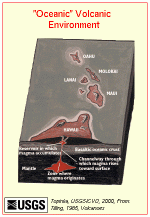
The shield volcanoes in the source (spreading) region of tectonic plates aren't explosive because they're composed of more pure basalts and have comparatively little to no rock over them. See:
oceanic shield volcano.gif

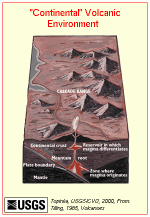
The pyroclastic volcanoes that result from subduction are more explosive because the plate carries many years accumulation of organic material deposited on the ocean floor, to beneath the plate being subducted. Those organic materials (including water) create an explosive mixture that releases itself into an unstable geologic area as a pyroclastic, explosive volcano. For a land-based pyroclastic see:
subduction pyroclastic.gif

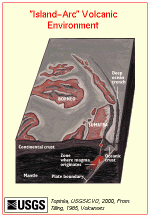
The pyroclastic volcanoes sometimes occur in or near oceans when the area of subduction occurs under the ocean floor (as Krakatoa). See:
oceanic pyroclastic - subduction.gif


So the nature of oceanic volcanoes depends on whether they're in the spreading zone or a subduction zone.

I noticed that one theory for Yellowstone activity is that plate movement "rearranges" the geology of underground areas feeding that magma chamber. I would expect that will be evidenced by earthquakes - some being quite distant.

It will be interesting to watch.
 
Back
Top