Translation Google
Fire-footed squirrel source of Mpox virus in Africa
Jeanne Brugère-PicouxArticles , Health & Life Sciences April 23, 2025
Jeanne Brugère-Picoux
Honorary Professor of Medical Pathology of Livestock and Farmyard Animals (National Veterinary School of Alfort), member of the National Academy of Medicine, Honorary President of the Veterinary Academy of France
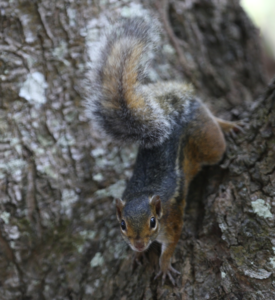
fire-footed squirrel (c) Oddfeel
On August 14, 2024 , the World Health Organization declared the ongoing Mpox (formerly monkeypox) epidemic on African soil a "public health emergency of international concern." This was clade 1b of the Monkeypox Orthopoxvirus (MPXV), more virulent than clade II (respective case fatality rates of 10% vs. 1%) which emerged in May 2022 in Europe with the spread of a variant (clade IIb) across all continents, justifying an alert from the National Academy of Medicine in France [1].
These viruses recognize a zoonotic origin in the forests of Africa but the nature of the animal reservoirs of this virus are not known with certainty, even if different species of small mammals, and especially sciurids (squirrels) are suspected of allowing transmission to humans [2] [3]. But no epidemiological link with a human infection had been confirmed in Africa. Curiously, the zoonotic risk was confirmed in the United States in 2003 where 72 people were contaminated by native sciurids ( Cynomys ludovicianus or prairie dogs), the latter having been contaminated in a pet shop by cricetomes or Gambian rats ( Cricetomys gambianus ) imported from Ghana and intended to be sold as non-traditional pets (NTPs) [4]. This imported zoonosis explains the current ban on the importation of African rodents in many countries.
For the first time, an international team of scientists suggests that the African reservoir of Mpox could be the fire-footed squirrel ( Funisciurus pyrropus ), a forest rodent found in West and Central Africa [5] [6]. This team, led by Fabian Leendertz (see insert), observed an outbreak of Mpox in Ivory Coast that affected a third of a group of 80 wild sooty mangabey monkeys ( Cercocebus atys ) from January to April 2023 (with 4 deaths). Present at the time of the outbreak, the scientists were able to access samples taken as part of their work on monitoring African monkeys since 2001 [7] and isolate the virus. Retrospectively, the study of tissues and swabs taken from dead animals found in the region made it possible to identify a virus with an identical genome in a fecal sample dating from December 2022 from a female mangabey named Bako, mother of the first Mpox death that attracted the attention of researchers, who had not developed symptoms. The origin of contamination by the consumption of a fire-footed squirrel was then suspected because of the video recordings showing that this rodent was hunted and ingested by mangabeys including Bako, but also because of the discovery of the virus in a corpse of this rodent a month before the first positive fecal sample from Bako.
The publication [6], currently being reviewed in the journal Nature , is the first evidence of transmission of MPXV between two species, but it remains to be demonstrated whether the squirrel is an asymptomatic wild reservoir or a susceptible species capable of contracting this virus and transmitting it.
This study is particularly important for public health because squirrels and non-human primates are hunted, traded and consumed by humans in Africa (bushmeat). Leendertz et al will now aim to identify whether other animal reservoirs of MPXV exist in African wildlife, particularly squirrels) to break the vicious circle of human exposure (by contact and ingestion) at the origin of the current epidemics, the importance of which is linked to the cessation of smallpox vaccination in 1980 and their extension in other countries linked to human-to-human contamination among Men who have Sex with Men (MSM) and who have multiple partners [ 1] .
Fabian Leendertz, responsible for this work and founding director of the Helmholtz Institute, is a German veterinarian. He is a member of the French National Academy of Medicine and the French Veterinary Academy. He participated in the bi-academic session organized by Jeanne Brugère-Picoux and Jean Luc Angot [8] on the subject of monitoring African great apes in the context of the COVID-19 pandemic [9].
Bibliography
[1] National Academy of Medicine. Monkey pox: zoonosis and sexually transmitted infection (STI) [Internet]. Comm; 2022. Available here
[2] Curaudeau M, Besombes C, Nakouné E, Fontanet A, Gssaisn A, Hassanin A. Identifying the Most Probable Mammal Reservoir Hosts for Monkeypox Virus Based on Ecological Niche Comparisons. Viruses. Mar 11, 2023;15(3):727
[3] Reynolds MG, Carroll DS, Olson VA et al C. A Silent Enzootic of an Orthopoxvirus in Ghana, West Africa: Evidence for Multi-Species Involvement in the Absence of Widespread Human Disease. Am J Trop Med Hyg. 1 Apr 2010;82(4):746‑54
[4] Ligon BL. Monkeypox: A review of the history and emergence in the Western hemisphere. Semin Pediatr Infect Dis. Oct 2004;15(4):280‑7
[5] Qiu J. An animal source of mpox emerges — and it's a squirrel. Nature. 17 Apr 2025;640(8059):575‑6
[6] Leendertz F, Riutord-Fe C, Schlotterbeck J, Lagostina L, Kouadio L, Herridge H, et al. Fire-footed rope squirrels (Funisciurus pyrropus) are a reservoir host of monkeypox virus (Orthopoxvirus monkeypox) [Internet]. 2025 [cited April 15, 2025]. Available here
[7] Gogarten JF, Düx A, Gräßle T, Lumbu CP, Markert S, Patrono LV, et al. An ounce of prevention is better: Monitoring wildlife health as a tool for pandemic prevention. EMBO Rep. 7 Jun 2024;25(7):2819‑31
[8] Brugère-Picoux J, Angot JL. Covid-19 and “one health”: medical, veterinary and environmental aspects. Bi-academic session of the National Academy of Medicine and the Veterinary Academy of France. 3 Dec 2020. Bull Académie Vét Fr [Internet]. 2021 [cited 16 Apr 2025];174. Available here
[9] Gillespie TR, Leendertz FH. COVID-19: protect great apes during human pandemics. Nature. 26 Mar 2020;579(7800):497‑497
https://www.afas.fr/lecureuil-a-pattes-de-feu-source-du-virus-du-mpox-en-afrique/
--------------------------------------------------------------
Fire-footed rope squirrels (Funisciurus pyrropus) are a reservoir host of monkeypox virus (Orthopoxvirus monkeypox)
Fabian Leendertz, Carme Riutord-Fe, Jasmin Schlotterbeck, Lorenzo Lagostina, and 17 more
This is a preprint; it has not been peer reviewed by a journal.https://doi.org/10.21203/rs.3.rs-6322223/v1
This work is licensed under a CC BY 4.0 License
Abstract
Mpox, caused by the monkeypox virus (MPXV;
Orthopoxvirus monkeypox), is on the rise in West and Central Africa. Most outbreaks are short-lived, but MPXV has recently caused larger epidemics driven by sustained human-to-human transmission. It is widely accepted that mpox outbreaks originate in zoonotic events. African rodents, especially squirrels, are suspected to be involved in MPXV emergence, but no formal link to human or nonhuman primate outbreaks has been established. Here, we describe an outbreak of MPXV in a group of wild sooty mangabeys (
Cercocebus atys) in Taï National Park (Côte d’Ivoire). The outbreak affected one third of the group between January and April 2023, killing four infants. To track its origin, we analysed rodents and wildlife carcasses from the region. We identified a MPXV-infected fire-footed rope squirrel (
Funisciurus pyrropus), found dead 3 km from the mangabey territory 12 weeks before the outbreak. MPXV genomes from the squirrel and the mangabey were identical. To establish a potential link between these species, we investigated the diet of these mangabeys. We found one video record of consumption of the same squirrel species in 2014. In addition, we performed metabarcoding analyses of faecal samples collected from mangabeys in the four months prior to the outbreak, which identified two faecal samples containing the DNA of the fire-footed rope squirrel. One of these samples was also the first positive for MPXV in the mangabey group. This represents an exceptionally rare case of direct detection of an interspecies transmission event, made possible only by long-term health monitoring. Our findings strongly suggest rope squirrels were the source of the MPXV outbreak in mangabeys. Since squirrels and nonhuman primates are hunted, traded, and consumed by humans in West and Central Africa, exposure to these animals is likely responsible for at least a fraction of human mpox outbreaks.
...
https://www.researchsquare.com/article/rs-6322223/v1