• FluTrackers.com Inc. does not provide medical advice. Information on this web site is collected from various internet resources, and the FluTrackers board of directors makes no warranty to the safety, efficacy, correctness or completeness of the information posted on this site by any author or poster. The information collated here is for instructional and/or discussion purposes only and is NOT intended to diagnose or treat any disease, illness, or other medical condition. Every individual reader or poster should seek advice from their personal physician/healthcare practitioner before considering or using any interventions that are discussed on this website. By continuing to access this website you agree to consult your personal physican before using any interventions posted on this website, and you agree to hold harmless FluTrackers.com Inc., the board of directors, the members, and all authors and posters for any effects from use of any medication, supplement, vitamin or other substance, device, intervention, etc. mentioned in posts on this website, or other internet venues referenced in posts on this website.
  • We are not asking for any donations. Do not donate to any entity who says they are raising funds for us.

Schmallenberg virus : new Akabane-like virus in cattle, sheep and goats in Europe - 2011/2012

Re: Schmallenbergvirus : new Akabane-like virus in cattle, sheep and goats in Europe

Re: Schmallenbergvirus : new Akabane-like virus in cattle, sheep and goats in Europe

Germany: current Information on ‛Schmallenberg virus’

last updated 27th February 2012

In Germany animals from 751 holdings have been tested positive for ‛Schmallenberg virus’ so far.

The cases occurred in 49 cattle holdings, 665 sheep holdings and 37 goat holdings.


Affected federal states are North Rhine-Westphalia (25 cattle, 236 sheep, 11 goat holdings), Lower Saxony (10 cattle, 106 sheep, 5 goat holdings), Hesse (1 cattle, 81 sheep holdings, 5 goat holdings), Schleswig-Holstein (6 cattle, 84 sheep, 1 goat holdings), Rhineland-Palatinate (1 Bison, 3 cattle, 35 sheep, 4 goat holdings), Baden-Wuerttemberg (2 cattle, 15 sheep, 5 goat holdings), Brandenburg (15 sheep holdings), Thuringia (25 sheep holdings, 2 goat holdings), Saxony-Anhalt (19 sheep holdings, 2 goat holding), Hamburg (1 cattle, 5 sheep holdings), Bavaria (14 sheep holdings), Saxony (22 sheep holdings), Mecklenburg-Western Pomerania (5 sheep holdings, 1 goat holding), Saarland (2 sheep holdings, 1 goat holding) and Berlin (1 sheep holding).


MAP

FLI
 
Re: Schmallenbergvirus : new Akabane-like virus in cattle, sheep and goats in Europe

Re: Schmallenbergvirus : new Akabane-like virus in cattle, sheep and goats in Europe

Belgium: Schmallenberg virus found in 166 holdings


Update feb 27 2012 : 12.00


Number of suspected premises : 534

Number of confirmed premises : 165

Cattle holdings: 30

Sheep holdings: 135

Goat holdings: 1


3 of the cattle holdings were confirmed from 23 samples taken last autumn


MAP

FAVV
 
Re: Schmallenbergvirus : new Akabane-like virus in cattle, sheep and goats in Europe

Re: Schmallenbergvirus : new Akabane-like virus in cattle, sheep and goats in Europe

Netherlands: Schmallenberg virus confirmed in 123 farms

Update feb 27 2012

Number of suspected premises : 701

Number of confirmed premises : 123


Cattle holdings: 21

8 cattle holdings were found to be positive from bloodsamples taken last autumn. These holdings are NOT included in the total number

Sheep holdings : 97

Goat holdings : 5


MAP

nVWA
 
Re: Schmallenbergvirus : new Akabane-like virus in cattle, sheep and goats in Europe

Re: Schmallenbergvirus : new Akabane-like virus in cattle, sheep and goats in Europe

MAP, showing outbreaks in Germany, close to the Danish border

"New virus headed to Denmark"

Danish cows, sheep and goats may soon be exposed to an unknown virus, resulting
in malformations in fetuses.


By Rasmus Boserup and Merian Garde Gras, Berlingske News Agency

27th February 2012

In a few months it has spread in countries like France, Italy, Holland, Britain and Germany.
Now, the so-called Schmallenberg Virus (SBV) is bound for Denmark.

- It can not be excluded that we will soon see this virus in Danish agriculture, says Stone
Mortensen, veterinary beredskabschef of Food Administration, told Berlingske News Agency.

Denmark for now has been free of the virus, but recently SBV was found in five herds in northern
Germany.

- We have not yet demonstrated that there would be infected herds in Denmark, says Stone
Mortensen.

The new virus was discovered in autumn 2011 and affects pregnant ruminants like cows, sheep or goats.
The disease results mainly in malformations in the fetuses that eventually will result in lambing
and calvings with stillborn animals.

translated from Danish

More: Ny virus har kurs mod det danske landbrug
 
Re: Schmallenberg virus : new Akabane-like virus in cattle, sheep and goats in Europe

Re: Schmallenberg virus : new Akabane-like virus in cattle, sheep and goats in Europe

27 February 2012

Welsh farms tested for livestock virus but no confirmed cases


Christianne Glossop warned Wales would probably have some cases of the virus

A small number of farms in Wales have been tested for the Schmallenberg virus which causes birth defects and miscarriages in livestock.

The country's chief vet Christianne Glossop said there were no confirmed cases, but the disease was expected to spread to Wales.

Read more / BBC News
 
Re: Schmallenberg virus : new Akabane-like virus in cattle, sheep and goats in Europe

Re: Schmallenberg virus : new Akabane-like virus in cattle, sheep and goats in Europe

MAP


Germany: current Information on ‛Schmallenberg virus’

last updated 28th February 2012

In Germany animals from 772 holdings have been tested positive for ‛Schmallenberg virus’ so far.

The cases occurred in 53 cattle holdings, 682 sheep holdings and 37 goat holdings.


Affected federal states are North Rhine-Westphalia (25 cattle, 237 sheep, 11 goat holdings), Lower Saxony (11 cattle, 107 sheep, 5 goat holdings), Hesse (3 cattle, 93 sheep holdings, 5 goat holdings), Schleswig-Holstein (7 cattle, 85 sheep, 1 goat holdings), Rhineland-Palatinate (1 Bison, 3 cattle, 36 sheep, 4 goat holdings), Baden-Wuerttemberg (2 cattle, 15 sheep, 5 goat holdings), Brandenburg (16 sheep holdings), Thuringia (25 sheep holdings, 2 goat holdings), Saxony-Anhalt (19 sheep holdings, 2 goat holding), Hamburg (1 cattle, 5 sheep holdings), Bavaria (14 sheep holdings), Saxony (22 sheep holdings), Mecklenburg-Western Pomerania (5 sheep holdings, 1 goat holding), Saarland (2 sheep holdings, 1 goat holding) and Berlin (1 sheep holding).

FLI
 
Re: Schmallenberg virus : new Akabane-like virus in cattle, sheep and goats in Europe

Re: Schmallenberg virus : new Akabane-like virus in cattle, sheep and goats in Europe

Netherlands: Schmallenberg virus confirmed in 135 farms

Update feb 29 2012

Number of suspected premises : 745

Number of confirmed premises : 135


Cattle holdings: 31

8 cattle holdings were found to be positive from bloodsamples taken last autumn. These holdings are NOT included in the total number

Sheep holdings : 99

Goat holdings : 5


MAP

nVWA

.
 
Re: Schmallenberg virus : new Akabane-like virus in cattle, sheep and goats in Europe

Re: Schmallenberg virus : new Akabane-like virus in cattle, sheep and goats in Europe

Vaccine for deadly sheep virus is on its way

29 February 2012 by Debora MacKenzie

A deadly, previously unknown virus that triggers abortions in sheep, goats and cattle, is spreading around Europe, causing more trouble for the beleaguered livestock industry. But farmers may have a vaccine to fight it with by next year.

Virologists are meeting in Leylstad, the Netherlands, this week to discuss Schmallenberg virus, which belongs to a virus family never seen in Europe before. Three companies are already testing candidate vaccines. Normally these would take years to come to market but faster approval could stop the virus taking hold.

Since Schmallenberg was identified in Germany last November, it has caused a wave of sheep abortions across northern Europe and the UK and has now spread to Italy.

The subgroup of the family to which the virus belongs includes Oropouche virus, which infects humans and is the second-most common cause of fever in tropical South America after dengue. Schmallenberg's closest relatives, such as Akabane virus found in Japan, Australia and Israel, only infect ruminants, however, so it is thought unlikely to infect humans.

The last animal virus to take Europe by surprise was bluetongue, which like Schmallenberg is spread by biting midges and exploded in the same regions of Germany, the Netherlands and Belgium in 2007. Accelerated approval for a vaccine cleared bluetongue from Europe by 2010.

Fast-track a vaccine

A sense of urgency might also stop Schmallenberg settling in. "All the tests required for licensing a vaccine would take two years," says Peter Mertens, head of insect-borne viruses at the Institute for Animal Health in Pirbright, UK. If governments lift the more onerous testing requirements, vaccines might be permitted after being given to animals and observed for long enough to see if they are safe, induce effective antibodies and prevent infection.

In Lelystad, however, researchers will focus on better ways to detect antibodies to the virus, says Martin Beer of the Friedrich Loeffler Institute in Insel Riems, Germany, which first isolated the virus and proved its link to disease.

Antibodies reveal which animals have been infected. Rapid tests in time for when midges return in spring will show where the virus spreads. An antibody test can also tell researchers when the virus has caused a fetus to be malformed, says Beer. Right now, that is not clear because the virus itself has cleared by the time the animal is delivered. The tests will also prove which animals are safe for export.

newscientist
 
Re: Schmallenberg virus : new Akabane-like virus in cattle, sheep and goats in Europe

Re: Schmallenberg virus : new Akabane-like virus in cattle, sheep and goats in Europe

MAP

Germany: current Information on ‛Schmallenberg virus?

last updated 29th February 2012

In Germany animals from 788 holdings have been tested positive for ‛Schmallenberg virus? so far.

The cases occurred in 54 cattle holdings, 696 sheep holdings and 38 goat holdings.


Affected federal states are North Rhine-Westphalia (26 cattle, 241 sheep, 11 goat holdings), Lower Saxony (11 cattle, 109 sheep, 6 goat holdings), Hesse (3 cattle, 94 sheep holdings, 5 goat holdings), Schleswig-Holstein (7 cattle, 87 sheep, 1 goat holdings), Rhineland-Palatinate (1 Bison, 3 cattle, 36 sheep, 4 goat holdings), Baden-Wuerttemberg (2 cattle, 16 sheep, 5 goat holdings), Brandenburg (18 sheep holdings), Thuringia (25 sheep holdings, 2 goat holdings), Saxony-Anhalt (20 sheep holdings, 2 goat holding), Hamburg (1 cattle, 5 sheep holdings), Bavaria (14 sheep holdings), Saxony (23 sheep holdings), Mecklenburg-Western Pomerania (5 sheep holdings, 1 goat holding), Saarland (2 sheep holdings, 1 goat holding) and Berlin (1 sheep holding).

FLI
 
Re: Schmallenberg virus : new Akabane-like virus in cattle, sheep and goats in Europe

Re: Schmallenberg virus : new Akabane-like virus in cattle, sheep and goats in Europe

Link to MAP

Germany: current Information on ‛Schmallenberg virus’

last updated March 1, 2012

In Germany animals from 797 holdings have been tested positive for ‛Schmallenberg virus’ so far.

The cases occurred in 58 cattle holdings, 701 sheep holdings and 38 goat holdings.


Affected federal states are North Rhine-Westphalia (28 cattle, 243 sheep, 11 goat holdings), Lower Saxony (12 cattle, 110 sheep, 6 goat holdings), Hesse (3 cattle, 94 sheep holdings, 5 goat holdings), Schleswig-Holstein (7 cattle, 87 sheep, 1 goat holdings), Rhineland-Palatinate (1 Bison, 4 cattle, 36 sheep, 4 goat holdings), Baden-Wuerttemberg (2 cattle, 16 sheep, 5 goat holdings), Brandenburg (18 sheep holdings), Thuringia (25 sheep holdings, 2 goat holdings), Saxony-Anhalt (20 sheep holdings, 2 goat holding), Hamburg (1 cattle, 5 sheep holdings), Bavaria (14 sheep holdings), Saxony (25 sheep holdings), Mecklenburg-Western Pomerania (5 sheep holdings, 1 goat holding), Saarland (2 sheep holdings, 1 goat holding) and Berlin (1 sheep holding).
 
Re: Schmallenberg virus : new Akabane-like virus in cattle, sheep and goats in Europe

Re: Schmallenberg virus : new Akabane-like virus in cattle, sheep and goats in Europe

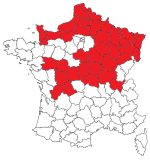
134 new Schmallenberg cases confirmed in France - Total is 411

Today the French Ministry of Agriculture confirmed Schmallenberg-virus on 134 new holdings. SBV now is found in total 411 holdings.

Most are sheepfarms: 391. 14 were cattlefarms, 5 goatfarms and 1 mixed farm with sheep and goats.

34 provinces / departments are affected.

Pr?sence du virus de Schmallenberg en France

2 mars 2012

La pr?sence du virus de Schmallenberg vient d??tre confirm?e dans 134 nouvelles exploitations.

Au total ce sont 411 ?levages qui sont donc touch?s dans 34 d?partements (01, 02, 03, 08, 10, 14, 16, 18, 21, 27, 36, 37, 45, 49, 50, 51, 52, 54, 55, 57, 58, 59, 60, 62, 67, 68, 70, 71, 76, 80, 86, 87, 88, 89).

Il s?agit essentiellement d??levages ovins, mais on compte 14 ?levages bovins, 5 ?levages caprins et 1 ?levage ovin/caprin.

FranceCarteD.gif
 
Re: Schmallenberg virus : new Akabane-like virus in cattle, sheep and goats in Europe

Re: Schmallenberg virus : new Akabane-like virus in cattle, sheep and goats in Europe

Link to MAP

Current Information on ‛Schmallenberg virus’

last updated March 2, 2012

In Germany animals from 820 holdings have been tested positive for ‛Schmallenberg virus’ so far.

The cases occurred in 66 cattle holdings, 716 sheep holdings and 38 goat holdings.


Affected federal states are North Rhine-Westphalia (35 cattle, 247 sheep, 11 goat holdings), Lower Saxony (13 cattle, 113 sheep, 6 goat holdings), Hesse (3 cattle, 94 sheep holdings, 5 goat holdings), Schleswig-Holstein (7 cattle, 87 sheep, 1 goat holdings), Rhineland-Palatinate (1 Bison, 4 cattle, 36 sheep, 4 goat holdings), Baden-Wuerttemberg (2 cattle, 19 sheep, 5 goat holdings), Brandenburg (18 sheep holdings), Thuringia (26 sheep holdings, 2 goat holdings), Saxony-Anhalt (20 sheep holdings, 2 goat holding), Hamburg (1 cattle, 5 sheep holdings), Bavaria (14 sheep holdings), Saxony (27 sheep holdings), Mecklenburg-Western Pomerania (5 sheep holdings, 1 goat holding), Saarland (2 sheep holdings, 1 goat holding) and Berlin (1 sheep holding).

FLI
 
Re: Schmallenberg virus : new Akabane-like virus in cattle, sheep and goats in Europe

Re: Schmallenberg virus : new Akabane-like virus in cattle, sheep and goats in Europe

2 March – Schmallenberg virus: further updates on GB testing results

Schmallenberg virus (SBV) infection has been identified on 92 farms.

Seven of the positive cases have been diagnosed in cattle, 85 in sheep, and none to date in other species.


So far, none of the affected farms have reported importing animals during 2011 from the affected areas in mainland Europe. SBV infection has so far only been identified in areas at risk of midge incursion from Northern Europe during summer / autumn 2011.

Figures correct as of 2 March 2012

County --(Sheep) -- (Cattle)

Berkshire 1 0

Cornwall 1 0

East Sussex 17 0

Essex 5 0

Hampshire 2 0

Hertfordshire 4 0

Isle of Wight 1 0

Kent 15 1

Norfolk 14 3

South Gloucestershire 1 0

Suffolk 12 2

Surrey 2 0

West Sussex 9 1

Wiltshire 1 0

Total 85 7

DEFRA
 
Re: Schmallenberg virus : new Akabane-like virus in cattle, sheep and goats in Europe

Re: Schmallenberg virus : new Akabane-like virus in cattle, sheep and goats in Europe

Netherlands: Schmallenberg virus confirmed in 137 farms

Update march 2 2012

Number of suspected premises : 785

Number of confirmed premises : 137


Cattle holdings: 33

8 cattle holdings were found to be positive from bloodsamples taken last autumn. These holdings are NOT included in the total number

Sheep holdings : 99

Goat holdings : 5


MAP

nVWA

.
 
Re: Schmallenberg virus : new Akabane-like virus in cattle, sheep and goats in Europe

Re: Schmallenberg virus : new Akabane-like virus in cattle, sheep and goats in Europe

Belgium: Schmallenberg virus found in 184 holdings


Update march 1 12:00


Number of suspected premises : 543

Number of confirmed premises : 166

Cattle holdings: 40

Sheep holdings: 143

Goat holdings: 1


3 of the cattle holdings were confirmed from 23 samples taken last autumn


Link to MAP

FAVV
 
Re: Schmallenberg virus : new Akabane-like virus in cattle, sheep and goats in Europe

Re: Schmallenberg virus : new Akabane-like virus in cattle, sheep and goats in Europe

Published Date: 2012-03-01 22:58:05
Subject: PRO/AH/EDR> Schmallenberg virus - Europe (22): update
Archive Number: 20120301.1058045
SCHMALLENBERG VIRUS - EUROPE (22): UPDATE
*****************************************
A ProMED-mail post
http://www.promedmail.org
ProMED-mail is a program of the
International Society for Infectious Diseases
http://www.isid.org

In this update:

[1] UK: prediction

[2] Vaccine and serology needs


******

[1] UK: prediction

Date: 1 Mar 2012

Source: Farmers Guardian [edited]

http://www.farmersguardian.com/all-of-the-uk-could-see-schmallenberg-infections/45253.article


Schmallenberg virus [SBV] is likely to be around for at least another year and could spread much further across the UK, a leading animal disease expert has warned.


At a briefing in London on Thursday [1 Mar 2012], scientists outlined 2 extreme scenarios for where disease could go from here.


It is possible, according to Professor Peter Mertens from the Institute of Animal Health, under one scenario Schmallenberg may burn out given the current high levels of infection and the fact infected animals become immune to the virus.


However, he said that was probably "too good to be true" and the major concern for farmers will come when the midge season starts again in the UK later this spring [2012].


If infected midges have over-wintered or if midges pick up the virus from animals in the UK, Schmallenberg could start spreading across the country.


"This virus has the potential to spread across the whole country," Prof Mertens said.


He also warned cattle farmers that evidence from mainland European countries showed the number of cases in calves from cows infected last year [2011] was increasing, whereas infections in sheep were decreasing. This was attributed to the cows longer gestation period compared to sheep [see comment].


Professor Wim Van Der Pol from the Central Veterinary Institute in Wageningen UR in the Netherlands said research conducted there showed it was very unlikely that the virus could infect humans.


[Byline: Alistair Driver]


--

Communicated by:

ProMED-mail <promed@promedmail.org>


[Prof Mertens' warning concerning possibility of increased SBV impact in cattle deserves attention. In the Netherlands, the number of affected cattle holdings increased from 2 to 31 within one month; a similar trend has been reported from Germany and Belgium (see figures in final commentary further).


If SBV dynamics are similar to those of Akabane virus, another teratogenic orthobunyavirus of the Simbu serogroup closely related to SBV, then past observations may be predictive.


During a major Akabane epizootic in Israel, 1969/1970, the following observations were made:


In cattle:

1. Arthrogryposis was caused by infection during the 4th to 6th month of pregnancy (mean gestation period in cattle is 280 days).

2. CNS involvement (predominantly hydranencephaly) was caused by infection during the 3rd month of pregnancy.

3. Most affected calves were affected by one of the above phenomena and not by both.

4. Among abnormal calves, males outnumbered females to a significant degree.


In sheep and goats:

1. The agent caused abortions.

2. There was less distinction between Arthrogryposis and hydranencephaly; many newborns suffered from both.

3. The damage was mainly caused during the period between 30-50 days of pregnancy. Practically no damage was caused in fetuses which were older than 50 days during the viraemia.

4. In badly affected flocks, up to 50 percent of all lambs and kids were affected.

5. No clinical symptoms were seen in pregnant animals.

6. Males, twins, and goats were more affected than females, singles, and sheep. - Mod.AS]


******

[2] Vaccine and serology needs

Date: Wed 29 Feb 2012

Source: New Scientist [edited]

http://www.newscientist.com/article/dn21529


A deadly, previously unknown virus that triggers abortions in sheep, goats and cattle, is spreading around Europe, causing more trouble for the beleaguered livestock industry. But farmers may have a vaccine to fight it by next year.


Virologists are meeting in Leylstad, the Netherlands this week to discuss Schmallenberg virus [SBV]. Three companies are already testing candidate vaccines. Normally, these would take years to come to market, but faster approval could stop the virus taking hold.


Since SBV was identified in Germany last November [2011], it has caused a wave of sheep abortions across northern Europe and the UK and has now spread to Italy.


The subgroup of the family to which the virus belongs includes Oropouche virus, which infects humans and is the 2nd-most common cause of fever in tropical South America after dengue. SBV's closest relatives, such as Akabane virus found in Japan, Australia and Israel, only infect ruminants, however, so it is thought unlikely to infect humans.


The last animal virus to take Europe by surprise was bluetongue, which, like SBV, is spread by biting midges and which exploded in the same regions of Germany, the Netherlands, and Belgium in 2007. Accelerated approval for a vaccine cleared bluetongue from Europe by 2010.


A sense of urgency might also stop SBV from settling in. "All the tests required for licensing a vaccine would take 2 years," says Peter Mertens, head of insect-borne viruses at the Institute for Animal Health in Pirbright, UK. If governments lift the more onerous testing requirements, vaccines might be permitted after being given to animals and observed for long enough to see whether they are safe, induce effective antibodies, and prevent infection.


In Lelystad, however, researchers will focus on better ways to detect antibodies to the virus, says Martin Beer of the Friedrich Loeffler Institute in Insel Riems, Germany, which 1st isolated the virus and proved its link to disease.


Antibodies reveal which animals have been infected. Rapid tests in time for when midges return in spring will show where the virus spreads. An antibody test can also tell researchers when the virus has caused a fetus to be malformed, says Beer. Right now, that is not clear, because the virus itself has cleared by the time the animal is delivered. The tests will also prove which animals are safe for export.


[Byline: Debora MacKenzie]


--

Communicated by:

ProMED-mail <promed@promedmail.org>

[SBV data as of 1 Mar 2012, including detailed country-maps, are available from the official web-sites of Belgium, Germany and Netherlands, as follows:


Country/last update/cattle/sheep/goats/total/map at

- Belgium/1 Mar 2012/37/138/1/176/http://www.afsca.be/_pictures/users/schmallenberg_20120229.jpg

- Germany/1 Mar 2012/58/701/38/797/http://www.fli.bund.de/fileadmin/dam_uploads/tierseuchen/Schmallenberg_Virus/Karten/Map_Schmallenberg_20120301.jpg

- Netherlands/1 Mar 2012/31/99/5/135/http://www.vwa.nl/txmpub/files/?p_file_id=2201854


UK's data, as of 27 Feb 2012, are the following (the BBC map is derived from the flutrackers web-site):

- UK/27 Feb 2012/5/78/0/83/http://www.flutrackers.com/forum/showpost.php?p=444250&postcount=100.


According to France's most recent (weekly) update, as of 23 Feb 2012, the total number of SBV-confirmed cases in France was 277; for details, see http://agriculture.gouv.fr/maladies-animales,11003. A map is available at http://www.flutrackers.com/forum/showpost.php?p=443608&postcount=93


A single case each has been reported from Italy and Luxembourg.


Antibody determination by a validated, reliable technique is essential for prospective determination of SBV incidence (expected number of malformed newborns within the domestic ruminants population in the affected region) and retrospective study of the virus circulation. A sero-survey covering representative numbers of animals of all age groups will help to determine how long the virus has been circulating in the region, the actual population susceptibility, and the true need of vaccine. - Mod.AS

A HealthMap/ProMED-mail map can be accessed at: http://healthmap.org/r/1wZE.]

See Also

Schmallenberg virus - Europe (21): Update 20120225.0455
Schmallenberg virus - Europe (20): Italy, Luxembourg, OIE 20120220.0418
Schmallenberg virus - Europe (19): update, RFI 20120218.0406
Schmallenberg virus - Europe (18): OIE, guidelines, int'l trade 20120217.0400]
.................................................sb/arn/msp/ml

http://www.promedmail.org/direct.php?id=20120301.1058045

 
Re: Schmallenberg virus : new Akabane-like virus in cattle, sheep and goats in Europe

Re: Schmallenberg virus : new Akabane-like virus in cattle, sheep and goats in Europe

Thanks to my son, we have a map displaying the affected departments in France.

134 new Schmallenberg cases confirmed in France - Total is 411

2 march 2012

Today the French Ministry of Agriculture confirmed Schmallenberg-virus on 134 new holdings. SBV now is found in total 411 holdings.

Most are sheepfarms: 391. 14 were cattlefarms, 5 goatfarms and 1 mixed farm with sheep and goats.

34 provinces / departments are affected.

Présence du virus de Schmallenberg en France

2 mars 2012

La présence du virus de Schmallenberg vient d’être confirmée dans 134 nouvelles exploitations.

Au total ce sont 411 élevages qui sont donc touchés dans 34 départements (01, 02, 03, 08, 10, 14, 16, 18, 21, 27, 36, 37, 45, 49, 50, 51, 52, 54, 55, 57, 58, 59, 60, 62, 67, 68, 70, 71, 76, 80, 86, 87, 88, 89).

Il s’agit essentiellement d’élevages ovins, mais on compte 14 élevages bovins, 5 élevages caprins et 1 élevage ovin/caprin.

Map can be used with acknowledgment.
Schmallenberg virus in France.png
 
Re: Schmallenberg virus : new Akabane-like virus in cattle, sheep and goats in Europe

Re: Schmallenberg virus : new Akabane-like virus in cattle, sheep and goats in Europe

http://viralzone.expasy.org/all_by_species/250.html

Orthobunyavirus

Molecular biology


Segmented Negative-stranded RNA linear genome, L segment is about 6.9kb, M segment about 4.5kb and S segment about 1kb.
Encodes for six proteins


Bunyaviridae_virion.jpg
 
Re: Schmallenberg virus : new Akabane-like virus in cattle, sheep and goats in Europe

Re: Schmallenberg virus : new Akabane-like virus in cattle, sheep and goats in Europe

It seems inevitable some politicians try to (mis)use the outbreak of SBV to gain support. Experts agree: a transport ban or import ban won't help. "Disproportionate and unjustified" indeed.

4 March 2012

Schmallenberg virus: Kent MP calls for livestock export ban

Calls for a ban on the export of livestock in the face of a recent UK outbreak of Schmallenberg virus have been made by a Kent MP.

Laura Sandys, the Conservative MP for Thanet, said the import and export of live animals should be banned to stop the virus spreading.

The disease causes birth defects and miscarriages in livestock.

The government said a ban on animal movements would be "disproportionate and unjustified".

Read more: BBC
 
Back
Top