• FluTrackers.com Inc. does not provide medical advice. Information on this web site is collected from various internet resources, and the FluTrackers board of directors makes no warranty to the safety, efficacy, correctness or completeness of the information posted on this site by any author or poster. The information collated here is for instructional and/or discussion purposes only and is NOT intended to diagnose or treat any disease, illness, or other medical condition. Every individual reader or poster should seek advice from their personal physician/healthcare practitioner before considering or using any interventions that are discussed on this website. By continuing to access this website you agree to consult your personal physican before using any interventions posted on this website, and you agree to hold harmless FluTrackers.com Inc., the board of directors, the members, and all authors and posters for any effects from use of any medication, supplement, vitamin or other substance, device, intervention, etc. mentioned in posts on this website, or other internet venues referenced in posts on this website.
  • We are not asking for any donations. Do not donate to any entity who says they are raising funds for us.

Saudi Arabia: Contagious Diseases Medicine Professor reveals that Camels were the key factor behind the spread of Corona Virus to humans

Shiloh

Editor, Senior Moderator
Source: http://www.spa.gov.sa/viewphotonews.php?id=1219151&pic=

Contagious Diseases Medicine Professor reveals that Camels were the key factor behind the spread of Corona Virus to humans

Jeddah, Jumada II 9, 1435, Apr 9, 2014, SPA -- A Saudi university professor has disclosed that the genetic series of the corona virus of a patient who was not positively responding to treatment at a Saudi hospital, and later died of the disease, proved that camels are the main source of spreading the virus to safe people.
In a statement to the Saudi Press Agency (SPA), Professor Tareq Ahmed Madani, Head Department of the Faculty of Medicine at Jeddah-based King Abdulaziz University, said continuous diagnosis and research conducted on the genetic series of a 22-year-old patient at King Abdulaziz Hospital in Jeddah since he was hospitalized in November 2013 revealed that it was related to the genes of one of the nine camels owned by the patient, who spent 18 days in hospital before passing away.
The professor said the outcome, the first of its kind on the disease in the world, will soon be published in an internationally-renowned specialist medical magazine.
He said the university research team found that the transfer of the disease from camels was conforming at a rate of 111 percent with the isolated virus taken from the camel. It was also discovered that unit-virus bodies were acting in all the nine-camel flock, he said, adding that it was also apparent that those bodies emerged in the camels even before the patient contracted the corona virus, a cause of MERS.
Giving the symptoms and signs of the disease, Dr. Madani said they are an increase of temperature, severe cough, dyspnea, and low white blood cells.
However, the doctor confirmed that most of cases discovered outside Saudi Arabia were transferred directly from human to human without infected camels as intermediaries.
--SPA
23:41 LOCAL TIME 20:41 GMT
 
Re: Saudi Arabia: Contagious Diseases Medicine Professor reveals that Camels were the key factor behind the spread of Corona Virus to humans

Without any doubt, in hospital settings, human-to-human transmission is almost certain. The calculated R0 during nosocomial outbreaks exceeded 1 and thus there was a sustained transmission, albeit containable through implementation of barrier techniques.

See, for example, this paper:

Source: PLoS Current Outbreaks, full page: (LINK).

State of Knowledge and Data Gaps of Middle East Respiratory Syndrome Coronavirus (MERS-CoV) in Humans


(...)

Epidemic Potential of MERS-CoV

Two groups have evaluated the transmission potential of the MERS-CoV virus by estimating the basic reproduction number (the number of secondary cases that one case would produce in a completely susceptible population, R<SUB>0</SUB>)<SUP>22</SUP><SUP>,</SUP><SUP>26</SUP>.

Breban and colleagues <SUP>26</SUP> used the first 55 laboratory-confirmed cases of MERS-CoV reported to WHO to assess the inter-human transmissibility of MERS-CoV. The authors estimated R<SUB>0</SUB> from the distribution of sizes of case transmission trees seen so far and compared their estimate with that of early data from the SARS-CoV epidemic in 2003. Two scenarios were considered. With the most pessimistic scenario, the authors estimated MERS-CoV R<SUB>0</SUB> to be 0.69 (95% CI 0.50?0.92); by contrast, the R<SUB>0 </SUB>for SARS-CoV was 0.80 (0.54?1.13). The optimistic scenario resulted in a R<SUB>0</SUB> of 0.60 (0.42?0.80). The authors suggest that, based on their analyses using PCR-confirmed cases, MERS-CoV does not yet have pandemic potential.

Cauchemez and colleagues <SUP>22</SUP> undertook independent analyses to assess the transmissibility and extent of spread of MERS-CoV to date. Using publically available epidemiological data on 111 confirmed and probable MERS-CoV patients and genetic sequence data from 10 cases, the study found central estimates of R<SUB>0</SUB> between 0.8 and 1.3. This work suggests that current data are consistent with two scenarios: (a) a sustained epidemic in an animal reservoir with sporadic spill-over into humans, or (b) sustained human-to-human transmission causing a slowly growing human epidemic.

They also used epidemiological and genetic data to evaluate the underlying scale of the epidemic so far. Analyses using numbers of exported cases of returning travellers from countries in the Middle East (n=4) and average length of visitor stays to Jordan, Qatar, KSA and UAE suggest that by now at least 900 symptomatic cases of MERS-CoV have occurred, implying substantial under-ascertainment of cases in the region. Genetic analyses suggest that approximately 17490 (IQR 3900-95000) infections in humans and in the reservoir(s) may have occurred between June 2012 and August 2013 <SUP>22</SUP>.

An analysis of 21 genetic sequences from cases in KSA was compared to those already available in public databases and concluded that the genetic diversity of available sequences supported multiple introductions from a presumed zoonotic source, with subsequent human-to-human transmission<SUP>27</SUP>. However, the authors could not exclude the possibility of unrecognized sustained transmission in humans associated with frequent movement of infected individuals to explain the observed genetic patterns

(...)

-
------
 
Re: Saudi Arabia: Contagious Diseases Medicine Professor reveals that Camels were the key factor behind the spread of Corona Virus to humans

Source: http://www.arabnews.com/news/557396

MERS-camel link confirmed
JEDDAH: HANI HAZAIMEH & MD RASOOLDEEN
Published ? Friday 18 April 2014
Last update 18 April 2014 12:31 am

A Saudi expert on infectious diseases on Thursday reaffirmed the link between the Middle East Respiratory Syndrome (MERS) and camels after research proved that the viruses isolated from a Saudi patient and his camel were 100 percent similar.

?We have succeeded in isolating the coronavirus and proving the role of camels in transmitting this deadly virus to humans,? said Dr. Tariq Ahmed Madani of the King Abdulaziz University Hospital in Jeddah.

Speaking with Arab News, he said the discovery proves that camels are the prime reservoir that allowed the coronavirus to infect and kill humans. ?This does not mean camels are the only source,? he said.
?This important discovery will help combat and contain the disease,? said Madani, who obtained a fellowship in infectious diseases from the University of Manitoba in Canada...

...Madani, meanwhile, emphasized the need to enlighten the public on the disease, especially residents dealing with camels...

...Research on the topic began in November 2013, when a 44-year-old Saudi who was suffering from pneumonia was admitted to the university hospital. He died after 15 days later after his body failed to respond positively to customary treatment.

?We isolated him and succeeded in determining his genetic sequence. A specialized medical team then isolated the same virus from one of the camels owned by the patient,? said Madani.

?We found antibodies for the virus in a herd of nine camels owned by the patient and discovered that these antibodies appeared before the patient was infected. As a result, we were able to prove for the first time that camels are one of the carriers of the virus to humans,? he said.

Patients contract MERS either by direct contact with an infected patient, especially through droplets while speaking, sneezing or coughing, or touching the belongings or objects touched by an infected person.

?It can also spread through direct contact with infected camels,? he said.

?Infected camels could show symptoms similar to those manifested by humans.?

?Most reported MERS cases in the world spread from human to human and they had no direct contact with infected camels,? Dr. Madani said.

?There is no proof so far to suggest that drinking the milk of an infected camel can cause the disease,? he said. ?Nevertheless, it is advisable to only drink camel milk, or any other type of milk for that matter, after boiling to kill disease-causing germs, including Maltese fever, found in the Najd and Hijaz regions.?...
 
Re: Saudi Arabia: Contagious Diseases Medicine Professor reveals that Camels were the key factor behind the spread of Corona Virus to humans

hat tip Michael Coston and Shiloh

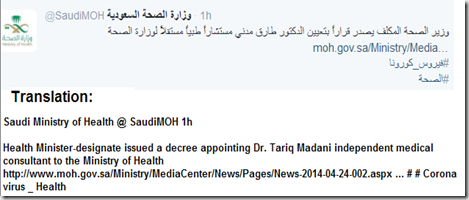
Saudi MOH Appoints Dr. Tariq Ahmed Madani Special MERS Advisor


image%25255B4%25255D.png

Saudi MOH Twitter Account
# 8522


The new Saudi Minister of Health Adel bin Mohammed Faqih announced the appointment this morning of Dr. Tariq Ahmed Madani, as a special MERS consultant to the Health Ministry.

Professor Madani ? an infectious disease specialist - has a brief profile posted on the King Abdulaziz University website, which includes details of his discovery of a new viral hemorrhagic fever in 2001.
A formal statement of his appointment was posted a short while ago on the Saudi MOH website:

Health Minister-designate issued a decree appointing Dr. Tariq Madani independent medical consultant to the Ministry of Health
24 June 1435
His Excellency Engineer Adel bin Mohammed Faqih and Health Minister-designate, today, a decree appointing Dr Tariq Ahmed Madani independent medical consultant to the Ministry of Health, part of the ministry's efforts to contain the incidence of HIV Corona Kingdom.
The decision was based on a statement by His Excellency the Minister of Health in charge issued immediately after assuming office, in which he pledged to communicate with permanent society, and coordination with health care experts to gather all the information that was able to stand on the current situation, and determine the extent of the seriousness of the situation and the potential dangers.
And Dr. Tariq Madani took office immediately after the decision of His Excellency the Minister, which will provide specialized consultancy to the Ministry of Health based on long experience in the field of infectious diseases. The work of Dr. Madani as a professor of internal medicine and infectious diseases at the Department of Internal Medicine, Faculty of Medicine - King Abdulaziz University, and has experience of over 20 years in dealing with infectious diseases.
HE Adel Al-Faqih, the Minister of Health in charge: "Based on what is owned by the expertise of medical and wide, will Dr. Tarek to coordinate the plan of urgent medical response to HIV Corona., And we aim to use the expertise and talent to help us to implement our plan effectively, which will enable us to ensure the safety of the public. "
He added: "I wish to reiterate my commitment to the ongoing work to address the Corona virus, is the decision to appoint Dr. Tarek is an important step towards achieving this goal."
So, said Dr. Tariq Madani: "I first would like to thank the Minister of Health in charge of giving me this opportunity. The virus Coruna health challenge facing the Kingdom and a number of countries around the world. For my part, I will do my best to help ensure the health and safety of the public in Saudi Arabia. " It is expected that the Minister of Health in charge of more appointments during the next week.
Posted by Michael Coston at <a class="timestamp-link" href="http://afludiary.blogspot.com/2014/04/saudi-moh-appoints-dr-tariq-ahmed.html" rel="bookmark" title="permanent link"><abbr class="published" itemprop="datePublished" title="2014-04-24T09:24:00-04:00">9:24 AM</abbr>
 
Back
Top