• FluTrackers.com Inc. does not provide medical advice. Information on this web site is collected from various internet resources, and the FluTrackers board of directors makes no warranty to the safety, efficacy, correctness or completeness of the information posted on this site by any author or poster. The information collated here is for instructional and/or discussion purposes only and is NOT intended to diagnose or treat any disease, illness, or other medical condition. Every individual reader or poster should seek advice from their personal physician/healthcare practitioner before considering or using any interventions that are discussed on this website. By continuing to access this website you agree to consult your personal physican before using any interventions posted on this website, and you agree to hold harmless FluTrackers.com Inc., the board of directors, the members, and all authors and posters for any effects from use of any medication, supplement, vitamin or other substance, device, intervention, etc. mentioned in posts on this website, or other internet venues referenced in posts on this website.
  • We are not asking for any donations. Do not donate to any entity who says they are raising funds for us.

Researching the Weather

mixin

Well-known member
Here is a choice of journals from the American Meteorlogical Society.
Monthly Weather Review is my favorite; it dates back to 1873.

Here is a partial list of others:
Journal of the Atmospheric Sciences
Journal of Applied Meteorology and Climatology
Journal of Physical Oceanography
Journal of Atmospheric and Oceanic Technology
Weather and Forecasting

http://ams.allenpress.com/perlserv/?request=get-archive
 
Re: Researching the Weather

1918: The Dustfalls of March

Light falls of dust occur so frequently as to attract no attention except from housewives; heavier falls are rare and pass away so quickly that uantitative measurements of them are not often made. Unusually heavy dustfalls occurred in March, 1918, in the Central and Eastern States.

Gross appearance of the dust.-At Madison, Wis. where the dust was mixed with a good deal of snow, it gave the latter a very light yellowish, or isabeau, tint. At Florence, Wis., "the snow was quite dusty in appearance, as to color a reddish brown", Chelsea, Vt.-“it was noticed here as brown;” Alstead Center, N. H.-“was of reddish brown color", Woodstock, Vt.-‘snow was yellow and pink", At Columbus, Ohio-“A peculiar reddish deposit was observed this morning on windows, and on white paint, where the rain of the morning had evaporated on the roofs.” After the dust-laden snow began to thaw the surface became black at Madison, “rusty” at Newberry, Mich. The snow at Madison, melted for measurement, became black water, and would doubtless have been called “black rain” if it had fallen as rain.

http://docs.lib.noaa.gov/rescue/mwr/046/mwr-046-11-0502.pdf
 
Re: Researching the Weather

It must have been pretty common for no one to notice but the women. I found this about farming; was it possible for there to be enough dust in the air that it reached those areas?
During World War I (1914–1918) the demand for wheat, along with the invention of the tractor, meant plowing larger areas of the virgin grassland. Between 1914 and 1917, the area of wheat planted increased to 27 million acres, much of which (more than 40 percent) had never been plowed before. After the war, the plowing continued.
http://www.encyclopedia.com/doc/1G2-3406400265.html

It seems almost impossible to connect influenza and weather. I just read that in the tropics, they have year around or 2 flu seasons whose peaks coincide with the rainy seasons (what are the temps then?). Here, flu comes when it's cold and dry; it's all the same flu, isn't it? Well, except for panflu that doesn't seem to care too much one way or the other.

I remember the article where Edgar's mother mentioned her husband sought work in Mexico City (?) due to the drought

Then I considered how much sunshine is there during flu seasons? and does it have any kind of an impact on flu? But flu is almost non-existant in England since 2000 and that's not an especially sunny country, is it?
 
Re: Researching the Weather

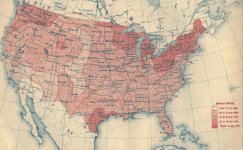
That journal includes a map of hours of sunshine for each month. Here's the one for Nov. 1918. I wonder if there is any connection between the areas of low sun and the areas of high flu.

Sunny Days Nov 1918.jpg
 
Back
Top