

Michael Coston
Editor, Senior Moderator
Reminder: The Great Shakeout is set for This Week (Oct 15th)

#19,369
Not quite 3 years ago the USGS unveiled a new seismic risk map (see below), increasing the percentage of Americans at risk of experiencing a damaging earthquake to nearly 75% (roughly 240 million people).

Globally, large swaths of southern and central Europe and Asia - and significant portions of South America, Africa, Oceania and Canada - are at risk as well.

While yearly totals fluctuate, on average the USGS expects approximately 16 earthquakes of magnitude 7.0 -7.9 per year - and one of magnitude 8.0 or greater.GEM_Global-Seismic-Hazard DOI 10.5281/zenodo.20208536 (CC BY-NC-SA 4.0)
Publication:
Pagani M, Garcia-Pelaez J, Gee R, et al. (2020) The 2018 version of the Global Earthquake Model: Hazard component, Earthquake Spectra, vol. 36, no. 1_suppl, 2020, pp. 226–251. https://journals.sagepub.com/doi/abs/10.1177/8755293020931866
Data:
Johnson, K., Bayliss, K., Villani, M., Brooks, C., Styron, R., Simionato, M., Chen, Y., Rood, A., & Pagani, M. (2026). Global Earthquake Model (GEM) Seismic Hazard Map (v2026.1). [Data set] Zenodo. https://doi.org/10.5281/ zenodo.8409646
But the fact remains, billions of people around the world live in active seismic zones, and knowing what to do during - and after - an earthquake can be lifesaving information.Over the past 4 months we've seen 7 Magnitude 7.0+ quakes, but that came after a nearly 2 month lull. Despite the internet clickbait hype machine, we are still well within expected norms.
Eighteen years ago (Nov 2008) Shakeout.org held the first their first event - dubbed The Great Southern California ShakeOut - which involved over five million participants across the region.
Since then, that event has grown - first nationally - and then internationally, and now it encompasses numerous states, territories, and a number of other countries.

While I don't have to worry much about earthquakes where I live (I make up for it with hurricanes. sinkholes, and alligators), I put high value in being prepared for all natural disasters, and I strongly urge others to do so as well.This year's International ShakeOut Day is October 15, when millions of people worldwide will participate in earthquake drills at work, school, or home!
At 10:15 a.m. (local time) on 10/15, you can join millions of people across the world practicing earthquake safety.
While we encourage participation with everyone, you can register your ShakeOut drill for any day of the year, and drill at a time of your choice. You can also include people in multiple locations through video conferencing.
If you live in, work in, or ever plan to visit a seismically active area, I strongly would urge you, your family, and your employees take part in these yearly drills.
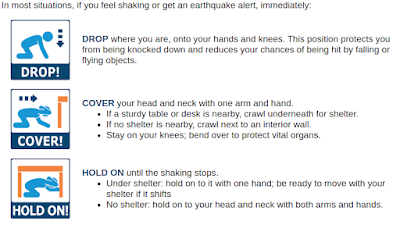
Once the shaking stops, you'll have to find ways to cope with the aftermath.
For starters - and as a bare minimum - every household should have a disaster plan, a good first aid kit (and the knowledge to use it), an emergency battery operated NWS weather radio, and emergency supplies to last at least 72 hours during a disaster.While the government will send help, you could find yourself pretty much on your own for several days and living in less than comfortable conditions for weeks (see #NatlPrep: 75% of Americans At Risk Of Experiencing A Damaging Earthquake).

While 72 hours is an admirable start, I wouldn't feel comfortable stopping there. Here in the United States many agencies and organizations recommend that households work towards having a 10-to-14 day supply of food, water, and emergency supplies on hand.
In addition to earthquakes, there are nearly a dozen `very high risk' volcanoes in the continental US (4 in Washington, 4 in Oregon & 3 in California), along dozens of `lesser' threats. While earthquake damage is generally localized, volcanic eruptions can affect property and populations thousands of miles away.

Over the years we've looked at a number of scientific or review articles on earthquake risks, including:
(JGR) Cajon Pass and the Southern San Andreas Fault System: Earthquake Cycle Stress Accumulation and Present-Day Loading
Dr. Lucy Jones: `Imagine America Without Los Angeles’
California Quakes : Concrete Concerns
OSU: Pragmatic Action - Not Fatalism - In Order To Survive The `Big One’
Estimating The Economic Impact Of A San Andreas Quake
https://afludiary.blogspot.com/2026/10/reminder-great-shakeout-is-set-for-this.html