Related to the posts above
Translation Google
Bird flu: a second case reported in Quebec in November
Mathieu Massé
Published at 2:57 PM CST
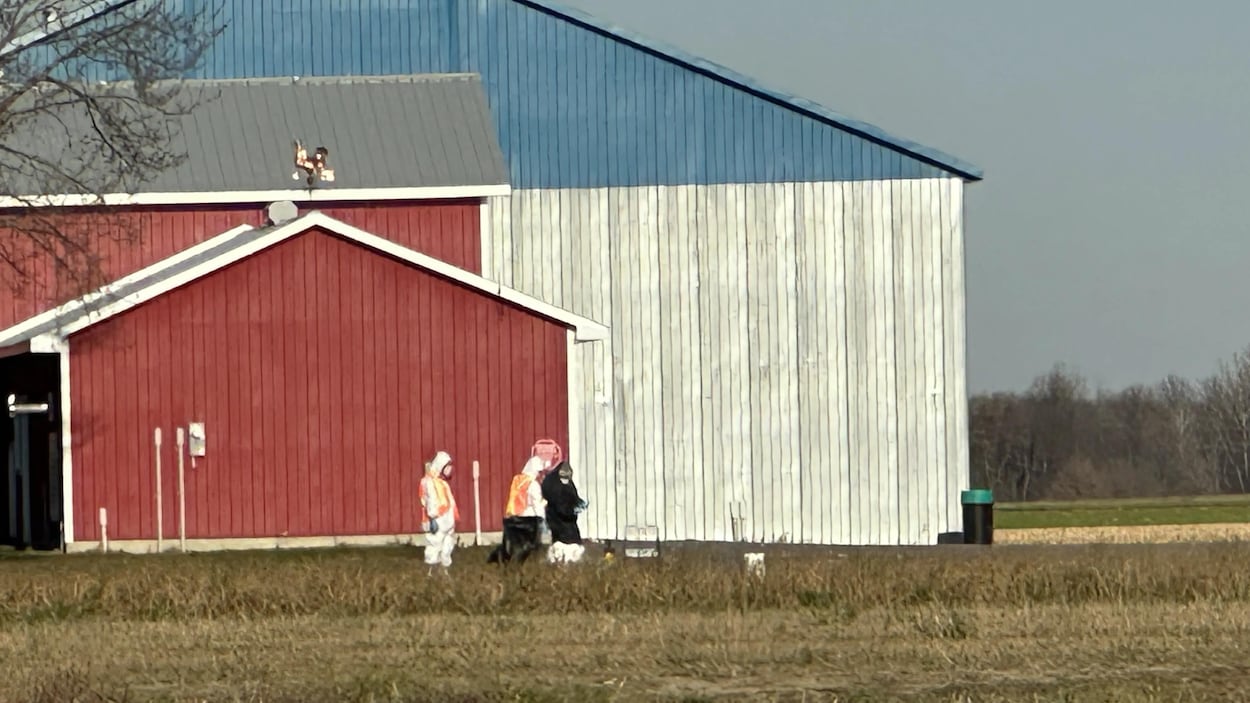
A case of avian influenza was reported Tuesday in the Saint-Hyacinthe region of Montérégie. This is the second confirmed outbreak in Quebec since the beginning of November.
The Canadian Food Inspection Agency (CFIA) has established a primary control zone in the MRCThe people of Maskoutains in order to prevent the spread of the virus.
The president of the Union of Agricultural Producers (UPA), Martin Caron, says he is taking the situation very seriously. " We are certainly worried ," he admits, while explaining that...ACIAand the Quebec Poultry Disease Control Team (EQCMA) took charge of the case.
There is a whole intervention protocol to ensure that this risk is contained , he assures.
It was not possible to determine the number of birds affected in the Saint-Hyacinthe area.
What is a primary control zone?
A primary control zone is being established by theACIAupon detection of an outbreak of avian influenza. This refers to a perimeter established around an outbreak. The Director General of theEQCMAAnik Marchand explains that, in order to stem the spread of the virus, animal traffic is limited as much as possible.
These zones are put in place to control not the restriction of human movement, but rather of animals or any animal by-products that need to move in this zone.
Farmers who need to move their goods must obtain a special permit to move around in the area, explains Ms. Marchand.
The presence of another outbreak of infection was confirmed on November 5 on Île d'Orléans, in the Quebec City region.
For the moment, Quebec has been relatively spared from avian flu this fall, compared to other Canadian provinces.ACIAreports that, since October, 18 cases have been recorded in Alberta, 15 in Manitoba, 7 in Saskatchewan, 6 in British Columbia and 1 in Ontario.
According to data from ACIA, no fewer than 268,600 birds had to be exterminated in the last 30 days.
According to the director general of the ECQMA. Anik Marchand explains that the risk of contamination is higher during this period of bird migration. The weather is still good, and we can see that migration is still taking place. However, both cases are under control, and this is not necessarily unusual.
Ms. Marchand points out that the last reported outbreak, before the two cases this fall, was in mid-January 2026. The situation is under control. Everything is going very well.
No danger to consumers
For his part, the president of theUPAHe asserts that consumers have no need to worry about these outbreaks. There is a detection system in place for slaughtering animals. Rest assured, measures are being taken to ensure food safety.
According to Martin Caron, the main concern for poultry producers lies more in the economic aspect. " Even though we have systems in place to help businesses, there are still impacts and losses for our companies ," he explains.
He adds that if cases were to multiply, consumers could feel the effect on the price of products.
Mr. Caron believes that in Quebec, the geographical distribution of farms is an advantage when outbreaks of infection are detected. Our farms are spread over a large area relative to the size of our businesses. [The distance between farms] allows for greater biosecurity. That's an added value we have here.
L'ACI Adid not respond to our interview requests.
With information from Karine Bastien and Emma Guerrero Dufour
Un cas de grippe aviaire a été rapporté le 17 novembre dans la région de Saint-Hyacinthe, en Montérégie, et une zone de contrôle primaire a été mise en place.

ici.radio-canada.ca