

Michael Coston
Editor, Senior Moderator
Preprint: Impact of SARS-CoV-2 Variant on the Severity of Maternal Infection and Perinatal Outcomes
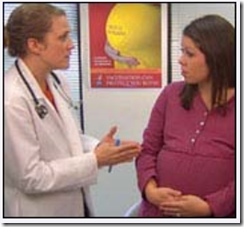
Credit CDC
#16,093
Pregnant women and their unborn offspring are often among the hardest hit during influenza pandemics (see 2009's Pregnancy & Flu: A Bad Combination), and even seasonal flu is known to hit pregnant women harder than non-pregnant women.
Since the emergence of COVID-19 18 months ago, similar concerns have been raised over SARS-CoV-2 infection - and while the evidence has been limited - some early studies/reports have suggested increased risks for pregnant women:
PAHO Epi Alert: COVID-19 During Pregnancy - 13 August 2020
Pregnancy & COVID-19: Still More Questions Than Answers
The CDC maintains a Data on COVID-19 during Pregnancy website, but cautions that their data is far from complete. They do list 17,555 hospitalized cases, and 119 deaths.

However, most of the data we have comes from 2020 and early 2021 - the `pre-variant' phase of the pandemic when the supposedly `milder', less transmissible, `wild type' COVID dominated.
Since then we've seen anecdotal reports - and some studies (see here, here & here) - suggesting that both Alpha & Delta carry an increased risk of hospitalization.
Today we have a preprint from the UK, on a national, prospective cohort study conducted between March 2020 and July 2021 involving 3371 pregnant women hospitalized with COVID that covers three distinct phases of the pandemic; wildtype, Alpha variant, and Delta.
While not yet peer-reviewed, this report finds that the risk of COVID symptomatic pregnant women admitted to the hospital developing severe disease increased first when the Alpha variant emerged, and increased again when Delta arrived.
I reproduced the abstract (and a snippet from the discussion section) from the preprint below (bolding mine). You'll want to read the full 21-page PDF file in its entirety, however. I'll have a brief postscript after the break.
Abstract
Full Text
Info/History
Metrics
Preview PDF
ABSTRACT
Background In the UK, the Alpha variant of SARS-CoV-2 became dominant in late 2020, rapidly succeeded by the Delta variant in May 2021. The aim of this study was to compare the impact of these variants on severity of maternal infection and perinatal outcomes within the time-periods in which they predominated.
Methods
This national, prospective cohort study collated data on hospitalised pregnant women with symptoms of confirmed SARS-CoV-2 infection and compared the severity of infection and perinatal outcomes across the Wildtype (01/03/20-30/11/20), Alpha (01/12/20-15/05/21) and Delta dominant periods (16/05/21-11/07/21), using multivariable logistic regression.
Findings
Of 3371 pregnant women, the proportion that experienced moderate to severe infection significantly increased between Wildtype and Alpha periods (24.4% vs. 35.8%; aOR1.75 95%CI 1.48-2.06), and between Alpha and Delta periods (35.8% vs. 45.0%; aOR1.53, 95%CI 1.07-2.17).
Compared to the Wildtype period, symptomatic women admitted in the Alpha period were more likely to require respiratory support (27.2% vs. 20.3%, aOR1.39, 95%CI 1.13-1.78), have pneumonia (27.5% vs. 19.1%, aOR1.65, 95%CI 1.38-1.98) and be admitted to intensive care (11.3% vs. 7.7%, aOR1.61, 95%CI 1.24-2.10).
Women admitted during the Delta period had further increased risk of pneumonia (36.8% vs. 27.5%, aOR1.64 95%CI 1.14-2.35). No fully vaccinated pregnant women were admitted between 01/02/2021 when vaccination data collection commenced and 11/07/2021. The proportion of women receiving pharmacological therapies for SARS-CoV-2 management was low, even in those critically ill.
Interpretation
SARS-CoV-2 infection during Alpha and Delta dominant periods was associated with more severe infection and worse pregnancy outcomes compared to the Wildtype infection, which itself increased risk compared to women without SARS-CoV-2 infection.1 Clinicians need to be aware and implement COVID-specific therapies in keeping with national guidance. Urgent action to tackle vaccine misinformation and policy change to prioritise uptake in pregnancy is essential.
Funding National Institute for Health Research HS&DR Programme (11/46/12).
This study, when combined with others I mentioned above, adds weight to concerns that as COVID evolves, it has not only become more transmissible, it has increased its severity as well.
Vaccines do appear to greatly blunt those impacts, but the uptake of vaccines remains less than optimal. Pregnant women are particularly reticent to get the vaccine, which puts them at increased risk.
While this study is unable to assess the impact of vaccination on the severity of infection among pregnant women, it is worth noting that no fully vaccinated woman was identified in this study as being hospitalized with COVID.
You can read some expert reactions to this study on the Science Media Centre's website. https://afludiary.blogspot.com/2021/07/preprint-impact-of-sars-cov-2-variant.html
Credit CDC
#16,093
Pregnant women and their unborn offspring are often among the hardest hit during influenza pandemics (see 2009's Pregnancy & Flu: A Bad Combination), and even seasonal flu is known to hit pregnant women harder than non-pregnant women.
Since the emergence of COVID-19 18 months ago, similar concerns have been raised over SARS-CoV-2 infection - and while the evidence has been limited - some early studies/reports have suggested increased risks for pregnant women:
PAHO Epi Alert: COVID-19 During Pregnancy - 13 August 2020
Pregnancy & COVID-19: Still More Questions Than Answers
The CDC maintains a Data on COVID-19 during Pregnancy website, but cautions that their data is far from complete. They do list 17,555 hospitalized cases, and 119 deaths.
However, most of the data we have comes from 2020 and early 2021 - the `pre-variant' phase of the pandemic when the supposedly `milder', less transmissible, `wild type' COVID dominated.
Since then we've seen anecdotal reports - and some studies (see here, here & here) - suggesting that both Alpha & Delta carry an increased risk of hospitalization.
Today we have a preprint from the UK, on a national, prospective cohort study conducted between March 2020 and July 2021 involving 3371 pregnant women hospitalized with COVID that covers three distinct phases of the pandemic; wildtype, Alpha variant, and Delta.
While not yet peer-reviewed, this report finds that the risk of COVID symptomatic pregnant women admitted to the hospital developing severe disease increased first when the Alpha variant emerged, and increased again when Delta arrived.
I reproduced the abstract (and a snippet from the discussion section) from the preprint below (bolding mine). You'll want to read the full 21-page PDF file in its entirety, however. I'll have a brief postscript after the break.
Nicola Vousden, Rema Ramakrishnan, Kathryn Bunch, Edward Morris, Nigel Simpson, Christopher Gale, Patrick O’Brien, Maria Quigley, Peter Brocklehurst, Jennifer J Kurinczuk, Marian Knight
doi: https://doi.org/10.1101/2021.07.22.21261000
doi: https://doi.org/10.1101/2021.07.22.21261000
Abstract
Full Text
Info/History
Metrics
Preview PDF
ABSTRACT
Background In the UK, the Alpha variant of SARS-CoV-2 became dominant in late 2020, rapidly succeeded by the Delta variant in May 2021. The aim of this study was to compare the impact of these variants on severity of maternal infection and perinatal outcomes within the time-periods in which they predominated.
Methods
This national, prospective cohort study collated data on hospitalised pregnant women with symptoms of confirmed SARS-CoV-2 infection and compared the severity of infection and perinatal outcomes across the Wildtype (01/03/20-30/11/20), Alpha (01/12/20-15/05/21) and Delta dominant periods (16/05/21-11/07/21), using multivariable logistic regression.
Findings
Of 3371 pregnant women, the proportion that experienced moderate to severe infection significantly increased between Wildtype and Alpha periods (24.4% vs. 35.8%; aOR1.75 95%CI 1.48-2.06), and between Alpha and Delta periods (35.8% vs. 45.0%; aOR1.53, 95%CI 1.07-2.17).
Compared to the Wildtype period, symptomatic women admitted in the Alpha period were more likely to require respiratory support (27.2% vs. 20.3%, aOR1.39, 95%CI 1.13-1.78), have pneumonia (27.5% vs. 19.1%, aOR1.65, 95%CI 1.38-1.98) and be admitted to intensive care (11.3% vs. 7.7%, aOR1.61, 95%CI 1.24-2.10).
Women admitted during the Delta period had further increased risk of pneumonia (36.8% vs. 27.5%, aOR1.64 95%CI 1.14-2.35). No fully vaccinated pregnant women were admitted between 01/02/2021 when vaccination data collection commenced and 11/07/2021. The proportion of women receiving pharmacological therapies for SARS-CoV-2 management was low, even in those critically ill.
Interpretation
SARS-CoV-2 infection during Alpha and Delta dominant periods was associated with more severe infection and worse pregnancy outcomes compared to the Wildtype infection, which itself increased risk compared to women without SARS-CoV-2 infection.1 Clinicians need to be aware and implement COVID-specific therapies in keeping with national guidance. Urgent action to tackle vaccine misinformation and policy change to prioritise uptake in pregnancy is essential.
Funding National Institute for Health Research HS&DR Programme (11/46/12).
(SNIP)
DISCUSSION
This national prospective cohort study has identified that, after adjusting for sociodemographics and pre-existing medical conditions, the proportion of symptomatic pregnant women admitted who experienced moderate to severe COVID-19 has significantly increased from 24% to 36% and then 45% in the Wildtype, Alpha, and Delta periods respectively.
DISCUSSION
This national prospective cohort study has identified that, after adjusting for sociodemographics and pre-existing medical conditions, the proportion of symptomatic pregnant women admitted who experienced moderate to severe COVID-19 has significantly increased from 24% to 36% and then 45% in the Wildtype, Alpha, and Delta periods respectively.
Women admitted in the Alpha period were more likely to require respiratory support, have pneumonia, and be admitted to ICU, compared to women admitted in the Wildtype period.
Women admitted during the Delta period had a further increase in risk compared to those admitted in the Alpha period, with a greater proportion having pneumonia and non-significant increases in respiratory support and ICU admission. Whilst the majority of babies were live born, babies born to mothers in the Alpha period were more likely to require admission for neonatal care compared to during the Wildtype period
This study, when combined with others I mentioned above, adds weight to concerns that as COVID evolves, it has not only become more transmissible, it has increased its severity as well.
Vaccines do appear to greatly blunt those impacts, but the uptake of vaccines remains less than optimal. Pregnant women are particularly reticent to get the vaccine, which puts them at increased risk.
While this study is unable to assess the impact of vaccination on the severity of infection among pregnant women, it is worth noting that no fully vaccinated woman was identified in this study as being hospitalized with COVID.
You can read some expert reactions to this study on the Science Media Centre's website. https://afludiary.blogspot.com/2021/07/preprint-impact-of-sars-cov-2-variant.html