

Michael Coston
Editor, Senior Moderator
Preprint: Fatal infection of a novel canine/human reassortant H3N2 influenza A virus in the zoo-housed golden monkeys
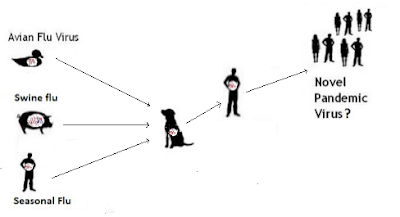
Just one of many scenarios - Dogs as `mixing vessels' for Influenza
#18,727
Until about 20 years ago dogs (and cats) were believed largely immune to influenza A infection. For cats that perception changed after hundreds of captive cats (tigers) died from H5N1 in Southeast Asia after being fed contaminated poultry (see H5N1: Catch as Cats Can).
For dogs, it happened after an equine H3N8 virus mutated enough to spill over into greyhounds at a Florida race track in 2004 (see EID Journal articleInfluenza A Virus (H3N8) in Dogs with Respiratory Disease, Florida).
Since then canine H3N8 has been sporadically reported across much of the United States. It is considered a `canine specific’ virus, and has not crossed back into horses. Additionally, there have been no reports of human infection.
Had that been the only instance, it might be easily dismissed. But in 2007 another virus -this time Avian H3N2 - spilled over and become endemic in dogs in South Korea (see Transmission of Avian Influenza Virus (H3N2) to Dogs).
Analysis showed that the HA and NA genes of the A/canine/Korea/01/2007 (H3N2) isolate were closely related to those identified in 2003 from chickens and doves in South Korea.
Since then we've seen numerous reports coming out of China and Korea suggesting the canine H3N2 continues to adapt and reassort with other avian and human flu viruses. Including:
A Canine H3N2 Virus With PA Gene From Avian H9N2 - Korea
Canine H3N2 Reassortant With pH1N1 Matrix Gene
Virology J: Human-like H3N2 Influenza Viruses In Dogs - Guangxi, China
Interspecies Transmission Of Canine H3N2 In The Laboratory
This canine H3N2 virus finally turned up in North America in 2015, and quickly spread across much of the United States over a remarkably short period of time. In 2017, the CDC added Canine H3N2 to their IRAT(Influenza Risk Assessment Tool) list of novel flu viruses with zoonotic potential.
We've looked into the evolution of Canine H3N2 a number of times since, including last March's Frontiers Vet. Sci: Genetic Characterization of an H3N2 Canine Influenza Virus Strain in China in 2023—Acquisition of Novel Human-like Amino Acid Substitutions.
Today we've a truly fascinating report out of China of an outbreak of a reassortant canine H3N2 virus among zoo-housed endangered golden monkeys in 2022. One that was not only fatal in two monkeys, but appears to have been efficiently transmitted amongst them.
This is a preliminary preprint (not yet peer reviewed). I've only posted the link, abstract, and a few excerpts, so follow the link to read it in its entirety. I'll have a bit more after the break.
Fatal infection of a novel canine/human reassortant H3N2 influenza A virus in the zoo-housed golden monkeys
X Wen, Xia Wen, Rong Chen, Yingjun Lv, Jinzhu Geng, Jingjing Guo, and 7 more

(SNIP)
(SNIP)
Six months after the outbreak, we collected nasal swabs and serum samples from 5 recovered golden monkeys and 5 asymptomatic contacts for detection of viral M gene and HI activity, respectively. Our data indicated that all the nasal swabs were tested negative for IAV infection, but the 10 animals were seropositive using the Gm-1 virus as antigen, with the HI antibody titers of 7log2 (30%), 5log2 (50%) and 4log2 (20%), respectively. The high seroprevalence in golden monkeys suggests that the virus can spread efficiently among golden monkeys, and antibodies induced by this virus can be maintained for a long time after remission of influenza infection.
(SNIP)
(Continue . . . )
This isn't the first reassorted canine influenza virus reported by Chinese researchers.
For some other blogs on canine reassortment possibilities, you may wish to revisit:
https://afludiary.blogspot.com/2025/05/preprint-fatal-infection-of-novel.html
Just one of many scenarios - Dogs as `mixing vessels' for Influenza
#18,727
Until about 20 years ago dogs (and cats) were believed largely immune to influenza A infection. For cats that perception changed after hundreds of captive cats (tigers) died from H5N1 in Southeast Asia after being fed contaminated poultry (see H5N1: Catch as Cats Can).
For dogs, it happened after an equine H3N8 virus mutated enough to spill over into greyhounds at a Florida race track in 2004 (see EID Journal articleInfluenza A Virus (H3N8) in Dogs with Respiratory Disease, Florida).
Since then canine H3N8 has been sporadically reported across much of the United States. It is considered a `canine specific’ virus, and has not crossed back into horses. Additionally, there have been no reports of human infection.
Had that been the only instance, it might be easily dismissed. But in 2007 another virus -this time Avian H3N2 - spilled over and become endemic in dogs in South Korea (see Transmission of Avian Influenza Virus (H3N2) to Dogs).
Analysis showed that the HA and NA genes of the A/canine/Korea/01/2007 (H3N2) isolate were closely related to those identified in 2003 from chickens and doves in South Korea.
Since then we've seen numerous reports coming out of China and Korea suggesting the canine H3N2 continues to adapt and reassort with other avian and human flu viruses. Including:
A Canine H3N2 Virus With PA Gene From Avian H9N2 - Korea
Canine H3N2 Reassortant With pH1N1 Matrix Gene
Virology J: Human-like H3N2 Influenza Viruses In Dogs - Guangxi, China
Interspecies Transmission Of Canine H3N2 In The Laboratory
This canine H3N2 virus finally turned up in North America in 2015, and quickly spread across much of the United States over a remarkably short period of time. In 2017, the CDC added Canine H3N2 to their IRAT(Influenza Risk Assessment Tool) list of novel flu viruses with zoonotic potential.
We've looked into the evolution of Canine H3N2 a number of times since, including last March's Frontiers Vet. Sci: Genetic Characterization of an H3N2 Canine Influenza Virus Strain in China in 2023—Acquisition of Novel Human-like Amino Acid Substitutions.
Today we've a truly fascinating report out of China of an outbreak of a reassortant canine H3N2 virus among zoo-housed endangered golden monkeys in 2022. One that was not only fatal in two monkeys, but appears to have been efficiently transmitted amongst them.
This is a preliminary preprint (not yet peer reviewed). I've only posted the link, abstract, and a few excerpts, so follow the link to read it in its entirety. I'll have a bit more after the break.
Fatal infection of a novel canine/human reassortant H3N2 influenza A virus in the zoo-housed golden monkeys
X Wen, Xia Wen, Rong Chen, Yingjun Lv, Jinzhu Geng, Jingjing Guo, and 7 more
Abstract
Influenza A virus (IAV) is one of the most challenging pathogens that threaten human and animal health. In June 2022, seven golden monkeys (Rhinopithecus roxellanaes) developed flu-like symptoms in succession at a zoo in Jiangsu Province of China, two of which died of respiratory distress.
All the swab samples from affected golden monkeys were tested positive for IAV. In the dead animals, the most notable involved organ is the lung, which manifested as emphysema and pulmonary parenchymatous carnification. Histopathological and immunostaining data supported a diagnosis of pulmonary infection with influenza virus. One strain of H3N2 virus, named A/golden monkey/Jiangsu/1/2022 (Gm-1), was isolated from the lungs of dead golden monkeys.
Sequence and phylogenetic analysis revealed that its PB1 gene is most closely related to an influenza isolate obtained from human (A/Hong Kong/4801/2014), while the remaining 7 genes show 100% sequence identity with those of canine H3N2 virus (A/canine/Jiangsu/06/2010, JS06).
Experimental infection of two rescued viruses (rGm-1 and rJS06) by reverse genetics in BALB/c mice revealed that the rGm-1 virus induced more persistent pathological damage in the lungs, and was less likely to be cleared, compared to the rJS06 virus.
Influenza A virus (IAV) is one of the most challenging pathogens that threaten human and animal health. In June 2022, seven golden monkeys (Rhinopithecus roxellanaes) developed flu-like symptoms in succession at a zoo in Jiangsu Province of China, two of which died of respiratory distress.
All the swab samples from affected golden monkeys were tested positive for IAV. In the dead animals, the most notable involved organ is the lung, which manifested as emphysema and pulmonary parenchymatous carnification. Histopathological and immunostaining data supported a diagnosis of pulmonary infection with influenza virus. One strain of H3N2 virus, named A/golden monkey/Jiangsu/1/2022 (Gm-1), was isolated from the lungs of dead golden monkeys.
Sequence and phylogenetic analysis revealed that its PB1 gene is most closely related to an influenza isolate obtained from human (A/Hong Kong/4801/2014), while the remaining 7 genes show 100% sequence identity with those of canine H3N2 virus (A/canine/Jiangsu/06/2010, JS06).
Experimental infection of two rescued viruses (rGm-1 and rJS06) by reverse genetics in BALB/c mice revealed that the rGm-1 virus induced more persistent pathological damage in the lungs, and was less likely to be cleared, compared to the rJS06 virus.
Further investigation indicated that human-origin PB1 could induce higher levels of proinflammatory cytokines than canine-origin PB1, which might be a contributing factor to pathobiological characteristics displayed by the rGm-1 virus. This study extends the host range of influenza viruses, and underscores the need for efficient biosecurity practices and enhanced surveillance efforts in the endangered species.
(SNIP)
Epidemiological investigation revealed the keeper, who kept a contact with golden monkeys by feeding and caring with them, has suffered from a bad cold before the onset of clinical signs in golden monkeys, although no pathogens have been detected timely. And notably, the molecular test on the nasal and anal swab samples from two dogs kept in the zoo yielded positive results for IAV.
(SNIP)
Six months after the outbreak, we collected nasal swabs and serum samples from 5 recovered golden monkeys and 5 asymptomatic contacts for detection of viral M gene and HI activity, respectively. Our data indicated that all the nasal swabs were tested negative for IAV infection, but the 10 animals were seropositive using the Gm-1 virus as antigen, with the HI antibody titers of 7log2 (30%), 5log2 (50%) and 4log2 (20%), respectively. The high seroprevalence in golden monkeys suggests that the virus can spread efficiently among golden monkeys, and antibodies induced by this virus can be maintained for a long time after remission of influenza infection.
(SNIP)
In conclusion, our study provides virological and molecular evidence for identification of an H3N2 canine/human reassortment virus isolated from golden monkeys. This finding extends the host range of influenza viruses, and more importantly, highlights the risk posed by this pathogen to golden monkeys. Golden monkeys are at risk of influenza infection through close contact with humans.
To protect the endangered species from this reverse zoonotic transmissible disease, the daily implement of biosecurity measures is essential. Animal keepers should get annual vaccinations against seasonal influenza and avoid contact with animals when they have flu-like symptoms. Considering the pandemic potential of newly emerging IAV and its risk of transmission between animals and humans, the ongoing surveillance are urgently needed.
(Continue . . . )
This isn't the first reassorted canine influenza virus reported by Chinese researchers.
- In May of 2022 we looked at a report in Frontiers in Microb.: Emergence & Evolution of A Novel Canine-Avian Reassortant H3N2 (China) which described a half dozen H3 viruses collected between 2018-2019 in Southern China, including a newly discovered H3N2 reassortant canine-avian H3N2 virus.
- A year later (May 2023), in China: Emergence of a Novel Reassortant H3N6 Canine Influenza Virus we looked at a report describing the detection of a canine-avian flu reassortant virus - H3N6 - which was isolated multiple times from dogs in Liaoning Province, China.
For some other blogs on canine reassortment possibilities, you may wish to revisit:
Nature: Adaptation Potential of H3N8 Canine Influenza Virus in Human Respiratory Cells
Viruses Review: Potential Intermediates in the Cross-Species Transmission of Influenza A Virus to Humans
One Health Adv.: Surveillance & Characterization of Avian-origin H3N2 Canine Influenza Viruses (China 2021)
Viruses: Zoonotic Animal Influenza Virus and Potential Mixing Vessel Hosts
Increased Public Health Threat of Avian-origin H3N2 Influenza Virus During Evolution in Dogs (Revisited)
,Viruses Review: Potential Intermediates in the Cross-Species Transmission of Influenza A Virus to Humans
One Health Adv.: Surveillance & Characterization of Avian-origin H3N2 Canine Influenza Viruses (China 2021)
Viruses: Zoonotic Animal Influenza Virus and Potential Mixing Vessel Hosts
Increased Public Health Threat of Avian-origin H3N2 Influenza Virus During Evolution in Dogs (Revisited)
https://afludiary.blogspot.com/2025/05/preprint-fatal-infection-of-novel.html