

Michael Coston
Editor, Senior Moderator
Preprint: Bovine H5N1 Influenza Virus Binds Poorly to Human-type Sialic Acid Receptors
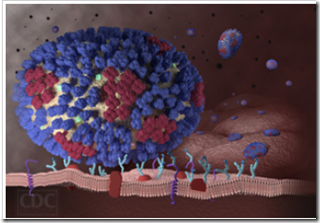
Flu Virus binding to Receptor Cells – Credit CDC
#18,223
Not quite 4 weeks ago, in in Nature Comms: Pathogenicity and Transmissibility of Bovine H5N1 Influenza Virus, we looked at a new study from researchers at UW-Madison on the bovine H5N1 affecting American Dairy cattle - that, unlike earlier versions of the virus - was able to bind to both human (α2,6-linked) and avian (α2,3-linked) receptor cells.
This finding came as a bit of a surprise since barely 3 weeks earlier the CDC published the following reassuring statement, indicating quite the opposite.

Why these studies should come up with such different results isn't clear, although it could boil down to differences in methods and materials.
Yesterday, researchers at the University of Pennsylvania and the Scripps Institute posted a preprint to the bioRxiv server, which reassuringly finds - much like the CDC - that the bovine B3.13 genotype of H5N1 binds poorly to human (α2,6-linked) receptor cells.
Bovine H5N1 influenza virus binds poorly to human-type sialic acid receptors
Jefferson J.S. Santos, Shengyang Wang, Ryan McBride, Yan Zhao, James C. Paulson, Scott E. Hensley
doi: https://doi.org/10.1101/2024.08.01.606177
Preview PDF
Abstract
Clade 2.3.4.4b highly pathogenic H5N1 avian influenza (HPAI) viruses started circulating widely in lactating dairy cattle in the United States at the end of 2023. Avian influenza viruses enter cells after binding to glycan receptors with terminally linked a2-3 sialic acid, whereas human influenza viruses typically bind to glycan receptors terminally linked a2-6 sialic acid in the upper respiratory tract.
Here, we evaluated the receptor binding properties of hemagglutinin (HA) trimers from a clade 2.3.4.4b avian isolate (A/American Wigeon/South Carolina/22-000345-001/2021) and a cattle isolate (A/dairy cattle/Texas/24-008749-002-v/2024). Using two different methods, we found that both of the 2.3.4.4b H5s bound efficiently to glycan receptors with terminally linked a2-3 sialic acid with no detectable binding to glycan receptors with terminally linked a2-6 sialic acid.
Our data suggest that clade 2.3.4.4b H5N1 viruses bind poorly to human receptors. It will be important to continue evaluating receptor binding properties of these viruses as they evolve in cattle.
(Continue . . . )
While it would be nice if all of these studies came to the same conclusion, this isn't the first time we've seen contradictory results from studies. A few past blogs on these conflicts include:
A reminder that gaining scientific knowledge is a process . . . one that evolves over time and often involves detours, setbacks, and constant reevaluation. Assuming scientific certainty about anything is often the first step towards a humbling.
And as we saw last June (see Preprint: A Single Mutation in Dairy Cow-Associated H5N1 Viruses Increases Receptor Binding Breadth), even a small change to the virus can sometimes produce a dramatic change it is behavior.
While it may be following a circuitous route, H5N1 continues to rapidly expand its host and geographic ranges, and shows no signs of losing momentum. Which means what we can say today about the virus could easily change tomorrow.
Stay tuned.
https://afludiary.blogspot.com/2024/08/preprint-bovine-h5n1-influenza-virus.html
Flu Virus binding to Receptor Cells – Credit CDC
#18,223
Not quite 4 weeks ago, in in Nature Comms: Pathogenicity and Transmissibility of Bovine H5N1 Influenza Virus, we looked at a new study from researchers at UW-Madison on the bovine H5N1 affecting American Dairy cattle - that, unlike earlier versions of the virus - was able to bind to both human (α2,6-linked) and avian (α2,3-linked) receptor cells.
This finding came as a bit of a surprise since barely 3 weeks earlier the CDC published the following reassuring statement, indicating quite the opposite.
How well the A(H5N1) virus HA binds to avian-type, but not to human-type receptors is shown in the graph. Results from these studies indicate that this virus maintains a preference for avian-type receptors and is not adapting to be able to infect people.
Why these studies should come up with such different results isn't clear, although it could boil down to differences in methods and materials.
Yesterday, researchers at the University of Pennsylvania and the Scripps Institute posted a preprint to the bioRxiv server, which reassuringly finds - much like the CDC - that the bovine B3.13 genotype of H5N1 binds poorly to human (α2,6-linked) receptor cells.
Bovine H5N1 influenza virus binds poorly to human-type sialic acid receptors
Jefferson J.S. Santos, Shengyang Wang, Ryan McBride, Yan Zhao, James C. Paulson, Scott E. Hensley
doi: https://doi.org/10.1101/2024.08.01.606177
Preview PDF
Abstract
Clade 2.3.4.4b highly pathogenic H5N1 avian influenza (HPAI) viruses started circulating widely in lactating dairy cattle in the United States at the end of 2023. Avian influenza viruses enter cells after binding to glycan receptors with terminally linked a2-3 sialic acid, whereas human influenza viruses typically bind to glycan receptors terminally linked a2-6 sialic acid in the upper respiratory tract.
Here, we evaluated the receptor binding properties of hemagglutinin (HA) trimers from a clade 2.3.4.4b avian isolate (A/American Wigeon/South Carolina/22-000345-001/2021) and a cattle isolate (A/dairy cattle/Texas/24-008749-002-v/2024). Using two different methods, we found that both of the 2.3.4.4b H5s bound efficiently to glycan receptors with terminally linked a2-3 sialic acid with no detectable binding to glycan receptors with terminally linked a2-6 sialic acid.
Our data suggest that clade 2.3.4.4b H5N1 viruses bind poorly to human receptors. It will be important to continue evaluating receptor binding properties of these viruses as they evolve in cattle.
(Continue . . . )
While it would be nice if all of these studies came to the same conclusion, this isn't the first time we've seen contradictory results from studies. A few past blogs on these conflicts include:
A reminder that gaining scientific knowledge is a process . . . one that evolves over time and often involves detours, setbacks, and constant reevaluation. Assuming scientific certainty about anything is often the first step towards a humbling.
And as we saw last June (see Preprint: A Single Mutation in Dairy Cow-Associated H5N1 Viruses Increases Receptor Binding Breadth), even a small change to the virus can sometimes produce a dramatic change it is behavior.
While it may be following a circuitous route, H5N1 continues to rapidly expand its host and geographic ranges, and shows no signs of losing momentum. Which means what we can say today about the virus could easily change tomorrow.
Stay tuned.
https://afludiary.blogspot.com/2024/08/preprint-bovine-h5n1-influenza-virus.html