Predicting the Antigenic Structure of the Pandemic (H1N1) 2009 Influenza Virus Hemagglutinin Manabu Igarashi et al.
The pandemic influenza virus (2009 H1N1) was recently introduced into the human population. The hemagglutinin (HA) gene of 2009 H1N1 is derived from "classical swine H1N1" virus, which likely shares a common ancestor with the human H1N1 virus that caused the pandemic in 1918, whose descendant viruses are still circulating in the human population with highly altered antigenicity of HA.
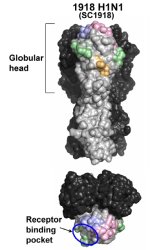
However, information on the structural basis to compare the HA antigenicity among 2009 H1N1, the 1918 pandemic, and seasonal human H1N1 viruses has been lacking. By homology modeling of the HA structure, here we show that HAs of 2009 H1N1 and the 1918 pandemic virus share a significant number of amino acid residues in known antigenic sites, suggesting the existence of common epitopes for neutralizing antibodies cross-reactive to both HAs.
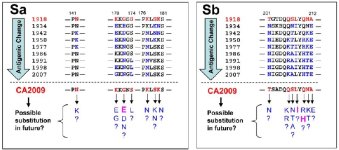
It was noted that the early human H1N1 viruses isolated in the 1930s-1940s still harbored some of the original epitopes that are also found in 2009 H1N1. Interestingly, while 2009 H1N1 HA lacks the multiple N-glycosylations that have been found to be associated with an antigenic change of the human H1N1 virus during the early epidemic of this virus, 2009 H1N1 HA still retains unique three-codon motifs, some of which became N-glycosylation sites via a single nucleotide mutation in the human H1N1 virus.
We thus hypothesize that the 2009 H1N1 HA antigenic sites involving the conserved amino acids will soon be targeted by antibody-mediated selection pressure in humans. Indeed, amino acid substitutions predicted here are occurring in the recent 2009 H1N1 variants. The present study suggests that antibodies elicited by natural infection with the 1918 pandemic or its early descendant viruses play a role in specific immunity against 2009 H1N1, and provides an insight into future likely antigenic changes in the evolutionary process of 2009 H1N1 in the human population.
PLoS http://tinyurl.com/ya4758n
The pandemic influenza virus (2009 H1N1) was recently introduced into the human population. The hemagglutinin (HA) gene of 2009 H1N1 is derived from "classical swine H1N1" virus, which likely shares a common ancestor with the human H1N1 virus that caused the pandemic in 1918, whose descendant viruses are still circulating in the human population with highly altered antigenicity of HA.
However, information on the structural basis to compare the HA antigenicity among 2009 H1N1, the 1918 pandemic, and seasonal human H1N1 viruses has been lacking. By homology modeling of the HA structure, here we show that HAs of 2009 H1N1 and the 1918 pandemic virus share a significant number of amino acid residues in known antigenic sites, suggesting the existence of common epitopes for neutralizing antibodies cross-reactive to both HAs.
It was noted that the early human H1N1 viruses isolated in the 1930s-1940s still harbored some of the original epitopes that are also found in 2009 H1N1. Interestingly, while 2009 H1N1 HA lacks the multiple N-glycosylations that have been found to be associated with an antigenic change of the human H1N1 virus during the early epidemic of this virus, 2009 H1N1 HA still retains unique three-codon motifs, some of which became N-glycosylation sites via a single nucleotide mutation in the human H1N1 virus.
We thus hypothesize that the 2009 H1N1 HA antigenic sites involving the conserved amino acids will soon be targeted by antibody-mediated selection pressure in humans. Indeed, amino acid substitutions predicted here are occurring in the recent 2009 H1N1 variants. The present study suggests that antibodies elicited by natural infection with the 1918 pandemic or its early descendant viruses play a role in specific immunity against 2009 H1N1, and provides an insight into future likely antigenic changes in the evolutionary process of 2009 H1N1 in the human population.
PLoS http://tinyurl.com/ya4758n